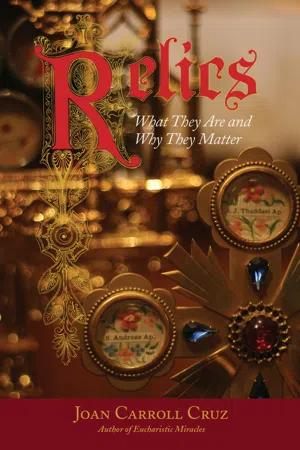
Scripture speaks of miracles wrought through relics: a dead man was raised when Elisha's bones touched him, and the clothing of Jesus and His apostles healed the sick. In the early Church, Masses were celebrated over the bones of the martyrs, and phials of their blood have effected countless miracles. Direct successors of the Apostles themselves speak of venerating relics; Church Fathers encourage it; throughout the ages of Catholic legacy, relics of the saints are always present. The Church takes diligent care in preserving and documenting the authenticity of her relics. Best-selling author Joan Carroll Cruz takes full advantage of these resources. With painstaking research, she exposes the details behind hundreds of the Church's most famous and beloved relics. She covers 38 second-class relicsof our Lord and Lady, such as the Holy Grail and Our Lady's Veil, and relics of all sorts from 75 favorite saints, such as St. Mary Magdalene, St. Agnes, St. Charles Borromeo, St. Francis of Assisi, St. Maria Goretti, and many more! Relics is a unique collection of years of dedicated research about the lives of the saints and the mementos they left behind, to remind us of their presence and intercession for us.
- 476 pages
- English
- ePUB (mobile friendly)
- Available on iOS & Android
eBook - ePub
About this book
Information
Topic
Theology & ReligionSubtopic
Christian DenominationsRelics of the Saints
_______________
St. Agatha
The waist-length statue of St. Agatha of Catania is adorned with countless jewels presented to her by devotees who have received favors, and by those who were grateful for her intercession in sparing them from the violence threatened by Mount Etna.
Agatha’s beauty and family position proved to be the detriment that led to her martyrdom. She was brought before Quinctianus, a magistrate during the persecution of Decius, who had heard reports of her virginal purity and physical charm. His advances were refused, as were the attempts to engage her in the activities of an immoral house. After being confined for a month in this evil place her virginity was maintained. She prayed all the more for endurance to undergo all her trials for the love of God, much to the chagrin of Quinctianus, who turned from passion to cruelty.
Her tortures were severe. It is recorded that she was scourged, her sides were torn with iron hooks, she was burned with blazing torches and as a final indignity, her breasts were cut from her body. Quinctianus, still bent on satisfying his revenge, had her rolled on burning coals, to which were added broken potsherds. She expired after affirming her love and trust in God. The year was 251.
First-class relics of the saint are kept in various reliquaries, but the skull and principal relics, said to be incorrupt, are kept in the gem-encrusted reliquary that is exposed on various occasions at Catania, Sicily.
Agatha’s name was inserted in the Canon of the Mass, and it occurred in the calendar of Carthage about the year 530. It is also included in all the Latin and Greek martyrologies. Because Agatha has been credited with arresting the eruptions of Mount Etna, she is invoked against the outbreak of fire. She has been designated one of the patronesses of nurses and is invoked against breast diseases.
St. Agnes
The name of Agnes, meaning “pure” in Greek, seems appropriate for one who has been regarded among the foremost of the virgin martyrs of the primitive Church.
Both St. Ambrose (d. 397) and St. Augustine (354–430) agree that Agnes was thirteen at the time of her death. Pope Damasus tells us that immediately after the promulgation of the imperial edict against the Christians, Agnes voluntarily declared herself a follower of Christ. She was subsequently threatened with fire and then confinement in a house of immorality. She proclaimed her confidence that God would protect her body from defilement and refused the suitors who offered her proposals of marriage. Her only concern was the defense of her modesty, since she was disrobed before the gaze of a heathen audience. Her flowing hair is said to have sufficiently concealed her nakedness.
St. Ambrose tells us in his sermon, De Virginibus of 377 that, “This child was holy beyond her years and courageous beyond human nature…. She stood, prayed, and then bent her neck for the stroke.”
The saint died in Rome about 305. Burial was in the cemetery (afterwards called by her name) beside the Via Nomentana.
A basilica, Sant’ Agnes Fuori Le Mura, was erected over her tomb before 354 by Constantia, the daughter of Emperor Constantine. The saint is entombed within a silver shrine given by Pope Paul V (1605–1621) that is located in the center of the crypt immediately below the main altar of the basilica.
The Sancta Sanctorum at the Lateran is in possession of the head of the saint, discovered in 1901 when Pope Leo XIII gave permission for the examination of the treasury after it had been closed for a number of years. According to archeologists, the dentition (teeth) of the skull showed conclusively that it belonged to a child of about thirteen years and was declared from other studies to be authentic. It was further observed that the body was found without a head when the relics of the saint were examined in her church in 1605.
Since the fourth century, the saint’s feast day has been observed on January 21. On this day each year, two white lambs are offered in her basilica during High Mass and are cared for until the time for shearing. Their wool is woven into the pallia given to archbishops throughout the Church as symbols of the jurisdiction that ultimately derives from the Holy See. A pallium, a band measuring three inches wide and decorated with six purple crosses, is placed over the head and worn about the shoulders atop the chasuble. Today an archbishop cannot exercise his function until he receives the pallium and may wear it only on special occasions. It is always buried with him. The investiture of the pope with the pallium at his coronation is the most solemn part of the ceremony and is a symbol older than the wearing of the papal tiara.
St. Aloysius Gonzaga
St. Aloysius has been presented by the Church as the patron of youths, a designation rightly deserved since from his earliest years he practiced virtue and an orderly prayer life that was unusual for a child of his years. He experienced a spiritual quickening and a sudden development of religious faculties when only seven years of age. According to his confessor, St. Robert Bellarmine, the saint never committed a mortal sin, and one wonders if he even committed a deliberate fault, so conscientious was he of the condition of his soul.
As the son of the marquis of Castiglione, he was often obliged to appear in court, but he despised such activities and resolved to enter the Society of Jesus. His mother rejoiced in his vocation, but his father and members of his family strenuously objected. After repeated delays he was permitted to resign the marquisate of Castiglione, relinguishing the right of succession to his brother, and entered the Jesuit novitiate during his eighteenth year. Two years later he pronounced his first vows and in a few months received minor orders. The saint served in Naples, Milan, and Rome, performing menial tasks and observing austere penances.
During an epidemic of the plague in 1591 he begged permission to serve the stricken. Being of a delicate constitution, he fell victim to the disease and died at Rome at twenty-three years of age.
The relics of the saint are now kept in an artistic urn beneath the altar of his monumental shrine in the Church of St. Ignatius in Rome. Here also are kept, in their respective shrines, the relics of St. John Berchmans and St. Robert Bellarmine. The room used by the saint during his stay in Rome has been converted into a chapel which tourists may visit.
The Basilica del Gesu Vecchio in Naples has two interesting relics of the saint: a small sample of his blood and a book, both of which are kept in appropriate reliquaries.
The saint was canonized in 1726.
Bl. Anna Maria Taigi
Anna Maria merited recognition by the Church by being an exemplary wife and mother amid poor and trying circumstances. The daughter of an unsuccessful apothecary, she was taken from her native Siena to Rome where her father sought new employment. She worked at various occupations to assist her family financially, and was married in 1790, at the age of twenty-one, to a butler, Domenico Taigi, who caused her considerable anguish because of his exacting and temperamental attitudes. Three of her seven children died in infancy. Those she raised to maturity were provided with the most complete religious and secular education.
In addition to many voluntary penances, Anna Maria patiently endured aridity of spirit, nursed her mother through a lengthy and repulsive illness, performed her duties as housewife and mother, saw to the needs of her quarrelsome husband, and struggled to maintain peace among members of the family in their overcrowded home. In spite of this seemingly uncongenial atmosphere, she was frequently in ecstasy, worked miracles of healing, foretold deaths, read hearts, and as a tertiary of the Third Order of the Most Holy Trinity, she perfectly fulfilled the obligations of the rule.
Shortly after her marriage she was favored with a constant vision of a luminous disc, somewhat like a miniature sun, that maintained a position before her. Above the upper rays was a large crown of interwoven thorns with two lengthy thorns on either side curving downward so that they crossed each other under the solar disc, their points emerging on either side of the rays. In the center sat a beautiful woman with her face raised toward heaven. In this vision Anna Maria saw things of the natural, moral, and divine order and could see present or future events anywhere in the world, as well as the state of grace of living individuals and the fate of those departed. Anna Maria saw this vision for forty-seven years, a period spanning the length of her marriage.1 Because of her infused knowledge she was frequently consulted by distinguished persons, including Pope Leo XII, Pope Gregory XVI, Napoleon’s mother, and Cardinal Fesh. Among her friends can be counted St. Vincent Pallotti, St. Gaspar del Bufalo, and St. Mary Euphrasia Pelletier.
Anna Maria died on June 9, 1837, and was buried in a cemetery on the outskirts of Rome. When her popularity became widespread and miracles were occurring through her intercession, her body was removed to the city in 1855, eighteen years after burial. Discovered incorrupt at this time, it remained so when it was placed in the Basilica of San Chrysogono three years later. The body of Anna Maria is no longer incorrupt, but her bones are well arranged and enclosed in a figure representing her. This is seen in a glass-sided reliquary beneath an altar of the basilica.
Among those who testified during the Process of Beatification was her husband, Domenico, then ninety-two years of age, who gave his wife a glowing tribute, as did two daughters who gave evidence of their mother’s heroic virtues.
Anna Maria was beatified on May 30, 1920, by Pope Benedict XV, who later designated her a special protectress of mothers.
_______________
1La Beata Anna Maria Taigi, Madre di Famiglia, Msgr. Cario Salotti, Libreria Editrice Religiosa, Francesco Ferrari, Rome, 1922, pp. 273–278.
St. Anthony of Padua
Although born in Lisbon, in 1195, to parents of Portuguese nobility, Anthony, nevertheless, derives his surname from the Italian city of Padua where he spent the last years of his life. Anthony joined the Canons of St. Augustine and was ordained at Coimbra at the age of twenty-five. At Coimbra he witnessed the transfer of relics of five Franciscans who had suffered martyrdom in Morocco. Hoping to offer the sacrifice of his life to Our Lord in a similar manner, he confided his desires to mendicant Franciscans who came to his monastery to beg alms. He was encouraged to join their order, and after overcoming some opposition he received the Franciscan habit. Having been given the name Ferdinand at his baptism, he adopted the name of Anthony in honor of St. Anthony of Egypt, the patriarch of monks.
Within a short time he was permitted to embark for Morocco where he intended to preach the Gospel to the Moors, but a severe illness totally incapacitated him for months and necessitated his return to Europe. He was brought to Messina in Sicily when contrary winds drove his vessel off course. From there he made his way to Assisi, where a general chapter was held in 1221 presided over by St. Francis and Brother Elias.
He was thereafter appointed to the lonely hermitage of San Paolo near Forli. What is certain is that no one suspected the intellectual and spiritual gifts of the young priest, who was content to wash the pots and dishes after the community meals. His theological knowledge and rhetorical talents were realized at the time of an ordination. Through a misunderstanding, none of the priests were prepared to deliver the customary address, and excused themselves on that account. Anthony was finally chosen to speak according to the inspirations of the Holy Spirit. His address was so eloquent and fervent, and displayed such an understanding of spiritual doctrines that he amazed and impressed all his listeners.
Commissioned as a preacher, he was sent to northern Italy and France. He founded the theological studies of the order and taught theology at Bologna, Montpellier, Toulouse, and Padua. He is said to have radiated holiness that attracted crowds who braved all inconveniences to hear him speak. When the churches could not hold the vast numbers, he preached in the marketplaces. It is related that when heretics at Rimini refused to hear him, fish rose from the Marecchia River at the sound of his voice and remained in orderly ranks until the saint finished his discourse.
Anthony’s last assignment was at Padua, but he died in 1231 next to the Poor Clare convent at Arcella outside the city. He was then only thirty-six years of age. At Arcella, the room in which the saint died was made into a simple oratory, with the altar marking the place of his death.
So much grief was displayed at his death, and so many miracles were performed, that an ecclesiastical examination of his holiness was initiated almost immediately and culminated with his canonization within a year of his death.
Early pictures of the saint depict him with a lily or a book emblematic of his knowledge of Holy Scripture, and he is also represented with the Infant Savior because of a report by a Count Tiso, who had donated a hermitage to the Franciscan order on property that he owned. On visiting the hermitage, the count saw a brilliant light at the door and fearing a fire he opened it, thus revealing the saint in a rapture with the Holy Child on his arm.
The saint is regarded as the patron of social outcasts, the poor, and imprisoned, all of whom he showed devotion during his life. Alms especially given to obtain his intercession are called “St. Anthony’s Bread.” It is uncertain how the saint came to be connected with the recovery of lost items, but an aged story relates that a novice once ran away carrying off a valuable psalter used by the saint. It was promptly returned after Anthony recited prayers for that intention. Another tradition that extends to the seventeenth century relates that the celebrated Franciscan of that period, Elbart of Temeswar, in praising Anthony declared, “Just as during life the Lord glorified St. Anthony by giving him the grace of bringing back straying souls, so now, after his death, He gives him the power of restoring lost items.”
Pope Gregory IX, who knew the saint well, called him the Ark of the Testament because of his singular knowledge of Holy Scripture. He was likewise recognized by Pope Pius XII, who numbered him among the doctors of the Church in 1946.
Confreres of the saint, aided by the people of Padua, began building a basilica the year after the saint’s death. In 1263, his body was transferred there in the presence of St. Bonaventure, who was then the master general of the order, and was later a bishop and cardinal. When the sarcophagus was opened the tongue that had so eloquently proclaimed the Word of God was found perfectly incorrupt. This was removed by Bonaventure and is now kept in a golden reliquary in the treasury chapel of the basilica in Padua where it is on constant display. A second recognition of the remains occurred in 1350 when the jaw and forearm were removed for placement in reliquaries.
The tomb of the saint, called the Ark of St. Anthony, is made of green-veined marble and is positioned so that pilgrims may walk around it. The rear of the tomb has been worn smooth by the contact of faithful hands. On some days visitors pass the tomb at two thousand or more an hour, while the saint averages approximately 370 letters received daily from all parts of the world.1
In Lisbon, a splendid church was built to enclose the site of the saint’s birthplace.
St. Anthony’s popularity has been described as “The Anthony Phenomenon” and it is a rare church that does not have an altar, statue, or picture of the saint.
The 750th anniversary of St. Anthony’s death was observed in 1981 with grand celebrations, the most important of which was the opening of the sarcophagus for the first time since 1350. Having obtained the permission of Pope John Paul II, the tomb was opened on January 6 under the watchful gaze of a pontifical delegation and distinguished Church officials. Present also were almost two hundred others, including professors of anthropology and anatomy and doctors of medicine from the University of Padua.
Inside the double wooden caskets were found three bundles wrapped in red damask with gold trimmings. One contained the habit in which the saint had been buried, the other two contained bones and the skull.
After the lapse of 750 years the pathologists and anatomists readily identified the saint’s vocal cords that were perfectly preserved. These are now kept in a unique container in the reliquary chapel beside the incorrupt tongue of the saint. The reliquary consists of an open book of silver with golden letters on each page. Golden flames rise from the center of the book and encircle a crystal glove under which the relics may be seen. It comprises a fitting memorial for the saint who was an outstanding preach...
Table of contents
- Cover Page
- Halftitle Page
- Title Page
- Copyright Page
- Acknowledgements
- Dedication
- Table of Contents
- Introduction
- Relics of Jesus Christ
- Relics of the Passion
- Relics of the Blessed Mother
- Miraculous Pictures and Statues of Mary
- Relics of the Apostles and Evangelists
- Relics of Bible Figures
- Miraculous Statues of the Infant Jesus
- Crosses and Crucifixes as Relics
- Buildings as Relics
- Relics of Blood: The Phenomenon of Liquefaction
- The Manna of the Saints
- Relics of the Saints
- Bibliographies
Trusted by 375,005 students
Access to over 1.5 million titles for a fair monthly price.
Study more efficiently using our study tools.
Frequently asked questions
Yes, you can cancel anytime from the Subscription tab in your account settings on the Perlego website. Your subscription will stay active until the end of your current billing period. Learn how to cancel your subscription
No, books cannot be downloaded as external files, such as PDFs, for use outside of Perlego. However, you can download books within the Perlego app for offline reading on mobile or tablet. Learn how to download books offline
We are an online textbook subscription service, where you can get access to an entire online library for less than the price of a single book per month. With over 1.5 million books across 990+ topics, we’ve got you covered! Learn about our mission
Look out for the read-aloud symbol on your next book to see if you can listen to it. The read-aloud tool reads text aloud for you, highlighting the text as it is being read. You can pause it, speed it up and slow it down. Learn more about Read Aloud
Yes! You can use the Perlego app on both iOS and Android devices to read anytime, anywhere — even offline. Perfect for commutes or when you’re on the go.
Please note we cannot support devices running on iOS 13 and Android 7 or earlier. Learn more about using the app
Please note we cannot support devices running on iOS 13 and Android 7 or earlier. Learn more about using the app
Yes, you can access Relics by Joan Carroll Cruz in PDF and/or ePUB format, as well as other popular books in Theology & Religion & Christian Denominations. We have over 1.5 million books available in our catalogue for you to explore.