Is it time to take your spiritual pulse, re-orient yourself to your Creator, and seek His guidance to live your faith more seriously?The Spiritual Exercises of St. Ignatius of Loyola outline the rigorous self-examination and spiritual meditations St. Ignatius set forth. Readers will learn how to make a new beginning on the path to holiness, repenting of their sins and attaining freedom from Satan's power. Though St. Ignatius wrote The Spiritual Exercises as a handbook for a four week guided retreat, this edition contains step by step explanations suitable for independent use over any time period. This is the original TAN edition now with updated typesetting, fresh new cover, new size and quality binding, and the same trusted content.
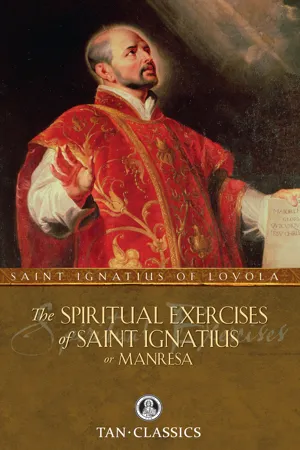
- 344 pages
- English
- ePUB (mobile friendly)
- Available on iOS & Android
eBook - ePub
About this book
Information
Topic
Theology & ReligionSubtopic
Christian DenominationsFIRST PART

Development of the Meditations and Contemplations of the Four Weeks’ Spiritual Exercises
FIRST WEEK
Introduction to Considerations on the End of Man
1. The consideration on the end of man serves as a commencement to the Exercises. It is called the foundation, because it is the basis of the whole spiritual edifice. It will be seen in the sequel that the other meditations are only a consequence of this and that it is upon this that all the success of the retreat depends.
It is necessary in this Exercise to know thoroughly the end for which God created us, to resolve generously to make sacrifice of everything that can divert us from this end, to look with indifference on everything but that which leads to it and even to carry our heroism so far as to choose whatever brings us to it most surely and rapidly, be the cost ever so great.
2. The object of this study is not precisely to excite gratitude toward God by recalling the benefits of creation; it is rather to show us the end for which we were created and to teach us to look upon the benefits of God as so many means for obtaining that end. Thus, even in this first meditation, the mind must concentrate its thoughts on itself and inquire what conduct has hitherto been observed, either with regard to the end or the means, the wanderings and errors into which we have been betrayed and how those creatures that should have been the means of raising us up to God, have been abused so as to separate us from Him. But the principal point is to impress well upon our minds the truth of our final end; for as the foundation of an edifice supports the whole building, so this first truth may be said to support all the others, in such manner that the success of the other meditations will be in proportion to the success of this.
3. The time to be given to this consideration has not been determined; but to render the beginning easier, each one is at liberty to devote the time most suited to his strength and his devotion, unless his director should have laid down some rule for him.
PRINCIPLE OR FOUNDATION
Man was created for a certain end. This end is to praise, to reverence and to serve the Lord his God and by this means to arrive at eternal salvation.
All the other beings and objects that surround us on the earth were created for the benefit of man and to be useful to him, as means to his final end; hence his obligation to use, or to abstain from the use of, these creatures,1 according as they bring him nearer to that end, or tend to separate him from it.
Hence we must above all endeavor to establish in ourselves a complete indifference toward all created things, though the use of them may not be otherwise forbidden; not giving, as far as depends on us, any preference to health over sickness, riches over poverty, honor over humiliation, a long life over a short. But we must desire and choose definitively in everything what will lead us to the end of our creation.
DEVELOPMENT OF THE PRINCIPLE OF THE EXERCISES
First Part of the Text:The End of Man
Text of St. Ignatius: Man was created for this end: to praise, reverence and serve the Lord his God and by this means to arrive at eternal salvation.
This meditation comprises three great truths that are the foundation of all the Exercises: I come from God; I belong to God; I am destined for God. That is to say, God is my first principle, my sovereign Master, my last end.
FIRST TRUTH
I come from God
CONSIDERATIONS
1. Where was I a hundred years ago? I was nothing. If I look back a hundred years, I see the world with its empires, its cities, its inhabitants; I see the sun that shines today, the earth on which I dwell, the land that gave me birth, the family from which I sprung, the name by which I am known: but I—what was I and where was I? I was nothing, and it is amid nothingness I must be sought. Oh, how many ages passed during which no one thought of me! For how can nothing be the subject of thought? How many ages when even an insect or an atom was greater than I! For they possessed at least an existence.
2. But now I exist. I possess an intellect capable of knowing, a heart formed for loving, a body endowed with wonderful senses. And this existence, who gave it me? Chance?—Senseless word!—My parents? They answer in the words of the mother of the Machabees: “No, it was not I who gave you mind and soul; it was the Creator of the world” (2 Mach. 7:22). Lastly, was I the author of my own existence? But nothingness cannot be the cause of existence. It is to God, then, that I must turn as my first beginning. “Thy hands, O Lord, have made me and formed me” (Ps. 118:73). “Thou hast laid Thy hand upon me” (Ps. 138:5). Thou hast taken me from the abyss of nothing.
3. Consider, O my soul, the circumstances of thy creation.
(1) God created me out of His pure love. Had He any need of my existence, or could I be necessary to His happiness? “I have loved thee with an everlasting love” ( Jer. 31:3).
(2) God created me, and the decree of my creation is eternal like Himself. From eternity, then, God thought of me. I was yet in the abyss of nothingness, and God gave me a place in His thoughts! I was in His mind and in His heart. “I have loved you with an everlasting love.”
(3) God created me and in creating me preferred me to an infinite number of creatures who were equally possible to Him and who will forever remain in nothingness. O God, how have I deserved this preference! “I have loved thee with an everlasting love.”
(4) God created me and by creation made me the most noble of the creatures of the visible world. My soul is in His image, and all my being bears the stamp, the living stamp of His attributes.
(5) Lastly, God created me, and He has continued His creation during every moment of my existence. As many as are the hours and moments of my life, so often does He make me a fresh present of life.
AFFECTIONS
Sentiments of humility at the sight of our nothingness. “My substance is as nothing before Thee” (Ps. 38:6).
Sentiments of admiration. “What is man, that Thou shouldst magnify him? or why dost Thou set Thy heart upon him?” ( Job 8:17).
Sentiments of gratitude. “Bless the Lord, O my soul, and let all that is within me bless His holy name. Bless the Lord, O my soul, and forget not all He hath done for thee” (Ps. 102:1, 2).
SECOND TRUTH
I belong to God
CONSIDERATIONS
1. I come from God; hence, I belong to God. God is my creator; hence, He is my Lord and my Master. To deny this consequence would be to deny my reason.
2. The Lord enters into judgment with me and deigns to argue His rights at the bar of His creature. Is it not true that the master has a right to the services of his servants or of his slaves? Is it not true that the king has a right to the obedience of his subjects and the father to the submission as well as the respect of his children? Is it not true that the workman has a right to dispose of his work as he chooses? And I, the creature of God, do I not belong more to God than the slave to his master, than the subject to his sovereign, the child to his father, the picture to him who painted it, or the tree to him who planted it? Does not God possess over me all the rights of men over the creatures and in a higher degree and by more sacred titles? What is there in me that does not belong to Him and is not the fruit, so to say, of His own capital and therefore His property? “What have you that you have not received?” (1 Cor. 4:7). What would remain to me if God took back all that He has given me? If God took back my mind, what should I be?—On a level with the brute animals. If He deprived me of life and motion, what should I be?—A little dust and ashes. If He took away my substance and my whole being, what should I be?—A simple nothing. O my God! All I have comes from Thee; it is just that all in me should belong to Thee. “O Lord, just art Thou, and glorious in Thy power, and no one can overcome Thee. Let all creatures serve Thee: for Thou hast spoken, and they were made; Thou didst send forth Thy Spirit, and they were created” ( Jdth. 16:16, 17).
3. Consider, O my soul, the characteristics of the dominion of God.
(1) Essential dominion. It was not necessary that God should draw me from nothing. But since God has created me, it is necessary that I should be His. He would cease to be God if, being my creator, He ceased to be my sovereign and my master.
(2) Supreme dominion. I belong to God before everything and above everything. Properly speaking, I belong to God alone, and men have no other rights over me except such as God has given them. Their rights, then, are subordinate to the rights of God; and their authority must be always subjected to the authority of God.
(3) Absolute dominion. God can dispose of me according to His pleasure; He can give or take from me fortune, health, honor, life; my duty is to receive everything from His hand with submission and without complaint.
(4) Universal dominion. Everything in me is from God; therefore all in me belongs to God. The dominion of the Lord extends to all the stages of my life, to all the situations in which I may be placed, to all the faculties of my soul, all the senses of my body, to every hour and moment of my existence.
(5) Eternal dominion. The dominion of God is immortal, like myself; it begins with time and continues through eternity; death, which deprives men of all their rights, is unable to do anything against the rights of God.
(6) Irresistible dominion. We may escape the dominion of men; but how escape the dominion of God? Willing or unwilling, we must submit to it; we must either live under the empire of His love, or under that of His justice; either glorify His power by free obedience, or glorify it by inevitable punishment.
“O man, who art thou that repliest against God? Shall the thing formed say to him who formed it, why hast thou made me thus?” (Rom. 9:20).
AFFECTIONS
1. Adoration. “Thou art worthy, O Lord our God, to receive glory and honour and power; for Thou hast created all things” (Apoc. 4:11). “Come, let us adore and fall down before the Lord that made us; for He is the Lord our God” (Ps. 54:6, 7).
2. Regret. “Is this the return thou makest to the Lord, O foolish and senseless people? Is not He thy father, that hath possessed thee, and made thee, and created thee? Thou hast forsaken the God that made thee, and hast forgotten the Lord that created thee” (Deut. 32:6, 18).
3. Submission. “O Lord, for I am Thy servant; I am Thy servant, and the son of Thy handmaid” (Ps. 115:16).
THIRD TRUTH
I am destined for God
CONSIDERATIONS
1. God is not only my creator and my master; He is also my last end. A God infinitely wise must have proposed to Himself an end in creating me; a God infinitely perfect could only have created me for His glory; that is to say, to know Him, to love Him and to serve Him.
2. O my soul! dost thou wish for a proof of this great truth?
(1) Ask thy faith; it will tell thee that God made all for Himself: “The Lord hath made all things for Himself” (Prov. 16:4). That He is the beginning and the end of all things: “I am the beginning and the end” (Apoc. 1:8). That the greatest of the commandments is to adore, to love and to serve God. “Thou shalt love the Lord thy God”; “Thou shalt adore the Lord thy God, and Him only shalt thou serve” (Matt. 22:37, 4:10).
(2) Ask thy reason; it will tell thee that there must be some proportion between the faculties of man and their object. Hence there is nothing but the infinite perfections of God that can be the objects of a mind and heart craving with an intense desire to know and to love.
(3) Ask the creatures; they will tell thee, by their imperfection, their inconstancy, their weakness, in a word, by their nothingness, that t...
Table of contents
- Cover Page
- Halftitle Page
- Title Page
- Copyright Page
- Dedication
- Contents
- Preface
- Prayer of St. Ignatius, “Anima Christi”
- Introduction
- First Part
- Second Part
- Third Part
- Fourth Part
- Appendix
Trusted by 375,005 students
Access to over 1.5 million titles for a fair monthly price.
Study more efficiently using our study tools.
Frequently asked questions
Yes, you can cancel anytime from the Subscription tab in your account settings on the Perlego website. Your subscription will stay active until the end of your current billing period. Learn how to cancel your subscription
No, books cannot be downloaded as external files, such as PDFs, for use outside of Perlego. However, you can download books within the Perlego app for offline reading on mobile or tablet. Learn how to download books offline
Perlego offers two plans: Essential and Complete
- Essential is ideal for learners and professionals who enjoy exploring a wide range of subjects. Access the Essential Library with 800,000+ trusted titles and best-sellers across business, personal growth, and the humanities. Includes unlimited reading time and Standard Read Aloud voice.
- Complete: Perfect for advanced learners and researchers needing full, unrestricted access. Unlock 1.5M+ books across hundreds of subjects, including academic and specialized titles. The Complete Plan also includes advanced features like Premium Read Aloud and Research Assistant.
We are an online textbook subscription service, where you can get access to an entire online library for less than the price of a single book per month. With over 1.5 million books across 990+ topics, we’ve got you covered! Learn about our mission
Look out for the read-aloud symbol on your next book to see if you can listen to it. The read-aloud tool reads text aloud for you, highlighting the text as it is being read. You can pause it, speed it up and slow it down. Learn more about Read Aloud
Yes! You can use the Perlego app on both iOS and Android devices to read anytime, anywhere — even offline. Perfect for commutes or when you’re on the go.
Please note we cannot support devices running on iOS 13 and Android 7 or earlier. Learn more about using the app
Please note we cannot support devices running on iOS 13 and Android 7 or earlier. Learn more about using the app
Yes, you can access The Spiritual Exercises of Saint Ignatius by in PDF and/or ePUB format, as well as other popular books in Theology & Religion & Christian Denominations. We have over 1.5 million books available in our catalogue for you to explore.