A probing analysis of Freemasonry in the U.S. in general, but especially relative to religious education, opposition to the Catholic Church, directing national social policy and how Masons attract members. Thoroughly documented. Immensely revealing. Covers the birth and rise of Freemasonry, the Catholic Church's early condemnation of it, etc. Essential to understanding the forces behind the scenes. 384 pgs,
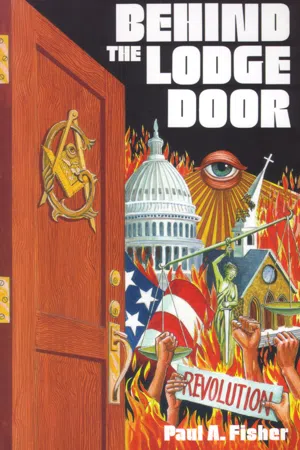
- 384 pages
- English
- ePUB (mobile friendly)
- Available on iOS & Android
eBook - ePub
About this book
Information
Topic
Teologia e religioneSubtopic
Denominazioni cristianePART I
UNDERSTANDING THE CONFLICT
1/ LIFTING THE VEIL
Although Freemasonry operates secretly, there is a surprising amount of information available about its influence on society.
For example, an article in the New Age, in 1946, called attention to the following remark by former French premier Andre Tardieu, who had died the previous year:
"Freemasonry does not explain everything; yet, if we leave it out of account, the history of our times is unintelligible."1
Masonic author and commentator Arthur E. Waite, writing about the 33rd degree of Freemasonry, said:
"It must be confessed that the whole scheme has a certain aspect of conspiracy continually presenting itself and as frequently eluding the mental grasp."2
In 1976, a book by Fred Zeller, former Grand Master of the Grand Orient of France, titled, Trois Points, C'est Tout (Three Points, That's All), revealed that between 1870 and 1971, France was dominated by Freemasons who fought through two major anti-clerical reforms in a battle against Church influence.3
And, in 1981, the world learned of the machinations of Grand Master Licio Gelli's Masonic Lodge known as Propaganda Due, or P-2, which had precipitated the fall of the Italian Government that same year.
Despite that known background of Masonic intrigue, there continues to be a reluctance by the media and social commentators to expose Masonry's long history of working to subvert Church and State.
It is true the press did inform the public that Gelli's lodge included three Cabinet ministers, two under-secretaries, 30 members of Parliament, 70 top military officers, and a number of magistrates, civil servants, industrialists, university professors, policemen and journalists, among whom was the editor and publisher of one of the nation's most prestigious daily newspapers, Corriere delta Sera.
The press also disclosed the financial machinations and tragedies surrounding bankers Roberto Calvi and Michele Sindona, including the former's strange death at Blackfriar's Bridge in London, and the involvement of the Vatican Bank with those two Masonic bankers.4
However, the press gave virtually no attention to the larger picture, that is, the philosophy and activities of the Freemason Fraternity itself, of which P-2 was an offspring.
Yet, it must be noted that Rupert Cornwell, Rome correspondent for the London Financial Times, does say in his book, God's Banker, which reports on the issue: "As early as 1738 Pope Clement XII described Freemasonry as 'Satan's synagogue.' "
And, the British journalist added, the Pope's fears "were well grounded."5
The Financial Times correspondent characterized P-2 as "a state within a state," and "little short of a parallel state."6 He also observed that Italy's late Fascist dictator, Benito Mussolini, had outlawed secret Masonic lodges.7
Still, despite the mind-boggling reality of what this one Roman Masonic lodge had done by gaining allegiance of so many key government officials, industrialists, members of the academic community and others, it seems curious that background information concerning P-2's parent entity, the Masonic Fraternity itself, was ignored by the media. It seems curious, because Freemasonry, over the centuries, is known to have played a secret and extraordinary role in attempting to mold societies according to its tenets.
What Mussolini Found
However, Cornwell's references to Pope Clement XII and Mussolini do provide a clue as to what the world-wide Masonic Fraternity is all about.
In that regard, the New Age, in one of a series of articles in 1949, commented on Mussolini's closing of the lodges prior to World War II.
(The series was written, incidentally, upon the recommendation of Justice Robert H. Jackson, who at that time was a 32nd degree Mason, and had recently returned to the United States after having taken leave from the Supreme Court to serve as Chief Prosecutor at the Nuremberg War Crimes Trials.)
The article said the Italian dictator had been prompted to investigate Masonic lodges after he noticed that many Socialist deputies and government employees "obeyed the orders of Freemasonry in preference to the orders of the Socialist Party."8
It should be noted that the Masonic cult "adhered to Fascism at the beginning," and "officially was never hostile" to it until Il Duce prepared legislation against secret societies.9
As a result of observing what he perceived as disloyalty among the Masons, Mussolini approved the appointment of a 15-member commission comprised "mostly of Senators and university professors," who "unanimously advised the suppression" of the lodges—because:
• Italian Freemasonry was "dominated by an anti-national state of mind."
• The Craft obliged its members to "deny they are Masons," thus contributing to "corrupt the character of Italians."
• Freemasonry used its hold upon the machinery of Government in favor of purely private interests and ambitions.
The report, in many ways so strikingly similar to the Italian Government's findings in 1981, further stated:
"Freemasonry has penetrated into the most delicate organs of the national life, using as its lever the chief banking institutions . . .Its chief weapon is secrecy, which debases men's conscience, making them prone to intrigue and obliging them to submit to discipline against which they cannot rebel without breaking their vows: [this] forces them to maintain an internal solidarity which annuls or overcomes every other duty of loyalty or justice, and . . . insures immunity to any one who profits by it.
"When one thinks of the characteristics of Freemasonry which have been set down above, and especially its ties with similar organizations abroad, one realizes that the existence of Freemasonry is a phenomenon of such gravity that it seems unbelievable that the State has permitted it hitherto."10
At that point, the article refers to a 1947 statement made by John Cowles, Grand Commander of the Scottish Rite of the Southern Jurisdiction, for the purpose of emphasizing the preeminent role played by Raoul V. Palermi, the former Grand Commander of Masonry in Italy who renounced the Fraternity and became friendly with Mussolini.
Cowles said:
"In Italy, the regular Freemasonry stems as follows: Garibaldi, Ballori, Fera, Ricciardi, Burgess (Acting), and Palermi. The last named was head of both the Grand Lodge and the Supreme Council. He betrayed them both, proving a traitor, was expelled from Freemasonry, and later given a position under Mussolini . . ."
Cowles then referred to the situation facing Masonry in Italy immediately following World War II, long after Mussolini had been murdered. The post-War government, he noted, adopted a new constitution which included a provision (Article 14) prohibiting the existence of secret societies.11
The fact that the Grand Commander of Italian Freemasonry was "given a position under Mussolini" strongly indicates that Mussolini and his Commission had first-hand evidence about the activities of Freemasonry.
Further, the fact that the new post-War government felt compelled to place a provision in the constitution banning secret societies gives credence to the findings of Mussolini's 15-member commission, and its fears about what such organizations can do to subvert a State.
However, Cowles noted that the new post-war Prime Minister, Alcide de Gasperi, a Christian Democrat, insisted that he did not view Freemasonry as a secret society, and would not war against it. 12
In retrospect, it appears that de Gasperi's naivete regarding the Masonic Fraternity in 1947 contributed to the P-2 scandal of 1981.
Church Exposes Masonry In 1738
Freemasonry, as we generally know it today, entered history when the Grand Lodge of England was established in 1717.
In 1723, Rev. James Anderson, an English divine, wrote his "New Constitutions" for the Craft, many parts of which were "lifted" from the works of Jan Amos Komensky (also known as Jan Amos Comenius), a 17th Century bishop of the Moravian Church. Anderson's "Constitutions" changed English Masonry from a more or less Christian orientation to "a universal creed based upon the Fatherhood of God and the Brotherhood of Man." This fundamental ideology of Komensky appealed at once "to freethinkers, to rationalists, and to lovers of magic and esoteric rites—to the love of mystery in myths, symbols and ceremonies."13
Fifteen years later, in 1738, Pope Clement XII, as Rupert Cornwell observed, issued his Pontifical Constitution, In Eminenti. The Pontiff declared:
"We have resolved and decreed to condemn and forbid such [secret] societies, assemblies, reunions, conventions, aggregations or meetings, called either Freemasonic or known under some other denomination. We condemn and forbid them by this, our present constitution, which is to be considered valid forever.
"We commend to the faithful to abstain from intercourse with those societies . . .in order to avoid excommunication, which will be the penalty imposed upon all those contravening to this, our order, none except at the point of death could be absolved of this sin, except by us or the then existing Roman Pontiff."
That, indeed, was a very severe indictment of blossoming Masonry, to have the Pope caution his international flock that membership in this new secret society was considered a "reserved sin," absolution for which, except at the point of death, being reserved to the Holy Father personally. However, just thirteen years later, Pope Benedict XIV, in his Pontifical Constitution, Providas, reaffirmed Clement's censure of Masonry and similar secret societies. Moreover, since that time "more than 200" documents issued by the Vatican have condemned Masonry,14 although the "reserved sin" status was dispensed with by Pope Paul VI, and a Catholic rapprochement with the secret society began in the 1940s. That ...
Table of contents
- Cover Page
- Copyright Page
- Dedication Page
- CONTENTS
- AMAZING DISCOVERY
- PART I: UNDERSTANDING THE CONFLICT
- PART II: TARGET—THE CHURCH
- PART III: TARGET—THE STATE
- PART IV: TARGETING MEN FOR THE FRATERNITY
- AFTERWORD
- APPENDIX A • Masonic Justices
- APPENDIX B • George Washington's Masonry
- APPENDIX C • The Ancient Mysteries
- NOTES
Trusted by 375,005 students
Access to over 1.5 million titles for a fair monthly price.
Study more efficiently using our study tools.
Frequently asked questions
Yes, you can cancel anytime from the Subscription tab in your account settings on the Perlego website. Your subscription will stay active until the end of your current billing period. Learn how to cancel your subscription
No, books cannot be downloaded as external files, such as PDFs, for use outside of Perlego. However, you can download books within the Perlego app for offline reading on mobile or tablet. Learn how to download books offline
We are an online textbook subscription service, where you can get access to an entire online library for less than the price of a single book per month. With over 1.5 million books across 990+ topics, we’ve got you covered! Learn about our mission
Look out for the read-aloud symbol on your next book to see if you can listen to it. The read-aloud tool reads text aloud for you, highlighting the text as it is being read. You can pause it, speed it up and slow it down. Learn more about Read Aloud
Yes! You can use the Perlego app on both iOS and Android devices to read anytime, anywhere — even offline. Perfect for commutes or when you’re on the go.
Please note we cannot support devices running on iOS 13 and Android 7 or earlier. Learn more about using the app
Please note we cannot support devices running on iOS 13 and Android 7 or earlier. Learn more about using the app
Yes, you can access Behind the Lodge Door by Paul A. Fisher in PDF and/or ePUB format, as well as other popular books in Teologia e religione & Denominazioni cristiane. We have over 1.5 million books available in our catalogue for you to explore.