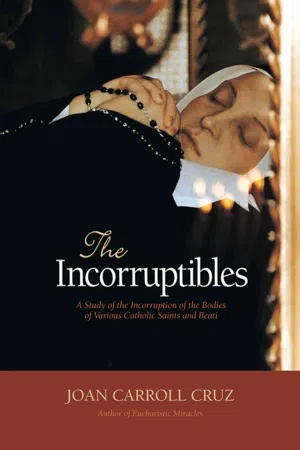
Continuously popular since it first appeared in 1977, TheIncorruptibles remains the acknowledged classic on the bodies of saints that did not undergo decomposition after death. Many remained fresh and flexible for years, or even centuries. After explaining both natural and artificial mummification, the author shows that the incorruption of the saints' bodies fits neither category but rather constitutes a much greater phenomenon that is unexplained by modern science to this day. The author presents 102 canonized saints, beati, and venerables, summarizing their lives, the discovery of their incorruption, and investigations by Church and medical authorities.The incorruptible bodies of saints are a consoling sign of Christ s victory over death, a confirmation of the dogma of the Resurrection of the Body, a sign that the Saints are still with us in the Mystical Body of Christ, and proof of the truth of the Catholic Faith—for only in the Catholic Church do we find this phenomenon. Impr. 342 pgs 33 Illus, .
eBook - ePub
The Incorruptibles
A Study of Incorruption in the Bodies of Various Saints and Beati
- 342 pages
- English
- ePUB (mobile friendly)
- Available on iOS & Android
eBook - ePub
The Incorruptibles
A Study of Incorruption in the Bodies of Various Saints and Beati
About this book
Information
Topic
Theology & ReligionSubtopic
Christian Denominations1
Saint Cecilia
Unknown–177
History indicates that the first Saint whose body experienced the phenomenon of incorruption is St. Cecilia, the patroness of musicians. The year of her birth is unknown, but it is believed she died about AD 177. Cecilia was a member of a rich and distinguished Roman family, who gave her in marriage to a young nobleman named Valerian, despite her desire to remain a virgin. On their wedding night Cecilia was successful in persuading the new groom to respect her vow of virginity and later converted him to the Faith when he was favored with a vision of Cecilia’s guardian Angel. Valerian and his brother, Tiburtius, who was also converted by Cecilia, were later called upon by the early Christian persecutors to renounce their religion. When both heroically refused, they were beheaded and buried along the Appian Way. Cecilia was arrested for having buried their bodies and for this “crime” was given the choice of sacrificing to the heathen gods or being put to death. She steadfastly affirmed her faith and chose to die rather than renounce it.
Because of her nobility and youth, her captors decided to execute her in secrecy to avoid the expected criticism of the people. She was subsequently confined to the vapor bath of her home to die of suffocation. She remained a whole day and night in that stifling environment, yet remained unharmed. An experienced executioner was then sent to behead her, but due to a loss of courage at having to kill such a young and beautiful woman, he failed to sever her head with the three blows prescribed by law. He ultimately fled, leaving the Saint on the pavement of her bath, alive and fully conscious, with her head half severed. She was lying on her right side, her hands crossed in prayer before her. She turned her face to the floor and remained praying in that position for three days and nights. The position of her fingers, three extended on her right hand and one on the left, were her final silent profession of faith in the Holy Trinity.
The early Christians clothed the body of the martyr in rich robes of silk and gold and placed it in a cypress coffin in the same position in which she had expired. At her feet were placed the linen cloths and veils that were used to collect her blood. She was laid to rest in the Catacomb of St. Callistus by the future Pope Urban, who had baptized her husband and brother-in-law.
In the year 822, during the time of the restoration of the church dedicated to her memory, Pope Pascal I wished to transfer the remains of the Saint to a place of honor in her cathedral but could not locate her grave. The Saint appeared to him in a remarkable vision while he was at prayer and told him of the location of her body. The relic was found in exactly the place indicated. The Pope then had the body, along with the bones of her husband, her brother-in-law and the martyr Maximum, placed below the altar of the church.
Seven hundred seventy-seven years later, one of the most documented exhumations of any Saint’s body occurred in 1599, when Cardinal Sfondrato ordered the restoration of some parts of the basilica. On October 20 of that year, during the course of work being done under and near the high altar, two white marble sarcophagi were discovered, which corresponded with the description left by Pascal I of the caskets containing the relics of the holy martyrs. The Cardinal had the sarcophagi opened in the presence of witnesses of unquestionable integrity. After the marble covering was removed, the original cypress casket was found in a good state of preservation. The Cardinal, with understandable emotion, raised the lid, exposing to view the treasure that had been confided to the grave by Popes Urban and Pascal. The mortal remains were found in the same position in which the Saint had died almost 1,500 years before. Through a silk veil that modestly covered the body could be seen the gold-embroidered dress of the Saint, the mortal wound in the neck and the blood-stained clothes. Pope Clement VIII was informed at once of the discovery but was unable to visit the tomb immediately because of a severe attack of the gout but sent instead Cardinal Baronius, who together with Antonio Bosio, the explorer of subterranean Rome, left us priceless descriptive documents relating to the events of this exhumation.
Peering through the ancient veil that covered the body, they noted that Cecilia was of small stature and that her head was turned downward, but due to a “holy reverence,” no further examination was made. Bosio recorded his opinion that the Saint was found in the same position in which she had expired.1
Cardinal Sfondrato wished to retain as a memorial of this touching event a small piece of the blood-stained linen, and he distributed tiny pieces of this cloth to many cardinals in Rome. But upon inspecting the last piece, which he had reserved for himself, he discovered adhering to it a small fragment of the Saint’s bone, which had been dislodged by the sword and which an early Christian had unknowingly picked up with the cloth while staunching the wound of the holy martyr. Sfondrato preserved this relic as a dear and priceless treasure and placed it and the skulls of SS. Valerian, Tiburtius and Maximum in separate reliquaries for exposition.2
The Cardinal also wished to retain a small piece of the Saint’s dress and while engaged in securing this, he felt under the virgin’s clothing the cords and knots of a hair shirt.3
The casket of the Saint was placed in a hall located at the upper extremity of a nave of the basilica where it could be seen through a grated window. The platform and casket were covered with gold-embroidered silk drapery, and the room was magnificently decorated with candelabras, handsome lamps and flowers of silver and gold. The sanctuary was further enhanced by a mysterious and delightful flowerlike odor that proceeded from the coffin.4
On the orders of Pope Clement VIII, the relic was left exposed there until the feast of St. Cecilia, November 22, and so great was the outpouring of the Roman faithful who converged on the basilica to view the body that the Pontifical Swiss Guards were called upon to maintain order.5
At the end of the one-month period of exposition, the relic, still reposing in the ancient cypress casket, was placed in a silver coffin that had been commissioned by the Pope himself as a symbol of his veneration for the holy martyr. In the presence of 42 cardinals and diplomatic representatives from several countries, the Pope celebrated the Solemn High Mass during which the body of the Saint was again interred beneath the main altar.
A sculptor of unusual talents, Stefano Maderno (1576–1636), who it appears was engaged in performing his trade during the restoration of the Basilica, executed a statue of the Saint, which is reputed to be one of the most celebrated and best-known Italian works of art and is believed to represent the Saint in the exact posture of her body. This statue is found immediately in front of the high altar in a niche of black marble, which was designed by Maderno to give the appearance of an open sarcophagus. Doing so, Maderno introduced a new altar design, which was frequently imitated.6
The Basilica of St. Cecilia is believed to have been built on the site of St. Cecilia’s family mansion. The second chapel, on the right aisle, is called the Caldarium and is the room where St. Cecilia was condemned to death. Here are found the remains of an ancient Roman bathroom; the conduits are preserved, which formerly contained the water that was heated in the lower room. The marble slab on the altar is the one on which Cecilia is believed to have survived the first martyrdom by suffocation and very well may be the slab that marked the place of her death.

A statue of Saint Cecilia (d. 177) executed by Stefano Maderno in 1599 at the time of the second exhumation of her incorrupt body. The position is the same as that of the relic and is believed to be the position in which she expired. Note the wound in the neck. The statue is located in the Basilica of Saint Cecilia in Rome.
2
Saint Agatha
Unknown–251
Saint Agatha, a martyr whose name is mentioned in the Canon of the Mass, has been honored since the most ancient times. Entirely reliable facts, other than those here mentioned, are scarce. The cities of Catania and Palermo dispute the honor of her birth. She is known to have been beautiful and wealthy, spending her life since early childhood in the grace and favor of God.
A magistrate named Quinctianus, whose chief occupation appears to have been the persecution of Christians, was attracted to the young virgin and attempted to seduce her. When she declined his advances, he entrusted her to a matron of a sinful house. When this tactic also failed to destroy her constancy, he had her beaten. Another time she was stretched on a wooden horse while an executioner tore her flesh with iron hooks and, on Quinctianus’ direct order, finally amputated her breasts. Although suffering grievously, history records that she was able to address her torturer with these words: “Cruel man, have you forgotten your mother and the breasts that nourished you, that you dare to mutilate me in such a way?” When the third attempt failed to weaken her morals, the magistrate had her rolled naked over hot coals. A violent and sudden earthquake is said to have toppled a nearby hill, causing the torturers to flee in terror. After offering a prayer, the virgin expired.
The holy martyr, having been tortured and having died in Catania, was buried by the Christians of that city, where her body remained until the 11th century. During an Arab occupation, it was transferred by the Byzantines to Constantinople, and a century later, through historical circumstances little known, it was returned to Catania. At this time, the incorrupt body was divided by the persons who had stolen it.
The body is now preserved in different reliquaries. The arms, legs and breasts are preserved in a glass case in an incorrupt condition, although rather dried and dark after more than 1,700 years. The skull and principal relics are at Catania, enclosed in an effigy on which rests a costly jeweled crown. The reliquary consists of the figure of the Saint from the head to the waist and is situated in an upright position. The figure is entirely covered with precious gems, rings, bracelets, pins, chains, jeweled flowers and crosses donated by her grateful clients whose lives, through her intercession, have been saved from the frequent eruptions of Mount Etna, Europe’s largest and most active volcano.
The jeweled reliquary is exposed for public veneration on three occasions during the year: during the three-day solemn festivities commemorating her feast on February 5; on February 12, which is the octave of the feast; and on the 17 of August, the feast of the translation of the relic.
St. Agatha has been designated one of the patronesses of nurses and is invoked against breast diseases and fires.
3
Saint Etheldreda
630–679
King Anna of the East Angles and Queen Hereswide of England have the unique distinction of being the parents of five daughters, all of whom bear the title “Saint.” Etheldreda, whose life is under consideration here, was the foundress of Ely Monastery, which she served as abbess for seven years. Her sister, St. Sexburga, entered this monastery after the death of her husband, King Erconbert, and later succeeded her sister as abbess. St. Withburga was a recluse at Dereham in Norfolk, where she founded a religious house, while St. Ethelburga and St. Sethrid each in turn served as abbess of the Monastery at Brie. History also records two brothers of these Saintly women, Adlwulf and Adulphus.1
Other Saints in this illustrious family were their aunt, St. Hilda, the foundress and abbess of Whitby monastery, and their mother, Hereswide, who, though not referred to as “Saint” Hereswide, nevertheless entered the religious life after the death of King Anna and died a holy death in the abbey of St. Clotilde, near Paris.
In spite of her protests, a diplomatic marriage was contracted between Princess Etheldreda and Prince Tonbercht, the ruler of the territory bordering her father’s. The bridegroom, however, respected the vow of virginity his bride had made in her youth, and after an alliance of only three years she was left a widow. She then retired to the Isle of Ely, which had been given her as a marriage settlement by her husband, and there devoted herself for the next five years to continual prayer.
When the Saint was 30 years of age, she was coerced into another political marriage, this time with King Egfrid, who was then only 16 years of age. During their 12 years of marriage, she preserved her virginity in spite of the wishes of her husband and the advice of her confessor, St. Wilfrid. Egfrid eventually permitted her to enter the monastery ruled by his aunt, the Abbess Ebba, at Coldingham, where the Saint was given the veil by St. Wilfrid in 671. Within a year, the king regretted the permission he had reluctantly given his wife, and Etheldreda, with the help of two companions, was forced to flee from the monastery in order to escape the king, who had journeyed to the monastery to reclaim her. In the year 672, she reached her property at Ely, and the following year she secured enough money from her family to begin building, as was the custom at that time, a double monastery for monks and nuns, which she successfully ruled for almost seven years.
History reports that she prophesied her own death from the plague and also the number of those from the community who would fall victim to the disease. In compliance with her wishes, she was buried with all simplicity in a wooden coffin, but 16 years later her sister, Sexburga, who had succeeded her as abbess, thought it best to take up the bones of the Saint and remove them to the church. It might be well to quote here the events surrounding the exhumation as recorded by St. Bede the Venerable, who carefully questioned those who witnessed the ceremony before reporting the event in his Ecclesiastical History of the English Nation, which was written about the year 730. He reports the proceedings in this manner:
… The body of the holy virgin and spouse of Christ, when her grave was opened, being brought into sight, was found as free from corruption as if she had just died and been buried on that very day; as the aforesaid Bishop Wilfrid, and many others that know it, can testify. But the physician, Cynefrid, who was present at her death, and when she was taken up out of the grave, was wont of more certain knowledge to relate, that in her sickness she had a very great swelling under her jaw. “And I was ordered,” said he, “to lay open that swelling, to let out the noxious matter in it, which I did, and she seemed to be somewhat more easy for two days, so that many thought she might recover from her distemper; but the third day the former pains returning, she was soon snatched out of the world, and exchanged all pain and death for everlasting life and health. And when so many years after her bones were to be taken out of the grave, a pavilion being spread over it, all the congregation of brothers were on the one side, and of sisters on the other, standing about it singing, and the abbess, with a few, being gone to take up and wash the bones, on a sudden we heard the abbess within loudly cry out.… Not long after they called me in, opening the door of the pavilion, where I found the body of the holy virgin taken out of the grave and laid on a bed, as if it had been asleep; then taking off the veil from the face, they also showed the incision which I had made, healed up; so that, to my great astonishment, instead of the open gaping wound with which she had been buried, there then appeared only an extraordinarily slender scar.”
Besides, all the linen cloths in which the body had been buried appeared entire and as fresh as if they had been that very day wrapped about her chaste limbs.… They washed the virgin’s body, and having clothed it in new garments, brought it into the church, and laid it in the coffin that had been brought, where it is held in great veneration to this day. The coffin was found in a wonderful manner, as fit for the virgin’s body as if it had been made purposely for her, and the place for the head particularly cut, exactly fit for her head, and shaped to a nicety.2
Etheldreda’s body was enshrined in the abbey church, but 100 years later the edifice was completely destroyed during an invasion by the Danes, who plundered the monastery and killed many of the sisters. The Saint’s remains, however, were left undisturbed and remained so for over 800 years, until the infamous Reformation, when, on the orders of Henry VIII, her relics were scattered and the shrine so completely destroyed that only a plinth (base) remains. This remnant is still pointed out to visitors to the famous Ely Cathedral, which had developed in architectural perfection about the abbey church.3
In spite of the Saint’s relics having disappeared during the time of the Reformation, her left hand was discovered about the year 1811, in what was evidently a priest’s hiding-hole in penal times. The relic passed from one owner to another until it became the property of the Dominican Sisters of Stone,...
Table of contents
- Title Page
- Copyright Page
- Dedication
- Contents
- About the Author
- List of Illustrations
- Preface
- Acknowledgments
- Introduction
- 1. Saint Cecilia (Unknown–177)
- 2. Saint Agatha (Unknown–251)
- 3. Saint Etheldreda (630–679)
- 4. Saint Cuthbert (Unknown–687)
- 5. Saint Werburgh (Unknown–699)
- 6. Saint Guthlac (667–714)
- 7. Saint Withburga (Unknown–743)
- 8. Saint Wunibald (702–761)
- 9. Saint Alphege of Canterbury (954–1012)
- 10. Saint Romuald (952–1027)
- 11. Saint Coloman (Unknown–1012)
- 12. Saint Edward the Confessor (1004–1066)
- 13. Saint Waltheof (Unknown–1159)
- 14. Saint Ubald of Gubbio (c. 1100–1160)
- 15. Saint Idesbald (Unknown–1167)
- 16. Saint Isidore the Farmer (1080–1172)
- 17. Saint Benezet (Unknown–1184)
- 18. Saint Hugh of Lincoln (1140–1200)
- 19. Blessed Bertrand of Garrigua (Unknown–1230)
- 20. Saint Edmund Rich of Canterbury (1180–1240)
- 21. Saint Rose of Viterbo (1235–1252)
- 22. Saint Sperandia (1216–1276)
- 23. Saint Zita (1218–1278)
- 24. Saint Albert the Great (1206–1280)
- 25. Saint Margaret of Cortona (1247–1297)
- 26. Blessed James de Blanconibus (Blessed James of Bevagna) (1220–1301)
- 27. Saint Nicholas of Tolentino (1245–1305)
- 28. Blessed Peter Ghigenzi (Blessed Peter of Gubbio) (Unknown–1306)
- 29. Blessed Angelo of Borgo San Sepolcro (Unknown–1306)
- 30. Saint Clare of Montefalco (1268–1308)
- 31. Saint Agnes of Montepulciano (1268–1317)
- 32. Blessed Mattia Nazzarei of Matelica (1252–1319)
- 33. Blessed Margaret of Metola (Blessed Margaret of Citta-di-Castello) (1287–1320)
- 34. Blessed John of Chiaramonte (Blessed John of Caramola) (Unknown–1339)
- 35. Saint Peregrine Laziosi (1265–1345)
- 36. Blessed Sibyllina Biscossi (1287–1367)
- 37. Saint Catherine of Siena (1347–1380)
- 38. Blessed Andrew Franchi (1335–1401)
- 39. Saint Frances of Rome (1384–1440)
- 40. Saint Bernardine of Siena (1380–1444)
- 41. Saint Herculanus of Piegaro (Unknown–1451)
- 42. Saint Rita of Cascia (1381–1457)
- 43. Saint Antoninus (1389–1459)
- 44. Blessed Antonio Vici (Blessed Anthony of Stroncone) (1381–1461)
- 45. Saint Didacus of Alcala (San Diego de Alcala) (1400–1463)
- 46. Saint Catherine of Bologna (1413–1463)
- 47. Blessed Margaret of Savoy (Unknown–1464)
- 48. Blessed Eustochia of Padua (1444–1469)
- 49. Blessed Anthony Bonfadini (1402–1482)
- 50. Blessed Eustochia Calafato (1434–1485)
- 51. Blessed Bernard Scammacca (Unknown–1486)
- 52. Blessed Arcangela Girlani (1460–1495)
- 53. Blessed Osanna of Mantua (1449–1505)
- 54. Saint Catherine of Genoa (1447–1510)
- 55. Blessed Margaret of Lorraine (1463–1521)
- 56. Saint Anthony Maria Zaccaria (1502–1539)
- 57. Saint Angela Merici (1474–1540)
- 58. Blessed Lucy of Narni (1476–1544)
- 59. Saint John of God (1495–1550)
- 60. Saint Francis Xavier (1506–1552)
- 61. Saint Stanislaus Kostka (1550–1568)
- 62. Blessed Mary Bagnesi (1514–1577)
- 63. Saint Louis Bertrand (1526–1581)
- 64. Saint Teresa of Avila (1515–1582)
- 65. Saint Charles Borromeo (1538–1584)
- 66. Venerable Catalina de Cristo (1554–1589)
- 67. Saint Benedict the Moor (1526–1589)
- 68. Saint Catherine dei Ricci (1522–1590)
- 69. Saint John of the Cross (1542–1591)
- 70. Blessed Alphonsus de Orozco (1500–1591)
- 71. Saint Paschal Baylon (1540–1592)
- 72. Saint Philip Neri (1515–1595)
- 73. Saint Germaine Cousin (1579–1601)
- 74. Saint Mary Magdalen de’ Pazzi (1566–1607)
- 75. Saint Camillus de Lellis (1550–1614)
- 76. Venerable John of Jesus Mary (1564–1615)
- 77. Saint Rose of Lima (1586–1617)
- 78. Venerable Maria Vela (1561–1617)
- 79. Saint Francis de Sales (1567–1622)
- 80. Saint Josaphat (1580–1623)
- 81. Venerable Mother Maria of Jesus (1560–1640)
- 82. Saint Jeanne de Lestonnac (1556–1640)
- 83. Saint Jane Frances de Chantal (1572–1641)
- 84. Saint John Southworth (1592–1654)
- 85. Saint Andrew Bobola (1590–1657)
- 86. Saint Vincent de Paul (1580–1660)
- 87. Saint Pacifico of San Severino (1653–1721)
- 88. Saint Veronica Giuliani (1660–1727)
- 89. Saint Lucy Filippini (1672–1732)
- 90. Saint Teresa Margaret of the Sacred Heart (Anna Maria Redi) (1747–1770)
- 91. Saint Julie Billiart (1751–1816)
- 92. Blessed Anna Maria Taigi (1769–1837)
- 93. Saint Vincent Pallotti (1795–1850)
- 94. Blessed Rose Philippine Duchesne (1769–1852)
- 95. Saint Jean-Marie-Baptiste Vianney (The Curé of Ars) (1786–1859)
- 96. Saint Madeleine Sophie Barat (1779–1865)
- 97. Saint Pierre Julien Eymard (1811–1868)
- 98. Saint Catherine Labouré (1806–1876)
- 99. Saint Bernadette Soubirous (1844–1879)
- 100. Blessed Paula Frassinetti (1809–1882)
- 101. Saint Charbel Makhlouf (1828–1898)
- 102. Blessed Maria Assunta Pallotta (1878–1905)
- Afterword
- Selected Bibliography
- Notes
Trusted by 375,005 students
Access to over 1.5 million titles for a fair monthly price.
Study more efficiently using our study tools.
Frequently asked questions
Yes, you can cancel anytime from the Subscription tab in your account settings on the Perlego website. Your subscription will stay active until the end of your current billing period. Learn how to cancel your subscription
No, books cannot be downloaded as external files, such as PDFs, for use outside of Perlego. However, you can download books within the Perlego app for offline reading on mobile or tablet. Learn how to download books offline
Perlego offers two plans: Essential and Complete
- Essential is ideal for learners and professionals who enjoy exploring a wide range of subjects. Access the Essential Library with 800,000+ trusted titles and best-sellers across business, personal growth, and the humanities. Includes unlimited reading time and Standard Read Aloud voice.
- Complete: Perfect for advanced learners and researchers needing full, unrestricted access. Unlock 1.5M+ books across hundreds of subjects, including academic and specialized titles. The Complete Plan also includes advanced features like Premium Read Aloud and Research Assistant.
We are an online textbook subscription service, where you can get access to an entire online library for less than the price of a single book per month. With over 1.5 million books across 990+ topics, we’ve got you covered! Learn about our mission
Look out for the read-aloud symbol on your next book to see if you can listen to it. The read-aloud tool reads text aloud for you, highlighting the text as it is being read. You can pause it, speed it up and slow it down. Learn more about Read Aloud
Yes! You can use the Perlego app on both iOS and Android devices to read anytime, anywhere — even offline. Perfect for commutes or when you’re on the go.
Please note we cannot support devices running on iOS 13 and Android 7 or earlier. Learn more about using the app
Please note we cannot support devices running on iOS 13 and Android 7 or earlier. Learn more about using the app
Yes, you can access The Incorruptibles by Joan Carroll Cruz in PDF and/or ePUB format, as well as other popular books in Theology & Religion & Christian Denominations. We have over 1.5 million books available in our catalogue for you to explore.