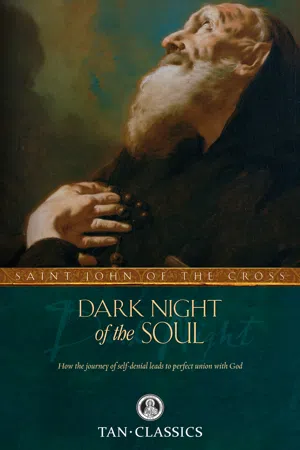
In Dark Night of the Soul, Saint John of the Cross presents for us a portrait painted from his own experience of one who advances successfully through the struggles of the spiritual life. The dark night that St John describes is not abandonment by God but special consideration from Him for those who desire to purify and perfect their souls. With a soul purified from earthly attachments, we can advance through the much quoted but oft misunderstood dark night of the souls into unity with God. By accepting the desolation and difficulty of this process, the soul cooperates with God and opens itself to receiving and revealing more perfectly God's glory. Be not afraid--Dark Night of the Soul, though austere and exacting in its instructions for holy living, is laced with St. John's charity and kindness, his love of all things beautiful and sacred--including you.
eBook - ePub
About this book
Information
Topic
Theology & ReligionSubtopic
Christian DenominationsBOOK TWO
Of the Night of the Spirit
CHAPTER ONE
The Second Night; That of the Spirit. When It Begins
1. Description of a soul which has passed through the sensitive night. 2. Continuation. 3. Continuation. 4. Cause of ecstasies.
THE soul, which God is leading onwards, enters not into the night of the spirit1 at once when it has passed through the aridities and trials of the first purgation and night of sense; yea, rather it must spend some time, perhaps years, after quitting the state of beginners, in exercising itself in the state of proficients. In this state—as one released from a rigorous imprisonment—it occupies itself in divine things with much greater freedom and satisfaction, and its joy is more abundant and interior than it was in the beginning before it entered the night of sense; its imagination and faculties are not held, as hitherto, in the bonds of meditation and spiritual reflections; it now rises at once to most tranquil and loving contemplation, and finds spiritual sweetness without the fatigue of meditation.
2. However, as the purgation of the soul is still somewhat incomplete—the chief part, the purgation of the spirit, being wanting, without which, by reason of the union of our higher and lower nature, man being an individual, the purgation of sense, however violent it may have been, is not finished and perfect—the soul will never be free from some trouble,2 aridities, darkness, and trials, sometimes much more severe than in the past, which are, as it were, signs and heralds of the coming night of the spirit, though not so lasting as that expected night; for when the days or the season of this tempestuous night have passed, the soul recovers at once its wonted serenity. It is in this way that God purifies some souls who are not to rise to so high a degree of love as others. He admits them at intervals into the night of contemplation or spiritual purgation, causing the sun to shine upon them, and then to hide its face, according to the words of the Psalmist: “He sendeth His crystal,” that is contemplation, “like morsels.”3 These morsels of dim contemplation are, however, never so intense as is that awful night of contemplation of which I am speaking, and in which God purposely places the soul, that He may raise it to the divine union.
3. That sweetness and interior delight, which proficients find so easily and so plentifully, come now in greater abundance than before, overflowing into the senses more than they were wont to do previous to the purgation of sense. The senses now being more pure, can taste of the sweetness of the spirit in their way with greater ease. But as the sensual part of the soul is weak, without any capacity for the strong things of the spirit, they who are in the state of proficients by reason of the spiritual communications made to the sensual part, are subject therein to great infirmities and sufferings, and physical derangements, and consequently weariness of mind,4 as it is written: “the corruptible body . . . presseth down the mind.”5 Hence the communications made to these cannot be very strong, intense, or spiritual, such as they are required to be for the divine union with God, because of the weakness and corruption of the sensual part which has a share in them.
4. Here is the source of ecstasies, raptures, and dislocation of the bones which always happen whenever these communications are not purely spiritual; that is, granted to the mind alone, as in the case of the perfect, already purified in the second night of the spirit. In these, raptures and physical sufferings have no place, for they enjoy liberty of spirit with unclouded and unsuspended senses. To make it clear how necessary it is for proficients to enter into the night of the spirit, I will now proceed to point out certain imperfections and dangers which beset them.
CHAPTER TWO
Of Certain Imperfections of Proficients
1. Habitual imperfections of proficients; roots of sin. 2. Dullness of mind. 3. Actual imperfections of proficients: self-deception. 4. Pride and presumption. 5. Necessity of spiritual night for perfection. 6. Continuation.
PROFICIENTS labor under two kinds of imperfections; one habitual, the other actual. The habitual imperfections are their affections and imperfect habits which still remain, like roots, in the mind, where the purgation of sense could not penetrate. The difference between the purgation of these and of the others is like the difference between plucking out a root and tearing off a branch; or removing a fresh and an old stain. For, as I have said,1 the purgation of sense is, for the spirit, merely the gate and entrance of contemplation, and serves rather to bend sense to the spirit than to unite the latter with God. The stains of the old man still remain in the spirit, though not visible to it, and if they be not removed by the strong soap and lye of the purgation of this night, the spirit cannot attain to the pureness of the divine union.
2. They suffer also from dullness of mind, and natural rudeness which every man contracts by sin; from distraction and dissipation of mind, which must be refined, enlightened, and made recollected in the sufferings and hardships of this night. All those who have not advanced beyond the state of proficients are subject to these habitual imperfections, which cannot co-exist, as I said before,2 with the perfect state of union with God in love.
3. But all are not subject to actual imperfections in the same way; some, whose spiritual good is so much on the surface, and so much under the influence of sense, fall into greater3 unseemlinesses and dangers, of which I spoke in the beginning of this book. For as their mind and sense and feelings are full of fancies whereby they very often see imaginary and spiritual visions—all this, together with other pleasurable impressions, befall many of them in this state, wherein the devil and their own proper fancy most frequently delude the soul—and as Satan is wont with so much sweetness to insinuate, and impress these imaginations, they are easily deluded and influenced by him, because they do not take the precaution to resign themselves into the hands of God, and defend themselves vigorously by faith4 against these visions and impressions. For now the devil causes many5 both to believe in vain visions and false prophecies, and to presume that God and His saints are speaking to them: they also frequently believe in their own fancies.
4. Now, too, Satan is wont to fill them with pride and presumption; and they, led on by vanity and arrogance, make a show of themselves in the performance of exterior acts which have an air of sanctity, such as ecstasies and other appearances. They thus become bold with God, losing holy fear, which is the key and guard of all virtue. Some of them become so entangled in manifold falseh...
Table of contents
- Cover Page
- Copyright Page
- Dedication Page
- PREFACE
- CONTENTS
- INTRODUCTION
- THE DARK NIGHT OF THE SOUL
- BOOK ONE: Of the Night of Sense
- BOOK TWO: Of the Night of the Spirit
Trusted by 375,005 students
Access to over 1.5 million titles for a fair monthly price.
Study more efficiently using our study tools.
Frequently asked questions
Yes, you can cancel anytime from the Subscription tab in your account settings on the Perlego website. Your subscription will stay active until the end of your current billing period. Learn how to cancel your subscription
No, books cannot be downloaded as external files, such as PDFs, for use outside of Perlego. However, you can download books within the Perlego app for offline reading on mobile or tablet. Learn how to download books offline
Perlego offers two plans: Essential and Complete
- Essential is ideal for learners and professionals who enjoy exploring a wide range of subjects. Access the Essential Library with 800,000+ trusted titles and best-sellers across business, personal growth, and the humanities. Includes unlimited reading time and Standard Read Aloud voice.
- Complete: Perfect for advanced learners and researchers needing full, unrestricted access. Unlock 1.5M+ books across hundreds of subjects, including academic and specialized titles. The Complete Plan also includes advanced features like Premium Read Aloud and Research Assistant.
We are an online textbook subscription service, where you can get access to an entire online library for less than the price of a single book per month. With over 1.5 million books across 990+ topics, we’ve got you covered! Learn about our mission
Look out for the read-aloud symbol on your next book to see if you can listen to it. The read-aloud tool reads text aloud for you, highlighting the text as it is being read. You can pause it, speed it up and slow it down. Learn more about Read Aloud
Yes! You can use the Perlego app on both iOS and Android devices to read anytime, anywhere — even offline. Perfect for commutes or when you’re on the go.
Please note we cannot support devices running on iOS 13 and Android 7 or earlier. Learn more about using the app
Please note we cannot support devices running on iOS 13 and Android 7 or earlier. Learn more about using the app
Yes, you can access Dark Night of the Soul by in PDF and/or ePUB format, as well as other popular books in Theology & Religion & Christian Denominations. We have over 1.5 million books available in our catalogue for you to explore.