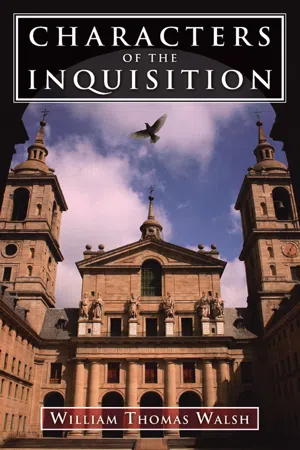
Refutes the many lies about the Inquisition raised by the enemies of the Church. Shows why it was instituted, the purpose it served, its long-term effects, and why it preserved Catholic countries from the infamous witch-hunts besmirching Protestant history. All this is achieved by narrating the stories of six Grand Inquisitors. Exonerates the Church of all wrong-doing. Really dispels the lies about this institution. 320 pgs,
- 314 pages
- English
- ePUB (mobile friendly)
- Available on iOS & Android
eBook - ePub
Characters of the Inquisition
About this book
Information
Topic
Theology & ReligionSubtopic
Christian DenominationsChapter 1
Moses
MOSES appeared among the children of Israel (as Christ would appear) in one of the darkest hours of their history.
Jacob had been gathered to his fathers, leaving behind him a prophecy, that was to be quoted for and against the Jews many centuries later, even in medieval Spain:
“The sceptre shall not be taken away from Juda, nor a ruler from his thigh, till he come that is to be sent, and he shall be the expectation of nations, tying his foal to the vineyard, and his ass, O my son, to the vine. He shall wash his robe in wine, and his garment in the blood of the grapes. His eyes are more beautiful than wine, and his teeth whiter than milk.”1
The children of Israel remained in the land of Egypt, multiplied and prospered. Their numbers aroused the fear, as their prosperity incited the envy, of the dwellers of the Nile, who “made their life bitter with hard works in clay, and brick, and with all manner of service, wherewith they were overcharged in the works of the earth,” until at last King Pharao, having failed to impose a sort of birth control on the Hebrews by corrupting their midwives, condemned all their male babies to be cast into the Nile—even as Herod, in his fear and jealousy of Christ, would deal with the male infants of Bethlehem.
It was at this moment of danger that Moses, precursor and prophet of the Messias, was born of a Levitical family, in which there were already two children, a son, Aaron, and a daughter, Miriam (Mary). The mother was a resourceful woman. She hid her baby in a basket of bulrushes, calked and camouflaged with pitch and mud, and laid him in shallow water, among the sedges by the river’s brink. The girl Miriam, watching from a distance, saw the daughter of Pharao go down with her maidens to bathe, open the basket, discover the crying infant, and take compassion on him, saying, “This is one of the babes of the Hebrews!”
Miriam stepped forward and said, “Shall I go and call to thee a Hebrew woman, to nurse the babe?”
“Go,” said the Princess.
Miriam of course fetched her own mother, who took him and nursed him, as another Hebrew woman, a greater Miriam, centuries later would nurse the Holy Child in Egypt. Pharao’s daughter called him Moses, “because,” she said, “I took him out of the water;” and when he grew up, she adopted him.2 He became a powerful lad, strikingly handsome, with a majestic presence, a quick temper, and a great deal of natural wisdom, with a certain diffidence and humility—Moses never could speak, for example, with the burning eloquence of his older brother; he may even have stammered a little. But he had a more profound intelligence than Aaron, and according to Rabbinical tradition, he was well taught in the lore of the Egyptians, the Assyrians, the Chaldaeans and the Greeks. The sufferings and sorrows of his people afflicted him, and he must have brooded long and often on how they could be redeemed from their servitude to a people spiritually inferior, who worshipped false gods made with human hands and had many base customs. One day he saw an Egyptian brutally striking a Hebrew workman. “And when he had looked about, this way and that way, and saw no one coming, he slew the Egyptian and hid him in the sand.”
Moses supposed that he was unseen, but the next day, stopping a quarrel between two of his own race, he found that one of them knew what he had done, and in resentment threatened to report the matter, as in fact he did: and Moses, condemned to death, fled to the land of Madian.
There, tired and dusty, he sat down by a well, as a far greater Man would sit by the well of Jacob in Samaria: and there came seven maidens, all daughters of the priest of Madian, to draw water for their sheep. Some shepherds arrived, and either out of deviltry, or because water was scarce, began to drive the girls away. To their great surprise, a powerful youth in Egyptian raiment rose up from beside the well, and gave them a thrashing; and after they had fled, Moses gallantly watered the flock for the young women.3
The upshot of all this was that he married one of the girls, Sephora, had two children by her, and remained for some years in the land of Madian, until Pharao died, “and the children of Israel groaning, cried out because of the works: and their cry went up unto God from the works. And He heard their groaning, and remembered the covenant which He made with Abraham, Isaac and Jacob.4
“Now Moses fed the sheep of Jethro his father-in-law, the priest of Madian: and he drove the flock to the inner parts of the desert, and came to the mountain of God, Horeb. And the Lord appeared to him in a flame of fire out of the midst of a bush: and he saw that the bush was on fire and was not burnt. And Moses said, I will go and see this great sight, why the bush is not burnt. And when the Lord saw that he went forward to see, he called to him out of the midst of the bush, and said, ‘Moses, Moses.’
“And he answered, ‘Here I am.’
“And he said, ‘Come not nigh hither, put off the shoes from thy feet: for the place whereon thou standest is holy ground.’
“And he said, ‘I am the God of thy father, the God of Abraham, the God of Isaac, and the God of Jacob.’
“Moses hid his face: for he durst not look at God.
“And the Lord said to him, ‘I have seen the affliction of my people in Egypt, and I have heard their cry because of the rigour of them that are over the works: and knowing their sorrow, I am come down to deliver them out of the hands of the Egyptians, and to bring them out of that land into a land that floweth with milk and honey, to the places of the Chanaanite, and Hethite, and Amorrhite, and Pherezite, and Hevite, and Jebusite. . . . But come, and I will send thee to Pharao, that thou mayst bring forth my people, the children of Israel out of Egypt.’ ”
Moses was terrified in such a Presence.
“Who am I,” he said, “that I should go to Pharao, and should bring the children of Israel out of Egypt?”
The Lord replied, “I will be with thee: and this shalt thou have for a sign that I have sent thee: When thou shalt have brought my people out of Egypt, thou shalt offer sacrifice to God upon this mountain.”
Moses was a practical person, accustomed to looking ahead. What would the children of Israel say when he told them, “The God of your fathers hath sent me to you?” Would they not say, “What is his name?” What then?
The voice of the Almighty answered,
“I AM WHO AM. Thus shalt thou say to the children of Israel: He WHO IS hath sent me to you.”
Moses still hesitated, even after God performed two miracles to convince him—the turning of the rod into the serpent, and the momentary leprosy that whitened his hand and disappeared as it came.
“I beseech thee, Lord, I am not eloquent from yesterday and the day before: and since thou hast spoken to thy servant, I have more impediment and slowness of tongue.”
“Who made man’s mouth? or who made the dumb and the deaf, the seeing and the blind? Did not I? Go therefore, and I will be in thy mouth: and I will teach thee what thou shalt speak.”
“I beseech thee, Lord, send whom thou wilt send.”
The Lord now was angry, but He gave Moses one more chance. He suggested Aaron as spokesman for his slow-tongued brother: “He shall speak in thy stead to the people, and shall be thy mouth: but thou shalt be to him in those things that pertain to God.”
The last objection having been removed, Moses obeyed. Setting his wife and sons upon an ass, he started on the long journey to Egypt, assembled there the ancients of the people, the earliest known Sanhedrin, and spoke as he had been instructed. “And the people believed . . . and falling down, they adored.”
How Moses and Aaron went to Pharao (Moses was then eighty years old, his brother three years older), and how the King refused to let the children of the promise go into the wilderness: how he caused them to make bricks without straw, and had them scourged until they cried out against Moses and Aaron, saying “The Lord see and judge, because you have made our savour to stink before Pharao and his servants, and you have given him a sword to kill us;” how the God of Abraham, Isaac and Jacob smote the Egyptians with seven plagues—the rivers of blood, the festering frogs, the sciniphs that came out of the dust, the grievous swarm of flies, the vexatious murrain on all the beasts of the Egyptians, the scattered ashes, the devastating and thunderous hail; the insatiable locusts on the burning wind, blackening out the sun; the three days’ darkness so thick it could be felt, and finally the slaying of all the first children of Egypt by the angel of the Lord, while the Hebrews celebrated their first Passover feast with unleavened bread, yearling lamb and wild lettuce behind blood-spattered doors, until “Pharao arose in the night, and all his servants and all Egypt, and there arose a great cry in Egypt, for there was not a house wherein there lay not one dead;” and how the Egyptians begged the children of Israel to go, lest all die; how the children of Israel, after 430 years of bondage, trooped forth, taking with them the sacred bones of Joseph, into the desert where the Lord went before as a pillar of cloud by day and a pillar of fire by night: how Pharao and his army pursued, and how the waters of the Red Sea closed over him and all his men and horses and chariots, while the Hebrews passed to safety between the walls of water, and went singing a mighty chorus, while Mary the prophetess and all the other women danced to the beat of their timbrels; and how the Lord showed them the tree that would sweeten the bitter waters of Mara, and fed them for forty years on the manna that fell from Heaven, a gomor of which He ordered kept in the Tabernacle, as it were a prefiguring of the Blessed Sacrament, until at last they came to the foot of the holy Mount of Sinai, where they held their breaths with fear while the Lord God gave to Moses the Ten Commandments which have been the moral law of the world from that day to this—all this is so familiar to us that we are in danger of forgetting what a sublime epic it is, and how living and untarnished and valid it is, after thousands of years, in contrast to all the merely human epics of the gentile world, which have no such claim upon our reverence. For the Law of Moses in its essentials is still the basic moral law of the Catholic Church, through which it has influenced, directly or indirectly, the conscience of the whole world; and must be so, in the nature of things, to the end of time. Often forgotten or overlooked nowadays is the oneness and continuity of the revelation on Mt. Sinai with the revelation of Christ: this oversight explains some of the starkest tragedies and blunders of history, and explains, surely, some of the mysteries which set the Hebrews apart from other peoples in ancient times, and set apart down to our own time the comparatively small group of them who are known to us as Jews.
The children of Israel were chosen very explicitly by the Creator of mankind for the loftiest of destinies, of which obviously there were two parts:
1) To keep the knowledge and worship of one true God alive among all the savage superstitions and vile debaucheries of less favored nations.
2) To receive, in good time, the Holy One of God, who should come to the earth to save not only the Hebrews but all men; and to give Him to mankind.
This privilege was conferred conditionally:
“Thus shalt thou say to the house of Jacob, and tell the children of Israel: You have seen what I have done to the Egyptians, how I have carried you upon the wings of eagles, and have taken you to myself. If therefore you will hear my voice, and keep my covenant, you shall be my peculiar possession above all people: for all the earth is mine. And you shall be to me a priestly kingdom, and a holy nation.”5
In this promise lies an explanation of a great deal of the strange history of the Chosen People, with its alternating triumphs and defeats, glories and humiliations, virtues and sins, even to our own day. It was not merely that their great law-giver gave them principles by which all the affairs of life were regulated more intelligently, in a human sense, than those of any other ancient people; that he anticipated modern theories of hygiene, and even the distinction our law books make about burglary, as a crime committed “in the night season”—and with this, the right of a man to kill a burglar, but not a daytime thief.6 It was not that the Jews had a harsh law of justice alone, contrasting with a Christian law of charity alone—this is a vulgar error, pregnant with conclusions unfair both to Jews and to Christians. The same Moses who, in those rude and dangerous times, told them to exact “eye for eye, tooth for tooth, hand for hand, foot for foot, burning for burning, wound for wound, stripe for stripe,”7 also transmitted these commands:
“Thou shalt not hate thy brother in thy heart, but reprove him openly, lest thou incur sin through him. Seek not revenge, nor be mindful of the injury of thy citizens. Thou shalt love thy friend as thyself. I am the Lord . . .8
“Neither shalt thou gather the bunches of grapes that fall down in thy vineyard, but shalt leave them to the poor and the strangers to take . . .9
“Thou shalt not calumniate thy neighbor, nor oppress him by violence. The wages of him that hath been hired by thee shall not abide with thee until the morning . . .10
“If a stranger dwell in your land, and abide among you, do not upbraid him: but let him be among you as one of the same country: and you shall love him as yourselves: for you were strangers in the land of Egypt. I am the Lord your God . . .11
“You shall not hurt a widow or an orphan. If you hurt them they will cry out t...
Table of contents
- Cover Page
- Copyright Page
- Dedication Page
- FOREWORD
- Contents
- 1. MOSES
- 2. POPE GREGORY IX
- 3. BERNARD GUI
- 4. NICHOLAS EYMERIC
- 5. TORQUEMADA
- 6. CARDINAL XIMENES
- 7. SOME SIXTEENTH CENTURY VICTIMS
- 8. LLORENTE
Trusted by 375,005 students
Access to over 1.5 million titles for a fair monthly price.
Study more efficiently using our study tools.
Frequently asked questions
Yes, you can cancel anytime from the Subscription tab in your account settings on the Perlego website. Your subscription will stay active until the end of your current billing period. Learn how to cancel your subscription
No, books cannot be downloaded as external files, such as PDFs, for use outside of Perlego. However, you can download books within the Perlego app for offline reading on mobile or tablet. Learn how to download books offline
Perlego offers two plans: Essential and Complete
- Essential is ideal for learners and professionals who enjoy exploring a wide range of subjects. Access the Essential Library with 800,000+ trusted titles and best-sellers across business, personal growth, and the humanities. Includes unlimited reading time and Standard Read Aloud voice.
- Complete: Perfect for advanced learners and researchers needing full, unrestricted access. Unlock 1.5M+ books across hundreds of subjects, including academic and specialized titles. The Complete Plan also includes advanced features like Premium Read Aloud and Research Assistant.
We are an online textbook subscription service, where you can get access to an entire online library for less than the price of a single book per month. With over 1.5 million books across 990+ topics, we’ve got you covered! Learn about our mission
Look out for the read-aloud symbol on your next book to see if you can listen to it. The read-aloud tool reads text aloud for you, highlighting the text as it is being read. You can pause it, speed it up and slow it down. Learn more about Read Aloud
Yes! You can use the Perlego app on both iOS and Android devices to read anytime, anywhere — even offline. Perfect for commutes or when you’re on the go.
Please note we cannot support devices running on iOS 13 and Android 7 or earlier. Learn more about using the app
Please note we cannot support devices running on iOS 13 and Android 7 or earlier. Learn more about using the app
Yes, you can access Characters of the Inquisition by William Thomas Walsh in PDF and/or ePUB format, as well as other popular books in Theology & Religion & Christian Denominations. We have over 1.5 million books available in our catalogue for you to explore.