Fr. Faber calls it the price of our salvation, for Our Lord died from loss of blood. Says, it is out of the Precious Blood that men draw martyrdoms, vocations, celibacies, austerities, heroic charities and all the magnificent graces of high sanctity. Says the Sacraments are God's machinery for keeping His Precious Blood always flowing in the Church and that the evils on earth and the pains of Hell would be much worse without the shedding of Our Lord's Precious Blood. Impr. 278 pgs,
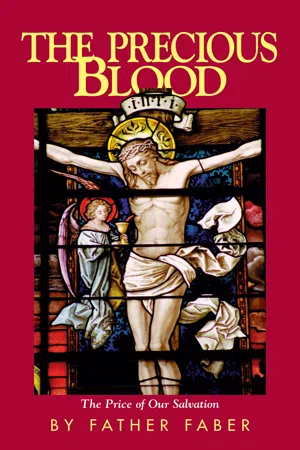
- 278 pages
- English
- ePUB (mobile friendly)
- Available on iOS & Android
eBook - ePub
About this book
Information
Topic
Theology & ReligionSubtopic
Christian DenominationsCHAPTER I
THE MYSTERY OF THE PRECIOUS BLOOD
CHAPTER I
THE MYSTERY OF THE PRECIOUS BLOOD
SALVATION! What music is there in that word — music that never tires but is always new, that always rouses yet always rests us! It holds in itself all that our hearts would say. It is sweet vigor to us in the morning, and in the evening it is contented peace. It is a song that is always singing itself deep down in the delighted soul. Angelic ears are ravished by it up in heaven; and our Eternal Father himself listens to it with adorable complacency. It is sweet even to him out of whose mind is the music of a thousand worlds. To be saved! What is it to be saved? Who can tell? Eye has not seen, nor ear heard. It is a rescue, and from such a shipwreck. It is a rest, and in such an unimaginable home. It is to lie down forever in the bosom of God in an endless rapture of insatiable contentment.
"Thou shalt call his name Jesus; for he shall save his people from their sins." Who else but Jesus can do this, and what else even from him do we require but this? for in this lie all things which we can desire. Of all miseries the bondage of sin is the most miserable. It is worse than sorrow, worse than pain. It is such a ruin that no other ruin is like unto it. It troubles all the peace of life. It turns sunshine into darkness. It embitters all pleasant fountains, and poisons the very blessings of God which should have been for our healing. It doubles the burdens of life, which are heavy enough already. It makes death a terror and a torture, and the eternity beyond the grave an infinite and intolerable blackness. Alas! we have felt the weightiness of sin, and know that there is nothing like it. Life has brought many sorrows to us, and many fears. Our hearts have ached a thousand times. Tears have flowed. Sleep has fled. Food has been nauseous to us, even when our weakness craved for it. But never have we felt any thing like the dead weight of a mortal sin. What then must a life of such sins be? What must be a death in sin? What the irrevocable eternity of unretracted sin?
From all this horror whither shall we look for deliverance? Not to ourselves; for we know the practical infinity of our weakness, and the incorrigible vitality of our corruption. Not to any earthly power; for it has no jurisdiction here. Not to philosophy, literature, or science; for in this case they are but sorry and unhelpful matters. Not to any saint, however holy, nor to any angel, however mighty; for the least sin is a bigger mountain than they have faculties to move. Not to the crowned queen of God's creation, the glorious and the sinless Mary; for even her holiness cannot satisfy for sin, nor the whiteness of her purity take out its deadly stain. Neither may we look for deliverance direct from the patience and compassion of God himself; for in the abysses of his wisdom it has been decreed, that without shedding of blood there shall be no remission of sin. It is from the Precious Blood of Jesus Christ alone that our salvation comes. Out of the immensity of its merits, out of the inexhaustible treasures of its satisfactions, because of the resistless power of its beauty over the justice and the wrath of God, because of that dear combination of its priceless worth and its benignant prodigality, we miserable sinners are raised out of the depths of our wretchedness, and restored to the peace and favor of our Heavenly Father.
Is hope sweet where despair had almost begun to reign? Is it a joy to be emancipated from a shameful slavery, or set free from a noxious dungeon? Is it gladness to be raised as if by miracle from a bed of feebleness and suffering, to sudden health and instantaneous vigor? Then what a gladness must salvation be! For, as there is no earthly misery like sin, so is there no deliverance like that with which Jesus makes us free. Words will not tell it. Thought only can think it, and it must be thought out of an enlightened mind and a burning heart, dwelt on for a long, long while. The first moment after death is a moment which must infallibly come to every one of us. Earth lies behind us, silently wheeling its obedient way through the black-tinted space. The measureless spaces of eternity lie outstretched before us. The words of our sentence have scarcely floated away into silence. It is a sentence of salvation. The great risk has been run, and we are saved. God's power is holding our soul lest it should die of gladness. It cannot take in the whole of its eternity. The least accidental joy is a world of beatitude in itself. The blaze of the vision is overwhelming. Then the truth that eternity is eternal—this is so hard to master. Yet all this is only what we mean when we pronounce the word salvation. How hideous the difference of that first moment after death, if we had not been saved! It turns us cold to think of it. But oh, joy of joys! we have seen the face of Jesus; and the light in his eyes, and the smile upon his face, and the words upon his lips, were salvation.
But there are some who do not feel that sin is such a horror or captivity. They say it lays no weight upon their hearts. They say their lives are full of sunshine, and that time flows with them as the merry rivulet runs in summer with a soothing brawl over its colored stones, and its waters glancing in the sun. They say it is so with them; and truly they should know best. Yet I hardly believe them. If they are happy, it is only by fits and starts; and then not with a complete happiness. There is ever an upbraiding voice within. An habitual sinner always has the look of a jaded and disappointed man. There is weariness in the very light of his eyes, vexation in the very sound of his voice. Why is he so cross with others, if he is so happy with himself? Then are there not also dreadful times, private times when no one but God sees him, when he is chilled through and through with fear, when he is weary of life because he is so miserable, when the past weighs upon him like a nightmare, and the future terrifies him like a coming wild beast? When death springs upon him, how will he die? When judgment comes, what will he answer? Yet even if the sinner could go through life with the gay indifference to which he pretends, he is not to be envied. It is only a sleep, a lethargy, or a madness—one or other of these according to his natural disposition. For there must be an awakening at last; and when and where will it be? They that walk in their sleep are sometimes wakened if they put their foot into cold water. What if the sinner's awakening should be from the first touch of the fire that burns beyond the grave?
But we claim no share in any foolish happiness of sin. We are on God's side. We belong to Jesus. Sin is our great enemy, as well as our great evil. We desire to break with it altogether. We are ashamed of our past subjection to it. We are uneasy under our present imperfect separation from it. Our uppermost thought—no! not merely our uppermost thought, our only thought—is our salvation. We care for no science, but the science of redeeming grace. The cross of Christ is our single wisdom. Once we wished for many things, and aimed at many things. But we are changed now. Our lives are amazingly simplified, simplified by the fear of sin and by the love of God. Our anxiety now is, that all this may remain. We fear another change, especially a change back again. We can think calmly of no change except from little love to much love, and from much love to more love. The right of Jesus to our love, to our best love, to all our love, is becoming plainer and plainer to us. His exceeding loveliness is growing more and more attractive, because it is revealing itself to us every day like a new revelation. What depths there are in Jesus, and how wonderfully he lights them up with the splendors of his eternal love! Do we not feel every day more and more strongly, that we must be more for Jesus than we are, that of all growing things divine love is the most growing, that all idea of a limit to our love of Jesus, or of moderation in our service of him, is a folly as well as a disloyalty? He was the brightness of innumerable lives and the sweetness of innumerable sorrows, when he was but the expectation of longing Israel. What must he be now, when he has come, when he has lived, and shed his Blood, and died, and risen, and ascended, and then come back again in all the unutterable endearments of the Blessed Sacrament? Why are our hearts so cold? Why is our love so faithless, and our faith so unloving? We try, and still we do not love as we wish to love. We try again, and love more; and yet it is sadly short of the love we ought to have. We strive and strive, and still we only languish when we ought to burn. He longs for our love, sweet, covetous lover of souls as he is. He longs for our love; and we long for nothing so much as to love him. Surely there must be a time and a place, when both he and we shall be satisfied; but the place will be heaven, and the time nothing else than the great timeless eternity.
Salvation is through the Precious Blood. We will take that for our study of Jesus this time. When love is humble, it prays with David to be washed more and more from its iniquity. But there is no washing away of iniquity, except in the Precious Blood of our most dear Redeemer. When love is bold, it prays to be set on fire with the flames which Jesus came to kindle. But it is only the Precious Blood which makes our heart beat hotly with the love of him. So let us take the Precious Blood for our study now: and let us study it in a simple, loving way, not so much to become deep theologians, though deep theology is near of kin to heroic sanctity, but that our hearts may be more effectually set on fire with the love of Jesus Christ. There is so much to be said, that we cannot say it all, because we do not know it all. We must make a choice; and we will choose these six things: the Mystery of the Precious Blood, the Necessity of it, its Empire, its History, its Prodigality, and, last of all, the Devotion to it in the Church.
We must take a saint to guide us on our way. Let it be that grand lover of Jesus, the Apostle St. Paul. His conversion was one of the chief glories of the Precious Blood. Redeeming grace was his favorite theme. He was forever magnifying and praising the Blood of Jesus. His heart was filled with it, and was enlarged by grace that it might hold yet more. After the Heart of Jesus, never was there a human heart like that of Paul, in which all other human hearts might beat as if it were their own, unless it be that other universal heart, the heart of King David, which has poured itself out for all mankind, in those varying strains of every changeful feeling, by means of its sweet psalms. St. Paul's heart feels for every one, makes every one's case its own, sorrows and rejoices with those who sorrow or rejoice, and becomes all things to all men that it may save them all. Among the wonders of creation there are few to compare with that glorious apostolic heart. The vastness of its sympathies, the breadth of its charity, the unwearied hopefulness of its zeal, the delicacy of its considerateness, the irresistible attraction of its imperious love—all this was the work of the Precious Blood; and that heart is still alive even upon earth, still beating in his marvellous Epistles as part of the unquenchable life of the Church. It is impossible to help connecting these characteristics of St. Paul's heart with the manifest devotion to the Precious Blood. Let us take him then as our guide amidst the unsearchable riches of Christ and the superabounding graces of his redeeming Blood. As it was with the disciples as they walked to Emmaus with Jesus, so will it be with us as we go along with his servant Paul. Our hearts will burn within us by the way; and we ourselves shall grow hot from the heat of that magnificent heart of him who guides us.
We are then to consider, first of all, the Mystery of the Precious Blood. It was one of God's eternal thoughts. It was part of his wisdom, part of his glory, part of his own blessedness from all eternity. You know that creation, although exceedingly ancient, perhaps so ancient as to be beyond our calculations, is nevertheless not eternal. It could not be so. To be eternal is to be without beginning; and to be without beginning is to be independent of any cause or power. This is a true description of God. But creation had a time at which it began, and it was the independent act of God's most holy, most condescending will. Thus there was an eternity before creation, a vast, unimaginable, adorable life, not broken up into centuries and ages, not lapsing but always still, not passing but always stationary, a life which had no past and no future, because its whole self was always present to itself. This was the life of God before any creation, an unspeakably glorious life, which we can think of with love and adoration, but which it is quite impossible for us to understand. We shall say more of it in the third chapter. Some holy persons, like Mother Anne Seraphine Boulier of the Visitation at Dijon, have had such an exceeding devotion to this life of God prior to creation, that they have by God's order shaped their spirituality wholly upon it. Very often, when the troubles of life vex and ruffle us, or when we are downcast and distrustful, it would do us good to think of that ancient life of God. It would fill us with quiet awe. We should feel our own littleness more sensibly, and we should care less about the judgments of the world. The thought of it would be like a bed to lie down upon, when we are weary with work or Fatigued with disappointment.
Nevertheless there is a sense in which creation was eternal. It was eternally in the mind of God. It was one of his eternal ideas, always before him; so that he never existed without this idea of creation in his all-wise mind and in his all-powerful intention. Moreover, it was always part of his intention that the Creator should become as it were part of his own creation, and that an Uncreated Person should really and truly assume a created nature and be born of a created mother. This is what we call the mystery of the Incarnation. It is this which makes creation so magnificent. It was not merely a beautiful thing which God made as an artificer, and which he set outside of himself, and kept at a distance from himself to look at, to admire, to pity, and to love. He always intended to be part of it himself in a very wonderful way. So that there would have been Jesus and Mary, even if there had never been any sin: only Jesus would not have been crucified, and Mary would not have had any dolors. But the sight of sin was also with God from the beginning, that is, through all his unbeginning eternity; and thus the Precious Blood also, as the ransom for sin, was with him from the beginning. It was one of his eternal thoughts. If we may dare to say so, it was an idea which made him more glorious, a thought which rendered him more blessed. That same dear Blood, the thought of which makes us so happy now, has been part of God's happiness forever.
He created the angels and the stars. How ancient the angels are we do not know. In all ways they are wonderful to think of, because they are so strong, so wise, so various, so beautiful, so innumerable. But they do not lie in our way just now; because, although they owe all their graces to the Precious Blood, they were not redeemed by the Precious Blood. Those angels, who did not fall, did not sin, and so needed no redemption; and God would not allow those who fell to be redeemed at all. This makes us sometimes think that God was more severe with his world of angels than with his world of men. But this is not really the case. It only shows us how we owe more to Jesus than we often think of. The angels could not make any satisfaction to the justice of God for their sins. If all the angels, good and bad together, had suffered willingly the most excruciating torments for millions upon millions of ages, those willing torments could not have made up to God for the sin of the least sinful of those angels who are now devils. If our dearest Saviour had taken upon himself the nature of angels, the case would have been different. But he became man, not angel; and so his Passion, as man, satisfied for all possible sins of men. The sufferings of his Passion were greater and of more price than all the torments of countless angels. The severity of God exacted more from him upon the Cross than it ever exacted or is exacting now, from the tortured angels. Thus you see God has not been more severe with them than with us: only that Jesus made himself one of us, and took all our share of God's severity upon himself, leaving us the easy happiness of faith, and hope, and love. You see we come upon the kindness of Jesus everywhere. There is not even a difficulty in religion, but somehow the greatness of his love is at the bottom of it, and is the explanation of it. Wonderful Jesus! that was the name the prophet Isaias gave him. "He shall be called Wonderful." How sweet it is to be so hemmed in by the tokens of his love, that we cannot turn to any side without meeting them! Yet his love would be sweeter to us if we could only repay it with more love ourselves.
God made the angels and the stars. The starry world is an overwhelming thing to think of. Its distances are so vast that they frighten us. The number of its separate worlds is so enormous that it bewilders us. Imagine a ray of light, which travels one hundred and ninety-two thousand miles in a second; and yet there are stars whose light would take a million of years to reach the earth. We know of two hundred thousand stars down to the ninth magnitude. In one single cluster of stars, eighteen millions of stars have been discovered between the tenth and eleventh magnitudes. Of these clusters men have already discovered more than four thousand. Each of these stars is not a planet, like the earth; but a sun, like our sun, and perhaps with planets round it, like ourselves. Of these suns we know of some which are one hundred and forty-six times brighter than our sun. What an idea all this gives us of the grandeur and magnificence of God! Yet we know that all these stars were created for Jesus and because of Jesus. He is the head and first-born of all creation. Mary's Son is the King of the stars. His Precious Blood has something to do with all of them. Just as it merited graces for the angels, so does it merit blessings for the stars. If they have been inhabited before we were, or are inhabited now, or will at some future time begin to be inhabited, their inhabitants, whether fallen and redeemed, or unfallen and so not needing to be redeemed, will owe immense things to the Precious Blood. Yet earth, our little, humble earth, will always have the right to treat the Precious Blood with special endearments, because it is its native place. When the angels, as they range through space, see our little globe twinkling with its speck of colored light, it is to them as the little Holy House in the hollow glen of Nazareth, more sacred and more glorious than the amplest palaces in starry space.
God made the stars; and, whether the earth was made by itself from the first, or was once part of the sun, and thrown off from it like a ring, God made the earth also, and shaped it, and adorned it, and filled it with trees and animals; and then looked upon his work, and it shone forth so beautifully with the light of his own perfections, that he blessed it, and, glorying in it, declared that it was very good. We know what an intense pleasure men take in looking at beautiful scenery. When we feel this pleasure, we ought to feel that we are looking at a little revelation of God, a very true one although a little one, and we ought to think of God's complacency when he beheld the scenery of the primeval earth and rejoiced in what he saw. There was no sin then. To God's eye, earth was all the more beautiful because it was innocent, and the dwelling-place of innocence. Then sin came. Why God let it come we do not know. We shall probably know in heaven. We are certain, however, that in some way or other it was more glorious for him, and better for us, that evil should be permitted. Some people trouble themselves about this. It does not trouble me at all. Whatever God does must of course be most right. My understanding it would not make it more right; neither could I do any thing to mend matters, if I understood it ever so well. Every one should keep in his own place: it is the creature's place to believe, adore, and love.
Sin came. With sin came many fearful consequences. This beautiful earth was completely wrecked. It went on through space in the sunshine as before; but in God's sight, and in the destiny of its inhabitants, it was all changed. Jesus could no longer come in a glorious and unsuffering incarnation. Mary would have to die; and, though she was sinless, she would need to be redeemed with a single and peculiar redemption, a redemption of prevention, not of rescue. She also, the Immaculate Mother and Queen of creation, must be bought by the Precious Blood. Had it not been for Jesus, the case of earth would have been hopeless, now that sin had come. God would have let it go, as he let the angels go. It would have been all hateful and dark in his sight, as the home of the fallen spirits is. But it was not so. Earth was dimmed, but it was not darkened, disfigured, but not blackened. God saw it through the Precious Blood, as through a haze; and there it lay with a dusky glory over it, like a red sunset, up to the day of Christ. No sooner had man sinned, than the influence of the Precious Blood began to be felt. There was no adorable abruptness on the part of God, as with the angels. His very upbraiding of Adam was full of paternal gentleness. With his punishment he mingled promises. He spoke of Mary, Eve's descendant, and illumined the penance of our first parents by the prophecy of Jesus. As the poor offending earth lay then before the sight of God, so does it lie now; only that the haze is more resplendent, since the Sacrifice on Calvary was offered. The Precious Blood covers it all over, like a sea or like an atmosphere. It lies in a beautiful crimson light forever, a light softening the very shades, beautifying the very gloom. God does not see us as we see ourselves, but in a brighter, softer light. We are fairer in his sight than we are in our own, notwithstanding his exceeding sanctity, because he sees us in the Blood of his dear Son. This is a consolation, the balm of which is not easily exhausted. We learn a lesson from it also. Our view of creation should be like God's view. We should see it, with all its countless souls, through the illuminated mist of the Precious Blood. Its spiritual scenery should be before us, every thing, everywhere, goldenly red.
This is the shape, then, which our Father's love takes to us his creatures. It is an invitation of all of us to the worship and the freedom of the Precious Blood. It is through this Blood that he communicates to us his perfections. It is in this Blood that he has laid up his blessings for us, as in a storehouse. This is true, not only of spiritual blessings, but of all blessings whatsoever. That the elements still wait upon us sinners, that things around us are so bright and beautiful, that pain has so many balms, that sorrow has so many alleviations, that the common course of daily providence is so kindly and so patient, that the weight, the frequency, and the bitterness of evils are so much lightened—is all owing to the Precious Blood. It is by this Blood that he has created over again his frustrated creation. It is out of this Blood that all graces come, whether those of Mary, or those of the angels, or those of men. It is this Blood which merits all good things for every one. The unhappy would be more unhappy, were it not for this Blood. The wicked would be more wicked, were it not for this Blood. The flames of hell wo...
Table of contents
- Cover Page
- Copyright Page
- CONTENTS
- CHAPTER I
- CHAPTER II
- CHAPTER III
- CHAPTER IV
- CHAPTER V
- CHAPTER VI
Trusted by 375,005 students
Access to over 1.5 million titles for a fair monthly price.
Study more efficiently using our study tools.
Frequently asked questions
Yes, you can cancel anytime from the Subscription tab in your account settings on the Perlego website. Your subscription will stay active until the end of your current billing period. Learn how to cancel your subscription
No, books cannot be downloaded as external files, such as PDFs, for use outside of Perlego. However, you can download books within the Perlego app for offline reading on mobile or tablet. Learn how to download books offline
Perlego offers two plans: Essential and Complete
- Essential is ideal for learners and professionals who enjoy exploring a wide range of subjects. Access the Essential Library with 800,000+ trusted titles and best-sellers across business, personal growth, and the humanities. Includes unlimited reading time and Standard Read Aloud voice.
- Complete: Perfect for advanced learners and researchers needing full, unrestricted access. Unlock 1.5M+ books across hundreds of subjects, including academic and specialized titles. The Complete Plan also includes advanced features like Premium Read Aloud and Research Assistant.
We are an online textbook subscription service, where you can get access to an entire online library for less than the price of a single book per month. With over 1.5 million books across 990+ topics, we’ve got you covered! Learn about our mission
Look out for the read-aloud symbol on your next book to see if you can listen to it. The read-aloud tool reads text aloud for you, highlighting the text as it is being read. You can pause it, speed it up and slow it down. Learn more about Read Aloud
Yes! You can use the Perlego app on both iOS and Android devices to read anytime, anywhere — even offline. Perfect for commutes or when you’re on the go.
Please note we cannot support devices running on iOS 13 and Android 7 or earlier. Learn more about using the app
Please note we cannot support devices running on iOS 13 and Android 7 or earlier. Learn more about using the app
Yes, you can access The Precious Blood by Frederick William Faber in PDF and/or ePUB format, as well as other popular books in Theology & Religion & Christian Denominations. We have over 1.5 million books available in our catalogue for you to explore.