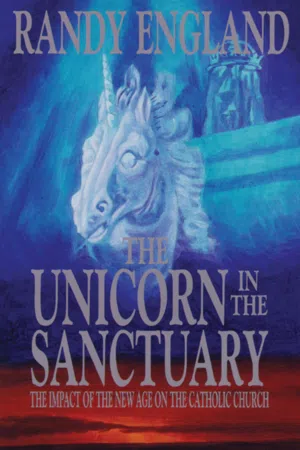
Randy England is a privately practicing Catholic attorney from Missouri. In addition to writingThe Unicorn in the Sanctuary: The Impact of the New Age Movement on the Catholic Church, he was also formerly employed as a managing editor of The Missouri Law Review. A pro-life activist, he is additionally an expert on the so-called New Age, and has written on both topics. Mr. England'sUnicorn in the Sanctuarywas originally published by Trinity Communications, Virginia, and printed by TAN in 1991.
eBook - ePub
The Unicorn In The Sanctuary
The Impact of the New Age Movement on the Catholic Church
- 176 pages
- English
- ePUB (mobile friendly)
- Available on iOS & Android
eBook - ePub
About this book
Information
Topic
Theologie & ReligionSubtopic
Christliche Konfessionen1.
The New Age Movement
"The soul goes round upon a wheel of stars and all things return. . . . Good and evil go round in a wheel that is one thing and not many. Do you not realize in your heart, do you not believe behind all your beliefs, that there is but one reality and we are its shadows; and that all things are but aspects of one thing; a center where men melt into Man and Man into God?"
"No," said Father Brown.
—G. K. Chesterton, The Dagger with Wings
Ideally, I would launch immediately into my subject, but the matter requires a familiarity with the material and its history. Readers already familiar with the background of the New Age Movement may wish to skim this chapter.
The New Age Movement is a worldwide phenomenon ostensibly dedicated to the ideas of the interconnectedness of all things and the powers of the human mind. In the New Age, knowledge supersedes faith and heralds a break with Western values and thought. Its goals are a one-world government, a one-world religion, and a one-world christ. These are not necessarily bad, not necessarily un-Christian. The question is: Which christ? Which religion?
Regarding a one-world government, the Bible seems to show that a united mankind—united not under God, but under man's own flag—is not a good thing. It has been tried before. At the Tower of Babel, God had to intervene in order to put down man's arrogant effort to set himself up as his own god. God knew the evil result and prevented our unification. Confusing the language and scattering mankind throughout the earth, God graciously kept us from our own pride. (Gen. 11:9).
We need only to look around at how some nations now oppress and even murder their own citizens. At least they are restrained in part by the disapproval of other nations and in greater part by their own borders. What will the torturers do when they know neither borders nor disapproving onlookers? Apart from grace, fallen man cannot live as one. The fantasy must wait.
St. Paul writes unequivocally that a new world leader will appear before the Second Coming of Christ. The Apostle tells of a great falling away from the Church and the rise of the Anti-Christ or "man of sin":
Let no man deceive you by any means, for unless there come a revolt first, and the man of sin be revealed, the son of perdition, who opposeth, and is lifted up above all that is called God, or that is worshipped, so that he sitteth in the temple of God, shewing himself as if he were God. Remember you not, that when I was yet with you, I told you these things? And now you know what withholdeth, that he may be revealed in his time. For the mystery of iniquity already worketh; only that he who now holdeth, do hold, until he be taken out of the way. And then that wicked one shall be revealed whom the Lord Jesus shall kill with the spirit of his mouth; and shall destroy with the brightness of his coming, him, whose coming is according to the working of Satan, in all power, and signs, and lying wonders, and in all seduction of iniquity to them that perish; because they receive not the love of the truth, that they might be saved. Therefore God shall send them the operation of error, to believe lying: that all may be judged who have not believed the truth, but have consented to iniquity. (2 Thess. 2:3-11).
The Didache, or "Teachings of the Twelve Apostles," which is one of the earliest extra-biblical Christian documents, teaches: "For in the last days . . . the Deceiver of the world will appear, claiming to be the Son of God, and giving striking exhibitions of power; the earth will be given over to his hands. . . ." (Didache 16:4).1
The "withholder" or "restrainer" referred to by St. Paul has variously been explained as St. Michael the Archangel, the Mass, the presence of the Church or the Holy Spirit. This "restrainer" of the Anti-Christ may be removed directly by God, or the indicated removal may reflect the loss of the influence of the Church or Holy Spirit as a result of the apostasy.
We wonder, as did Jesus' disciples: ". . . when shall these things be?" And Jesus tells us: "But of that day and hour no one knoweth, no not the angels of heaven, but the Father alone." (Matt. 24:3,36). What is certain is that the day will come, and when it does come it may be the New Age Movement which fosters the apostasy; this Movement may be the very delusion which will prepare the world for the Anti-Christ.
The New Age Movement is as old as mankind, and although its beliefs have probably never been without adherents, it needs no human continuity to maintain its ancient tenets, for all its essential elements flow straight from Hell. The first victims of the New Age Movement are well-known. In fact, we have all inherited an attraction for its lies: And the woman answered him (the serpent), saying:
Of the fruit of the trees that are in paradise we do eat; but of the fruit of the tree which is in the midst of paradise, God hath commanded us that we should not eat; and that we should not touch it, lest perhaps we die. And the serpent said to the woman: No, you shall not die the death. For God doth know that in what day soever you shall eat thereof, your eyes shall be opened: and you shall be as Gods, knowing good and evil. (Gen. 3:2-5).
These two lies are the foundation of every pagan religion and cult:
•You will not die.
•You will be like God.
In every imaginable fashion these ideas are woven into endless patterns, along with enough truth to fool nearly anyone. They are found in the doctrines of reincarnation and the divinity of man. In the New Age, the wages of sin is not death, but just another go around in another life. Nothing really matters. There is no personal Creator-God to interfere with the attractions of pride and sensuality—no one to whom we must give account. And even if God did exist, what claim could He make upon us, His fellow gods?
Modernism, Immanence and Pantheism
The supposedly Catholic equivalent of the New Age Movement began to exert a strong influence in the seminaries of the Church before the turn of the century. Strangely enough, this old heresy was called by the name of "Modernism." Pope St. Pius X, in his encyclical Pascendi (Dominici) Gregis or On the Doctrines of the Modernists, undertook a description of the problem, realizing how obscure, shadowy and unconnected all the threads seemed. Nevertheless, he boldly traced the connections and exposed Modernism, beginning a period of purification in the Church that unfortunately died soon after him. From the encyclical, Pascendi:
We must now interrupt a silence, which it would be criminal to prolong, that we may point out to the whole Church, as they really are, men who are badly disguised.
It is one of the cleverest devices of the Modernists . . . to present their doctrines without order and systematic arrangement, in a scattered and disjointed manner so as to make it appear as if their minds were in doubt or hesitation, whereas in reality they are quite firm and steadfast. For this reason it will be of advantage to bring their teachings together here into one group, and to point out their interconnection. . . .2
Christians have always worshipped the God who created the universe. He made it from nothing and is distinct from it. "Thou hast created all things; and for thy will they were, and have been created." (Apoc. 4:11).
The doctrine of immanence is the idea that God is not separate and distinct from His creation, but that He is (somehow) diffused throughout it while at the same time the creation is (somehow) diffused throughout God. And yet the Church has always taught a similar idea: that God is omnipresent. This is clear from Scripture, as King David wrote:
Whither shall I go from thy spirit? or whither shall I flee from thy face? If I ascend into heaven, thou art there: if I descend into hell, thou art present. If I take my wings early in the morning, and dwell in the uttermost parts of the sea: Even there also shall thy hand lead me: and thy right hand shall hold me. (Ps. 138:7-10).
Apart from this natural omnipresence, there is also the supernatural presence of God through His grace. Truly, every member of Christ's Church who is in the state of grace is indwelt by the Holy Spirit, but neither is this what is meant by immanence.
Proponents of this sort of "immanence" believe either that there is no God out there at all, or that if He is out there, then He is unknowable. In practice, this means that man must not look outward to a God separate from himself, but rather to the god within. We must look inside ourselves if we will learn of God. In fact, the Modernist New Age perspective considers the concept of a God outside ourselves to be absurd and even revolting. The key is to go within. Pius X understood the distinction when he wrote: "Religion . . . must, like every other fact, admit of some explanation. [When] all external revelation [is] absolutely denied, it is clear that this explanation will be sought in vain outside of man himself. It must, therefore, be looked for in man."3
As St. Pius X was producing his encyclical, G.K. Chesterton was writing his classic work, Orthodoxy. In it, he spoke of the insufficiency of the "Inner Light":
Of all the conceivable forms of enlightenment the worst is what these people call the Inner Light. Of all horrible religions the most horrible is the worship of the god within. Any one who knows any body (sic) knows how it would work. . . . That Jones shall worship the god within him turns out ultimately to mean that Jones shall worship Jones. Let Jones worship the sun or moon, anything rather than the Inner Light; let Jones worship cats or crocodiles, if he can find any in his street, but not the god within. Christianity came into the world firstly in order to assert with violence that a man had not only to look inwards, but to look outwards, to behold with astonishment and enthusiasm a divine company and a divine captain. The only fun of being a Christian was that a man was not left alone with the Inner Light, but definitely recognized an outer light, fair as the sun, clear as the moon, terrible as an army with banners. . . .
That transcendence and distinctness of the deity which some Christians now want to remove from Christianity, was really the only reason any one wanted to be a Christian.4
Pius X taught that the Modernists' (and I would add the New Agers') concept of "god immanent" squares best with Pantheism. He asked, "Does or does not this 'Immanence' leave God distinct from man? If it does not, it is Pantheism."5
Pantheism simply means that God is Everything and that Everything is God. Pantheism is the natural upshot of the doctrine of immanence, though many Catholic New Agers (forgive the oxymoron) try to draw convoluted arguments to the contrary. One popular writer-speaker-Dominican priest has tried to sidestep the charge of heresy by calling the doctrine of God immanent "panentheism," or as he explains it: "God is in everything, and everything is in God."6
With just a little verbal shuffling, the lie is obscured and made palatable. The phrase may not be instantly recognized as false, but something is wrong. Often, the New Ager will use innocent-sounding language, but with a new and different twist. In this example the writer uses his "panentheism" as a starting point from which he develops what eventually turns out to be open paganism and witchcraft—but more on that later.
No matter what you call it, pantheism dilutes the idea of God so thoroughly that in the end all meaning disappears. In J.D. Salinger's story, "Teddy," a ten-year-old boy recounts his realization of the pantheistic god: "I was six when I saw that everything was God . . . It was on a Sunday, I remember. My sister was . . . drinking her milk and all of a sudden I saw that she was God and the milk was God. I mean all she was doing was pouring God into God, if you know what I mean."7
Holism and Hinduism
Holism (Wholism) is the view that all things are interconnected and form a single entity. This entity or "whole" has an independent reality which is greater than the sum of its parts. This is the viewpoint of Hinduism and has its foundation in the experience of the individual.
In Christianity, our leaders are those who, through their faith and obedience to God, teach us about Him. Some of our earliest teachers were directly inspired by God to write the Bible. The Hindu teacher, or guru, should not be seen in the same way, but rather as a tour guide.
It is as if, when St. John on Patmos had received the Revelation (Apocalypse), rather than writing down the revealed truth, he had opened a school instructing aspiring Christians in his methods for corresponding with God. He would insist that the truth was impossible to communicate. John's advice would be for the Christian to find his own connection with the source. That is the advice now popular with many Catholic teachers today.
It is the task o...
Table of contents
- Title Page
- Copyright Page
- Dedication Page
- THE UNICORN
- Table of Contents
- Foreword
- Introduction: Change. . .or Exchange?
- 1. The New Age Movement
- 2. Education in the New Age
- 3. Priest or Guru?
- 4. Pierre Teilhard de Chardin
- 5. The New Age Mystic: Different Path, Same God?
- 6. Witchcraft, WomanChurch, and the Goddess
- 7. Close to Home
- 8. Fight It?. . .or Forget It?
- Appendix: New Age Politics, Economics and Social Change
- Suggested Reading
Trusted by 375,005 students
Access to over 1.5 million titles for a fair monthly price.
Study more efficiently using our study tools.
Frequently asked questions
Yes, you can cancel anytime from the Subscription tab in your account settings on the Perlego website. Your subscription will stay active until the end of your current billing period. Learn how to cancel your subscription
No, books cannot be downloaded as external files, such as PDFs, for use outside of Perlego. However, you can download books within the Perlego app for offline reading on mobile or tablet. Learn how to download books offline
Perlego offers two plans: Essential and Complete
- Essential is ideal for learners and professionals who enjoy exploring a wide range of subjects. Access the Essential Library with 800,000+ trusted titles and best-sellers across business, personal growth, and the humanities. Includes unlimited reading time and Standard Read Aloud voice.
- Complete: Perfect for advanced learners and researchers needing full, unrestricted access. Unlock 1.5M+ books across hundreds of subjects, including academic and specialized titles. The Complete Plan also includes advanced features like Premium Read Aloud and Research Assistant.
We are an online textbook subscription service, where you can get access to an entire online library for less than the price of a single book per month. With over 1.5 million books across 990+ topics, we’ve got you covered! Learn about our mission
Look out for the read-aloud symbol on your next book to see if you can listen to it. The read-aloud tool reads text aloud for you, highlighting the text as it is being read. You can pause it, speed it up and slow it down. Learn more about Read Aloud
Yes! You can use the Perlego app on both iOS and Android devices to read anytime, anywhere — even offline. Perfect for commutes or when you’re on the go.
Please note we cannot support devices running on iOS 13 and Android 7 or earlier. Learn more about using the app
Please note we cannot support devices running on iOS 13 and Android 7 or earlier. Learn more about using the app
Yes, you can access The Unicorn In The Sanctuary by Randy England in PDF and/or ePUB format, as well as other popular books in Theologie & Religion & Christliche Konfessionen. We have over 1.5 million books available in our catalogue for you to explore.