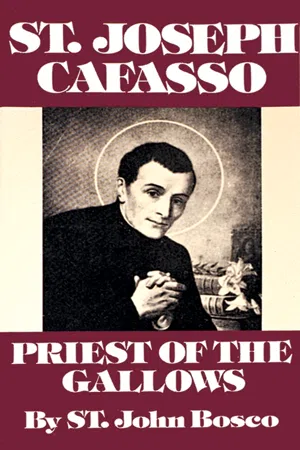
The life of St. John Bosco's spiritual mentor and model in the priesthood, told by St. John Bosco himself. Called the "Priest of the Gallows" because he converted so many criminals on death row (and promised them immediate entrance into Heaven). Great stories show how he did it. Also, stories of how he taught young St. John Bosco to put God first. Impr. 89 pgs,
- 89 pages
- English
- ePUB (mobile friendly)
- Available on iOS & Android
eBook - ePub
About this book
Information
Topic
Theology & ReligionSubtopic
Christian DenominationsThe Second Panegyric on St. Joseph Cafasso
This second panegyric was delivered on the 30th of August, on the occasion of a solemn commemoration of his death held in the church of St. Francis of Assisi, where the saint had ministered during his life. This commemoration was surrounded with great pomp and ceremony: the church was elaborately decorated, and besides a very large concourse of the laity, there were no fewer than three hundred priests present.
"He wrought that which was good, and right, and truth, before the Lord, his God, in all the service of the ministry of the house of the Lord." (2 Para. 31:20,21).
There is one person alone who, if he were here among us at this moment, would be our joy and delight, but he is no more. In this church he exercised his ministry; in it, he knelt and prayed; in it are the altars on which a short time ago he offered the Eucharistic Sacrifice. You have here still—look over and see it—the confessional in which he purified, consoled and comforted our souls; you have also that chair of truth from which, with holy zeal, he explained the word of God, but he himself is no longer here. That gloomy reminder of the departed, that stately bier, and, much more, your sorrowful appearance, tell me that our friend is no longer among the living.
Ah! Don Cafasso, Don Cafasso, where are you? Why have you left us? Come at least even for a moment and comfort us.
I hear a voice which appears to me to come from Heaven saying, "Grieve not, for I am still among you." Yes, my brethren, Don Cafasso is still with us. It is true that his soul is enjoying its happy repose with God, but he lives, speaks, converses with us. He lives with us in the holy actions that he performed in the course of his life; he lives among us through the numerous spiritual sons who, having drunk in from him the milk of prudence and wisdom and piety, are scattered over various countries where they teach, preach, propagate his doctrine, his counsels, his moral precepts. He converses with us by the holy rules of a good life which he gave us viva voce and left to us in writing. He lives, and I hope that from his place in Heaven he will look benignly upon us his friends who are gathered here in veneration of him.
You have been moved by two considerations to come to this church today: to be present at the celebration of a religious function, and to listen to an account of the virtuous actions of a distinguished benefactor. On me has been imposed the duty of delivering an appropriate oration. The first part, namely the exercises of piety, the decorations, the sacred chants and other religious rites have all been prepared in splendid fashion. As to the part that has fallen to my lot, I confess that I find myself in great difficulty, and I do not know how I shall be able to accomplish my task. For having considered one by one the beautiful virtues that adorned our dear departed friend, I find that each of them would demand a long discourse. The facts of his life are, however, so luminous and so complete in their kind that to attempt to adorn them by a long drawn-out discourse would result rather in obscuring than in embellishing them. In my perplexity the words of Sacred Scripture come to my aid: "He wrought that which was good, and right, and truth, before his God," for Don Cafasso was a priest who wrought what was good and right and truth in every field of the ministry of the Lord.
With this quotation from Holy Writ I begin my discourse, relying on the truth that the logic of facts is more persuasive than the most sublime and labored eloquence. I leave aside those rhetorical embellishments commonly used in funeral orations, and shall confine myself to a simple exposition of the actions thanks to which Don Cafasso, in the exercise of Christian charity, has accomplished all the good that can be done by a minister of Jesus Christ in the course of his mortal life. But before commencing I think it well to make two preliminary remarks: firstly, I shall confine myself to what I have seen with my own eyes, or what has been related to me by trustworthy persons who have lived with him. In this way all that I shall relate will have the testimony of ocular witnesses and will be worthy of belief. Secondly, if I sometimes use expressions reserved for those who have been recognized by the Church as saints, I do not intend to anticipate the judgment of the Church; I intend merely to state the facts of his life, leaving to our Holy Mother the Church, when the time is opportune, to issue that infallible judgment to which we all most willingly submit.
But you, Don Cafasso, have said, and have left in writing, that it was your wish that no one should speak of you when you were dead and in your grave. You wished that your works should remain hidden in order to flee from human glory and the applause of men. Permit us today to do violence to that wish of yours; permit us to make known to the public your virtuous actions, not in order to gain for you the praise of man, for you abhor all worldly praise, but to honor God for whose glory you have expended all your solicitude, all your substance, your whole mortal life.
Principles Underlying the Life of Don Cafasso
The fulfillment of every law, the totality of Christian virtues, according to St. Paul, consists in charity. A man raises himself toward God in proportion as he perfects himself in this heavenly virtue, and when this virtue is accompanied by its external fulfillment in a person, that person becomes a perfect Christian, a model of sanctity: "Love therefore is the fulfilling of the law." (Rom. 13:10).
This was the virtue that characterized the whole life of Don Cafasso. Every word, every thought, every deed from his tenderest youth to the last moment of his life was a continuous and uninterrupted exercise of charity; it permeated all his duties toward God, toward men and toward himself.
Let us go now in thought to Castelnuovo and observe him in that place of his birth privileged to witness his early life. When only a boy between the tender ages of eight and ten, he is already a model for the other pupils by the marvelous exactness with which he fulfills his duties at school. With what joy and eagerness he goes to church, takes part in all the functions and frequents the sacraments! From this time his apostolate begins. On Sundays when at church, he listens carefully to the word of God so as to be able to repeat it to his companions and friends on his return. He labors at teaching catechism, but his labors are mingled with ejaculatory prayers, acts of patience and the continual offering of his heart to God.
Even at that tender age, he found means to do good to those around him; to give good advice, to reconcile son with father and employer with servant were frequent triumphs of the boy Cafasso. But what was most surprising in this holy youth was the ingenious ways he found to give alms. He renounced all pleasure and amusement; he frequently deprived himself of things most attractive to boys, and even gave of his necessities. He used to put carefully into a basket pieces of bread, fruit, a few coins to be distributed to those in need, who already formed the delight of his young heart because he had already learned to see in them the person of the Savior.
Instead of diminishing with the passing of childhood, these wonderful adolescent virtues went on increasing with the years. At the age of twelve, when he went to Chieri to continue his studies, his companions gave him the name of the new St. Aloysius. The Lord, seeing this tender plant adorned with the rarest virtues, took him out of the world and planted him in the garden of the Church in order to make of him in due time the worthy minister he himself so ardently desired to be. When young Cafasso put on the clerical garb, his parents and friends were filled with joy and all said in their hearts, "This youth is truly worthy of such a holy habit because he walks with righteousness and works with justice in all his actions": Operatus est bonum et rectum.
When he became a cleric he resolved to become a saint, and so he determined to continue to live a life of holiness as he had hitherto lived. He was accustomed to say that a young man who had embraced the ecclesiastical state should be filled with two great ideas: that he had given himself up to the Lord, thus depriving the world of all further claim on him; and that he had received the clerical habit from the hands of Jesus Christ Himself, who on a corresponding occasion had said to His apostles, "You are the light of the world." (Matt. 5:14). "Woe to you if you allow that light to become extinguished, thus leaving yourself in obscurity and forcing others to walk in darkness!" Such expressions of his were, we might say, the plan that regulated his whole life. Both at home in his native district and in the seminary, his superiors and companions were filled with admiration for him. His promptness and diligence in study, the facility with which he grasped difficulties, his obedience to his superiors, his affability and patience toward equals and inferiors, his frequenting of the sacraments and assiduity in the practices of piety appeared as a mystery to all who knew him. They were unable to explain how a clerical student so young could have arrived at such a high degree of virtue. They sometimes gave expression to their amazement by saying that the cleric Cafasso had never been affected by original sin.
I have thought it well to give you this glimpse of his early life in order that you may not be surprised at the account of the deeds of which I am now going to speak. For if the life he had led up to then was—in his acts, his speech, his conversation, his dealings with others—a life such as befits one called to the service of the Lord, we must say that his life as a priest was that of a saint: "He wrought that which was good, and right, and truth before the Lord his God in all the service of the ministry of the house of the Lord." (2 Para. 31:20,21).
Many of those who had long and intimate acquaintance with Don Cafasso were kind enough to give me both verbal and written accounts of his life, and all were agreed that his life as a priest might rather be called the life of an angel than of a man. He himself has left us in writing the resolutions made at the beginning of his priestly career. He knelt down one day before a crucifix and said, "O Lord, Thou art my inheritance. 'The Lord is the portion of my inheritance.' (Psalm 15:5). This is the choice which I have made voluntarily on the memorable day of my ordination. Yes, O my God, Thou art my inheritance, my delight, the life of my heart forever: 'Thou art the God of my heart and the God that is my portion for ever.' (Psalm 72:26). But not only, O my God, do I wish to be all Thine; I wish to become a saint, and as I do not know whether my life will be long or short, I protest to Thee that I wish to make myself a saint soon. Let the people of the world seek the vanity and pleasures and dignities of this earth; I wish and desire and seek only to become a saint, and I shall be the happiest of men if I make myself a saint soon—a great saint." This he said, and he kept his word.
With reference to his negative sanctity, which consisted in the absence of all sin and in the avoiding of every voluntary defect, we have the most splendid testimonies. I have read these testimonies, and in addition, have questioned his parents, friends and school companions and other people who had long acquaintance with him. I have asked them whether they ever noticed anything in the life of Don Cafasso that merited reproof, or even that required to be corrected as a defect. All agreed in asserting that, in the forty-nine years of his life, they had never noticed an act, a gesture, a look, a word or even a jest that was unworthy of a virtuous boy, a model cleric and a holy priest. On the other hand, speaking of positive sanctity, which consists in the practice of virtue, all used the most laudatory expressions. Some called him a new St. Alphonsus on account of the innocence and purity of his conduct; others spoke of him as a St. Vincent de Paul on account of the great charity that he showed toward all classes of sufferers. There were some who did not hesitate to call him a St. Charles Borromeo on account of the rigidness of his life and the austerities that he practiced; but while they were amazed at the rigid tenor of his life, they called him a new St. Alphonsus on account of his gentleness, condescension and goodness.
I regret that the time at my disposal for this discourse does not permit me to corroborate these statements by quoting the facts which rise up before me in a long series. I shall confine myself to two classes of the most important ones. The first comprises his manifold activities at the ecclesiastical college attached to the church of St. Francis of Assisi, an institution which for forty years had been a fruitful source of grace and blessings for the diocese of Turin and, one might say, for the whole of Piedmont.
The Ecclesiastical College of St. Francis
The scope of this college is to train young priests in the practical duties of the sacred ministry, particularly in the administration of the Sacrament of Penance and in the preaching of the word of God. The five years' study of elementary theology, even when carried out with diligence and regularity, is hardly sufficient to form a learned, pious and prudent minister of the sanctuary. It is necessary for the young priest to see the practical consequences of abstract principles and hear them expounded, to have certain rules for guidance and certain instructions from an experienced professor in order to form efficient ministers of the sanctuary.
Don Guala, a learned theologian and great benefactor of the clergy, was such a professor. In the year 1817, with the consent of the ecclesiastical authorities, he opened a college for young priests where they could find such instruction. The provision of endowment was a major practical difficulty. The parents of the young priests had, for the most part, exhausted their resources in paying for the education of their sons and had now no funds at their disposal. The industrious charity of Don Guala provided for this necessity, partly from a subsidy from the governor, partly from his own resources, and partly from the subscriptions of charitable friends. Only a small pension that was within the capacity of young priests who wished to t...
Table of contents
- Cover Page
- Copyright Page
- CONTENTS
- PREFACE
- INTRODUCTION
- The First Panegyric on St. Joseph Cafasso
- The Second Panegyric on St. Joseph Cafasso
- Preparation for Death
- Visits to the Blessed Sacrament
Trusted by 375,005 students
Access to over 1.5 million titles for a fair monthly price.
Study more efficiently using our study tools.
Frequently asked questions
Yes, you can cancel anytime from the Subscription tab in your account settings on the Perlego website. Your subscription will stay active until the end of your current billing period. Learn how to cancel your subscription
No, books cannot be downloaded as external files, such as PDFs, for use outside of Perlego. However, you can download books within the Perlego app for offline reading on mobile or tablet. Learn how to download books offline
Perlego offers two plans: Essential and Complete
- Essential is ideal for learners and professionals who enjoy exploring a wide range of subjects. Access the Essential Library with 800,000+ trusted titles and best-sellers across business, personal growth, and the humanities. Includes unlimited reading time and Standard Read Aloud voice.
- Complete: Perfect for advanced learners and researchers needing full, unrestricted access. Unlock 1.5M+ books across hundreds of subjects, including academic and specialized titles. The Complete Plan also includes advanced features like Premium Read Aloud and Research Assistant.
We are an online textbook subscription service, where you can get access to an entire online library for less than the price of a single book per month. With over 1.5 million books across 990+ topics, we’ve got you covered! Learn about our mission
Look out for the read-aloud symbol on your next book to see if you can listen to it. The read-aloud tool reads text aloud for you, highlighting the text as it is being read. You can pause it, speed it up and slow it down. Learn more about Read Aloud
Yes! You can use the Perlego app on both iOS and Android devices to read anytime, anywhere — even offline. Perfect for commutes or when you’re on the go.
Please note we cannot support devices running on iOS 13 and Android 7 or earlier. Learn more about using the app
Please note we cannot support devices running on iOS 13 and Android 7 or earlier. Learn more about using the app
Yes, you can access St. Joseph Cafasso by St. John Bosco in PDF and/or ePUB format, as well as other popular books in Theology & Religion & Christian Denominations. We have over 1.5 million books available in our catalogue for you to explore.