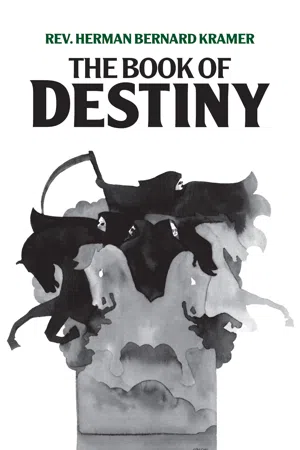
An in-depth analysis of the Apocalypse that really makes sense. Proves it is a prophetic history of the Catholic Church. Proceeds chapter by chapter and verse by verse, explaining everything in terms of the language and symbolic meaning of Scripture itself. Gives the keys to understanding the Apocalypse. Shows we are on the verge of dramatic events! A masterpiece! 526 Pp.. Impr.
The second natural division of the Apocalypse portrays in symbolic visions together with literal narratives the culmination of the growth of evil upon earth and the most sanguine attack upon the Church jeopardizing her very existence and the salvation of the world. The various evil institutions appearing at the trumpet blasts have grown to maturity by the time the prophecies of the open booklet shall go into fulfillment. Out of these institutions shall grow the enormities predicted in this and the following chapters. That prediction is contained in the first part of this open booklet. In the second part (XIV.-XX.) is contained the overthrow of the reign of evil and the end of wickedness, and in the third part the unending reign of justice, during which the whole world will serve the King of Kings.
Chapter X. is divided into two parts: In the first part verses 1-7, an angel appears and announces with an oath that "the mystery of God" shall be accomplished at an appointed time; in the second part St. John receives the revelations which describe the manner of fulfillment.
1. THE MIGHTY ANGEL WITH THE OPEN BOOKLET. SEVEN THUNDERS. OATH.
Chapter X.
Verses 1-7.
Verse 1
This vision presents a powerful angel stepping into the wicked world to make a momentous revelation. He is not a saint of the Church indicated by the nimbus surrounding him, which is the vehicle of celestial spirits, but he resembles Christ (I. 13-17) and bears a message similar to that of Christ. His face shines like the face of Christ and reflects a rainbow from the cloud. The word,
"rainbow" is preceded by the definite article probably referring to IV. 3 and signifying a message of mercy, although it forebodes the direst of all God's judgments upon the world. His face shining as the sun beams with divine authority and knowledge to enlighten the Church and the world. And his feet like pillars of fire foreshadow a guidance of the Church in truth and justice and the extermination of the evils in it. It alludes to the pillar of fire that led the children of Israel out of Egypt. The angel is probably St. Michael.
The vision of chapter X. 1-11 is connected with, is the introduction to and the announcement of what chapter XI. 1-14 relates; and the latter narrative is the culmination of evil begun in IX. 15-21. The first WOE ended in IX. 12. Thereafter the sixth trumpet announced the SECOND WOE; this began with IX. 13 and continues through chapter X. and up to XI. 14. All events then predicted in these three chapters, IX. 13 to XI. 14, are continuous. But the vision of chapter X. coming between IX. 21 and XI. 1 reveals a distinct world-event which is to begin at XI. 1. Chapters twelve and thirteen show a different phase of that same event. It is related to chapter IX., because it is part of the sixth trumpet blast and the full development of the SECOND WOE. Chapter X. indicates that a time of preparation is allotted the Church to enable her to face the trials of chapters XI. XII. XIII. and XIV., as chapter VII. showed a time of preparation for VIII. 7-13.
Verse 2
The angel holds a very small scroll in his left hand. In Greek the diminutive of a diminutive is used perhaps to signify the short duration of the events recorded therein, although their being written on a special scroll denotes their importance. The size of the scroll may also signify that it contains a very small fragment of the revelations recorded in the Book of Seven Seals. The contents may be readily understood and explained because the scroll is open. St. John retains the standpoint of I. 9, IV. 1, and VII. 1 before the open door of the Church. The action of the angel setting his right foot upon the sea and his left upon the land manifests his plenipotential authority over all God's creation. The judgments contained in the scroll shall be executed upon all things terrestrial. The sea is as solid a footing for him as the land. This fact and the gigantic stature of the angel would convince the Seer of his irresistible power and authority and his certainty of victory over all enemies.
Verse 3
The angel speaks with a great voice like the deep roar of a lion. The Greek verb employed suggests distant thunder that sends threatening reverberations through the ground. It is a fearless challenge flung at the enemies of God inspiring awe and terror. It is so like Michael's attitude towards the rebellious angels. It is the antithesis of what St. Peter attributes to the devil (1 Pet. V. 8).
The angel did not utter an articulate word, but when the roar of his voice rolled away into the distance, there was an immediate answer. 'The Seven Thunders' utter their own voices. The definite article designates them as well-known voices. They are the supreme voices of authority in the Church not the single voice of the Supreme Pontiff alone but "seven" voices, the totality of sacred authority, the voices of an ecumenical council. The time has arrived for decisions of far-reaching importance. The arrival of the angel uttering that ominous cry shall set the day and the hour. The thunders may mean dogmatic declarations of the Church against infidels expressed in an ecumenical council. In the revelations of St. Brigitt (Book VI. chap. x), when the question is asked what the seven thunders signified, the answer is said to have been, that by divine revelation she learned the seven thunders were threats decreed from heaven on the persecutors of the Church. (Cor. a Lapide, p. 216).
The Seven Thunders might mean the voices of several popes declaring infallible doctrines of the Church, such as that of the Immaculate Conception or of the Infallibility of the Pope by Pius IX. Or they may be wonderful encyclicals, such as the one on the correct relationship of labor and capital by Leo XIII., the condemnation of Modernism by Pius X. and the epoch-making encyclical on the advantage of a native over a foreign clergy by Benedict XV. These doctrines and encyclicals thundered around the world. But these do not seem to fit into the context of the following chapters.
Chapters XI. 1-2 and XII. 7 argue for many and great evils in the Church. And those verses together with XII. 5 suggest a great conflict between the Church and the world-powers and the necessity of drastic measures of reform for the Church to free herself from the danger of contamination by the evils in the world and purify her from the prevalent internal evils. The Seven Thunders may then be declarations of an ecumenical council clearing up all that was left unfinished by the magisterial office of the Church, before God will permit Satan to exert his supreme efforts to destroy her from without. The Seven Thunders will strengthen the faithful and loyal clergy in their belief and practices, expel all who are addicted to corrupt lives and superstitions and manifest the unwavering stand of the Church on the then prevailing maxims of the world.
Verse 4
According to this verse, St. John had been taking notes all the way through the visions and narratives. He is about to dip his pen into the ink and write what the Thunders had spoken. He therefore understood their message clearly and knew its import. But a voice came forth from the Church ordering him to seal up what the thunders had revealed by not writing it. Through the Seven Thunders, God gave him a special revelation of great importance, indicating what would immediately precede the coming of Antichrist, but it was to remain a secret to the Church. It was as with the revelation made to Daniel concerning the most savage persecutor of the Jews, Antiochus. The length of time he would oppress God's people was to be revealed through Daniel, 2300 days, but the time of his arrival was not to be revealed, was to be "sealed up" (Dan. VIII. 26; XII. 4 & 9). St. Paul likewise heard secret revelations which he was not allowed to communicate to the Church. The Thunders do reveal this: there will be special decisions made by the Church and these will complete the work of her magisterial office before the culmination of evil is due to arrive. The decisions may be the "reed" by which the wicked are separated from the good and expelled from the Church. This scene of the Seven Thunders is a scene within a scene leaving the Church at sea as to the time of Antichrist but foreshowing her preparedness for the attack. No creature will know his time until the Church has enacted what the Seven Thunders have spoken.
Verses 5 and 6
The angel lifts up his right hand to Heaven, which is the gesture of an oath. He still holds the little scroll in his left hand. His oath will be the immediate answer to the Seven Thunders. He swears by the "Living God" who has given existence to all creatures and therefore all creatures must bear witness to the truth of his words. The earth, the sea and heaven is a standard division of all creation. All creatures received life from the Source of life, and they are to witness the universal judgment, because men would not adore the true and living God nor serve Him, though He is the Origin of their life, but adored the works of their hands (IX. 20) and subverted the whole moral order of God in the world (IX. 21). All creatures are furthermore evidence of God's irresistible power. The 200,000,000 warriors have wiped out a third of mankind, and men have lost control of human affairs. The world-wars were only a prelude to the great war or revolution in which one third of mankind shall perish. By the time the 200,000,000 killers have done their work, all thinking men will envision nothing but chaos. All ideals will vanish. And therefore the angel calls attention to the power of God, who will be able to direct all life to the end for which He has created it. No power in Heaven, earth or sea can withstand His decrees. If men are no longer able to manage their affairs for their own felicity, the almighty Creator will step in to guide them. When that direct intervention of God is finished, men will acknowledge their inability to get along without Him and will submit to Him willingly.
"There shall be no more delay" in the execution of God's judgments is the angel's oath. St. John mentions again his position upon the earth and the sea, to assert his universal authority and the speedy beginning of divine intervention in human affairs and to put an end to the kind of things that are wrecking the world. Evils have grown so rapidly and to such enormities as to bring to despair the most optimistic. The time has come in which this shall be stopped. The world is not to be destroyed but to be saved. And salvation shall be brought by the Church (See XII. 10). The Church in men's outlook seems doomed. The oath of the angel does not mean that evil shall be overcome at once, but that the end is in sight. It will be a continuous development and a successive growth into the accomplishment of the "mystery of God" when the seventh angel will begin to blow his trumpet. And this comprises the culmination of evil under the Beast and his destruction. So his appearance and reign is at hand. St. Peter predicted a time when scoffers would laugh at the promise of the Parousia made by the apostles, because the delay had been long, and all creation followed its natural course (2 Peter III. 3). The angel therefore assures all that the exact time is pre-determined in divine providence and there is no doubt of its fulfillment. But this oath was not intended to awaken in the minds of the Asiatic Christians an expectation of a speedy Parousia.
Verse 7
The time of fulfillment shall be when the seventh angel shall begin to blow his trumpet. The Christians at the end of the first century were confronted by the "great tribulation", the Roman persecutions, which would soon become universal. And although the predictions of this prophecy could not be realized in their entirety at once, Christ's ultimate triumph must be affirmed time and again in the revelations. The successive events in chapters 8 and 9 if diligently studied would convince anyone of a long lapse of time before the Parousia. So no one could conclude from the angel's oath to its immediate arrival but only to the promise of its certainty. Before the "mystery of God" shall be fulfilled, the "mystery of iniquity" (2 Thess. II. 7) must run its course in XI. 7-13.
The "mystery of God" as foretold by the prophets (Amos. III. 7) will begin to become an actual fact on "the great day of almighty God" (Mal. IV. 5). This will be the conversion of all nations to God and unending peace for the Church and the world (Is. LXII. 1 ff). The powers of evil shall by that time have spent all their fury against the Church; they shall be surfeited with the blood and slaughter of the true believers; their measure of iniquity shall be filled up, and they shall be ripe for the sickle (XIV. 18) and the winepress of God's wrath. (Is. LXIII. 3). After their swift destruction, the golden age shall dawn upon the world. Not the message of woe was sworn to by the angel but as stated in Greek and Latin the joyful message of peace. The evils adhered to and propagated, as IX. 20-21 states, shall hasten the judgment; and this is announced at XI. 14. If the nations would return to God and halt the progress of evil, the judgment would be postponed (Is. XXXVIII. 6-7). It will not wait till the Church has become so much affected by the prevalent evils that only a remnant can be saved.
The EXECUTION OF THE JUDGMENT does not begin at XI. 15 but at XVI. 1. There are many phases in this judgment, and they are minutely narrated in chapters XVI. to XX. The reign and persecution of Antichrist and the False Prophet partly shown in XI. 1-12 must be related first. This is the climax of the "mystery of iniquity". Human language must traverse the same ground several times to depict the many phases of the supreme conflict in separate scenes, before it can unravel the final outcome into which all events of the grand drama converge. The completion of the mystery of God will not come about immediately after the angel's oath, but in future "days" when the seventh angel shall begin to blow the trumpet. That trumpet heralds the end of the mystery of iniquity and at the same time the solution of the mystery of God.
2. ST. JOHN TAKES AND EATS THE SCROLL.
Verse 8
The same voice that forbade him to write what the Seven Thunders had spoken now commands St. John to take the open scroll from the hand of the angel. The sea and the land are mentioned again to keep before the Seer's mind the universal authority of the angel and the extent of the revelations in the scroll.
Verse 9
St. John rapturously leaves his station at the door of the Church and goes to the mighty angel to ask him for the booklet. The angel invites him to take it, adding that it will be sweet to the taste but bitter to the stomach. This is rather a strange metaphor, because the stomach has no sense of taste. The metaphor is used in the Old Testament to signify the imparting of future secrets to the prophet. He eats the scroll by pondering deeply over its contents to get a clear understanding of the whole scope of the revelations contained in it.
From the angel's words as also from his oath and appearance, we can draw the inference that the wicked shall receive their just retribution. The last words of verse seven, "as he has declared the joyful message by his servants the prophets", assure the preservation of the faithful and the triumphant ascendancy of the Church above the smoke of the great conflagration. The message will fill St. John with mixed feelings. The angel's words convey the fearsome foreboding of persecution and martyrdoms and the uncertanity of what will become of the spiritually lame and sick. Will they be converted or not? And what will the faithful be made to endure? St. John is to ponder the revelations to understand them clearly and then to relate all we need to know to suffer steadfastly for the faith.
Ezechiel was handed a book (II. 9), which was written within and without (Apoc. V. 1). He was ordered to eat it (III. 1-3). When he ate the book, it was "sweet as honey" to the taste. He says nothing of its bitterness, though it contained the final judgment upon Jerusalem and its utter destruction in 586 B. C. Jeremias calls receiving the revelations of God "eating" His words (Jer. XV. 16). In Ezechiel's book, eating the book of God's judgments had the same meaning as here in the Apocalypse. By pondering it deeply St. John would understand its far-reaching application in God's plans and the importance of a clear and true knowledge of it by the Church.
Verse 10
As he absorbed the contents of the scroll with his mind, St. John found the angel's words verified. At first reading, the message seemed sweet and consoling, for it revealed the sweeping triumph of Christ and the Church and the peace and security resultant from the victory for the just. This the prophets had foretold; for this blessed consummation they had y...
Table of contents
Cover Page
Copyright Page
Dedication Page
ABOUT THE AUTHOR
FOREWORD
I INTRODUCTION
SYNOPSIS
DIVISION AND CONTENTS
BIBLIOGRAPHY
BOOK I
THE BOOK OF THE SEVEN SEALS
BOOK II
THE OPEN BOOKLET
Trusted by 375,005 students
Access to over 1.5 million titles for a fair monthly price.
Study more efficiently using our study tools.
Frequently asked questions
Yes, you can cancel anytime from the Subscription tab in your account settings on the Perlego website. Your subscription will stay active until the end of your current billing period. Learn how to cancel your subscription
No, books cannot be downloaded as external files, such as PDFs, for use outside of Perlego. However, you can download books within the Perlego app for offline reading on mobile or tablet. Learn how to download books offline
Perlego offers two plans: Essential and Complete
Essential is ideal for learners and professionals who enjoy exploring a wide range of subjects. Access the Essential Library with 800,000+ trusted titles and best-sellers across business, personal growth, and the humanities. Includes unlimited reading time and Standard Read Aloud voice.
Complete: Perfect for advanced learners and researchers needing full, unrestricted access. Unlock 1.5M+ books across hundreds of subjects, including academic and specialized titles. The Complete Plan also includes advanced features like Premium Read Aloud and Research Assistant.
Both plans are available with monthly, semester, or annual billing cycles.
We are an online textbook subscription service, where you can get access to an entire online library for less than the price of a single book per month. With over 1.5 million books across 990+ topics, we’ve got you covered! Learn about our mission
Look out for the read-aloud symbol on your next book to see if you can listen to it. The read-aloud tool reads text aloud for you, highlighting the text as it is being read. You can pause it, speed it up and slow it down. Learn more about Read Aloud
Yes! You can use the Perlego app on both iOS and Android devices to read anytime, anywhere — even offline. Perfect for commutes or when you’re on the go. Please note we cannot support devices running on iOS 13 and Android 7 or earlier. Learn more about using the app
Yes, you can access The Book Of Destiny by Rev. Fr. Herman B. Kramer in PDF and/or ePUB format, as well as other popular books in Theology & Religion & Christian Denominations. We have over 1.5 million books available in our catalogue for you to explore.