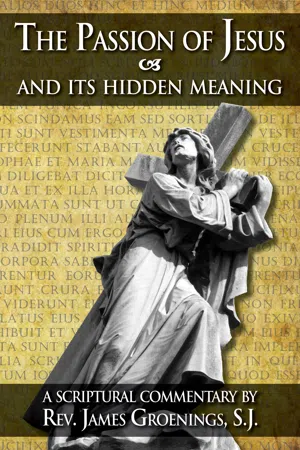
The Passion of Jesus and Its Hidden Meaning shows how every person in the world, whether he realizes it or not, is personally involved in the sufferings and death of Jesus Christ. It was because of our sins, and the seriousness of these sins, that Our Lord underwent so cruel a torture. Using only classic Catholic Commentaries on the Scriptures, Fr. Groenings demonstrates the historical context and spiritual significance of each episode of the Passion of Jesus. From the Agony in the Garden through Our Lord's death and burial, every page of this book is replete with vaulable lessons and superabundance of material for meditation and reflection. Drawing from both the Old and New Testaments, Fr Groenings is able to illustrate the meaning of every event and episode, showing how to apply these lessons to our lives today. Far from being merely an act of unspeakable brutality, the Passion and death of Jesus Christ are shown to be the greatest proof of God's love and mercy to each of us.
eBook - ePub
The Passion of Jesus and Its Hidden Meaning
A Scriptural Commentary on the Passion
- 478 pages
- English
- ePUB (mobile friendly)
- Available on iOS & Android
eBook - ePub
The Passion of Jesus and Its Hidden Meaning
A Scriptural Commentary on the Passion
About this book
Information
Topic
Teologia e religioneSubtopic
Denominazioni cristianeTHE PASSION OF JESUS
CHAPTER I.
THE SUFFERINGS OF CHRIST'S SOUL IN THE GARDEN OF OLIVES
The Most Holy Sacrament of the Altar had been instituted. The words of leave taking had been spoken by the Saviour. The hymn of praise, prescribed by the law, had been sung. Then Jesus, as was His wont, went with His disciples to a garden situated on the Mount of Olives. The garden was distant about half a league from the Cenacle and belonged to a farm called Gethsemane, a word meaning "Oil Press." The way led over the brook Cedron, which, fed by the rains of winter, was dry in mid-summer. The word, "Cedron" means a dark, obscure ravine, a vale of shadows. This name had been given the stream either because of the darkness spread by the thick growth of woods along its borders, or because the valley of Josephat, through which it flowed, was the valley of sin, the valley of tombs. For there, in olden times, sacrifices were offered to Moloch, there the Jews were buried. Every year, over a specially constructed bridge, which spanned this deep rock-ribbed ravine, the red cow was led to the Mount of Olives, there to be burnt for the atonement of the people. Over the same way the scapegoat was driven out to be devoured by wild beasts, thus to give vicarious satisfaction for the sins of men. We now behold, following the same way, the Son of God, the Pure One, the innocent Lamb, Who shall take away the sins of the world. In days gone by, King David with his faithful adherents had also crossed the Cedron, in tears and his head covered in mourning, for he was fleeing from his son Absalom. Christ crossed the brook, not to flee from His enemies, but to deliver Himself to the betrayer in the Garden of Olives. For Judas, the traitor, knew the place, because Jesus had often gone there with His disciples, especially in the days just passed.
On the way, Jesus, in clear terms, again foretold the unfaithfulness of the disciples, especially of Peter; but they would not believe Him. Peter, with self-confident presumption, protested anew that, even if all the others should be scandalized in the Master, he certainly would not; that he would rather die with Him than deny Him. Extolling himself above the others by his assurances of attachment and fidelity, Peter caused them to take offense, and they began to protest in like manner. But the Lord sought to prepare them for the things to come and to console them, even then, by directing their attention to His proximate resurrection. Conversing on these themes, they at length arrived at the garden of Gethsemane.
The events in the Garden of Olives can properly be considered under the following heads: Christ plunged in sadness and wrestling with death; Christ praying to His heavenly Father; Christ calling on His disciples; Christ betrayed by Judas; Christ captured by His enemies and forsaken by the apostles.
Let us consider, the sufferings of the Saviour's soul:
I. | As to their nature. |
II. | As to their causes. |
I.
The sufferings of our Saviour's soul in their first stage are described in the following manner by the evangelists: St. Matthew writes, "He began to grow sorrowful and to be sad. Then he saith to them: My soul is sorrowful even unto death." St. Mark says, "And he began to fear and to be heavy. And he saith to them: My soul is sorrowful even unto death."
The evangelists, then, make use of three expressions in characterizing the mental sufferings of the Saviour. They speak of sadness, of fear and of heaviness which we may call repugnance. Sadness is the result of present evil that already has befallen one; fear arises from the thought of future evil, to avoid which seems very difficult; repugnance is felt under the pressure of present inevitable evils and at the thought of future evils which appear unavoidable and are therefore considered as already present.
At the thought of present or future evils, we human beings are overwhelmed with sadness, fear and repugnance. For these passions or emotions do not arise in us as a result of reason's reflections or of free will. They rather have their origin in the lower powers of the soul, whence they ascend to the higher faculties, moving the will and alluring its sympathy. They run ahead of the reflections of reason, and they are present before one is aware of it. They therefore render more difficult the calm apprehension of the intellect. But thus far there is no personal fault, no sin. It is merely something human, a peculiar result of our deteriorated nature. At this point however, it becomes the duty of the intellect and will to control and to conquer these ebullitions of passion by adducing motives of reason and of faith, and also by prayer and correspondence with divine grace. But instead of acting in such a manner, our walls too often, through our own fault, yield and allow full sway to the emotions and permit us to be carried onward to sins of impatience, anger and others similar, all of which causes the reason to become still more obscured.
It was not so with Christ. All that He suffered never in the least bedimmed the clear apprehension of reason. For with full conviction and freedom He first presented to His mind the causes of sadness, of fear and of repugnance. Then, it is true, He permitted these emotions to produce their painful effects to the fullest extent upon His will and, through the will, upon the other faculties of His soul. But at the same time He presented to His soul counter-motives, which en couraged Him to patiently undergo the sufferings, and, for our example, He simultaneously addressed Himself in earnest prayer to His heavenly Father. Thus He suffered and still always retained perfect control over these inner emotions.
We are here confronted by a great mystery. On the one hand, the soul of Christ from the moment of its creation, enjoyed the beatific vision and, in consequence, untold happiness whilst in the mortal body; but, on the other, it experienced sorrows from other causes and was sad even unto death.1 Only a most incomprehensible miracle of Divine Power and Love could bring this about and did bring it about in the case of the Saviour alone. For faith teaches us that the blessed in heaven, owing to the beatific vision, are immune from any and all sufferings and that, after the last day, their bodies shall also be impassible.
In the second stage, the sufferings of the soul of Christ increased to a real fear of death, whence they passed to a condition of agony, or death-struggle, which produced a bloody sweat. This incident is mentioned by the evangelist St. Luke in the following terms: "And being in agony," i. e., whilst struggling against the fear of death, "he prayed the longer. And his sweat became as drops of blood trickling down upon the ground."
How shall we explain the fear of death in Christ? In the rest of men, this fear usually arises from three causes: from the consciousness of sins committed in the past, from the uncertainty of the future lot awaiting the soul and, lastly, from the natural reluctance of the soul to leave the body. It is evident that in Christ the fear of death could not arise from the first and second causes, for He had nothing to regret in the past, and, as to the future, He knew full well that He would go to the Father. The fear of death in Him arose, therefore, from the last mentioned cause. It is to be remarked, however, that the fear of death in Him was different from that which we experience. In us the repugnance to death and its fear are felt without the consent of our will, even against its consent, while in Christ the fear of death was willed with full deliberation and freedom.
The agony of the Saviour consisted in His struggling with the whole power of His will against the fear of death which He had freely admitted, in His subduing and conquering it. It was, indeed, a most remarkable conflict in the heart of the God-Man. Christ there appears as a general who, being certain of victory, challenges and provokes the enemy to combat, but only to conquer and to slay him.
The bloody sweat, finally, which accompanied the fear of death, was the result of the struggle and not of the fear. Fear, notably the fear of impending death, does not drive the blood out of the heart, but rather back to it. Fright and fear produce a pale, not a ruddy complexion. The bloody sweat, therefore, was the result of the death-struggle, that is, of the great effort of will power to overcome the fear of death. It must, indeed, have been a powerful effort, which drove the blood, after it had rushed through fear to the heart, back through the sacred body to find vent and burst forth in great drops through the pores.
There He lies, the Almighty, the Strong One of Israel, the Shield of the Hero, the Lion of the tribe of Juda, like to a worm trodden in the dust, scarcely able to emit a sigh. Finally, with great effort, He rises. He uplifts His face to heaven, and in the calm light of the full moon that Holy Face appears covered with innumerable red drops, and these drops are the heart's blood of the Son of God, which, amid the most fearful pains, is pressed from all the pores of His sacred Body. The bloody drops fall upon the earth to free it from the ancient curse, and, like to the blood of Abel, they cry to heaven, not for vengeance, however, but for mercy. What then, we have a right to ask, were the causes which gave rise to these sufferings of the soul?
II.
The sufferings of the soul of Christ resulted chiefly from four causes. The first cause was the clear knowledge the Saviour had of all the pains He had to endure in His natural body, in His sacramental body, and in His mystic body. The images of all the terrors and of all the tortures to be brought forth by the coming day arranged themselves vividly before His eyes. He beheld the bloody scourge, the crown of thorns, the dishonor of the purple mantle, the false testimonies, the scornful and biting jeers, the altar of sacrifice on Golgotha. These dreadful images caused Him to feel all the impending pains even before the rude menial raised the fearful scourge, before the cruel nails pierced His sacred hands and feet. The mere thought of an approaching operation or of a threatened disgrace has caused many a one to swoon. Why should it be a matter of surprise that the heart of the Redeemer, at the sight of such woes, trembled in its inmost fibres and prematurely shed its blood? Add to this the foreknowledge of all the wrong and ignominy He was to suffer in His sacramental body through the various sins against the Blessed Sacrament, of all the persecutions and outrages which would be heaped upon His mystic body, the holy Church, by infidels, heretics and schismatics, by cruel tyrants, by anti-Catholic governments and from the scandalous lives of many Catholics. He knew that He could no more endure these pains after His death, therefore He drank in advance this cup of suffering in the garden of Gethsemane. In the second place, the conduct of His ungrateful disciples was to the Redeemer a source of untold sadness. One is already on the way to betray Him for thirty pieces of silver; another, a few hours hence, will deny Him; all are indifferent and given over to careless slumber. In ages to come, the example of these ingrates will be followed by millions of Christians after they shall have reaped the abundance of His benefits, after they shall have been freed, through His precious Blood, from the thraldom of Satan and nourished with His own sacred flesh. Truly the Saviour could exclaim with the Psalmist, "I am become a stranger to my brethren, and an alien to the sons of my mother. And I looked for one that would grieve together with me, but there was none: and for one that would comfort me and I found none."
The third cause was the painful knowledge that all His struggles and sufferings would be wasted on innumerable souls. Hear His plaint in the words of Isaias, the prophet: "I have labored in vain, I have spent my strength without cause and in vain." May God grant that, in these pathetic lamentations, his thoughts were not directed towards any of us! Above all, He was afflicted at the thought of the awful end of His apostle Judas, as well as the temporal and eternal ruin towards which His chosen and beloved people of Israel were drifting.
All this is, indeed, more than sufficient to break a heart, even though that heart were divine. And still St. Chrysostom says that we should err were we to think that the knowledge of all these sufferings was the principal cause of the mental grief and of the mortal anguish of Christ. For no matter how fearful these sufferings were, the Redeemer had anxiously desired them and intensely longed for them. No matter how heavy, how shameful the cross might be, no matter that to many it was a folly and a scandal, it would also bring salvation unto many; for Christ Himself it would be the foundation of His Glory; to the heavenly Father it would bring infinite honor.
It must, then, have been something else that made the soul of Our Saviour tremble; it must have been something else that could make of a God of infinite glory a God struggling with death. It was sin. "The sorrows of death surrounded me: and the torrents of iniquity troubled me." In the hour when the high priests and pharisees consulted together in the court of Caiphas how they might apprehend Jesus, the heavenly Father imposed upon Him, (the purity of His soul, however, remaining unsullied), all the injustice of the whole world, the sins of all nations, the sins of all times, the sins of all classes; the sins of kings, the sins of subjects; the sins of the rich, the sins of the poor; the sins of parents and the sins of children. Is it a wonder that this burden of iniquities, laid upon the Saviour, should press Him to the ground?
To us, indeed, who know so little of the supernatural, sin often appears in more subdued colors. We excuse it, we consider it a mere weakness, something natural, a result of youth and of temperament. We fear at most the penalties of sin threatened by God's anger. But the soul of Christ saw, clearly and distinctly, not only the entire series of sins, from the disobedience of our first parents down to the desolations of dooms-day, but also all the malice, all the abomination, the revolt, the contempt, the dark ingratitude contained in each and every sin. Even when we recognize the wrong done to Almighty God by our sins, we take it little to heart, because we love Him so little. But the soul of Christ, which sought nothing more strenuously than the glory of His heavenly Father and which loved Him with an immeasurable love greater than that of all the Cherubim and Seraphim, felt most vividly the wrong inflicted on the Divine Majesty by sin. The sorrows of David over the injustices of the chosen people, the grief and indignation of Elias at the scandals and the idolatries of Israel, the tears of the prophet Jeremiah over the infidelities of Jerusalem were merely faint figures of the sadness of Jesus when He beheld the sins of the entire world.
And if this be true, we cannot shut out from our hearts another consideration. At the sight of our sins a God is seized with painful disquiet, and we remain calm. A God is sad over our sins, and we take pleasure therein. A God sweats blood for our sins, and we never shed a tear. We sin and, instead of hesitating and trembling, we think, perhaps, "I have sinned and what harm hath befallen me?" At the sight of our sins a God-Man writhes in agony, and we, perhaps, live on in a dreadful torpor which is an insult to the agony of Christ, in a false security, which, in a way, is more terrible than sin itself. We, perhaps, shall slumber on in utter blindness until that hour in which the voice of the eternal Judge will awaken us. Oh, dreadful moment in which the Redeemer, now mute and patient in the Garden of Olives, burdened down with the mountain of our sins, will unsheathe before the sinner the flaming sword of vengeance! Oh, dreadful moment, in which the same Redeemer, who now sheds His blood for our sins, will demand of the sinner an account of the blood shed in vain! Oh, most dreadful moment, in which the heart, now tortured out of love for us, even unto death, will appear glowing with eternal wrath!
Still, however great our fault may be, even if our sins be as numerous as the grains of sand on the sea-shore, we must not despair. Now is still the time of grace, even now, from all the pores of the Redeemer wrestling with death, His precious blood is being shed for us, even now His divine Heart is beating warmly for us. Let us firmly resolve to flee the monster sin which caused a God to tremble; by means of the Precious Blood, to purify ourselves in the sacrament of Penance, and, henceforth so to live as to justify the hope that, when we shall writhe in the throes of death, the agony of Christ may bring us, not despair, but solace; not ruin, but salvation.
CHAPTER II.
CIRCUMSTANCES SURROUNDING THE SUFFERINGS OF CHRIST IN THE GARDEN OF OLIVES
"And he saith to them: My soul is sorrowful even unto death."
(St. Mark, xiv., 34.)
In considering the history of the Passion, we must, as much as possible, pass in review not only the chief events, but also the subordinate occurrences, even minute details narrated by the evangelists. Whatever, that is to say, the Holy Ghost, through the Sacred Scriptures, has made known to us concerning the person, the work and the Passion of Christ, cannot be considered small or trivial; it must be worthy of our consideration and mature reflection. These various outward circumstances are often full of deep mystery, and, when we penetrate into their meaning, they heighten the interest in the chief event itself. Furthermore, for a thorough understanding of the facts, it is also very useful to examine and investigate, with humble moderation, in so far as our limited powers will permit, their inward circumstances, i. e., the ca...
Table of contents
- Cover Page
- Copyright Page
- Preface
- CONTENTS
- CHAPTER I. The sufferings of Christ's Soul in the Garden of Olives, considered
- CHAPTER II. Circumstances surrounding the sufferings of Christ's Soul in the Garden of Olives
- CHAPTER III. The prayer of Christ in the Garden of Olives
- CHAPTER IV. The repeated appeals of Christ to His apostles
- CHAPTER V. The treason of Judas
- CHAPTER VI. The seizure of the Redeemer
- CHAPTER VII. The incidents directly following the seizure
- CHAPTER VIII. The trial of Christ before Caiphas
- CHAPTER IX. The three denials of Peter
- CHAPTER X. The death of the traitor
- CHAPTER XI. The accusation before Pilate
- CHAPTER XII. The first hearing of Christ before Pilate
- CHAPTER XIII. Christ before Herod
- CHAPTER XIV. Christ and Barabbas
- CHAPTER XV. The scourging of Christ
- CHAPTER XVI. The crowning with thorns
- CHAPTER XVII. Eece Homo!
- CHAPTER XVIII. The second hearing of Christ before Pilate
- CHAPTER XIX. The close of the trial
- CHAPTER XX. The carrying of the Cross
- CHAPTER XXI. The march to the place of execution
- CHAPTER XXII. The execution
- CHAPTER XXIII. The first word of Christ on the cross
- CHAPTER XXIV. The second word of Christ on the cross
- CHAPTER XXV. The third word of Christ on the cross
- CHAPTER XXVI. The fourth word of Christ on the cross
- CHAPTER XXVII. The fifth word of Christ on the cross
- CHAPTER XXVIII.The sixth word of Christ on the cross
- CHAPTER XXIX. The seventh word of Christ on the cross
- CHAPTER XXX. The sufferings of Christ on the Cross
- CHAPTER XXXI. Wonderful events before and at the death of Christ
- CHAPTER XXXII. Events immediately following the death of Christ
- CHAPTER XXXIII. The last events in the history of the Passion
- CHAPTER XXXIV. The watch at the tomb
- Notes
Trusted by 375,005 students
Access to over 1.5 million titles for a fair monthly price.
Study more efficiently using our study tools.
Frequently asked questions
Yes, you can cancel anytime from the Subscription tab in your account settings on the Perlego website. Your subscription will stay active until the end of your current billing period. Learn how to cancel your subscription
No, books cannot be downloaded as external files, such as PDFs, for use outside of Perlego. However, you can download books within the Perlego app for offline reading on mobile or tablet. Learn how to download books offline
We are an online textbook subscription service, where you can get access to an entire online library for less than the price of a single book per month. With over 1.5 million books across 990+ topics, we’ve got you covered! Learn about our mission
Look out for the read-aloud symbol on your next book to see if you can listen to it. The read-aloud tool reads text aloud for you, highlighting the text as it is being read. You can pause it, speed it up and slow it down. Learn more about Read Aloud
Yes! You can use the Perlego app on both iOS and Android devices to read anytime, anywhere — even offline. Perfect for commutes or when you’re on the go.
Please note we cannot support devices running on iOS 13 and Android 7 or earlier. Learn more about using the app
Please note we cannot support devices running on iOS 13 and Android 7 or earlier. Learn more about using the app
Yes, you can access The Passion of Jesus and Its Hidden Meaning by Rev. Fr. James Groenings in PDF and/or ePUB format, as well as other popular books in Teologia e religione & Denominazioni cristiane. We have over 1.5 million books available in our catalogue for you to explore.