Former Title: Why Colleges Breed Communists. Absolutely devastates Evolution as a credible theory. Studies the history; the theories; the "proof;" the propaganda campaign for; and the results of the theory of Evolution; plus gives the preponderating evidence against it. Great and sadly needed to dispel the now almost universal assumption that Evolution is true.
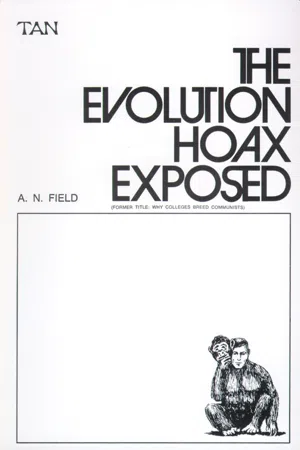
- 104 pages
- English
- ePUB (mobile friendly)
- Available on iOS & Android
eBook - ePub
The Evolution Hoax Exposed
About this book
Information
Topic
Theologie & ReligionSubtopic
Christliche KonfessionenChapter V
THE MONKEY-MAN FABLE
DARWIN discreetly waited twelve years after 1859 before applying his evolutionary speculations to human ancestry. His first lieutenant, Huxley, wasted no time in beating about the bush. In his scientific addresses, writings, and lectures to working men and others, Huxley forthwith preached the kinship of man and ape. A large section of the public today believes man's descent to be a scientifically established fact. Actually, this portion of the evolution theory has not so much as a feather to fly with.
Some years ago a London jury awarded a certain peer of the realm £30,000 in damages against the proprietor of a newspaper which had wrongfully described him as of Jewish descent. It would be an excellent thing if those of us who resent the evolutionist libel that our ancestors were apes or other animals were to club together and bring into court all the publishing-houses, professors, etc., proclaiming it. Nothing more would ever be heard of evolution if evolutionists were forced to come to light with evidence that a judge and jury would accept. If they failed to prove their words damages on a much higher scale than in the case quoted could very justly be claimed, for the moral harm done by evolutionist lying is immense, and this particular lie is a vile one.
The evidence in the monkey-man case rests on certain fossilised remains. The first of these to appear, consisting of a skull-cap and some fragments, was found in a cave near Dusseldorf shortly before the Origin of Species was published. Numerous other skulls of similar type have since been discovered, and are known as Neanderthal man. The earlier skulls were too incomplete to show the position of the aperture by which the spinal cord entered the brain. It was thus impossible to tell whether Neanderthal man stood upright or not. In conformity with their evolutionist imaginings, scientists for a long time assumed that Neanderthal man was a shaggy, crouching, ape-like creature. A reconstruction of him on these lines was made by the eminent Professor Boule, director of the Museum of Natural History in Paris. Similar models appeared in other museums, and pictures were freely published. A few scientists protested, but they were ignored. In 1929 some more complete remains were discovered at Rome, and showed Neanderthal man to have had an erect human posture and the evolutionist assumptions to have been unfounded (Dewar, Man, p. 38). Dr. H. H. Woollard, F.R.S., professor of anatomy in the University of London, in Science Progress for July, 1938, describes Neanderthal man as a primitive being, below but nearer to the Australian black than the Australian black is to the modern European.
Rhodesian fossil man is now ranked as of Neanderthal type, and Professor Wood Jones in his Man's Place among the Mammals has pointed out how lack of "a little elementary anatomical knowledge" (coupled no doubt with evolutionist dreamings) similarly caused Mr. W. P. Pycraft in a British Museum report in 1928 unwarrantably to turn Rhodesian man into another crouching ape-like being (quoted by Dewar. Man, p. 38).
Today the three chief alleged fossil "missing links" between man and ape are Java man, Piltdown man discovered in England, and Peking man. Apart from these is Heidelberg man represented by nothing but a massive fossil jaw-bone described by most anthropologists as essentially human but with some simian characteristics. It may be noted that Whitaker's Almanack for 1931 recorded that the remains of Deeming, a notorious Australian murderer of 1892, had been exhumed and were reported by Sir Colin Mackenzie, director of the Australian Institute of Anthropology, to have remarkable simian characteristics. Heidelberg man may thus have had as much or as little connection with the apes as Deeming had.
Java man, otherwise Pithecanthropus erectus, or Trinil man, was discovered by Dr. Eugene Dubois. In 1887 Dr. Dubois, then holding a junior position on the staff of Amsterdam University, surprised his colleagues by refusing promotion, and announcing his intention of going out to Java as a Dutch army doctor in order to hunt for evolution's missing link between man and monkey (vide Prof. Elliot Smith in Smithsonian Report, 1931). In 1894 Dr. Dubois duly returned with his alleged monkey-man and became the lion of the scientific world.
These fossil remains, which have ever since been the subject of controversy, consist of a skull-cap of chimpanzee type, with no forehead and beetling brows; two molar teeth; and a diseased thigh-bone of human type and abut the size of that of a man 5ft. 7in. high. They were discovered by Dr. Dubois near Trinil in central Java, in a part of the bed of the Bangawan River only uncovered in the driest part of the dry season.
The point at issue is whether any ground exists for assuming these remains to have belonged to one and the same individual. The owner of the skull-cap obviously had a head very like that of a chimpanzee, but of exceptional size, for the largest existing ape has a cranial capacity of about 625 c.c, and the scientists figure it out that the Java skull-top indicates a cranial capacity of about 900 c.c. Here it may be noted that an Australian aboriginal had a 1,250 c.c. brain-case, and a modern European averages around 1,400 c.c.
Whoever owned the Java thigh-bone very obviously stood upright, which no ape does. As for the two teeth, they are generally described as ape-like but unusual. Combine the fragments, and the result is a creature standing erect, with chimpanzee brows and no forehead, a human thigh, and with face, feet, body and arms left to be sketched in according to fancy.
Dr. Dubois' great discovery began with the finding of a tooth in the riverbed in September, 1891. A month later he discovered the skull-cap a yard away. Continuing his explorations of the same locality in September, 1892, he found the thigh-bone 50 feet away from where the skull-cap had been; and also the second tooth, 13 feet away from the thigh-bone and in the direction of the skull-cap. The skull-cap was water-worn and eroded. The teeth and the thigh-bone had their contours clear and sharp, and apparently had not moved since their original deposit.
Dr. Dubois attributed the erosion of the skull-cap to seepage from a cliff on the river-bank. In the report of the Smithsonian Institution of the U.S.A. for 1898 appears the text of an address delivered by Dr. Dubois to the Berlin Anthropological Society in 1896; and in the Smithsonian Report for 1913 is a very full paper on all the remains of fossilised man known to that date, compiled by Dr. A. Hrdlicka, curator of the Division of Anthropology of the U.S. National Museum, after a special mission to Europe to examine them for the Smithsonian Institution. From the plans, illustrations, and letterpress in these reports, it appears that the eroded Java skull-cap was up-stream from the uneroded teeth and thigh-bone. But no doubt water would run uphill to help on evolution.
In his Berlin address on his discoveries, Dr. Dubois stated that "associated with these bones" he had found fossil remains of Stegodon (an extinct elephant) and of a small deer, and "further away" remains of buffalo, antelope, ox, pig, rhinoceros, and hyaena. Sir Arthur Keith in his Antiquity of Man says that altogether Dr. Dubois removed from this spot in the bed of the Bangawan River between 1891 and 1894 fossils of twenty-seven different kinds of mammals. A German expedition under Madame Selenka also spent two years from 1906 making much more extensive explorations in the same spot and unearthed an immense quantity of miscellaneous fossils, but got no traces of monkey-men.
It thus appears that the scanty fragments constituting Java man were sorted out by their discoverer from a pretty complete Noah's Ark bone-heap. This discoverer, moreover, is stated to have sacrificed a superior position in Amsterdam for an inferior position in Java for the express purpose of hunting for the monkey-man missing link predicted by evolution. Most of us in such case would be prone to view in the most hopeful light whatever oddments our digging in tropical riverbeds might produce. We would have our monkey-man or perish in the attempt.
Dr. Dubois told the Berlin savants in 1896 that "in other situations of the same stratum" he had found fossil remains of a gigantic scaly ant-eater and of hippopotamus. He did not tell them that in these "other situations" there had been discovered in 1889 at Wadjak about fifty miles from Trinil, a fossil human skull of Australian black type, and that he himself in 1890 had there unearthed a second fossil skull of the same type. These interesting facts Dr. Dubois strangely withheld from publication until 1920, fully thirty years on. According to Nature for January 6, 1921, he then casually disclosed them following on discussion of a find of fossil man at Talgai, Queensland. Possibly Dr. Dubois had good reasons for keeping quiet for so long. At the same time it requires no great powers of penetration to perceive that the cause of evolution might not have been helped by revealing true man as in existence along with his supposed monkey-man ancestor. As Sir Arthur Keith remarks, to have put all the articles on the table simultaneously would have provided the learned with more than they could digest—perhaps with more even than they could swallow.
Java man—still evolution's chief mainstay—appears throughout his career to have been shrouded from the gaze of profane eyes. One finds Dr. Hrdlicka writing thus in the Report of the Smithsonian Institution for 1913: "All that has thus far been furnished to the scientific world is a cast of the skull-cap, the commercial replicas of which yield different measurements from those reported taken of the original, and several not thoroughly satisfactory illustrations: no reproductions can be had of the femur and the teeth, and not only the study, but even a view of the originals, which are still in the possession of their discoverer, are denied to scientific men." Dr. Hrdlicka, official emissary of the great Smithsonian Institution, presided over by the President and Chief Justice of the United States, was refused permission even to inspect the originals. He described the position as "anomalous."
Since 1936 two incomplete skulls and some skull fragments, similar to the Java man skull-cap, have been discovered at Sangiran in Java by Dr. G. H. R. von Koenigswald, as recorded in Nature of December 2, 1939. The most complete of these gives a cranial capacity of 835 c.c, according to its discoverer, as against the 900 c.c. estimated for the Dubois Java man. No human-like thigh-bones or other skeletal parts had been discovered up to the last report seen by the present writer.
There has never been the least agreement among scientific men that Dr. Dubois was justified in assuming his skull-cap and thigh-bone to belong to the same individual. In his Berlin paper of 1896 Dr. Dubois tabulated the opinions of about a score of leading scientific men on the remains, showing the utmost variance. Finally, to cap all, Dr. Dubois himself in 1938 announced that after prolonged study of anthropological textbooks, of the Pithecanthropus bones, and "of other material from the same provenance in his possession, for the most part not previously published," he was of opinion that "we are here concerned with a gigantic gibbon."
In making this announcement in its issue of February 26, 1938, Nature flatly refused to yield up Java man as evolution's prize exhibit. Dr. Dubois' new conclusions about his fossils, it said, had been received "with respect, but not with general acceptance; and in the light of the new evidence must be regarded as definitely disproved." This leading scientific journal then asserted: "Pithecanthropus now stands within the line of human descent, if only as a pre-hominoid."
It thus appears that the editor of Nature is a better authority on Java man than its discoverer. Nethertheless, whatever Pithecanthropus may have been, it is quite impossible for him to have been ancestral to man, as we shall see later. Nature's dogmatic statements, moreover, are extremely rash in view of Dr. Dubois' announcement that even after half a century he still has some cards up his sleeve in unpublicised Trinil fossils. Java man would probably never have been heard of, had Dr. Dubois in 1894 placed his two Wadjak human skulls on the table alongside his Trinil chimpanzee skull-cap and human thigh-bone. Java man is hardly likely to be abandoned by his discoverer without the very best of reasons.
Piltdown man, otherwise Eoanthropus, or Dawn man, is the next item on the monkey-man list. He hails from a fossil-bearing stratum six inches thick, near the bottom of a small gravel pit, four feet deep, used for metalling a by-road on the Sussex Downs, eight miles north of Lewes. Piltdown man consists of nine small fragments of skull-bone, and rather less than half of a chimpanzee-like jaw bone. There was not much of him altogether, and he was discovered in sections over a considerable period of years by Mr. Charles Dawson, solicitor of Lewes, an amateur fossil-hunter. Toward the end the assistance was secured of Dr. (later Sir) A. Smith Woodward, of the British Museum staff and soon afterwards president of the Geological Society.
This jig-saw puzzle was laboriously fitted together—so far as it would fit—to form part of the top and back of a skull. The vacant spaces were filled with plaster of paris, with forehead and facial bones duly modelled in plaster. Finally, the jaw-bone, with its missing three-fifths also completed in plaster, was neatly hung on in front. The resulting monkey-man was then exhibited to a crowded and sensational meeting of the Geological Society in London on December 18, 1912.
Piltdown man as first presented was announced to have a cranial capacity of 1,070 c.c., which puts him ahead of Java man's 900 c.c., but well below the Australian blacks' 1,250 c.c. He has been several times reconstructed—apparently with still more generous assistance from the plaster-pot—as he is nowadays quoted as measuring 1,300 c.c. in cranial capacity.
The chief of the numerous points at issue in this highly conjectural item of evolutionist evidence is whether the chimpanzee jawbone ever had any real connection with the human skull fragments. It is a debatable point, and there is the utmost diversity of opinion in scientific circles on it. There is reason for doubt, for along with the skull fragments and jaw-bone there were extracted from this six-inch wide fossil-bearing stratum the following things: A tooth of a mastodon, a tooth of a Stegedon (an extinct elephant previously unknown in Western Europe), two teeth of a hippopotamus, two teeth of a beaver, the femur of an elephant shaped up for use as a tool, and finally some flint implements. There would appear to be nothing wildly incredible in a real chimpanzee having contributed part of a jaw-bone to this miscellaneous zoological collection.
Piltdown man got the late Mr. Charles Dawson a monument, and helped Dr. Smith Woodward on to the presidency of the Geological Society in 1914 and a knighthood later on. His claims are by no means universally accepted, for one finds Professor Sir Grafton Elliot Smith stating in 1931 of this evolutionist exhibit: "Even today many Continental anthroplogists refuse even to refer to it in treatises on fossil man, or when they do, brush it aside as so doubtful that it is best to ignore it" (Nature, June 27, 1931).*
Peking man, the final exhibit of the series, next presents himself to our view. He hails from the floor of a cave in a disused limestone quarry, thirty-five miles southwest of Peking in China. In the Smithsonian Report for 1931 Professor Elliot Smith stated that Dr. Davidson Black, on learning of the discovery of a peculiar fossil tooth somewhere near Peking, went out to China to join the Chinese Geological Survey in the hope of finding a fossil monkey-man. In 1929 Dr. Black made his first discovery of an incomplete skull. A considerable number of skulls have since been found, one or more complete enough to show the nose as broad and flat; and the cranial capacity of the skulls is put at from 1,000 c.c. to 1,100 c.c.
These remains so closely resembled the chimpanzee-like Java skull-cap that there was long argument whether Peking man was sufficiently distinct from Java man to be allotted a scientific name of his own. Eventually he was christened Sinanthropus, though some scientists affirmed that there was next to nothing to distinguish him from Pithecanthropus erectus of Java. In Nature of December 2, 1939, it was recorded that seven thigh-bones of Peking man had been discovered, mostly incomplete shafts, and according to the descriptive matter they lacked the human characteristics of the Java thigh-bone. Incidentally, it may be noted that along with Peking man there were also found in the cave floor remains of over fifty types of mammals, as well as fossil frogs, snakes, turtles, and birds. Up to 1930 no less than 1,475 cases of fossil bones were removed from the site (vide Prof. G. B. Barbour at the British Association, Nature, September 27, 1930).
Java man got his semi-human attributes by assumption that a human thigh-bone had belonged to a chimpanzee skull-cap. Peking man is Java man over again, but without any human thigh-bone. In view of the condition of uncritical credulity induced in the scientific mind by the evolution theory, the layman must be pardoned for wondering if the position is that Peking man climbs up to semi-human status on Java man's knees—or Java man's thigh-bone, to be precise. If such is the case, one can understand the total havoc which ...
Table of contents
- Title Page
- Copyright Page
- CONTENTS
- PREFACE
- I THEORY VERSUS REALITY
- II THE SKELETON IN THE CUPBOARD
- III EVOLUTION'S CASE TODAY
- IV FOOTPRINTS ON THE SANDS OF TIME
- V THE MONKEY-MAN FABLE
- VI How EVOLUTION WAS BORN
- VII FROM BOOM TO RACKET
- VIII ALL ABOARD FOR ATHEISM
- IX EVOLUTION'S OFFSPRING
- X WHAT SCIENCE is FINDING
- XI MAN AND CIVILISATION
- XII CONCLUSION
- APPENDIX Scientists who reject evolution.
Trusted by 375,005 students
Access to over 1.5 million titles for a fair monthly price.
Study more efficiently using our study tools.
Frequently asked questions
Yes, you can cancel anytime from the Subscription tab in your account settings on the Perlego website. Your subscription will stay active until the end of your current billing period. Learn how to cancel your subscription
No, books cannot be downloaded as external files, such as PDFs, for use outside of Perlego. However, you can download books within the Perlego app for offline reading on mobile or tablet. Learn how to download books offline
Perlego offers two plans: Essential and Complete
- Essential is ideal for learners and professionals who enjoy exploring a wide range of subjects. Access the Essential Library with 800,000+ trusted titles and best-sellers across business, personal growth, and the humanities. Includes unlimited reading time and Standard Read Aloud voice.
- Complete: Perfect for advanced learners and researchers needing full, unrestricted access. Unlock 1.5M+ books across hundreds of subjects, including academic and specialized titles. The Complete Plan also includes advanced features like Premium Read Aloud and Research Assistant.
We are an online textbook subscription service, where you can get access to an entire online library for less than the price of a single book per month. With over 1.5 million books across 990+ topics, we’ve got you covered! Learn about our mission
Look out for the read-aloud symbol on your next book to see if you can listen to it. The read-aloud tool reads text aloud for you, highlighting the text as it is being read. You can pause it, speed it up and slow it down. Learn more about Read Aloud
Yes! You can use the Perlego app on both iOS and Android devices to read anytime, anywhere — even offline. Perfect for commutes or when you’re on the go.
Please note we cannot support devices running on iOS 13 and Android 7 or earlier. Learn more about using the app
Please note we cannot support devices running on iOS 13 and Android 7 or earlier. Learn more about using the app
Yes, you can access The Evolution Hoax Exposed by A. N. Field in PDF and/or ePUB format, as well as other popular books in Theologie & Religion & Christliche Konfessionen. We have over 1.5 million books available in our catalogue for you to explore.