The nature of sin and its consequences. How venial sin leads to mortal, and sins of omission to sins of commission, why sin is worse than disease, etc. Consoling emphasis on how grace and penance bring pardon and healing. Written by Cardinal Manning, the Archbishop of Westminster.
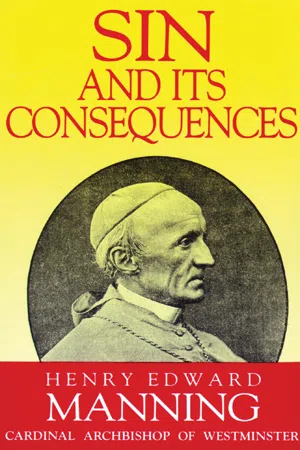
- 182 pages
- English
- ePUB (mobile friendly)
- Available on iOS & Android
eBook - ePub
Sin and Its Consequences
About this book
Information
Topic
Theology & ReligionSubtopic
Christian DenominationsSermon VI
TEMPTATION
"Then Jesus was led by the spirit into the desert, to be tempted by the devil."
—Matt. 4:1
The Son of God, who is Incarnate Sanctity and Eternal Life, when He came into the world to redeem mankind, placed Himself in the most intimate contact, possible to His perfections, with sin in the desert, and with death upon the Cross. In the temptation in the desert, Jesus tasted of all the bitterness of sin, except only of its guilt: in His death upon the Cross, the immortal God tasted death for every man. Now I have taken the temptation of our Divine Saviour as the outset of our present thoughts, because in itself it is sufficient proof of what I affirmed some time ago, namely, that to be tempted is not to sin, and that many who are the most tempted are innocent. You will remember I was speaking about the distinctions of sin, when I touched upon the subject of temptation. It was necessary to guard what I was saying, lest those who are tempted, and perhaps sorely and habitually, should lose heart, and begin to fear lest their temptations are personal sins.
Now the example of our Divine Lord shows us that One who is sinless may be the subject of temptation. He suffered temptation for our sakes, just as He suffered death for our sakes. He suffered temptation, in order, as St. Paul says, "that we may have such a high priest, not one who cannot have compassion or be touched with a feeling of our infirmities, but one who was tempted in all things like as we are, yet without sin" (Heb. 4:15); and again, that "He suffered, being tempted, that he might know how to succor or give help to those that are tempted." (Heb. 2:18). It was that, out of His own personal experience, the Son of God, incarnate in our humanity, might taste of sin in all its bitterness, in all its penalties, save only that which to Him is impossible, the guilt of sin, that so He might be a Saviour full of sympathy with sinners.
And now it is necessary to observe the distinction, which I have drawn with all possible care and precision. Though it is true that temptation is not sin, nevertheless temptation and sin are very nearly allied—they are very like each other, and they may be easily mistaken; secondly, temptations are the occasions of sin; and thirdly, temptations with great rapidity and with great facility pass into sins. For this cause it is necessary with all accuracy to distinguish between them. Perhaps someone will say: "I can quite understand that the Son of God, being man, was capable of being tempted; but that gives me little encouragement, because every temptation presented to His sinless soul was instantly quenched, like as sparks falling upon the face of pure water are immediately extinguished; but when temptations come to me, the sparks are struck upon the touchwood, they fall upon the flax, and upon the dry leaves which are ready to kindle."
There is indeed this difference. The temptations of our Divine Saviour were altogether from without, and none of them from within; our temptations are indeed in great part from without; but a very large part of them, and the worst part of them, are from within. They come up out of our own hearts, they are in our own thoughts, in our own passions, in our own tempers, in our faculties, in our memory—here are the lairs and the haunts of temptation. These are the most dangerous, and the example of our Divine Lord does not reach to what we suffer. Now, nothing is more certain than this, that all the sorrows which come upon a man in life—sickness, pain, bereavements, afflictions, all the crosses he may meet with, losses, disappointments, bankruptcy—all these things are nothing, compared with the bitterness, the keenness, of temptation.
A man may say: "I could bear all these things readily. They come from without; and they have not that which is the special suffering of temptation, the bitterness of sin is not in them. They do not come between me and God. Indeed, the more of suffering and sorrow I have in this world, the more I am driven to the presence of God. They are rods and scourges, driving me nearer and nearer to Him; but my temptations come between me and God. They come and cut me off from Him. They hang like a dark cloud between me and the face of God. They make me feel it to be impossible that God can love me, impossible that I can be saved, impossible that I should not be grieving the Holy Spirit of God all the day long. I am like those who are described in Holy Scripture, who do many things for the best, nevertheless, after all, do not know whether they are the objects of love or hatred."1 (Eccles. 9:1).
Now, I dare say there is not one of you who does not know and feel what Holy Scripture calls "the wound of his own heart." The wound of a man's heart is the great master fault, or the besetting sin, or the three or four besetting sins, such as pride, anger, irritability of temper, jealousy, envy, slothfulness, and many others which I need not specify. I desire to meet the objection of such persons, and I desire to show and to prove, that it is quite possible that a man who suffers all the day long from temptations of this kind, may, nevertheless, in the sight of God, be innocent; and so far as those temptations go, he may be perfectly guiltless. I do not say that this is a common case, but I say it may be; and, therefore, everyone may, if he will only be faithful to the rules I will hereafter try to lay down, take to himself, at least in part, this consolation.
1. First of all, then, temptation is inevitable. Until we have put off our mortality, until corruption is turned into incorruption, we shall be assailed by temptation. To be tempted is simply to be man; to be man is to be tempted. In Holy Scripture, in the book of Genesis, we read these words, that "God did tempt Abraham" (Gen. 22:1); but in the Epistle of St. James we read, "Let no man when he is tempted say that he is tempted by God." (James 1:13). This seems to be a contradiction—but it is not, because the word "tempt" is a word of perfectly neutral signification. It does not necessarily mean "tempt with evil"; it simply means to "try"—"God did try Abraham"; for God puts us on our trial, and that in two ways. He either by His providence sends us a variety of afflictions, or crosses, or losses, or contradictions, by which He tries what our spirit is; or, secondly, He permits that Satan should try us, as He permitted Satan to try and afflict Job. Therefore, when it is said that God "tempts," it means that God tries us; but the other signification is an evil one; for all the temptations that come from Satan are evil in themselves. He never tempts any man to good, unless some accidental good may be the occasion of evil. Now, it is in this latter sense that I am going to speak—that is, of our being tried by evil, tried by Satan. God overrules even the temptations of Satan for our benefit, as I will show.
I say, then, that these temptations are inevitable, and that for this reason: from the time when the Dragon and his angels were overcome by Michael and his angels in Heaven, and Satan was cast out with his evil angels upon earth, from that moment to this there has been warfare round about us. Remember that Satan is an angel created with an intelligence and a will and a power far exceeding that of man.
There is something satanic in the contempt and the ridicule with which men treat Satan. I say it is satanic, because it is a satanic illusion to make men cease to fear him, or cease even to believe in him. He is never more completely master of a man than when the man ridicules his existence—when, as we hear in these days, men say, "There is no devil." The man most under the power of the tempter is he who does not believe in the existence of his enemy. His enemy is round about him day and night, and under his feet. Satan, being of angelic nature, has an angelic intelligence greater than that of man, pervaded by craft and by subtilty. He has also an angelic will mightier than ours, pervaded by an intensity of malice. He has also a power greater than ours, which is always exerted out of jealousy against those who are redeemed in the Precious Blood of Jesus Christ. It was not shed for him; and he is laboring, therefore, day and night, without ceasing, to destroy those who are the heirs of salvation.
There are two titles given to Satan in Holy Scripture: Our Lord called him "the prince of this world" (John 14:30), and St. Paul calls him "the god of this world" (1 Cor. 4:4); and therefore we have closely surrounding us, like an atmosphere, the world of which he is the prince, and, I may say, the sanctuary of which he is the god. For what is the world? It is the intellectual and moral state of the race of mankind without God, pervaded, darkened, falsified, and corrupted by the influence of Satan into the likeness of his own malice. Therefore, Holy Scripture declares that the world is an enemy of God, an immutable enemy; that the world can never be reconciled with God, or God with the world; that the world can never be purified; that even the waters of Baptism only save individuals out of the world; and that the world itself will never be saved, but will be burned up by fire.
Now, this world signifies the tradition of the sin of mankind, the worldwide corruption of human nature by the sins of the flesh and the sins of the spirit, with all their falsehood, impiety, and malice against God. This hangs in the atmosphere of the world: outside Christendom it reigns supreme; inside Christendom it has entered again, like as in the time of pestilence; the very air of our dwellings, after all the care we can bestow, is infected. Even among baptized nations the spirit of the world, wafted from without, and arising up again under our feet from the corrupt soil of human nature, is perpetually renewing itself; and we live surrounded by an atmosphere in which all forms of truth are distorted, and where illusions are presented on every side, so that men are misled, and are turned away from God and from His laws. We live in the midst of such a world, and that world we renounced in our Baptism—"the world with all its pomps"; nevertheless, it has a perpetual action and influence upon every one of us. There is what is called the worldly spirit, which enters with the greatest subtilty into the character of even good people; and there is what is called the time-spirit, which means the dominant way of thinking and of acting which prevails in the age in which we live; and these are powerful temptations, full of danger, and in perpetual action upon us.
Then, thirdly, we carry our temptations about us. We have every one of us the three wounds of Original Sin: ignorance in the understanding; turbulence in the affections, so that they become passions; instability and weakness in the will. The soul is wounded with those three wounds; and nevertheless it is in perpetual motion in thought, word, and deed, save only during the time of sleep. In our waking hours our nature is in unceasing activity, and in perpetual anarchy too, except in those who, being guided by the Spirit of God, are under the influence of grace and conformed to the truth. The thoughts, tempers, affections, passions of the heart, are in a state of ceaseless turbulence, so that the Holy Ghost by the Prophet describes the heart in these words: "The wicked are like a raging sea which cannot rest, casting up mire and dirt." (Is. 57:20). As the sea casts up from its depths the soil under the waters, so the perpetual activity of the heart is casting up the passions and the concupiscences that lie within it. This description applies in its measure to every one of us. We are all in this state; and, therefore, the temptations of Satan, the temptations of the world which are without us, and the temptations from our own heart within—these three temptations are inevitable. We cannot escape them.
Every one of us singly stands between two spirits—there is the Spirit of God on the one side, there is the spirit of Satan on the other; and the human spirit, that is, the soul with its intelligence, heart, and will, stands between. These two spirits, of God and of Satan, are in perpetual conflict round about us and for us—the spirit of Satan striving to pervert, to delude, and to cast us down; the Spirit of God perpetually guiding, strengthening, and upholding us. The thoughts of Satan are infused into us, and also the lights of the Holy Ghost—and sometimes we do not know the one from the other. We sometimes mistake the false lights of Satan for the lights of truth. We sometimes fancy that the lights of truth which come are only temptations. Sometimes we imagine our own human thoughts to be the thoughts and the lights of God; and so we deceive ourselves. We are in this constant state of temptation, which is common to all men.
2. Next, the universality of this temptation is so great, that there is no state of man that is not visited by it. Take, for example, sinners, those that live voluntarily in sin. Satan tempts them; they are the subjects of constant satanic temptation; but be sure that they are not the chief subjects of his temptations, for this reason: they are his servants already, they are already doing his will, they already share his own mind, they already love those evils to which he tempts them. Satan leaves his own servants to do their work for him; they have united themselves with his evil angels.
When our Lord was tempted in the wilderness, it was but the lifting of the veil, and the making visible of that which invisibly is taking place every hour and every moment round about us. "We wrestle not with flesh and blood," as the Apostle says, "but with principalities and powers, and spiritual wickedness in high places" (Eph. 6:12); that is, with the whole hierarchy of fallen angels round about us. They are mingling among evil and wicked men; the evil and the wicked have united themselves to their allegiance, and Satan leaves them alone—they are doing his work.
The blasphemer is not tempted to blasphemy. Why should he be? He blasphemes already. The unbeliever is not tempted to unbelief—he has lost his faith. The scoffer is no longer tempted to scoffing—he scoffs enough already to satisfy even the "god of this world." So I might go on with every other kind of sin. They have become the members of the "mystery of impiety." (2 Thess. 2:7). Just as all faithful children of God are members of Christ, and the mind and the will and spirit of Jesus Christ descend into them; and being living members of the Mystical Body of Christ, they are united to their Divine Head, so the wicked and sinful are pervaded, as it were, by the mind and the spirit and the will and the malice of Satan: they are, as it were, members of Satan, members of what we might call the "mystical body" of Satan, and are united to their satanic head, and are under his guidance.
But, next, if any one of them strives to return to God, he becomes the subject of a twofold temptation. Satan follows up every deserter who leaves his camp, and he follows him with an intensity of redoubled malice. He multiplies all his temptations. Those by which he fell before, when he tries to rise again and to escape from them, Satan doubles their power and their effect. He never gives him rest. If any of you have tried to break off a fault, I have no doubt you have found that you have been more tempted to that same fault from the very time you began to master it. Need I tell you why? Before, you were swimming with the stream; but when you tried to break off that fault you were swimming against the stream, and you felt the strength of the stream against you. That is to say, you were going onward before the temptation until you turned from sin, then you felt the full force of temptation against you like the stream and current of a river; and that stream and current was doubled by the malice of the tempter.
He is not only very strong in his temptations, but he is very subtle; and when men begin to break off sins of one kind, he will leave them perfectly quiet on that side, and will tempt them on the other to something else which is altogether unlike their former faults. As, for instance, if any man has been tempted to gross sins and has gained the mastery, he will find himself tempted to spiritual sins, which, casting him down, will bring him back to where he was before. Be sure of it, whoever begins, for example, to mortify such a sin as excess in food, if he gains the mastery, will find himself tempted perhaps to some spiritual sin, such as anger, ill-temper, or, it may be, vainglory at what he has achieved. It is all one; what does it matter? There are seven capital sins, of which three may be said to be of the body and four of the soul, but they all can cast the soul into Hell; and if a man perishes by spiritual sin, he is just as certainly condemned to eternal death as if he perishes by the grossest sins of the flesh. Satan in his subtlety knows this, and follows up every man that has turned away from him; and those who turn from him and strive to convert their souls to God are his special objects of temptation.
Even those whom we call servants of God, who have really turned away from Satan and are confirmed in a life of faith and piety—they too have special temptations. For instance, when Satan sees any soul escape out of his hands, and no longer under the dominion of the grosser sins of the body, he changes himself into the likeness of an angel of light. He knows that the grosser forms of temptation will have no more power, that they will be disgusting and alarming, that they will repel and will drive the soul from him; and therefore he changes himself into an angel of light. He comes as a messenger of peace and a preacher of justice and a teacher of purity: and then he will stimulate and excite the imprudent to strain after perfections of penance and perfections of prayer and mystical reaches of the spiritual life, which we read of no doubt in saints, but such as are yet far out of the grasp of those who are beginning to serve God. Nevertheless, these things are sufficient to turn the head and to infuse vainglory, and to call men off from the humble practice of daily duty, and make them climb and clamber up into high places, where they have not the head to stand, and at last they fall through a spiritual intoxication.
So also, those who have turned away from him he tempts to a censorious judgment of others. When they have light to know their own faults and their eyes are opened to discern sin, the use they make of their enlightened eyes is very often to be quick and searching to find the faults of their neighbors; and by turning their eyes outwardly, which are intended to be turned inwardly, they range to and fro, finding out and censuring the faults of other people, and perpetually committing rash judgments in their hearts, and very often, sins of detraction with their tongues.
There is also another temptation, even for those that are advancing far in the way of perfection. Spiritual writers tell us that there is a temptation which they call "the storm in the harbor"; that is, as a ship which has passed through a tempestuous sea and has come at last into the haven of rest, and is lying calmly over its anchors, may yet be struck by lightning or by a sudden squall, and may founder even in the port of safety; so spiritual pride, spiritual self-love, vainglory at our own imagined perfection, may wreck us at last.
By looking at ourselves in the glass, by reading the lives of the saints until we believe we are saints, by filling our mind with disproportionate and strained imaginations, and then applying them to ourselves: by dreaming that we are that which we can describe, and that there is an aureola, a crown of light hanging over our heads, we may finally cast ourselves down from God. These imaginings and delusions, which come from a profound self-love, and as profound a want of self-knowledge, will turn the heads and the consciences even of those who have escaped from grosser sins, and make them like Simon the Pharisee, who, being blind to his own faults, and censorious of the faults of others, was, in comparison with poor Mary Magdalen, a sinner before the eyes of our Lord: or like the Pharisee in the Temple, who, after thanking God he was not like other men, went down to his house not justified as the poor Publican was.
Therefore we see that temptations are inevitable and universal; and whether you are only penitents or on the way to be saints, do not expect to be exempt from them. Remember, then, that "there is nothing come upon you," as the Apostle says, "but that which is common to man; and God will make also an issue, or a way of escape, so that you may be able to bear it." (1 Cor. 10:13). No temptation is a perfect circle. If indeed the circle of temptation were complete, there would be no way out of it. God never permits any temptation to be a perfect ring; there is always an outlet, always a break out of which the soul with safety may escape.
3. Ther...
Table of contents
- Cover Page
- Copyright Page
- CONTENTS
- Sermon I—The Nature of Sin
- Sermon II—Mortal Sin
- Sermon III—Venial Sin
- Sermon IV—Sins of Omission
- Sermon V—The Grace and the Sacrament of Penance
- Sermon VI—Temptation
- Sermon VII—The Dereliction on the Cross
- Sermon VIII—The Joys of the Resurrection
Trusted by 375,005 students
Access to over 1.5 million titles for a fair monthly price.
Study more efficiently using our study tools.
Frequently asked questions
Yes, you can cancel anytime from the Subscription tab in your account settings on the Perlego website. Your subscription will stay active until the end of your current billing period. Learn how to cancel your subscription
No, books cannot be downloaded as external files, such as PDFs, for use outside of Perlego. However, you can download books within the Perlego app for offline reading on mobile or tablet. Learn how to download books offline
Perlego offers two plans: Essential and Complete
- Essential is ideal for learners and professionals who enjoy exploring a wide range of subjects. Access the Essential Library with 800,000+ trusted titles and best-sellers across business, personal growth, and the humanities. Includes unlimited reading time and Standard Read Aloud voice.
- Complete: Perfect for advanced learners and researchers needing full, unrestricted access. Unlock 1.5M+ books across hundreds of subjects, including academic and specialized titles. The Complete Plan also includes advanced features like Premium Read Aloud and Research Assistant.
We are an online textbook subscription service, where you can get access to an entire online library for less than the price of a single book per month. With over 1.5 million books across 990+ topics, we’ve got you covered! Learn about our mission
Look out for the read-aloud symbol on your next book to see if you can listen to it. The read-aloud tool reads text aloud for you, highlighting the text as it is being read. You can pause it, speed it up and slow it down. Learn more about Read Aloud
Yes! You can use the Perlego app on both iOS and Android devices to read anytime, anywhere — even offline. Perfect for commutes or when you’re on the go.
Please note we cannot support devices running on iOS 13 and Android 7 or earlier. Learn more about using the app
Please note we cannot support devices running on iOS 13 and Android 7 or earlier. Learn more about using the app
Yes, you can access Sin and Its Consequences by Cardinal Henry Edward Manning in PDF and/or ePUB format, as well as other popular books in Theology & Religion & Christian Denominations. We have over 1.5 million books available in our catalogue for you to explore.