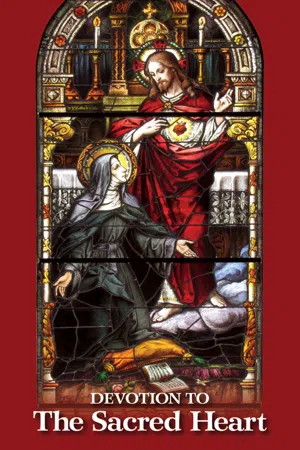
Devotion to the Sacred Heart is a powerful little booklet filled with many of the treasures to be found in the veneration of the Sacred Heart of Jesus. Besides containing an explanation of the symbolism found within the Image of the Sacred Heart, it also includes explanations of the 9 First Fridays devotion, known as The Great Promise, the miraculous cure of St. Gemma Galgani as well as many profound exhortations to offer reparation to the Sacred Heart.Authoritative and moving, Our Lord instituted this devotion Himself, saying: " I set neither limit nore measure to My gifts of grace for those who seek them in My heart."In our age of religious indifference, when fervor and charity have grown cold, Jesus exhibits to the world His Sacred Heart as the symbol of God s infinite love showing His Divine Heart as a furnace whose burning rays of love are able to reanimate faith and rekindle love in hearts grown cold and ungrateful pg. 4-5
- 76 pages
- English
- ePUB (mobile friendly)
- Available on iOS & Android
eBook - ePub
Devotion to the Sacred Heart
About this book
Information
Topic
Theology & ReligionSubtopic
Christian Denominations
Chapter 1
True Devotion to the Sacred Heart
Heart of Jesus, Symbol of Love
THE Church, governed and taught by the Holy Ghost, has approved and recommended devotion to the Sacred Heart of Jesus and has enriched it with many indulgences. She has instituted the Feast of the Sacred Heart, which, in the course of years, has increased in extent and solemnity until now it is celebrated solemnly with an octave by the universal Church on the Friday after the Octave of Corpus Christi.
Confraternities have been established, and throughout the Christian world numberless altars, chapels and churches have been dedicated to the Sacred Heart. Through the Apostleship of Prayer, millions of the faithful daily offer all their prayers, works and sufferings for the intentions of the Sacred Heart of Jesus. During the past two hundred years or more, the Popes have zealously employed their sovereign power in fostering devotion to the Sacred Heart. Pope Leo XIII, toward the end of his long pontificate, consecrated the whole human race to the Sacred Heart. Thus the Church has, as it were, earnestly forced this devotion upon us. Zealously to promote the Sacred Heart devotion means to work in the Spirit of God, who ordains that at all times the Church should adopt just that devotion which is of most profit to her, because the Holy Spirit knows the needs of the times and the remedies for the times.
In our age of religious indifference, when fervor and charity have grown cold, Jesus exhibits to the world His Sacred Heart as the symbol of God’s infinite love—the symbol of His own generous self-sacrificing love for men. Jesus shows His Divine Heart as a furnace whose burning rays of love are able to reanimate faith and rekindle love in hearts grown cold and ungrateful.
But why His Heart? Because in every language, in every age, the heart is regarded as the natural symbol of love and affection. What more natural and expressive symbol is there, then, of the excessive love of Jesus than His Sacred Heart?
The direct and material object of devotion to the Sacred Heart is the real, physical Heart of Jesus—the Heart of flesh, the living and loving Heart of our Blessed Lord; the Heart that beat in His Divine breast at the moment of the Incarnation; the Heart that loved us during the life of Jesus on earth, that poured forth Its blood to the last drop on Mount Calvary; the beatified Heart now glorious in Heaven and still dwelling among us in the Blessed Sacrament; the Heart ever united to the Person of the Divine Word, to whom is due supreme homage and adoration.
Besides the direct and material object of the devotion, there is another, called the spiritual object, and that is the infinite charity or love of Jesus Christ, of which His Sacred Heart is a symbol. The substance of devotion to the Sacred Heart really consists in calling to mind and in venerating the unbounded charity and excessive love of our Redeemer under the symbol of His Heart.
In 1765 Pope Clement XIII, when granting permission to the Order of the Visitation for the observance of the Feast of the Sacred Heart, expressed the wish that the faithful in celebrating this feast should “call to mind the principal benefits received from the love of Jesus: 1st, in assuming our nature (His Incarnation); 2nd, in suffering and dying for our Redemption (His Passion); and 3rd, in instituting the Sacrament of His Body and Blood (the Holy Eucharist).”
By this devotion, Holy Church desires to reveal to the faithful the most holy affections, desires and movements of the Sacred Heart, through which our Saviour honored His Heavenly Father, sanctified the faithful and presented Himself to mankind as the perfect model of eminent sanctity. These emotions of the Heart of Jesus are: a burning zeal for the glory of His Father, a boundless love for all mankind, a most profound humility, an unconquerable patience, a total sacrificing and devoting of self to the will of the Father, a perpetual adoration of God’s sovereign Majesty, an unceasing act of thanksgiving, etc. All these emotions and affections were present even at the first moment of His Incarnation; they animated His Heart to the last moment on the Cross and will continue to animate His Heart in the Blessed Sacrament to the end of time.
Chapter 2
Motives Impelling Devotion
BY Original Sin man lost Sanctifying Grace and thereby forfeited the right to Heaven. But God, in His merciful love, had decreed from eternity to restore him to the state of supernatural grace and to make him worthy of eternal happiness. This was to be accomplished by the Incarnation of the Son of God, who, in place of the fallen human race, would render perfect satisfaction to Divine Justice.
Accordingly, in the fullness of time the Eternal Son of God became man, by the power of the Holy Spirit, assuming human nature in the womb of the virginal Mother, Mary. In the mystery of the Incarnation, the Divine and human natures were inseparably united in the Second Person of the Blessed Trinity, in the “hypostatic” union. By virtue of the hypostatic union of the two natures, it follows that all the actions and all the sufferings of Jesus Christ are of infinite worth and merit because they are deeds of a God Incarnate and are referred to the Divine Person.
Redemption began with the Incarnation, and the first act of homage and love of the Incarnate God ascended to Heaven to the Eternal Father from the blessed Heart of Jesus which throbbed in Mary’s womb.
Love of the Sacred Heart In the Redemption
For 30 years the Incarnate Word of God was hidden and almost unknown. True, His Immaculate Mother, St. Joseph and a few other favored ones knew Him and returned love for love to His Divine Heart, but outside of this little circle, Jesus was not known. Yet His mercy embraced the whole world; sweet love and holy, silent reparation ascended to Heaven at every moment, day and night, from His Sacred Heart to appease the just wrath of the Eternal Father.
The entire life of Jesus Christ on earth had no other object than the Redemption and restoration of the human race. It was a life of abasement in His Incarnation, in His birth and in His hidden and public life, which terminated in His Passion and Death. By the agonizing tortures and most profound humiliations of His Passion, and especially by His Death on the Cross, Jesus became our Redeemer who rendered superabundant satisfaction for our sins. Even though the sins of mankind are almost infinite in number and enormity, and an infinite offense against God, yet the Life, Passion and Death of the God-man have made perfect reparation for these offenses. He was able to do this in our stead because He is our Head and we are His members, and whatever He has done in satisfaction for our sins will be considered by God as though we ourselves had done it. Still, we must not forget that despite this perfect and superabundant ...
Table of contents
- Cover Page
- Copyright Page
- Contents
- The Author of This Booklet
- 1. Devotion to the Sacred Heart
- 2. Motives Impelling Devotion
- 3. True Devotion and Atonement
- 4. True Devotion and the Image of the Sacred Heart
- 5. True Devotion and Confidence
- 6. True Devotion and Union
- 7. Prayers
Trusted by 375,005 students
Access to over 1.5 million titles for a fair monthly price.
Study more efficiently using our study tools.
Frequently asked questions
Yes, you can cancel anytime from the Subscription tab in your account settings on the Perlego website. Your subscription will stay active until the end of your current billing period. Learn how to cancel your subscription
No, books cannot be downloaded as external files, such as PDFs, for use outside of Perlego. However, you can download books within the Perlego app for offline reading on mobile or tablet. Learn how to download books offline
Perlego offers two plans: Essential and Complete
- Essential is ideal for learners and professionals who enjoy exploring a wide range of subjects. Access the Essential Library with 800,000+ trusted titles and best-sellers across business, personal growth, and the humanities. Includes unlimited reading time and Standard Read Aloud voice.
- Complete: Perfect for advanced learners and researchers needing full, unrestricted access. Unlock 1.5M+ books across hundreds of subjects, including academic and specialized titles. The Complete Plan also includes advanced features like Premium Read Aloud and Research Assistant.
We are an online textbook subscription service, where you can get access to an entire online library for less than the price of a single book per month. With over 1.5 million books across 990+ topics, we’ve got you covered! Learn about our mission
Look out for the read-aloud symbol on your next book to see if you can listen to it. The read-aloud tool reads text aloud for you, highlighting the text as it is being read. You can pause it, speed it up and slow it down. Learn more about Read Aloud
Yes! You can use the Perlego app on both iOS and Android devices to read anytime, anywhere — even offline. Perfect for commutes or when you’re on the go.
Please note we cannot support devices running on iOS 13 and Android 7 or earlier. Learn more about using the app
Please note we cannot support devices running on iOS 13 and Android 7 or earlier. Learn more about using the app
Yes, you can access Devotion to the Sacred Heart by Rev. Fr. Lucas Etlin in PDF and/or ePUB format, as well as other popular books in Theology & Religion & Christian Denominations. We have over 1.5 million books available in our catalogue for you to explore.