This popular French Catholic writer, from the Nineteenth Century, has assembled over 30 common objections to going to Confession. He has answered them all with kindness, wit and wisdom. A book to allay fears and to give courage in approaching Confession, that Sacrament which will unlock the Gates of Heaven for many. Includes How to go to Confession.
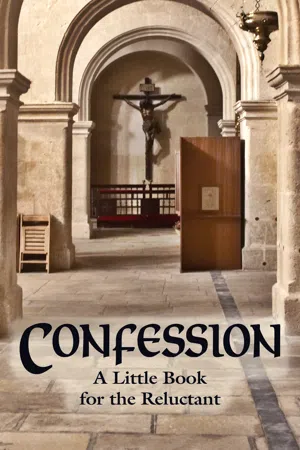
- 88 pages
- English
- ePUB (mobile friendly)
- Available on iOS & Android
eBook - ePub
About this book
Information
Topic
Theology & ReligionSubtopic
Christian Denominations1. The Definition of Confession
Confession means acknowledgment. It is the acknowledgment of our sins which we must make to a priest to obtain our pardon from God. To confess is to go to a priest, a minister of Jesus Christ, and acknowledge to him, in simplicity and repentance, all the sins we have had the misfortune to commit.
Those who never confess have the strangest and most absurd ideas of Confession. A Protestant lady, who had often come for advice to Msgr. Cheverus, Bishop of Boston, said to him one day that Confession appeared to her absurd. “Not quite so absurd as you think,” replied the saintly Bishop, smiling. “Without suspecting it, you have felt its value and necessity, and for a long time you have been confessing to me, since Confession is nothing more than confiding the troubles of conscience that you find so much relief in disclosing to me.” This good lady made no delay in confessing properly and becoming a Catholic.
Again, nothing is more natural than Confession. Voltaire (a witness not to be suspected of pro-Catholic prejudice) acknowledged as much in one of his lucid moments. “There is perhaps no institution more useful,” wrote he. “Most men, when they fall into great faults, feel remorse. If there is anything on earth to console them, it is the means of being reconciled to God and themselves.” Then, when we confess we unburden our conscience of the sins which dishonor it, and we find, in the Sacrament of Penance, peace of heart and joy of soul.
2. Is It Absolutely Necessary to Confess?
Yes, absolutely, my dear friend; there is no more room for questioning. God wills it, and He is Master. In vain you exclaim or expostulate. God wills that we confess; He Himself established Confession, and what He has established is permanent.
When God came on earth, He chose a certain number of disciples, whom He made His priests. To these He gave the command to go and preach penance to all men—and He gave them and their successors, to the end of time, the power of pardoning sins in His name. By this act He has imposed on all, without exception, the obligation to acknowledge, to CONFESS, to these men who are His ministers, His representatives. Without this Confession, we remain in the bonds of sin, and after death we shall go to Hell. It was God Himself, our Saviour Jesus Christ, who said to His priests, “Receive ye the Holy Ghost. Whose sins you shall forgive, they are forgiven; whose sins you shall retain, they are retained. Whatsoever you shall bind on earth shall be bound in heaven, and whatsoever you shall loose on earth shall be loosed also in heaven.”
What is more clear, what more formal than these divine words? “Whose sins you shall forgive, they are forgiven.” God Himself, then, has established Confession on earth. It is He who wills us to go and confess to His priests, in order to obtain, by their ministry, remission of our sins and deliverance from Hell. Whether we will or not, we must go by either way, either Confession or Hell; each one has a choice.
3. That Confession Has Been Practiced In All Times
In all time, since the creation of the world, confession has been the necessary means of obtaining pardon.
Adam, the first who sinned, was not pardoned until, at the feet of God the Son, who appeared to him under a human form, he confessed verbally, in the terrestrial paradise, the great sin he had committed. “I have eaten the forbidden fruit.” Behold his confession! Eve, in like manner, confessed before being absolved: “The serpent beguiled me and I did eat.”
Cain would not confess.
“What hast thou done? Where is thy brother?’’ he was asked by God, clothed as before in the appearance of that humanity which afterwards was to become a reality. “My sin is too great for God to pardon,” replied the miserable wretch, and he was cursed; and he fled from the face of the Lord, wandering over the earth like a lost soul.
Among the Jews, in the Old Law, it was necessary to confess to the priest, as we do now: to confess in words and in detail, before offering the sacrifice and obtaining remission of sins. This obligation is signified in several places throughout the Books of Moses. Confession has always been the distinctive sign of the true religion.
Our Saviour Jesus Christ raised Confession to the dignity of a Sacrament, and established it in His Church, as an inexhaustable source of salvation and consolation, as the refuge of poor sinners and the support of human frailty. He Himself heard the confession of and absolved the poor woman taken in adultery who remained alone with Him in the Temple, as the sick patient with the Physician, as misery with Mercy. She confessed her sin with repentance, and Jesus said to her, “Go in peace. Thy sins are forgiven.”
His Apostles, His first priests, were also the first confessors. St. Paul and his companion, on one of their missions in Ephesus, were known to move the hearts of the faithful in such a way that many among them “came confessing and declaring their deeds.” (Acts 19:18).
In the catacombs of Rome, and in the monuments of the first ages of Christianity, traces of Confession are found in such numbers, and so unequivocally, that the Protestant historian Gibbon has to acknowledge (in spite of his hatred of our religion) that a learned man cannot resist the historical evidence which proves that Confession was one of the principal doctrines of the Papists, that is, Catholics, during the first four centuries. (Decline of the Roman Empire). He speaks only of the first four centuries, because after that time there was no one who doubted of it. This avowal in favor of Confession, from such a bitter enemy of the Church, might dispense with any other proof. We cite here, nevertheless, for the consolation of the reader, four or five of the many who show, clear as day, that the first Christians all confessed as we do.
In the first century, Pope St. Clement, who was baptized and consecrated by St. Peter himself, gave this rule: “Let him who takes care of his soul blush not to confess to the priest sentiments of envy and other faults which may glide secretly into his heart, that he may receive healing and salutary advice by the Word of God”—the name he gives to absolution. (Epistle to St. James).
Again in the first century, within the lifetime of St. Paul, St. Denis, a disciple of this great Apostle and one ordained by him first Bishop of Athens, severely reproached a Christian named Demophiles because he had harshly treated a poor sinner who had come to confess at the feet of the priest. “This poor man,” said the Bishop, “was praying and coming to confess as a remedy for his sins, and thou hast not only repulsed him, but violently outraged the good priest who had compassion on this penitent.”
Among the Christians of the second and third centuries, the celebrated Origen, universally admired for his knowledge, speaks in several places of Confession. “If we repent of our sins and confess not only to God but also to those who can apply a remedy, the sin will be forgiven us.” He says in another place, “When the sinner accuses himself in Confession, he vomits out his sin and extirpates the cause of the evil. Only, when you confess, do it in such a way that the physician to whom you make known the cause of your malady may compassionate your misery and understand the state of your soul, so that he may be to you an able physician, and may give you wise and salutary counsel.” Tertullian, who lived in the same epoch, is not less formal than Origen. “There are those,” he says, “who avoid the painful labor of Confession and who postpone it from day to day because they value their honor more than their salvation. They resemble those who, having a secret and shameful malady, hide their disease from the physician and die, victims of false shame. Is it more profitable to be damned, hiding one’s sin, than to be purified by confesssing it? It is at the feet of the priest,” he adds, “that we must humble ourselves.”
St. Cyprian, Bishop of Carthage, a martyr of the third century, speaks of the faithful who come to confess to the priest of God with repentance and simplicity.
“They disclose the secrets of their consciences—discharge their souls from the weight of its faults and seek the remedy of salvation.” (Treatise on Apostates). It was in the third century that penitentiary priests were appointed over the whole Church, that all sinners might confess to them in detail. “To be pardoned,” said one of these, “you must confess your sins.”
In the fourth century, St. Basil, the great Bishop of Caesarea in Asia Minor, declared that it is necessary to confess to those who have the dispensation of the mysteries of God, viz., to the priests. (Abridgments of Rules, Q. 288).
St. Gregory, Bishop of Nyssa, says that we must disclose without fear the most hidden secrets of our consciences to our confessors, to our spiritual physicians.
St. Ambrose, Bishop of Milan, in Italy, says, “The penance we perform for our sins, although in secret, is useless unless followed by the reconciliation and absolution, which depend on the ministry of priests.” The Deacon Paul, who wrote his life, relates that whenever a penitent presented himself to St. Ambrose, the holy Bishop wept so bitterly that he constrained the sinner to weep with him.
St. Augustine, Bishop of Hippo, in Africa, speaks of Confession very often in his numerous writings. He replies, among others, to an old objection which has since been raked up by Protestants and infidels: “Let no one say ‘I do penance in secret; I repent before God; God knows it and pardons me.’ What! Was it then said in vain to the priests, ‘Whatsoever you shall loose on earth, shall be loosed in heaven’? Was it in vain that the keys were given to the Church? You hold the Gospel of no account; you despise the words of Christ, and you promise yourself what He refuses to you.” (Sermon 392).
Finally, to end these numerous quotations, which might be added to infinity, we shall cite only the beautiful testimony of the great Archbishop of Constantinople, St. John Chrysostom: “Men have received from God a power not granted to angels or archangels. Never was it said to the heavenly spirits, ‘Whatsoever you shall bind and unbind on earth shall be bound and unbound in heaven.’ The princes of this world can only bind and unbind the body. The power of the priest extends further; it reaches the soul, and it is exercised not only in baptizing, but still more in pardoning sins. Let us not blush, then, to confess our faults. He who blushes to discover his sins to a man, and who will not confess, shall be covered with shame on the Day of Judgment in the presence of the whole universe. (Treatise on Priests, Bk. 3).
I ask you now, is this not, to the very letter, what our priests of today teach and say? The faith of the Church has not varied on this point any more than on the other points of her doctrine; and it is evident to any honest man that Confession was practiced at all times—and that in all times Confession made to a priest was regarded as a divine institution, as an absolute necessity.
4. That Confession Is Not an Invention of Priests
This is very evident, seeing that it is the invention of God. If you are the inventor of a machine, it is very evident that I am not the inventor. Hence the patent for the invention of Confession is recorded, as we have just seen, in all the writings of the Evangelists. If Confession had been invented by the priesthood, we would not, in the first place, have found it in the time of the Apostles and martyrs, who certainly cannot be suspected of ruse or deceit; and, in the second place, we should see in history some traces of the innovation.
An invention which affected every Christian in the world must certainly have attracted public attention. Would not exclamations have been heard on all sides? We know the precise epoch of all the inventions of the progress of industry—of our civil institutions, political institutions, and others. We can name the authors, the inventors, of games of piquet, of lotto, of the polkas, of chemical matches, of even lesser discoveries—and the origin of Confession alone escapes the universal law! Impossible! Absurd! Protestants have sometimes attempted to point out its origin and have rendered themselves ridiculous to the eyes of science, but we have just seen that their co-religionist, the famous historian Gibbon, avows honestly that Confession is traced back to the very cradle of Christianity.
Do you believe it much of an amusement to priests to hear Confessions? Truly, what a fine invention is this laborious, painful ministry which ruins their health, fatigues their mind, creates a thousand enemies, a thousand fears, burdens them with a dreadful responsibility and excites against them the rage and hatred of every scapegrace! How much people would love priests, were it not for Confession! And then, if priests had invented Confession, would they not have begun by exempting themselves? Understand well that to confess is quite as painful to them as it is to you; for they are men like you and preserve, alas! underneath the sublime sacerdotal dignity, not only the weakness of human nature, but also its self-love, which recoils before humiliation.
The inventor of Confession is the inventor of priests themselves: the Lord Jesus, who made priests, who communicates to them His divine power, and who, by their ministry, saves those whose sins they pardon. Look at the crucifix! There is the sole inventor of Confession.
5. Why It Is Not Sufficient To Confess to God Alone
That does not suffice because He does not will it. There is no other reason; but that is well worth any other.
The Pharisees wished to go straight to God without passing by Jesus Christ, and Jesus answered them, “No man cometh to the Father but by Me.”
Protestants and infidels, in their turn, wish to go to Jesus Christ without passing by the priest; and the priest says to them, in the name of God, “No man cometh to Jesus Christ but by me. It is I whom Jesus Christ has sent to men to instruct, purify, judge and save them; and it is to me that He has said, ‘He who hears you, hears Me, and he who despises you, despises Me.’’’
The priest holds the place of Jesus Christ on earth. He is man, as Jesus Christ was man; and if he is not true God as Jesus was, he is nevertheless invested with the divine authority of Jesus Christ to save his brethren. Jesus Christ remains among us in the person of the priest; for this reason we must go to him as to Christ, and to Christ by him. “It suffices to confess to God!” And for what purpose would you confess to God? Must you tell your sins for Him to know them? Does He not know them all? My dear friend, what you say on that subject is silly. Besides, it is not straightforward. It is pharisaical, for you have no more desire of confessing to God than to the priest. Put your hand on your heart and say you confess often and humbly to God if you do not wish to confess, like everyone else, to the priest. Pharisees! Whitened sepulchres! Be silent, say no more of your imaginary confessions.
For us, we understand it to be through mercy and goodness that God has confided to man the care of forgiving our sins.
Without this, we would never be sure of having obtained pardon, and in this certitude what sweetness there is to the repentant sinner who has confessed his sins with simplicity of heart, who has hidden nothing which he was conscious of, and who hears the sentence of the priest, the confessor: “I absolve thee, in the name of the Father, and of the Son, and of the Holy Ghost; go in peace, and sin no more.”
6. What Good Is It to Tell All We Do To a Priest, a Man Like Other Men?
Because the priest is not a man like other men. Our Saviour Jesus Christ was, in appearance, a man like the others; in reality He was God. The priest is a man like you. He has, like you, a head, two arms, two feet, but he is a man elected by God to be the depositary of grace, light and eternal salvation to the soul. He is man and he is priest, as Jesus Christ was man and was God.
Your father is a man like you; as a man you are what he is, but as a father he is above you; he has authority over you; he is what you are not. It is the same with the marshal, judge, officers, the field-marshal himself; under one aspect they are men like other men, under another aspect they are more than other men. Have a little more faith, my honest friend, and endeavor to see God concealed for your sake in the priest. It is to God, to Jesus Christ, that we confess when we acknowledge our sins to His representative. It is God, it is Jesus Christ, who forgives us when the priest gives us sacramental absolution in His name. The priest in his priesthood is Jesus Christ Himself, the Sovereign Eternal Priest.
7. I Am a Man of Honor and Would Not Degrade Myself by Kneeling to a Priest.
Satan also would not degrade himself to acknowledge the priest as his master, and for his recompense he is in Hell! You are a man of honor! And are we not also men of honor? Are other Christians not men of honor, who serve God and practice Confession?
Was there no honor in Turenne, Bayard, Duguesclin, the great Conde, Henry IV, Louis XIV, and so many other great men? They confessed, however: confessed often, on their two knees, and sometimes in the sight of their soldiers and companions in arms. We, like them, have sentiments of honor in cherishing sentiments of duty....
Table of contents
- Cover Page
- Copyright Page
- Contents
- About the Author
- Prologue for the Reluctant
- 1. The Definition of Confession
- How to Go to Confession
- An Act of Contrition
Trusted by 375,005 students
Access to over 1.5 million titles for a fair monthly price.
Study more efficiently using our study tools.
Frequently asked questions
Yes, you can cancel anytime from the Subscription tab in your account settings on the Perlego website. Your subscription will stay active until the end of your current billing period. Learn how to cancel your subscription
No, books cannot be downloaded as external files, such as PDFs, for use outside of Perlego. However, you can download books within the Perlego app for offline reading on mobile or tablet. Learn how to download books offline
We are an online textbook subscription service, where you can get access to an entire online library for less than the price of a single book per month. With over 1.5 million books across 990+ topics, we’ve got you covered! Learn about our mission
Look out for the read-aloud symbol on your next book to see if you can listen to it. The read-aloud tool reads text aloud for you, highlighting the text as it is being read. You can pause it, speed it up and slow it down. Learn more about Read Aloud
Yes! You can use the Perlego app on both iOS and Android devices to read anytime, anywhere — even offline. Perfect for commutes or when you’re on the go.
Please note we cannot support devices running on iOS 13 and Android 7 or earlier. Learn more about using the app
Please note we cannot support devices running on iOS 13 and Android 7 or earlier. Learn more about using the app
Yes, you can access Confession by Rev. Msgr. Louis Gaston de Segur in PDF and/or ePUB format, as well as other popular books in Theology & Religion & Christian Denominations. We have over 1.5 million books available in our catalogue for you to explore.