The best introduction to Catholic prophecy in print. Covers the Great Catholic Monarch who will rule the entire world, the Angelic Pastor (a holy pope who will convert the world), the period of peace and prosperity, the Antichrist, etc., all taken from the prophecies of many saints through the centuries. It is amazing how they coalesce upon this epoch, which seems to be immediately before us. Brief, comprehensive and enthralling! 150 pgs,
eBook - ePub
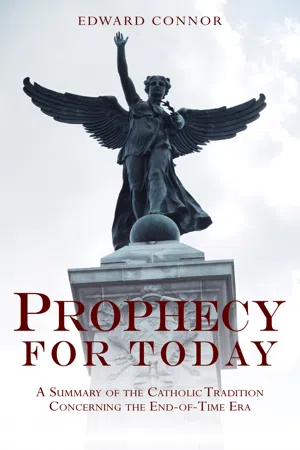
Prophecy For Today
A Summary of the Catholic Tradition Concerning the End-of-Time Era
- 150 pages
- English
- ePUB (mobile friendly)
- Available on iOS & Android
eBook - ePub
About this book
Information
Topic
Theology & ReligionSubtopic
Christian DenominationsChapter 1
PROPHECY
Prophecy in General
Prophecy is a word of many meanings but it is commonly understood to mean knowledge of the free future, i.e., how God will act in the future, how man will use his free will in the future, and the events resulting from both. It is in this sense that the word is used in this volume.
A doctor outlining the course of a disease to a patient is not gifted with prophecy. Neither is an astronomer foretelling the year, month and day of a comet's return. They are dealing with scientific facts in which a given cause produces certain effects or some part of the universe acts in accordance with certain inviolable laws.
The free future is known only to God and those to whom He chooses to reveal it. Neither the angels (faithful or fallen), the saints, nor Our Lady herself know future events contingent upon God or man's use of free will—unless it is made known to them.
Because of its unique quality, prophecy has always been linked with miracles as a sign from God that a certain revelation is true. Thus our Blessed Lord made use of prophecy in two ways to prove His messianic and divine claims: He showed that He fulfilled all the prophecies of the Old Testament that had foretold His life in detail, while Himself making prophecies that were fulfilled both in His lifetime and generations later.
Biblical Prophecy
All prophecies found in the Bible have been fulfilled except those referring to the "last days."
The prophecies of the Old Testament pertained mainly to the Jewish people, the nations with whom they mingled, and to the coming Messiah. The unfulfilled prophecies relate to the signs preceding the Second Coming of Christ, the Last Judgment, and the "new heaven and earth," and are found mainly in the books of Isaias and Daniel.
In the four gospels we find many references to the last days by Our Lord, especially in the famous Eschatological Discourse. Other such prophecies are to be found in the epistles of St. Paul and St. Peter, and of course in the single prophetic book of the New Testament, the Apocalypse. These prophecies will be considered in their proper place.
Private Prophecy
In the centuries since the canon of sacred Scripture was determined, many saints and mystics have claimed the gift of prophecy. Since all such comes under the heading of private revelation, it is never binding upon the faithful to believe. No matter how great the saint, we have no guarantee that every word found in his or her writings is infallible, especially when it comes to prophecy. When the cause of a proposed saint is introduced in Rome and the steps leading to canonization are begun, the writings of the person are carefully examined to judge their content of holiness, and to see if there is anything in them contrary to Catholic doctrine. If such writings are approved for the Acts of Beatification, that is no guarantee that the Church accepts as authentic any prophecy found in them. It simply means that the prophecy has nothing in it contrary to faith or morals.
The extreme caution one should use in approaching all private revelation is graphically exemplified by the classic instances in which a saint has been proven wrong in his predictions. Thus St. Vincent Ferrer (1350-1419) went about preaching the coming of the Antichrist and the end of the world in his own generation!
Then, too, there is the ticklish problem of one saint contradicting another in a revelation. It is true we may err in applying both prophecies to the same event, or one or the other prophecy may have been tampered with, but both suppositions bolster more strongly the premise that all private prophecy must be approached with great caution.
On the other hand, if it should be wondered whether only saints and mystics are endowed with this gift, we have the words of Benedict XIV: "The recipients of prophecy may be angels, devils, men, women, children, heathens, or gentiles; nor is it necessary that a man should be gifted with any particular disposition in order to receive the light of prophecy provided his intellect and senses be adapted for making manifest the things which God reveals to him. Though moral goodness is most profitable to a prophet, yet it is not necessary in order to obtain the gift of prophecy." (Heroic Virtue III, 144:150).
It will be noted in reading private prophecy that a great many of those that threaten calamities to the human race—and do not necessarily refer to the last days—are conditional in quality. It is made clear that if man turns from his sins, returns to God, and does penance, the scourges will not fall. Such were the messages given by Our Lady at LaSalette and at Fatima, and by Our Lord to Blessed Anna Maria Taigi. A notable example of this is found in sacred Scripture itself when Jonas preached to the men of Ninive:
' "Yet forty days, and Ninive shall be destroyed.' And the men of Ninive believed in God, and they proclaimed a fast, and put on sackcloth from the greatest to the least . . . And God saw their works, that they were turned from their evil way. And God had mercy with regard to the evil which He had said that He would do to them, and He did it not." (Jonas 3:4-5, 10).
It is well to remember this "conditional" qualification when reading such prophecies as those referring to the "heavenly scourge" and the three days darkness.
Questionable Prophecies
Certain prophets of the Middle Ages have enjoyed great fame, especially Mother Shipton (born c. 1486 in Yorkshire, England) and Nostradamus (born 1503, Provence, France).
Many are fond of quoting the prophecies of Mother Shipton in which she foretells automobiles, airplanes, submarines and radio, but they rarely quote her couplet:
"The world to an end shall come
In eighteen hundred and eighty one."
Nostradamus has never enjoyed a prominent position as a prophet in the eyes of the Church. Many of his 354 quatrains are based on astrology, and in some of them he seems to prophesy the downfall of the Church. One prediction in regard to the papacy states: "After the seat is held seventeen years, five shall change in the same length of years." Pius XI was the first pontiff to reign seventeen years (Feb. 1922-Feb. 1939); his successor, Pope Pius XII, reigned nineteen years, thus eliminating the other four popes promised in the prophecy.
Nostradamus also wrote: "When St. George's day falls upon Good Friday; when St. Mark's falls on Easter; when St. John's falls on Corpus Christi; then the end of the war will arrive." These feasts concurred in 1943 and will not do so again until 2038. As we all know, World War II came to an end in 1945.
Others who spoke of events in a year that would have the same concurrence of feasts were:
Werdin d'Otrante (13th century): "The Pope will cross the sea in a year when the Feast of St. George falls on Good Friday, and St. Mark's Feast comes on Easter Sunday, and the Feast of St. Anthony falls on Pentecost and the Feast of St. John the Baptist falls on Corpus Christi."
St. Bridget of Sweden (died 1373): "When the Feast of St. Mark shall fall on Easter, the Feast of St. Anthony on Pentecost, and that of St. John on Corpus Christi, the whole world shall cry 'Woe.' "
Venerable Magdalene Porzat (died 1850): "In the year when Easter occurs on the Feast of St. Mark, Pentecost on the Feast of St. Anthony, and Corpus Christi occurs on the Feast of St. John the Baptist, then the world will cry: 'Woe! Woe! Woe!' "
The Holy Father did not cross the sea in 1943, and certainly the year did not seem more "woeful" than the years that preceded and followed it. Perhaps 2038 is the destined year.
In the last century a good deal of attention has been given to the so-called Pyramid Prophecy. It is claimed that those who designed and built the Great Pyramid of Cheops worked into it a prophetic history of all the centuries to come until the year 2000 A.D. The reasoning is involved, having to do with lengths of corridors, tunnels and chambers, etc. Proponents of the prophecy solemnly declared that the date November 27, 1939 "closed off the evil forces from interfering in the affairs of men." (Invasion of Poland had taken place two months earlier. World War II still had over five and one half years to go.) The date October 12, 1940 was also given as the time when "the forces of good have been given the upper hand over all forces of evil, unhappiness, poverty, ill health and disease." (This was a year before Pearl Harbor.)
Chapter 2
THE PROPHECY
OF ST. MALACHY
OF ST. MALACHY
Few private prophecies have captured the popular imagination like that prophecy on the popes ascribed to St. Malachy O'Morgair, Archbishop of Armagh, Ireland, who died in 1148. Tradition has it that when Malachy visited Pope Innocent II in Rome in 1139, he was granted a vision of all the Holy Fathers of the future. He wrote down a description of each in two to four Latin words and gave the list to Innocent, who was deeply troubled at the time and who is said to have derived great comfort from the prophecy. Nothing more is heard of the list until 1590 when a Benedictine monk, Arnold de Wyon, discovered it in the Vatican archives. It was published, promoting a controversy that has continued to our day.
Since Malachy was a good friend of St. Bernard of Clairvaux (in whose arms he died), it is asked why the latter did not mention the prophecy in his famous Life of St. Malachy. Why was the list lost for so many years? Of the 112 popes described in the prophecy, 74 had already reigned when the list was discovered, and opponents of the prophecy claim that the descriptions of these are far more exact than those of subsequent pontiffs. Was not the list the work of a forger who simply used hindsight to describe the popes of the preceding 450 years, and clever ambiguity for the popes of the future?
Proponents of the prophecy, however, stand on the fact that the prophetic utterances did fit all the popes after 1590 with uncanny aptness. Here are some in detail:
Clement XIII (reigned 1758-1769) is described as Rosa Umbriae ("The Rose of Umbria.") This pontiff had been governor of Rieti in Umbria, and the symbol of that district was a rose.
His successor, Clement XIV (1769-1774), appears as Ursus Velox ("The Nimble Bear.") His coat of arms showed a bear in flight.
The next pontiff, Pius VI (1775-1799), is described as Peregrinus Apostolicus ("The Apostolic Wanderer.") During his reign, this pope went to Germany to confer with the Emperor Joseph II. In the last years of his pontificate, he was forced by revolutionaries to flee Rome. After an arduous journey over the Alps, he died in Valence, France!
His successor was Pius VII (1800-1823), and he appears on Malachy's list as Aquila Rapax ("The Rapacious Eagle.") Since this pope was the most gentle and dove-like of men, the inscription has presented difficulties which some have tried to circumvent by applying the prophecy to Napoleon at whose hands Pius suffered so much.
The prophecy for Gregory XVI (1831-1846) reads De Balneis Etruriae ("From Balnea in Etruria.") This pontiff belonged to the religious order of Camaldoli, whose seat is at Balnea in Etruria.
Coming to the popes of the last century: Pius IX (1846-1878) Crux de Cruce ("Cross from a Cross.") The House of Savoy, which caused this pope so much suffering, had a cross on its coat of arms.
Leo XIII (1878-1903): Lumen in Caelo ("Light in the Heavens.") His coat of arms showed a shooting star.
Pius X (1903-1914): Ignis Ardens ("Burning Fire.")
Benedict XV (1914-1922): Pope of the first World War: Religio Depopulata ("Religion Devastated.")
Pius XI (1922-1939): Fides Intrepida ("Intrepid Faith.")
Pius XII (1939-1958): Pastor Angelicus ("The Angelic Shepherd.")
John XXIII (1958-1963): Pastor et Nauta ("The Shepherd and the Sailor.") Since he was formerly Patriarch of Venice, this pontiff came from a city of canals.
Paul VI (1963-1978): Flos Florum ("The Flower of Flowers.") His coat of arms displayed the fleur-de-lis.
John Paul I (1978-1978): De Medietate Lunae ("From the Half of the Moon.") The first two letters of his family name, Luciani, form half of "luna," the Latin word for "moon."
John Paul II (1978- ): De Lahore Solis ("From the Labor of the Sun.")
Only two more popes remain on Malachy's list:
De Gloria Olivae ("From the Glory of the Olive") and Petrus Romanus ("Peter the Roman.")
The prophecy concludes: "In the final persecution of the Holy Roman Church there shall reign Peter the Roman who will feed his flock amid many tribulations, after which the seven-hilled city will be destroyed and the terrible judge will judge the people."
However, there is no inference that there might not be other pontiffs between "From the Glory of the Olive" and "Peter the Roman."
Mention might also be made of the Monk of Padua who in 1740 added his own observations to the prophecies of Malachy, even indicating which name each future pope would take. In this regard he was correct until Benedict XV, who, according to the Monk, was to be Paul VI. Pius XII was also incorrectly designated as Gregory XVII, while John XXIII, Paul VI, John Paul I and John Paul II were erroneously called Paul VII, Clement XV, Pius XII and Gregory XVIII. Thus it appears the Monk of Padua is discredited as a prophet, unless we are to suppose that the later part of his work is a forgery.
Malachy's complete list is given in Appendix A. A study of the entire prophecy shows that fulfillment is made possible only by including anti-popes—almost a death blow to the integrity of the prophecy since Malachy's vision of all popes of the future co...
Table of contents
- Cover Page
- Copyright Page
- Dedication Page
- TABLE OF CONTENTS
- 1. Prophecy
- 2. The Prophecy of St. Malachy
- 3. The Secrets of La Salette and Fatima
- 4. The Earthly Scourge, the Heavenly Scourge and the Three Days Darkness
- 5. The Great Monarch and the Angelic Pastor
- 6. Spiritual Aids in Times of Distress
- 7. The Gospel and the End of the World
- 8. Signs Before the End of the World
- 9. The Antichrist In Scripture
- 10. The Antichrist in Other Sources
- 11. Extraordinary Disturbances in Nature
- 12. The Apocalypse
- 13. The Last Judgment
- Appendix A—The Complete Prophecy of Saint Malachy
- Appendix B—Apparitions Since Fatima
- Appendix C—Can the Devil Raise the Dead?
- Bibliography
Trusted by 375,005 students
Access to over 1.5 million titles for a fair monthly price.
Study more efficiently using our study tools.
Frequently asked questions
Yes, you can cancel anytime from the Subscription tab in your account settings on the Perlego website. Your subscription will stay active until the end of your current billing period. Learn how to cancel your subscription
No, books cannot be downloaded as external files, such as PDFs, for use outside of Perlego. However, you can download books within the Perlego app for offline reading on mobile or tablet. Learn how to download books offline
Perlego offers two plans: Essential and Complete
- Essential is ideal for learners and professionals who enjoy exploring a wide range of subjects. Access the Essential Library with 800,000+ trusted titles and best-sellers across business, personal growth, and the humanities. Includes unlimited reading time and Standard Read Aloud voice.
- Complete: Perfect for advanced learners and researchers needing full, unrestricted access. Unlock 1.5M+ books across hundreds of subjects, including academic and specialized titles. The Complete Plan also includes advanced features like Premium Read Aloud and Research Assistant.
We are an online textbook subscription service, where you can get access to an entire online library for less than the price of a single book per month. With over 1.5 million books across 990+ topics, we’ve got you covered! Learn about our mission
Look out for the read-aloud symbol on your next book to see if you can listen to it. The read-aloud tool reads text aloud for you, highlighting the text as it is being read. You can pause it, speed it up and slow it down. Learn more about Read Aloud
Yes! You can use the Perlego app on both iOS and Android devices to read anytime, anywhere — even offline. Perfect for commutes or when you’re on the go.
Please note we cannot support devices running on iOS 13 and Android 7 or earlier. Learn more about using the app
Please note we cannot support devices running on iOS 13 and Android 7 or earlier. Learn more about using the app
Yes, you can access Prophecy For Today by Edward Connor in PDF and/or ePUB format, as well as other popular books in Theology & Religion & Christian Denominations. We have over 1.5 million books available in our catalogue for you to explore.