416 pages of famous dogmatic Church pronouncements: The Athanasian Creed, Oath Against Modernism, Interpretation of Sacred Scripture, Condemnation of the Modernists, Papal Infallibility, etc. Fully indexed; excellent reference! 416 pgs;
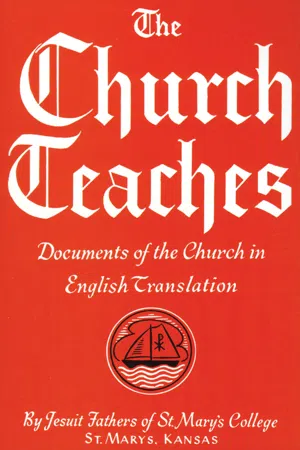
- 416 pages
- English
- ePUB (mobile friendly)
- Available on iOS & Android
eBook - ePub
About this book
Information
Topic
Theology & ReligionSubtopic
Christian DenominationsThe Sacraments
When the Word was made flesh and dwelt in our midst, the mysterious, invisible life of God took visible form in this material world of human life. The paradoxical union of the divine with the human, the invisible with the visible, that characterized the Incarnation of the Word, continues in the Church in which the divine person of Christ lives on in mysterious union with the visible, external society, the mystical body, of which he, as man, is the head. The sacramental system of the Church is an extension of this same divine plan. In the seven sacraments Christ communicates the divine life to the members of his Church through visible, external signs which he instituted for this purpose. In themselves the external, perceptible rites of the sacraments are powerless to produce the spiritual effects they signify. It is only by Christ's appointment and by the operation of his power that they can and do effect what they signify. For the same reason, the efficacy of the sacraments is not dependent on the holiness or orthodoxy of their ministers. The early controversies about the need for rebaptizing heretics occasioned clear pronouncements by the Church on this point.
Each of the sacraments confers or increases sanctifying grace. This sanctifying grace is known as sacramental grace inasmuch as it carries with it a right to the supernatural helps necessary and useful for the accomplishment of the purpose of each sacrament. In addition, three of the sacraments, baptism, confirmation, and orders, confer an indelible character which renders their valid repetition impossible.
The Sacraments in General
That there are seven sacraments of the New Law is a truth of Catholic faith. The Church has always taught the existence of the seven sacraments and this teaching had always been universally accepted. It was only in the twelfth century that scholastic theologians began to seek a definition of the nature of a sacrament as such and to be aware that this nature was realized in seven, and only seven, of the Church's rites. From this time, therefore, come the first precise formulations in official Church documents regarding the nature and number of the sacraments in general and the conditions of their administration.
Few heretics of major importance in the history of dogma denied the existence of the sacraments, or contested the number seven, until the Reformers of the sixteenth century. These heretics denied that Christ had instituted any of the sacraments except two, baptism and the Eucharist. They considered that the sacramental signs were not real causes of grace but mere symbols exciting to faith (Luther) or pledges of divine benevolence (Calvin). To meet these fundamental errors the Council of Trent undertook an official presentation of the true doctrine on all of the sacraments in general and each of them in particular.
THE PROFESSION OF FAITH PRESCRIBED FOR DURANDUS OF OSCA AND FOLLOWERS, 1208
In 1208, this profession of faith was proposed by Innocent III (1198–1216) to Durandus of Osca (see introd. to 150), a converted Waldensian, and to his followers. Durandus's orthodoxy was no longer in question, but the profession was meant to guarantee the right doctrine in the preaching of the religious society he was founding. The errors included are principally those of the Albigenses and Waldensians. Selections from this profession of faith that pertain to the individual sacraments will be distributed throughout this chapter (see 685, 713, 853).
658 (424)
Furthermore, we do not reject the sacraments that are conferred in the Church, in cooperation with the inestimable and invisible power of the Holy Spirit, even though these sacraments be administered by a sinful priest as long as he is recognized by the Church. And we do not disparage ecclesiastical functions and benedictions celebrated by such a one; but we accept them in a kindly manner, as if performed by the most just of men. For the evil life of a bishop or a priest does not invalidate either the baptism of an infant, or the consecration of the Eucharist, or other ecclesiastical duties performed for the faithful.
THE FOURTH COUNCIL OF THE LATERAN, 1215
In the definition of faith against the Albigenses (see introd. to 151 and 306) the twelfth ecumenical council included the following doctrine on the sacraments. Not all the sacraments are enumerated here, but the number of the sacraments had not been called into question at this time.
659
(430)
(430)
Indeed, there is but one universal Church of the faithful outside which no one at all is saved and in which the priest himself, Jesus Christ, is the victim; his body and blood are truly contained in the Sacrament of the Altar under the species of bread and wine, transubstantiated by the divine power—the bread into his body and the wine into his blood—that, for the enacting of the mystery of unity, we may take from his substance as he himself took from our substance. And no one can consecrate this sacrament except a priest who is rightly ordained according to the Church's powers that Jesus Christ gave to the apostles and to their successors. But the sacrament of baptism (which is performed with water together with the invocation of God and the undivided Trinity; namely, the Father, the Son, and the Holy Spirit) is salutary both for infants and for adults if it is administered correctly by anyone according to the form of the Church. And if after receiving baptism, anyone shall fall into sin, he can always be restored by true contrition. Not only virgins and those who observe continence but also married people who please God by true faith and good works merit to come to eternal happiness.
THE SECOND COUNCIL OF LYONS, 1274
The great profession of faith of Emperor Michael Palaeologus, subscribed to by his delegates at this Council of Lyons (see introd. to 152 and 456), dealt in its latter part with the points of difference between the Latin and Greek Churches in doctrinal matters. The first sentence of this present section on the sacraments seems to mention the sevenfold number of the sacraments as a matter taken for granted by all. It is in the details concerning certain sacraments that the points of difference are touched.
660
(465)
(465)
Furthermore, the same holy Roman Church holds and teaches that there are seven sacraments of the Church. One is baptism which has been treated above. Another is the sacrament of confirmation which bishops confer by the imposition of hands, anointing those who have been reborn. Then there is penance, the Eucharist, the sacrament of orders, matrimony, and extreme unction which, according to the teaching of St. James, is administered to the sick. The same Roman Church consecrates the sacrament of the Eucharist from unleavened bread, and she holds and teaches that in this sacrament the bread is truly transubstantiated into the body of our Lord Jesus Christ, and the wine into his blood. As regards matrimony, the Church holds that one man may not have more than one wife at the same time, nor is a woman permitted to have more than one husband. When a lawful marriage is dissolved by the death of one of the spouses, the Church teaches that two, three, or even further marriages are successively lawful, provided there is no canonical impediment from any other source.
THE COUNCIL OF CONSTANCE, 1414-18
Although Wyclif and Hus (see introd. to 158 and 521) did not deny the existence of seven sacraments, their doctrines concerning their natural and the dispositions required in the minister and recipient of the sacraments was at variance with orthodoxy.
Error of Wyclif
661
(584)
(584)
4. If a bishop or a priest is in mortal sin, he does not ordain, he does not consecrate, he does not effect the Sacrifice, and he does not baptize.
Question proposed for followers of Wyclif and Hus
662
(672)
(672)
22. Likewise, whether he believes that an evil priest who has the correct matter and form and the intention of doing what the Church does, truly effects the Sacrifice, truly absolves, truly baptizes, truly confers the other sacraments.
THE COUNCIL OF FLORENCE, 1438-45
After the Council of Florence (see introd. to 164) had achieved apparent success in reuniting the Greek with the Latin Church, Pope Eugene IV (1431–47) prolonged the council and continued to work for the reunion of other schismatic groups with Rome. A delegation from the Armenian Church arrived at Florence, and after lengthy conferences reunion was agreed upon. November 22, 1439, the decree Exultate Deo on the union, was published. In the decree, along with the Nicene Creed and the definitions of the Councils of Chalcedon and Constantinople, there was an important instruction on the sacraments. This instruction follows St. Thomas's opuscule De articulis fidei et Ecclesiae sacramentis very closely and is an authoritative pre-Reformation testimony to the traditional doctrine on the number of the sacraments and to the employment of the terms matter and form to describe the rites and formulae that constitute the sacraments. It is, however, probably not an infallible definition.
663
(695)
(695)
Fifthly, We are putting the true doctrine of the sacraments of the Church into a brief formula as an easier means for instructing the Armenians, both those of the present and those of the future. There are seven sacraments of the New Law: they are baptism, confirmation, the Eucharist, penance, extreme unction, holy orders, and matrimony; and they differ greatly from the sacraments of the Old Law. The sacraments of the Old Law did not cause grace but were only a figure of the grace that was to be given through the Passion of Christ; but our sacraments both contain grace and confer it on those who receive the sacraments worthily. The first five of these are ordered to the interior spiritual perfection of the individual; the last two are ordered to the government and to the spread of the whole Church. For by baptism we are spiritually reborn and by confirmation we grow in grace and are strengthened in the faith; being reborn and strengthened, we are nourished with the divine food of the Eucharist. If, by sin, we become sick in soul, penance spiritually heals us; extreme unction heals us in spirit and in body as well, insofar as it is good for the soul. By holy orders the Church is governed and given spiritual growth; by matrimony she is given bodily growth. All these sacraments are brought to completion by thr...
Table of contents
- Cover Page
- Copyright Page
- Contents
- Preface
- Foreword
- Acknowledgments
- Professions of Faith
- Revelation, Faith, and Reason
- Tradition and Holy Scripture
- The Church
- The Triune God
- God the Creator and Sanctifier
- The Incarnation and Redemption
- Grace
- The Sacraments
- The Last Things
Trusted by 375,005 students
Access to over 1.5 million titles for a fair monthly price.
Study more efficiently using our study tools.
Frequently asked questions
Yes, you can cancel anytime from the Subscription tab in your account settings on the Perlego website. Your subscription will stay active until the end of your current billing period. Learn how to cancel your subscription
No, books cannot be downloaded as external files, such as PDFs, for use outside of Perlego. However, you can download books within the Perlego app for offline reading on mobile or tablet. Learn how to download books offline
Perlego offers two plans: Essential and Complete
- Essential is ideal for learners and professionals who enjoy exploring a wide range of subjects. Access the Essential Library with 800,000+ trusted titles and best-sellers across business, personal growth, and the humanities. Includes unlimited reading time and Standard Read Aloud voice.
- Complete: Perfect for advanced learners and researchers needing full, unrestricted access. Unlock 1.5M+ books across hundreds of subjects, including academic and specialized titles. The Complete Plan also includes advanced features like Premium Read Aloud and Research Assistant.
We are an online textbook subscription service, where you can get access to an entire online library for less than the price of a single book per month. With over 1.5 million books across 990+ topics, we’ve got you covered! Learn about our mission
Look out for the read-aloud symbol on your next book to see if you can listen to it. The read-aloud tool reads text aloud for you, highlighting the text as it is being read. You can pause it, speed it up and slow it down. Learn more about Read Aloud
Yes! You can use the Perlego app on both iOS and Android devices to read anytime, anywhere — even offline. Perfect for commutes or when you’re on the go.
Please note we cannot support devices running on iOS 13 and Android 7 or earlier. Learn more about using the app
Please note we cannot support devices running on iOS 13 and Android 7 or earlier. Learn more about using the app
Yes, you can access The Church Teaches by in PDF and/or ePUB format, as well as other popular books in Theology & Religion & Christian Denominations. We have over 1.5 million books available in our catalogue for you to explore.