The best biography of St. Dominic in English we have seen. Covers his preaching, miracles, founding of the Dominicans, the Rosary, the incredible fruit of his life, and the miraculous growth of the Dominicans. 256 pgs,
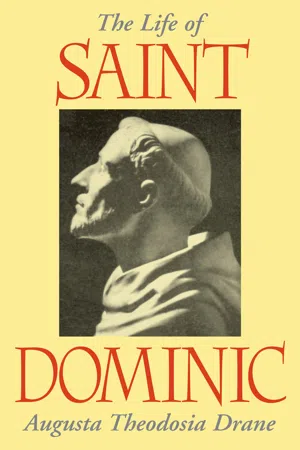
- 256 pages
- English
- ePUB (mobile friendly)
- Available on iOS & Android
eBook - ePub
The Life of St. Dominic
About this book
Information
Topic
Theology & ReligionSubtopic
Christian Denominations

The birth of Dominic. His youth and university life.
It was in the year 1170, during the pontificate of Alexander III, that Dominic Guzman, the founder of the order of Friars Preachers, was born at his father’s castle of Calaroga, in old Castile. The history of a genealogy, however illustrious, seems scarcely to find its place in the biography of a saint; though indeed few families can boast of one more honorable than that of the Castilian Guzmans. But if their long line of chivalrous ancestors, and the royal privileges granted to them by the kings of Spain, have no claim to be noticed here, the immediate ancestors of St. Dominic possessed at least one distinction which had a more powerful influence on his life. They were a family of saints.
The household of his father, Don Felix Guzman, was so remarkable for the religious character of its inmates that it was said to resemble rather a monastery than a knightly castle. His mother, Joanna of Aza, after being constantly held in popular veneration, has, almost within our own time, received the solemn beatification of the Church. The same testimony has been borne to the heroic sanctity of Manez, her second son; and though Antonio, the eldest of the three brothers, has not indeed received similar honors, yet was he no unworthy member of his illustrious family. We read of him that he became a secular priest, in which position he might have aspired to the highest ecclesiastical distinctions; but, enamored of holy poverty, he distributed his patrimony to the poor and retired to a hospital where he spent the remainder of his days in humbly ministering to the sick.
The future greatness of her younger son was announced to Joanna even before his birth. The mysterious vision of a dog, bearing in his mouth a lighted torch which set fire to the world, appeared to indicate the power of that doctrine which should kindle and illuminate men’s hearts through the ministry of his words. The noble lady who held him at the font saw, as the water was poured on his head, a brilliant star shining on the infant’s forehead; and this circumstance, which is mentioned in the earliest life which we have of the saint (that of Blessed Jordan), bears a singular connection with the beautiful description of his appearance in after-life, left by his spiritual daughter, the Blessed Cecilia; in which she says, among other things, that “from his forehead, and between his brows, there shone forth a kind of radiant light, which filled men with respect and love.”
Nor were the expectations which were excited by these prodigies in any way diminished by the promises of his childhood. His early years were passed in a holy household, and his first impressions were received from the all-powerful influence of a saintly mother. Amid the associations of a Christian family, his mind was molded into a religious shape even from his cradle; and the effect of this training is to be traced in the character of his maturer sanctity.
From first to last we admire the same profound and unruffled tranquillity of soul. So far as his interior life is revealed to us, he seems to have known nothing of those storms and agitations through which the human mind so often works its way to God; nothing seems to have interrupted the upward growth of his soul; and even the tales of his combats with the powers of evil give us more the idea of triumphs achieved, than of temptations suffered and overcome.
When seven years old, he was committed to the charge of his uncle, the arch-priest of Gumiel di Izan, a town not far from Calaroga. Here he grew up in the service of the altar, finding his pleasure in frequenting the churches and learning to recite the Divine office, in singing hymns, and serving at Mass and other public ceremonies, and in all those numberless little devout offices which make the life of so many Catholic boys much like that of the child Samuel in the Temple. To Dominic they were all labors of love; and his biographers dwell on the devotion kindled in the hearts of those who saw the grave and reverent manner with which he bore himself in the presence of the Most Holy Sacrament, or busied himself in the cleaning and adorning of the altar. At fourteen he was sent to the University of Palencia, then one of the most celebrated in Spain. He was but young to be suddenly removed from so retired and sheltered a home into intercourse with a world of which, as yet, he knew nothing. With how many would such a change have brought only the rapid loss of all which had hitherto rendered his life so innocent and happy. But to Dominic it did but give room for larger growth in holiness.
During the ten years of his residence at Palencia, he was equally distinguished for his application to study, and for the angelic purity of his life. Worldly pleasures afforded no seductions to one who from his very birth had received an attraction to the things of God. Even human science failed to satisfy his desires, and he hastened to apply himself to the study of theology, as to the only fountain whose limpid waters were capable of quenching the thirst of his soul after the highest truth. He spent four years in the most profound application to philosophy and sacred letters, often spending his nights as well as his days over his books; and, convinced that Divine Science can only be acquired by a mind that has learned to subjugate the flesh, he practiced a rigid austerity, and for ten years never broke the rule he imposed on himself at the commencement of his studies to abstain entirely from wine.
The influence of a holy life is never unfelt by those who would be the last to imitate its example. Dominic’s companions bore witness, by their respect, to the sublimity of a virtue far above the standard of their own lives. Boy as he was, none ever spoke with him without going away the better for his words, and feeling the charm of that Divine grace which shone even in his exterior gestures. “It was a thing most marvelous and lovely to behold,” says Theodoric of Apoldia; “this man, a boy in years, but a sage in wisdom; superior to the pleasures of his age, he thirsted only after justice; and not to lose time, he preferred the bosom of his mother the Church to the aimless and objectless life of the foolish world around him. The sacred repose of her tabernacles was his resting place; all his time was equally divided between prayer and study; and God rewarded the fervent love with which he kept His Commandments by bestowing on him such a spirit of wisdom and understanding as made it easy for him to resolve the most deep and difficult questions.”
Before we quit his university life, two circumstances must be recorded which happened during its course and illustrate the peculiar gentleness and tenderness of his character. Such terms may seem strange to a Protestant reader, for there is, as it were, a traditional portrait of St. Dominic, handed down from one age to another by means of epithets, which writers are content to repeat and readers to receive, without a thought of inquiry as to their justice. We can scarcely open a book which professes to give the history of the thirteenth century and its religious features without finding something about “the cruel and bloodthirsty Dominic,” or the “gloomy founder of the Inquisition”; and under this popular idea the imagination depicts him as a dark-browed, mysterious zealot, without a touch of human tenderness, remorselessly handing over to the flames the victims of his morose fanaticism. The author of the well-known Handbook, from which so many English travellers gather their little stock of knowledge on Italian matters, finds something of an almost providential significancy in the fact that the tree planted by the father of the Friars Preachers in his convent garden at Bologna should be the “dark and melancholy cypress.” And all the while the true tradition of his character is one preeminently of joy and gentleness. With his fair auburn hair and beaming smile, he does not present in his exterior a more perfect contrast to the received notion of the Spanish Inquisitor than may be found in the tales of tender-hearted compassion, which are almost all we know of him during the first twenty years of his life.
We find him, in the midst of the famine which then desolated Spain, so sensibly touched with the sufferings of the people that not only did he give all he had, in alms, selling his very clothes to feed the poor—but he set a yet nobler example of charity to his fellow students by a sacrifice which may well be believed to have been a hard one. His dear and precious books were all that remained to give; and even those he parted with, that their price might be distributed to the starving multitudes. To estimate the cost of such an act, we must remember the rarity and costliness of manuscripts in those days, many having probably been laboriously copied out by his own hands. Yet when one of his companions expressed astonishment that he should deprive himself of the means of pursuing his studies, he replied, in words preserved by Theodoric of Apoldia and treasured by after-writers as the first which have come down to posterity, “Would you have me study off those dead parchments, when there were men dying of hunger?” This example roused the charity of the professors and students of the university, and an effort was soon made which relieved the sufferers from their most urgent wants.
On another occasion, finding a poor woman in great distress on account of the captivity of her only son, who had been taken by the Moors, Dominic—having no money to offer for his ransom—desired her to take him and sell him, and release her son with his price; and though this was not permitted to be done, yet the fact exhibits him to us under a character which is strangely opposed to the vulgar tradition of his severity and gloom.
It is said by some authors that his early desires led him to form plans for the foundation of an order for the Redemption of Captives, similar to that afterwards established by St. John of Matha; but of this we find no authoritative mention in the writers of his own order; and it is probable that the idea arose from the fact to which allusion has just been made.
Dominic is appointed canon of Osma. His mission to the north in company with Diego of Azevedo.
It was not until his 25th year that Dominic was called to the ecclesiastical state. Until that time the designs of God regarding him had not been clearly manifested; but some important changes which took place in the diocese of Osma were the means of bringing him into a position where the latent powers of his soul were displayed before the eyes of the world. Martin de Bazan at that time ruled the Church of Osma—a man of eminent holiness, and most zealous for the restoration of Church discipline. Following the plan then generally adopted in most of the countries of Europe, he had engaged in the difficult but important task of converting the canons of his cathedral into canons regular, an arrangement by which they became subject to stricter ecclesiastical discipline and community life. In this labor he had been greatly assisted by a man whose name will ever have a peculiar interest to all the children of St. Dominic—Don Diego de Azevedo, the first prior of the new community, and afterwards successor to Martin in the episcopal see.
The name of Dominic, and the reputation of his singular holiness no less than of his learning, had already reached the ears of both; and they determined, if possible, to secure him as a member of the chapter, not doubting but the influence of his example and doctrine would greatly assist their designs of reform. In his 25th year, therefore, he received the habit of the Canons Regular, and the influence of his character was so soon felt and appreciated by his brethren that he was shortly afterwards chosen sub-prior, in spite of his being the youngest of the whole body of canons.
Nine years were thus spent at Osma, during which time God was doubtless gradually training and preparing his soul for the great work of his future life. Jordan of Saxony has left us a beautiful sketch of his manner of life at this period. “Now it was,” he says, “that he began to appear among his brethren like a bright burning torch, the first in holiness, the last in humility, spreading about him an odor of life which gave life, and a perfume like the sweetness of summer days. Day and night he was in the church, praying as it were without ceasing. God gave him the grace to weep for sinners and for the afflicted; he bore their sorrows in an inner sanctuary of holy compassion, and so this loving compassion which pressed on his heart flowed out and escaped in tears. It was his custom to spend the night in prayer, and to speak to God with his door shut. But often there might be heard the voice of his groans and sighs, which burst from him against his will. His one constant petition to God was for the gift of a true charity; for he was persuaded that he could not be truly a member of Christ unless he consecrated himself wholly to the work of gaining souls, following the example of Him who sacrificed Himself without reserve for our redemption.”
It is interesting, among the very scanty details left us of Dominic’s early years, to find two books mentioned, the study of which seem to have had an extraordinary influence in forming and directing his mind. The one was the Dialogues of Cassian, and the other, the Epistles of St. Paul. In after-years he always carried a copy of the Epistles about his person, and he seems to have shaped his whole idea of an apostolic life after the model of this great master. In 1201, Don Diego de Azevedo succeeded to the bishopric of Osma, and two years afterwards was appointed by Alfonso VIII, the king of Castile, to negotiate a marriage between his eldest son and a princess of Denmark. He accordingly set out for the north, taking Dominic as his companion; and it was on the occasion of this journey that, as they passed through the south of France, the frightful character and extent of the Albigensian heresy, which then infected the whole of the southern provinces, first came under their notice. Though they were not then able to commence the apostolic labors for which they saw there was so urgent a demand, yet an impression was left on the hearts of both which was never effaced; and Dominic felt that his life, which had hitherto seemed without any determinate call or destiny, had been, as it were, reserved for a work which he now saw clear before him. Probably this feeling was strengthened by a circumstance which occurred at Toulouse, where they stopped for a night on their journey. The house where they lodged was kept by a man who belonged to the sect of the Albigenses, and when Dominic became aware of the fact, he resolved to attempt at least to gain this one soul back to the Faith. The time was short, but the dispute was prolonged during the whole night; and in the morning the eloquence and fervor of his unknown guest had conquered the obduracy of the heretic. Before they left the house he made his submission, and was received back into the bosom of the Church.
The effect of this first conquest on Dominic’s mind was a feeling of unspeakable gratitude and a determination, so soon as he should be free to act, to found an order for the express purpose of preaching the Faith. Castiglio, in his history of the Order, tells us that the embassy on which Diego and Dominic were employed was not to Denmark, but to the court of France—and that it was on this occasion that, finding Queen Blanche in much affliction on account of her being without children, Dominic recommended to her the use of the Rosary.
The queen, he adds, not only adopted the devotion herself, but propagated it among her people and distributed rosaries amongst them, engaging them to join their prayers to hers, that her desire might be granted; and the son whom God gave in answer to these prayers was no other than the great St. Louis. This is the first direct mention of the devotion of the Rosary which we find in St. Dominic’s life; it is probable, from the date of St. Louis’ birth, which is generally given in 1215, that the circumstances referred to—if they ever really took place—occurred at some later visit to the French court. But though there is evidently some confusion in the time, we do not like altogether to abandon the story as without foundation; for there is always a peculiar charm in the little links which unite the lives of two great saints together, and those who claim any interest in the Order of St. Dominic may feel a pleasure in thinking of St. Louis as a child of the Rosary.
Pilgrimage to Rome. First labors among the Albigenses.
The death of the princess whose marriage they were negotiating whilst engaged in a second embassy at her father’s court, having relieved Diego and Dominic from their charge in this affair, they determined to take the occasion of their absence from the diocese to visit Rome on pilgrimage before returning to Spain. Many motives concurred in inducing them to undertake this journey; but with Diego the most powerful one was the desire to obtain permission from Pope Innocent III to resign his bishopric and undertake the labors of an apostolic missionary life among the Cuman Tartars, who were then ravaging the fold of Christ in Hungary and the surrounding countries.
It would seem as if the impressions made on the minds of these two great men by what they had witnessed of the sufferings of the Church in their journey through Europe had been of that kind which is never effaced, and which, whenever it touches the soul, is to it the commencement of a new life. In them it had kindled the desire to devote themselves to a far wider field of labor than the limits of one diocese: they had both received the heroic call of the apostolate. The state of the Church at that time was one which might well make such an appeal to hearts ready to receive it. “Without were fightings, within were fears.” Whilst hordes of savage and heathen enemies were pressing hard on the outworks of Christendom and watering the ground with the blood of unnumbered martyrs, heresy, as we have seen,...
Table of contents
- Cover Page
- Copyright Page
- CONTENTS
- Preface
- CHAPTER 1. The birth of Dominic. His youth and university life.
- CHAPTER 2. Dominic is appointed canon of Osma. His mission to the north in company with Diego of Azevedo.
- CHAPTER 3. Pilgrimage to Rome. First labors among the Albigenses.
- CHAPTER 4. Dominic in Languedoc. The miracles of Fanjeaux and Montreal. The foundation of the Convent of Prouille.
- CHAPTER 5. Diego returns to Spain. His death. Dominic remains in Languedoc. The murder of Peter de Castelnau, and the commencement of the Albigensian war.
- CHAPTER 6. Proclamation of the Crusade. Simon de Montfort. Dominic among the heretics. His apostolic labors.
- CHAPTER 7. The institution of the Rosary. The Council of Lavaur. The battle of Muret.
- CHAPTER 8. Dominic commences the foundation of his Order at Toulouse. The grant of Fulk of Toulouse. Dominic’s second visit to Rome. The Council of Lateran. Innocent III approves the plan of the Order. Meeting of Dominic and Francis.
- CHAPTER 9. Dominic’s return to France. The brethren assemble at Prouille to choose a rule. The spirit of the Order. Some account of the first followers of Dominic. The convent of St. Romain.
- CHAPTER 10. Dominic’s third visit to Rome. Confirmation of the Order by Honorius III. Dominic’s vision in St. Peter’s. He is appointed master of the Sacred Palace. Ugolino of Ostia.
- CHAPTER 11. Dominic returns to Toulouse. He disperses the Community of St. Romain. His address to the people of Languedoc. Future affairs of the Order in that country
- CHAPTER 12. Dominic’s fourth visit to Rome. His mode of travelling.
- CHAPTER 13. The convent of St. Sixtus. Rapid increase of the Order. Miracles and popularity of St. Dominic. The visit of the angels.
- CHAPTER 14. The monastery of Santa Maria in Trastevere. Dominic is appointed to reform and enclose the community. His success. Their settlement at St. Sixtus. The restoration to life of the Lord Napoleon. Sister Cecilia.
- CHAPTER 15. Affairs of the Order in France. First settlement of the brethren at the convent of St. James at Paris. Foundation at Bologna. Character of the religious houses of the Order. Settlement of the Friars in Spain and Portugal. Brothers Tancred and Henry of Rome.
- CHAPTER 16. Dominic at Santa Sabina. The vocation of St. Hyacinth. Reginald of Orleans. The Blessed Virgin bestows on him the habit of the Order.
- CHAPTER 17. Dominic’s life at Rome. The rule of the Order. Description of his person and appearance. His prayer, and manner of life.
- CHAPTER 18. Attacks of the devil. Legends of St. Sabina and St. Sixtus.
- CHAPTER 19. Dominic leaves Rome. He visits Bologna on his way to Spain. Incidents of his journey. He preaches at Segovia. Foundations there, and at Madrid. His continual prayer.
- CHAPTER 20. Return to St. Romain. He proceeds to Paris. Jordan of Saxony. Interview with Alexander, King of Scotland. Return to Italy.
- CHAPTER 21. The Convent of Bologna. Effects of Reginald’s preaching and government. Fervor of the Community of St. Nicholas. Conversion of Fathers Roland and Moneta. Dispersion of the brethren through the cities of Northern Italy. Reginald’s novices. Robaldo. Bonviso of Placentia. Stephen of Spain. Rodolph of Faenza. Reginald is sent to Paris. Jordan joins the Order. Reginald’s success—and death.
- CHAPTER 22. Dominic journeys through Italy and returns to Rome for the fifth time. Increase of the Order. Character of the first fathers. Interview with St. Francis. Favors of the Holy See.
- CHAPTER 23. First general Chapter at Bologna. Law of poverty. The Order spreads through Europe. Dominic’s illness at Milan. Visit to Siena. Tancred. Apostolic journeys through Italy. Return to Bologna, and conversion of Master Conrad. John of Vicenza. Anecdotes.
- CHAPTER 24. Heretics of northern Italy. Foundation of the third order. Last visit to Rome. Meeting with Fulk of Toulouse. Second general chapter. Division of the Order into provinces. Blessed Paul of Hungary. St. Peter Martyr.
- CHAPTER 25. The Order in England. Arrival at Oxford of Gilbert de Fresnoy. Celebrated Englishmen of the Order. Walter Malclerk, Bacon, and Fishacre. The Order and the universities. The German province.
- CHAPTER 26. Dominic’s last missionary journey. His return to Bologna, and illness. His death. Revelations of his glory. His canonization, and the translation of his relics.
- CHAPTER 27. Dominic’s writings. His supposed defense of the Immaculate Conception. His portraits by Fra Angelico, and in the verses of Dante. Observations on the Order.
Trusted by 375,005 students
Access to over 1.5 million titles for a fair monthly price.
Study more efficiently using our study tools.
Frequently asked questions
Yes, you can cancel anytime from the Subscription tab in your account settings on the Perlego website. Your subscription will stay active until the end of your current billing period. Learn how to cancel your subscription
No, books cannot be downloaded as external files, such as PDFs, for use outside of Perlego. However, you can download books within the Perlego app for offline reading on mobile or tablet. Learn how to download books offline
Perlego offers two plans: Essential and Complete
- Essential is ideal for learners and professionals who enjoy exploring a wide range of subjects. Access the Essential Library with 800,000+ trusted titles and best-sellers across business, personal growth, and the humanities. Includes unlimited reading time and Standard Read Aloud voice.
- Complete: Perfect for advanced learners and researchers needing full, unrestricted access. Unlock 1.5M+ books across hundreds of subjects, including academic and specialized titles. The Complete Plan also includes advanced features like Premium Read Aloud and Research Assistant.
We are an online textbook subscription service, where you can get access to an entire online library for less than the price of a single book per month. With over 1.5 million books across 990+ topics, we’ve got you covered! Learn about our mission
Look out for the read-aloud symbol on your next book to see if you can listen to it. The read-aloud tool reads text aloud for you, highlighting the text as it is being read. You can pause it, speed it up and slow it down. Learn more about Read Aloud
Yes! You can use the Perlego app on both iOS and Android devices to read anytime, anywhere — even offline. Perfect for commutes or when you’re on the go.
Please note we cannot support devices running on iOS 13 and Android 7 or earlier. Learn more about using the app
Please note we cannot support devices running on iOS 13 and Android 7 or earlier. Learn more about using the app
Yes, you can access The Life of St. Dominic by Sr. Augusta Theodosia Drane in PDF and/or ePUB format, as well as other popular books in Theology & Religion & Christian Denominations. We have over 1.5 million books available in our catalogue for you to explore.