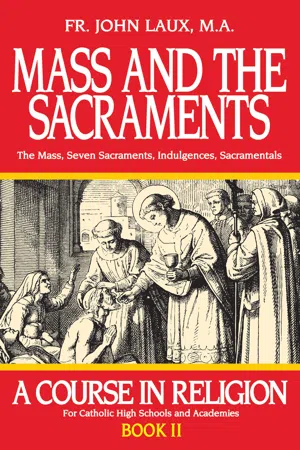
The doctrine and history of the 7 Sacraments. Also covers Indulgences and Sacramentals. Topics include the Scriptural background of the Sacraments, their institution by Christ, essential requirements for receving them, their effects in the soul, etc. Will deepen understanding of these 7 lifelines of grace and salvation.
- 210 pages
- English
- ePUB (mobile friendly)
- Available on iOS & Android
eBook - ePub
About this book
Information
Topic
Theology & ReligionSubtopic
Christian DenominationsCHAPTER I
The Sacraments in General
1. THE NATURE OF THE SACRAMENTS
1. Means of Grace.—Without grace we can do no good work of ourselves towards our salvation. Hence the all-important question is, how can we obtain God's grace?
The principal means of obtaining grace are Prayer and the reception of the Sacraments. Prayer will be treated under the Ten Commandments; for the present it will suffice to point out the difference between prayer and the sacraments as means of grace:
a) The sacraments produce grace in us; prayer obtains it for us.
b) Through the sacraments we obtain those special graces for which they were instituted; through prayer we receive all kinds of graces, except those which are given only by the sacraments.
The word sacrament comes from the Latin word sacramentum, which the Romans used for any holy or sacred thing, such as forfeit money deposited in a temple or the military oath of allegiance. In the early Church it was applied to any religious object, rite, or ceremony which was hidden from the knowledge of the heathen; it was synonymous with mystery. In the course of time it received its present restricted meaning.
2. A Sacrament is an outward or sensible sign instituted by Christ through which inward grace is imparted to the soul. Hence three things are necessary for a sacrament:
a) An outward or sensible sign;
b) A corresponding inward or invisible grace;
c) Institution by Christ.
a) The Outward Sign.—An outward or sensible sign is something that can be perceived by one or other of the senses. Its purpose is to make something hidden known to us; thus a word, a movement of the hand, an inclination of the head makes known to us what is hidden in another's mind. The outward signs of the sacraments make known to us the inward grace that is being produced in the soul.
The outward sign of the sacraments is composed of two things, matter and form. The matter of the sacrament is the sensible thing or exterior act used in its administration, such as water, oil, bread and wine. The form consists in the words pronounced by the minister when he applies the matter, e.g., "I baptize thee in the name of the Father, and of the Son, and of the Holy Ghost."
To constitute a sacrament, the form must be united to the matter. "Take the word away," says St. Augustine, "and what else is baptismal water except ordinary water? but add the words to the element and it becomes a sacrament" (In Joan, tract. 80,3).
The matter of a sacrament is remote or proximate, according as we consider it in itself or in its actual application. Water in itself is the remote, the pouring of the water the proximate matter of the sacrament of Baptism.
b) The Inward Grace.—The outward signs of the sacraments do not merely signify grace, but actually impart the graces which they signify, unless we on our part put some obstacle in the way (Council of Trent, Session VII, Canon 6). When a priest pours water on the forehead of a child and pronounces the words, at that very moment the child is really cleansed from original sin and made holy and pleasing to God.
c) Institution by Jesus Christ.—No sensible things or outward signs have of themselves the power to produce inward supernatural grace, nor can any created being give such power to sensible things. If they have this power, it must have been given to them by God. He who merited grace for us, the God-Man Jesus Christ, attached to certain outward signs the power of imparting inward grace and sanctification to our souls. These signs have thus become the sacred channels through which flow to us the graces which Jesus Christ merited for us by His Passion and Death.
3. But why, it may be asked, should God bestow His supernatural favors upon us by means of outward signs and material symbols? The reason is because He adapts His methods to our nature. We are not pure spirits, but beings composed of body as well as of soul; so that even in our most spiritual operations we constantly make use of material and physical elements. Thus, when we wish to convey an intellectual idea to others we have to clothe it in language written or oral. In the same way God makes use of visible things as the vehicles of His invisible graces and blessings. We thus have visible pledges of the invisible graces.
There is another reason why God should convey His graces by visible signs, namely, to unite us all more closely together. "Since the sacraments are conferred under visible forms, we cannot receive them without giving public testimony of our faith, and of our fellowship with the millions of other Catholics spread throughout the world. We thereby prove ourselves to be members of the same Church, and sharers in the same benefits, and sheep of the same divine Shepherd."
4. Sacramental Ceremonies.—Christ gave His Church the power to administer the sacraments. Hence the Church also has the power to prescribe certain ceremonies and prayers, to be used before and after their administration. Their purpose is
a) To direct our attention to the graces received in the sacraments;
b) To prepare us for those graces;
c) To represent to us the dignity of the sacrament;
d) To increase our devotion and reverence.
Some of these ceremonies have Christ Himself as their author; others were instituted by the Apostles; others, again, by the Church at different times. As the ceremonies do not belong to the matter and form of the sacraments, they can be omitted or abbreviated in case of necessity.
2. NUMBER OF THE SACRAMENTS
1. The Council of Trent declared that there are seven, and only seven, sacraments instituted by Christ.—Baptism, Confirmation, Holy Eucharist, Penance, Extreme Unction, Holy Orders, and Matrimony,
In the case of four of the sacraments—Baptism, Holy Eucharist, Penance, Holy Orders—we know when Christ instituted them; Confirmation and Extreme Unction were administered by the Apostles; the sacramental character of Matrimony is clearly indicated in Holy Scripture.
The Greek Church, which separated from the Catholic Church in the ninth century, also recognizes seven, and only seven, sacraments. The Coptic, Armenian and Syrian Monophysites, who separated in the fifth century, have seven, and only seven, sacraments—a proof that the doctrine of seven sacraments was universally recognized in the Church at the time of their separation.
Lutherans admit only two sacraments, Baptism and the Eucharist. Luther at first also counted Penance among the sacraments, but later rejected it. When the Protestants of Germany sent a copy of their articles of faith to the Schismatic Patriarch Jeremias of Constantinople in the year 1573 for his approval, the Patriarch strongly objected to their tampering with the number of the sacraments. "There are seven sacraments," he replied, "no more and no less."
2. The Sacraments Supply Seven Great Needs in Man's Spiritual Life, which form a striking parallel to the needs of his bodily life.
a) In the first place, a man must be born into this world. But he needs a spiritual, no less than a natural, birth. In the sacrament of Baptism he is born into the Church, and becomes a child of God. The spiritual life is received.
b) But a child must grow and acquire strength, or it will never be able to hold its own in the battle of life. A similar need is felt by the newly born Christian in the spiritual order. The sacrament of Confirmation strengthens the soul and raises it from the weakness of childhood to the vigor of Chr...
Table of contents
- Cover Page
- Copyright Page
- MASS AND THE SACRAMENTS
- A Word To The Teacher
- CONTENTS
- CHAPTER I. The Sacraments in General
- CHAPTER II. Baptism
- CHAPTER III. Confirmation
- CHAPTER IV. The Holy EucharistIntroduction
- CHAPTER V. Penance
- CHAPTER VI. Extreme Unction
- CHAPTER VII. Holy Orders
- CHAPTER VIII. Matrimony
- CHAPTER IX. The Sacramentals of the Church
- APPENDIX. The "Ordinary of the Mass" in Latin and English with Rubrics and Explanatory Notes
Trusted by 375,005 students
Access to over 1.5 million titles for a fair monthly price.
Study more efficiently using our study tools.
Frequently asked questions
Yes, you can cancel anytime from the Subscription tab in your account settings on the Perlego website. Your subscription will stay active until the end of your current billing period. Learn how to cancel your subscription
No, books cannot be downloaded as external files, such as PDFs, for use outside of Perlego. However, you can download books within the Perlego app for offline reading on mobile or tablet. Learn how to download books offline
Perlego offers two plans: Essential and Complete
- Essential is ideal for learners and professionals who enjoy exploring a wide range of subjects. Access the Essential Library with 800,000+ trusted titles and best-sellers across business, personal growth, and the humanities. Includes unlimited reading time and Standard Read Aloud voice.
- Complete: Perfect for advanced learners and researchers needing full, unrestricted access. Unlock 1.5M+ books across hundreds of subjects, including academic and specialized titles. The Complete Plan also includes advanced features like Premium Read Aloud and Research Assistant.
We are an online textbook subscription service, where you can get access to an entire online library for less than the price of a single book per month. With over 1.5 million books across 990+ topics, we’ve got you covered! Learn about our mission
Look out for the read-aloud symbol on your next book to see if you can listen to it. The read-aloud tool reads text aloud for you, highlighting the text as it is being read. You can pause it, speed it up and slow it down. Learn more about Read Aloud
Yes! You can use the Perlego app on both iOS and Android devices to read anytime, anywhere — even offline. Perfect for commutes or when you’re on the go.
Please note we cannot support devices running on iOS 13 and Android 7 or earlier. Learn more about using the app
Please note we cannot support devices running on iOS 13 and Android 7 or earlier. Learn more about using the app
Yes, you can access Mass and the Sacraments by John Laux in PDF and/or ePUB format, as well as other popular books in Theology & Religion & Christian Denominations. We have over 1.5 million books available in our catalogue for you to explore.