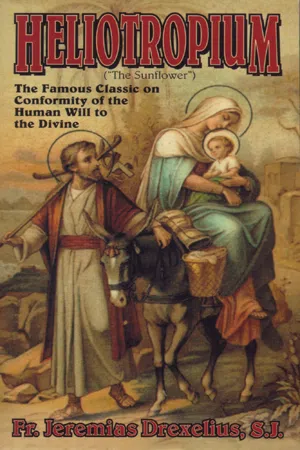
A 17th century classic on conforming our will with God's will. Uniformity with God's will is the easiest way to achieve peace of heart and happiness in this world, and this book is the best guide to discovering God's will for us and living it out in our daily lives. Impr. 428 pgs,
eBook - ePub
Heliotropium
Conformity of the the Human Will to the Divine
- 428 pages
- English
- ePUB (mobile friendly)
- Available on iOS & Android
eBook - ePub
About this book
Information
Topic
Theology & ReligionSubtopic
Christian DenominationsBOOK V
CONCERNING THE AIDS IN CONFORMING THE HUMAN WILL TO THE DIVINE
"The Lord is with us, fear ye not." Numb. XIV. 9.

THE HELIOTROPIUM
BOOK V
CHAPTER I
THAT THERE CAN BE NO CONFORMITY OF THE HUMAN WILL TO THE DIVINE WITHOUT GREAT TRUST IN GOD
THE oblation of self to the Divine Will will never be perfect unless in all things we thoroughly trust in God. For how can I be in agreement with another in all things, if I do not trust in him? And how can I trust in him, if I do not believe that he will faithfully and diligently care for what belongs to me? I must now, therefore, treat of placing Trust in God.
1. To one who desires to know what the Holy Scriptures say about this virtue, an eminent writer (Luiz of Granada) replies:—"Scarcely a single chapter can be found in the Sacred Writings in which God does not promise His help, and Grace, and Providence to those who trust in Him." David, that holy king, who is a most admirable instructor in this kind of Trust, strenuously enforces this single virtue in almost all the Psalms. "But let all them be glad that hope in Thee: they shall rejoice forever and thou shalt dwell in them." (Ps. V. 12.) "I will love Thee, O Lord, my strength: the Lord is my Firmament, my Refuge, and my Deliverer. My God is my Helper, and in Him will I put my trust. My Protector and the Horn of my salvation, and my Support." (Ps. XVII. 2, 3.) "The Lord is my Light and my Salvation, whom shall I fear? The Lord is the Protector of my life: of whom shall I be afraid? If armies in camp should stand together against me, my heart shall not fear. If a battle should rise up against me, in this will I be confident." (Ps. XXVI. 1-3.) "He that dwelleth in the aid of the Most High, shall abide under the protection of the God of Jacob." (Ps. XC. 1.) "They that put their trust in the Lord shall be as Mount Sion: he shall not be moved for ever." (Ps. CXXIV. 1.) "In Thee, O Lord, have I hoped, let me never be confounded: deliver me in Thy justice." (Ps. XXX. 2.)
The heart of this king was capacious, and very full of a mighty Trust in God. He gave forth, in truth, those Divine streams from which he had already drunk.
And this same Trust in God the wisest and holiest of men have ever commended very highly. Solomon, that prodigy of wisdom, says,—"Have confidence in the Lord with all thy heart." (Prov. III. 5.) It is not any kind of trust which he requires, but that which proceeds from the entire heart. And so also the chief of the Apostles,—"Casting all your care upon Him, for He hath care of you." (1 Pet. V. 7.) And the Psalmist,—"Cast thy care upon the Lord, and He shall sustain thee." (Ps. LIV. 23.) Solomon, too, gives this advice,—"In all thy ways think on Him, and He shall direct thy steps." (Prov. III. 6.) "It is good to confide in the Lord, rather than to have confidence in man." (Ps. CXVII. 8.) "Blessed be the man that trusteth in the Lord, and the Lord shall be his confidence. And he shall be as a tree that is planted by the waters, that spreadeth out its roots towards moisture: and it shall not fear when the heat cometh. And the leaf thereof shall be green, and in the time of drought it shall not be solicitous, neither shall it cease at any time to bring forth fruit." (Jer. XVII. 7, 8.) "And thus consider through all generations: that none that trust in Him fail in strength." (1 Mach. II. 61.) "Blessed are all they that trust in Him." (Ps. II. 13.) For this Trust constrains God to do good to you if you put your Trust in Him. Therefore, trust in God, and abide in your own appointed place, contented with your lot. Cheerfully embrace your condition, however lowly, and refrain from stretching yourself beyond the measure of the rule which God has apportioned to you. Remember "that man liveth not by bread alone" (Luke IV. 4); "that God is able of these stones to raise up children to Abraham" (Matt. III. 9); and that "it is easy for the Lord to save either by many, or by few." (1 Kings XIV. 6.)
2. Amasias, King of Juda, hired an army for a hundred talents of silver, by the payment of which sum he brought to his standard a hundred thousand men. And when he had done this,—"A man of God came to him, and said: O King, let not the army of Israel go out with thee, for the Lord is not with Israel, and all the children of Ephraim: And if thou think that battles consist in strength of the army, God will make thee to be overcome by the enemies: for it belongeth to God to help, and to put to flight. And Amasias said to the man of God: What will then become of the hundred talents which I have given to the soldiers of Israel? and the man of God answered him: The Lord is rich enough to be able to give thee much more than this." (2 Par. XXV. 7-9.) Amasias trusted in God and obeyed, and slew twenty thousand of his enemies. So great a thing is it to trust in God, and not in human strength.
Sir Thomas More, a man of remarkable saintliness and learning, when he was in prison replied to the arguments of his daughter Margaret in nearly these words:—"Nothing," he said, "can happen which God does not will. Moreover, what He wills, however much it may appear to us to be evil, is in reality the best thing that can happen. I will not distrust the Goodness of God, my Margaret, however weak and frail I may feel myself to be. Yea, if I perceived myself to be in such a state of terror and dread that I should seem likely to fall immediately, still I would remember that St. Peter through little faith began to sink with a single blast of wind, and I would do what he did, I would call upon Christ and say, 'Lord, save me.' And I trust that He would stretch forth His Hand and take hold of me, and would not suffer me to sink. But if He should permit me even further to enact the part of Peter, and to fall entirely, and to deny Him with oaths and curses, yet I still hope He would look upon me with the eye of His bounteous Mercy, and would raise me up again, so that I might confess the Truth afresh, unburden my conscience, and manfully endure the pain and shame of my former denial. In one word, I hold it as most certain that without my own fault God will not forsake me." And this was said like a wise and Christian man; for Divine Providence mingles itself with all things, and we know that while numberless people are restrained by it from falling, none are impelled by it to fall. "When he shall fall he shall not be bruised, for the Lord putteth His Hand under him." (Ps. XXXVI. 24.) And how can he be injured who falls upon so soft a couch? Wherefore, before all things we must trust in God.
3. And what does our Lord inculcate in so many ways, and urge upon us, but this very Trust in God? How variously does our Divine Master reason upon this subject from birds, and flowers, and the hairs of our head, to encourage us to this Trust. Thus, when bringing before us the ravens, and lilies, and sparrows, He says,—"Consider the ravens: for they sow not, neither do they reap; neither have they storehouse nor barn; and God feedeth them: how much are you more valuable than they? And which of you by taking thought can add to his stature one cubit? If then ye be not able to do so much as the least thing, why are you solicitous for the rest? Consider the lilies how they grow: they labour not, neither do they spin; but I say to you, not even Solomon in all his glory was clothed like one of these. Now if God clothe in this manner the grass that is to-day in the field, and tomorrow is cast into the oven; how much more you, O ye of little faith?" (Luke XII. 24-28.) And by how many illustrations did our Lord urge His disciples, in order to teach them to trust entirely in God. Thus, too, when He was about to feed the five thousand in the wilderness, He inquired of Philip whence they can buy bread. "And this He said to try him." (John VI. 6.) And so also, when about to feed the four thousand, He called the disciples into council upon the same matter, and asked,—"How many loaves have ye?" But their Trust in Him was small, and so they replied,—"From whence can anyone fill them here with bread in the wilderness?" (Mark VIII. 4.) Oh, Sirs, God can do it, who wills that in all things we should trust in Him without wavering. Divine Providence cannot be deceived, and it wills not to deceive any one. God will abide by His promises.
4. Tostatus, a bishop, and a prodigy of learning, discoursing on the Chronicles of the Kings, says,—"Such is the law of Adam, which man is bound to observe with God; viz., that when any one humbles himself before God, and worships Him to the utmost of his power, God also will show His care for him." For to whom do we cry,—"Our Father, who art in Heaven?" Surely this munificent Father will abundantly provide for all. "But if," says S. Jerome, "small animals depart not from God, Who is their Creator, and if His Providence is over all things, and those among them which are destined to perish do not perish without the Will of God, ought not you, who are immortal, to fear because you live without regard to the Providence of God? Why, then, do we not trust in Him with all our strength, and excite feelings worthy of so great a Father? Not even in the very fire ought we to despair. Are we straitened in domestic matters? We have a rich Master Who never suffers those who belong to Him to die of hunger. Do hosts of enemies rise against us, whether springing from the earth, or excited by hell? We have a Leader of greater power than these, Who with one blast will scatter the armies of the kingdom of darkness. Do slanderous tongues harass us, and load us with false accusations? Let us look at God, our Judge and Avenger, and we shall not fear earthly things; for God will not suffer Himself to be vanquished by man, or his bounty to be outdone by human trust. Does any one dare to trust in Him? God will dare to give him greater blessings. Does any one venture to hope for much? God will overpass human hope, and from the rich treasure-house of Heaven will bestow on him far greater blessings than he thought of; so that, in order to banish human need, it is enough to have placed one's Trust in God, and to have had great hopes of his bounty. For the greater the hope is, the greater are the heavenly gifts. So that we may perceive that human hope and trust are not merely equalled by the Divine bounty, but in numberless ways are surpassed by it. And a most glorious struggle is this! Man's great trust in God with the boundless liberality of God; entered upon, as it were, with prodigal rivalry, on both sides, of trust and munificence, just as if man did not will to be conquered, while God is not able to be conquered.
5. And here listen to S. Augustine, Bishop of Hippo, (In Ps. CXLV.), who argues most forcibly:—"God," he says, "made the heaven, and the earth, and the sea, and all that is in them; if, therefore, He made all that is in them, He made you also, sparrow, locust, and worm; there is none of these which He made not, and He has a care for them all. Forbear, therefore, to say, 'I belong not to God;' your soul belongs to God, and your body belongs to God, because God made both your soul and your body. You reply perhaps, 'God does not take account of me among such a great multitude.' What? God not take account of you, Who numbers even all the hairs of your head? 'But we are sometimes involved,' you say, 'in such misfortunes, and so are entirely stripped of all consolations and help, that it is not to be wondered at if our trust does sometimes falter.'" Here, also, S. Augustine shall answer for me. And I pray all you who read this, or hear it read, to treasure in your inmost heart the reply of that most holy man:—"Whatever, then," says Augustine (In Ps. CXLVII.), "happens to us here contrary to our will, you must understand that it does not happen except by the Will of God, by His Providence, by His Ordinance, by His Good-pleasure, by His Laws. And if we understand not why anything is done, let us ascribe it to His Providence, because it is not done without cause." And that the matter may be made the clearer by examples, the same holy Father says (In Ps. CXLVII.):—"Who hath arranged the limbs of a flea and a gnat that they should have their proper order, life, motion? Consider one little creature, even the very smallest, whatever thou wilt. If thou considerest the order of its limbs, and the animation of life whereby it moveth, how doth it shun death, love life, seek pleasures, avoid pain, exert divers senses, and vigorously use movements suitable to itself! Who gave its sting to the gnat for it to suck blood with? How narrow is the pipe whereby it sucketh! Who arranged all this? Who made all this? Thou art amazed at the smallest things; praise Him that is great." And so fear God as the Judge, hope in Him as the Rewarder, and in none else; and thus, rising superior to all human affairs, put your trust in God alone, feeling sure that He is neither able nor willing to deceive. "No one hath hoped in the Lord, and hath been confounded." (Ecclus. II. 11.) "Blessed are all they that trust in Him." (Ps. II. 13.)
CHAPTER II
WHEREIN TRUST IN GOD CONSISTS
HOW small is the knowledge which we wretched mortals have of God! Scarcely through a crevice even do we derive any Divine light. This much, indeed, we know, that God is the Supreme Good, and is so boundlessly supreme that we may not lawfully seek or wish for anything which we are not able to obtain from this so great Good. In His time we shall certainly obtain all we desire, only let us not meanwhile fail in courage, but standing firm, with perfect Trust in God, let us believe that,—"It is good to wait with silence for the salvation of God." (Lam. III. 26.) The Lord is good to those who hope in Him, and to the soul which seeks Him. But wherein this Trust in God chiefly consists we will now proceed to examine.
1. Trust is superior to hope in this way, that it is not hope of every kind, but that which is of the greatest vigour and perfection. Seneca (Ep. 16) well observes this distinction when he says,—"I have hope of you, but not trust as yet." Now it is necessary that this Trust in God should embrace all human actions, for under all circumstances, great and small alike, and in all the affairs of life, we must trust in God with the utmost sincerity, believing that He will never fail those that put their trust in Him.
King David founded a school, and "commanded that they should teach the children of Juda the use of the bow, as it is written in the book of the just" (2 Kings I. 18); and in this art Jonathan, the king's son, greatly excelled, for so sure a marksman was he that he received this commendation from his beloved friend David,—"The arrow of Jonathan never turned back," (2 Kings I. 22;) for his arrows were wont not to strike lightly, or merely graze the surface, but to pierce through the armour of his enemies. And such a bow is Trust in God; it both hits and pierces the Heart of God with its arrows that never miss their mark. But of all the kings of Israel and Juda (there were thirty-nine in all) how many were able to use this bow? Three or four only out of the whole number; David, Ezekias, Josias, with whom Josaphat also might be reckoned, since he abolished the sacrifices in the high places. The heart of these kings was certainly perfect with God, and ever full to overflowing with entire Trust in Him.
When a vast army of Moabites and Ammonites was threatening King Josaphat, and he was utterly inferior in numbers to the enemy, with sure Trust he "betook himself wholly to pray to the Lord" (2 Par. XX. 3,) and when he had prayed at great length, he added to his prayer this most excellent clause, "but as we know not what to do, we can only turn our eyes to Thee." (Ver. 12.) "And Jahaziel was there, upon whom the Spirit of the Lord came in the midst of the multitude, and he said: Attend ye, all Juda, and you that dwell in Jerusalem, and thou King Josaphat: Thus saith the Lord to you: Fear ye not, and be not dismayed at this multitude: for the battle is not yours, but God's. It shall not be you that shall fight, but only stand with confidence, and you shall see the help of the Lord over you, O Juda, and Jerusalem: fear ye not, nor be you dismayed: to-morrow you shall go out against them, and the Lord will be with you." (Ver. 14, 15, 17.) Josaphat was greatly encouraged by these words, and led his army against the enemy; but, lest his soldiers should be afraid to engage so vast a host, like a careful general he fortified their courage and said,—"Believe in the Lord your God, and you shall be secure: believe His prophets, and all things shall succeed well." (Ver. 20.) And then, unlike what is usually done in battles, "he appointed the singing men of the Lord, to praise him by their companies, and to go before the army, and with one voice to say: Give glory to the Lord, for His mercy endureth for ever." (Ver. 21.) Behold, the King advancing with his army to b...
Table of contents
- Cover Page
- Copyright Page
- EXPLANATION OF THE TITLE OF THIS BOOK
- PREFACE
- CONTENTS
- BOOK I CONCERNING THE RECOGNITION OF THE DIVINE WILL
- BOOK II CONCERNING THE CONFORMITY OF THE HUMAN WILL TO THE DIVINE
- BOOK III CONCERNING THE BENEFITS ARISING FROM THE CONFORMITY OF THE HUMAN WILL TO THE DIVINE
- BOOK IV CONCERNING THE HINDRANCES TO CONFORMITY OF THE HUMAN WILL WITH THE DIVINE
- BOOK V CONCERNING THE AIDS IN CONFORMING THE HUMAN WILL TO THE DIVINE
- SUPPLEMENT
Trusted by 375,005 students
Access to over 1.5 million titles for a fair monthly price.
Study more efficiently using our study tools.
Frequently asked questions
Yes, you can cancel anytime from the Subscription tab in your account settings on the Perlego website. Your subscription will stay active until the end of your current billing period. Learn how to cancel your subscription
No, books cannot be downloaded as external files, such as PDFs, for use outside of Perlego. However, you can download books within the Perlego app for offline reading on mobile or tablet. Learn how to download books offline
Perlego offers two plans: Essential and Complete
- Essential is ideal for learners and professionals who enjoy exploring a wide range of subjects. Access the Essential Library with 800,000+ trusted titles and best-sellers across business, personal growth, and the humanities. Includes unlimited reading time and Standard Read Aloud voice.
- Complete: Perfect for advanced learners and researchers needing full, unrestricted access. Unlock 1.5M+ books across hundreds of subjects, including academic and specialized titles. The Complete Plan also includes advanced features like Premium Read Aloud and Research Assistant.
We are an online textbook subscription service, where you can get access to an entire online library for less than the price of a single book per month. With over 1.5 million books across 990+ topics, we’ve got you covered! Learn about our mission
Look out for the read-aloud symbol on your next book to see if you can listen to it. The read-aloud tool reads text aloud for you, highlighting the text as it is being read. You can pause it, speed it up and slow it down. Learn more about Read Aloud
Yes! You can use the Perlego app on both iOS and Android devices to read anytime, anywhere — even offline. Perfect for commutes or when you’re on the go.
Please note we cannot support devices running on iOS 13 and Android 7 or earlier. Learn more about using the app
Please note we cannot support devices running on iOS 13 and Android 7 or earlier. Learn more about using the app
Yes, you can access Heliotropium by Rev. Fr. Jeremias Drexelius, S.J. in PDF and/or ePUB format, as well as other popular books in Theology & Religion & Christian Denominations. We have over 1.5 million books available in our catalogue for you to explore.