It has ever been the practice of the Catholic Church to recommend to her spiritual children the meditation on man's Four Last Things - death, Judgment, Heaven and Hell. Keeping these sobering aspects of human destiny ever before our eyes, we will be that much less likely to fall into mortal sin and be lost eternally. Gives many facts we should meditate on as we contemplate death. This book has converted numerous Protestants in our day because of its cogent reasons for rectifying our lives. Impr. 223 pgs,
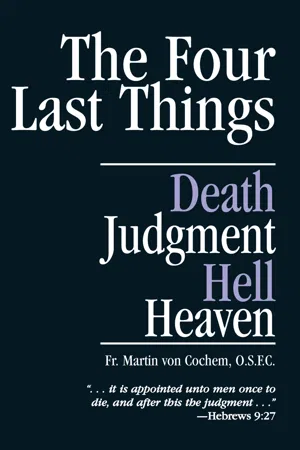
- 223 pages
- English
- ePUB (mobile friendly)
- Available on iOS & Android
eBook - ePub
About this book
Information
Topic
Theology & ReligionSubtopic
Christian DenominationsTHE FOUR LAST THINGS.

PART I.
ON DEATH.

CHAPTER I.
ON THE TERRORS OF DEATH.
IT appears to me unnecessary to say much about the terrors of death. The subject has been sufficiently enlarged upon by various writers; besides, every one knows and feels for himself that life is sweet and death is bitter. However old a man may be, however broken in health, however miserable his circumstances, the thought of death is an unwelcome one. There are three principal reasons why all sensible people fear death so much:
First, because the love of life, the dread of death is inherent in human nature. Secondly, because every rational being is well aware that death is bitter, and the separation of soul and body cannot take place without inexpressible suffering. Thirdly, because no one knows whither he will go after death, or how he will stand in the Day of Judgment.
It will be well to explain the second and third of these reasons rather more fully, in order on the one hand that those who lead a careless life may perhaps be awakened thereby to a fear of death, and learn to avoid sin, and on the other that each one of us may be warned to prepare for death, lest we be overtaken by it unawares. Every one shrinks instinctively from death, because it is bitter, and painful beyond description to human nature. The soul of man is subject to many anxieties, apprehensions and sorrows, and the body is subject to pain and sickness of all kinds, yet none of these pains can be compared to the agony of death. A man who loses his good name and his property feels acute grief, but he does not die of it. All suffering and sickness, all grief and anguish, however terrible, is less bitter than death. Hence we see death to be a mighty monarch, the most cruel, the most relentless, the most formidable enemy of mankind. Look at a man wrestling with death, and you will see how the tyrant overpowers, disfigures, prostrates his victim.
Now why is death so hard, so terrible a thing? It is because the soul has to separate itself from the body. Body and soul were created for each other, and so intimate is their union that a parting between them seems almost impossible. They would endure almost anything rather than be torn asunder. The soul is fearful of the future, and of the unknown land to which she is going. The body is conscious that as soon as the soul departs from it, it will become the prey of worms. Consequently the soul cannot bear to leave the body, nor the body to part from the soul. Body and soul desire their union to remain unbroken, and together to enjoy the sweets of life.
In one of his epistles to St. Augustine, St. Cyril, Bishop of Jerusalem, relates what was told him by a man who had been raised from the dead. Amongst other things, he said: "The moment when my soul left my body, was one of such awful pain and distress that no one can imagine the anguish I then endured If all conceivable suffering and pain were put together they would be as nothing in comparison with the torture I underwent at the separation of soul and body." And to emphasize his words, he added, addressing St. Cyril: "Thou knowest that thou hast a soul, but thou knowest not what it is. Thou knowest that beings exist called angels, but thou art ignorant of their nature. Thou knowest also that there is a God, but thou canst not comprehend His being. So it is with everything that has not corporeal shape; our understanding cannot grasp these things. In like manner it is impossible for thee to understand how I could suffer such intense agony in one short moment."
And if some people apparently pass away most peacefully, this is because nature, exhausted by suffering, has no longer the force to struggle with death. We know from the testimony of Our Redeemer Himself that no agony is like the agony of death. Although throughout the whole course of His sorrowful Passion, He was tortured in a terrible manner, yet all the martyrdom He endured was not to be compared with what He suffered at the moment of His death. This we gather from the Gospels. Nowhere do we find that at any period of His life the greatness of the pains He bore extorted from Our Lord a cry of anguish. But when the moment came for Him to expire, and the ruthless hand of death rent His Heart asunder, we read that He cried out with a loud voice, and gave up the ghost. Hence it is evident that at no period of the Passion did Christ suffer so acutely as at the most painful separation of His sacred soul from His blessed body.
In order that mankind might at least in some measure understand how terrible was the death Christ died for us, He ordained that we, at our dissolution, should taste something of the bitterness of His death, and experience the truth of the following words of Pope St. Gregory: "Christ's conflict with death represented our last conflict, teaching us that the agony of death is the keenest agony that man has ever felt or will ever feel. It is the will of God that man should suffer so intensely at the close of his life, in order that we may recognize and appreciate the magnitude of Christ's love for us, the inestimable benefit He has conferred on us by enduring death for our sakes. For it would have been impossible for man fully to know the infinite love of God, unless he too had drunk to some extent of the bitter chalice which Christ drank."
In this passage from the writings of the holy Pope Gregory we are taught that Christ ordained that all men in the hour of their dissolution should suffer the like pains which Christ suffered for us in His last agony, in order that they may gain some knowledge, by their own experience, of the terrible nature of the death He endured for us, and the great price He paid for our ransom. How painful, how terrible, how awful death will be for us, if our death is in any degree to resemble Christ's most agonizing death!
How severe a conflict is before us poor mortals! What torments await us at our last hour! One is almost inclined to think it would have been preferable never to have been born, than to be born to suffer such anguish. But it is thus that heaven is to be won, and through this narrow gate alone can we enter into paradise. Wherefore, O Christian, accept your destiny cheerfully, and form a steadfast resolution to bear unmurmuringly the bitterness of death. For it is a great merit to yield up one's life—the life every man loves so well—and submit with a ready and willing mind to the pangs of death. And for the purpose of encouraging you to gain merit in your last moments, let me counsel you to make the following determination to suffer death bravely.
RESOLUTION.
O God of all justice, who hast ordained that since the Fall of our first parents all men should die, and also that it should be the lot of many amongst us to taste in their death something of the pains Thy Son endured at the hour of His death, I submit most willingly to this Thy stern decree. Although life is sweet to me, and death appears most bitter, yet out of obedience to Thee I voluntarily accept death with all its pains, and am ready to yield up my soul whenever, wherever, in what way or manner soever it may please Thy divine providence to appoint. And since Thou hast made death so bitter to man, in order that we may feel to a certain extent by our own experience how painful a death Thy beloved Son underwent for our sakes, I willingly accept the penalty of death, that I may at least at my latter end know something of the pains my blessed Lord suffered on my account. In honor, therefore, of His bitter Passion and death, I now cheerfully subject myself to whatever sufferings I may be called upon to pass through at the moment of my departure, and declare my determination to bear them with all the constancy of which I am capable. I pray that this resolution on my part may be pleasing in Thy sight, and that Thou wilt give me grace to bear my last agony with patience. Amen.
CHAPTER II.
ON THE ASSAULTS OF SATAN AT THE HOUR OF DEATH.
ALTHOUGH death is in itself most bitter, yet its bitterness is not a little enhanced by the vivid remembrance of the sins of our past life, by the thought of the judgment to come, of the eternity before us, and by the assaults of Satan. These four things fill the soul with such terror, that it would infallibly despair unless strengthened by the help of God. We will enter into some explanation of each of these four things, and also indicate some means of combating the fears they inspire.
With regard to the assaults of Satan, know that the all-just God permits him to have great power to assail us at the hour of death; not indeed for our perdition, but for our probation. Before expiring the Christian has yet to prove that nothing can avail to make him forsake his God. For this reason the evil enemy employs all the power he has received, and brings all his forces to bear upon a man when he is dying, in the hope of causing him to sin, and thrusting him down to hell. During our whole lifetime he attacks us fiercely, and neglects no means whereby he may deceive us. But all these persecutions do not bear comparison with the final onslaught with which he endeavors to overcome us at the last. Then he raves and rages, like a roaring lion, seeking whom he may devour.
This we learn from the following passage in the Apocalypse (xii. 12): "Woe to the earth and to the sea, because the devil is come down unto you, having great wrath, knowing that he hath but a short time." These words bear a special application for the dying, against whom the devil conceives a great wrath, and whom he makes every effort to seduce. For he knows full well that if he does not get them into his power now, he will never again have the chance of doing so. Hear what St. Gregory says on this point: "Consider well how terrible is the hour of death, and how appalling the remembrance of our evil deeds will be at that time. For the spirits of darkness will recall all the harm they have done us, and remind us of the sins which we have committed at their instigation. They will not go to the deathbed of the godless only, but they will be present with the elect, striving to discover something sinful whereof to accuse them. Alas! how will it fare with us hapless mortals in that hour, and what can we say for ourselves, seeing how innumerable are the sins to be laid to our charge? What can we answer to our adversaries, when they place all our sins before us, with the object of reducing us to despair?"
The evil spirits will tempt their unhappy victim at the moment of death on various points, but especially in regard to the sins into which he has most frequently fallen. If during his lifetime he has cherished hatred towards any one, they will conjure up before his dying eyes the image of that person, rehearsing all he did to injure him, in order to revive the flame of hate towards that enemy, or kindle it anew. Or if any one has transgressed against purity, they will show him the accomplice of his sin, and strive to awaken the guilty passion felt for that individual. If he has been troubled with doubts concerning faith, they recall to his mind the article of belief which he had difficulty in accepting, representing it to him as untrue. If a man has a tendency to pusillanimity, the evil spirits encourage it in him, that they may perchance rob him of his hope of salvation. The man who has sinned through pride, and boasted of his good works, they seek to ensnare by flattery, assuring him that he stands high in the favor of God, and all he has done cannot fail to secure him a place in heaven. Again, if in his lifetime a man has given way to impatience, allowing himself to be angry and irritated by every trifle, they make his illness appear most irksome to him that he may become impatient, and rebel against God for having sent upon him so painful a malady. Or if he has been tepid and indevout, without fervor in prayer or assiduity in his religious exercises they try to maintain in his soul this state of apathy, suggesting to him that his physical weakness is too great even to allow him to join in the prayers his friends read to him. Finally, they tempt those who have led a godless life, and repeatedly fallen into mortal sin, to despair, representing their transgressions to be so great as to be past forgiveness. In a word, the spirits of evil assail mortals at the moment of death most fiercely at their most vulnerable point, just as a skilful general will storm a fortress on the side where he perceives the ramparts to be weakest.
But the devils do not always confine themselves to tempting a man in regard to his chief failings and predominant faults; they frequently tempt him to sins of which he has not hitherto been guilty. For these crafty foes spare no pains to deceive the dying, and if they fail in one way, they attempt to succeed in another. These temptations are of no ordinary character. They are sometimes so violent that it is impossible for weak mortals to resist them without supernatural assistance. If it is all that any one in good health can do to withstand the assaults of the devil, and even such a one is often overcome by them, how difficult must it be for one who is enfeebled by sickness to struggle against foes so formidable! On this point a pious writer says: "Unless the dying man has, previous to his last illness, armed himself against these attacks, and accustomed himself to do battle with his spiritual adversaries, he stands a poor chance of prevailing against them at the moment of death. If he does so, it will be only through the assistance of almighty God, of our blessed Lady, of his guardian angel, or of one of the saints. For our merciful God and His angels and blessed saints do not abandon the Christian in the hour of his direst need; they hasten to his help, that is, provided he is deserving of their aid." In order to prepare one's self before one's last illness to combat these temptations, it will be advisable to recite with due devotion the following prayer:
O Jesus, compassionate Redeemer of mankind, I recall to mind the threefold temptation Thou didst undergo from the evil enemy, and I pray Thee through the glorious victory Thou didst obtain over him, to stand by me in my last conflict and fortify me against all his temptations. I know that in my own strength I cannot contend against so powerful a foe, and I must assuredly be vanquished unless Thou, or Thy blessed saints, grant me timely assistance. Therefore I now earnestly implore Thy help and that of Thy saints, and propose to arm myself to the best of my ability by Thy grace, to meet the temptations that await me. I promise now, before Thee and the holy angels and blessed saints, that I will never voluntarily expose myself to any temptation, of whatever nature it may be, but with the help of Thy grace I will combat it vigorously. Amen.
CHAPTER III.
ON THE APPARITION OF THE SPIRITS OF DARKNESS.
BESIDES what has been already mentioned, the terrible appearance of the evil spirits makes death yet more alarming to us. It is the opinion of many of the Fathers, that every one, when expiring, sees the evil enemy, at any rate at the moment of drawing his last breath, if not before. How appalling this sight is, and with what terror it must inspire the dying, exceeds the power of words to declare. It is related of Brother Giles that one day, when he was praying in his cell, the devil appeared to him in so frightful a shape, that the Brother lost the power of speech, and thought his last hour had come. As his lips could not utter a sound, he raised his heart in humble supplication to God, and the apparition vanished. Afterwards, when relating what had befallen him to his brother-monks, he trembled from head to foot as he described the hideous aspect of the adversary of mankind. Then going to St. Francis, he asked him this question: "Father, have you ever seen anything in this world the sight of which was so horrible that it was enough to kill one to behold it?" And the Saint replied: "I have indeed seen such a thing; it is none other than the devil, whose aspect is so loathsome that no one could gaze upon it even for a short time and live, unless God specially enabled him to do so."
St. Cyril also, writing to St. Augustine, says that one of the three men who were raised from the dead told him: "As the hour of my departure drew nigh, a multitude of devils, countless in number, came and stood about me. Their forms were more horrible than anything imagination can conceive. One would rather be burnt in the fire than be compelled to look upon them. These demons ranged themselves around me, and reproached me with all the misdeeds I had ever done, thinking to drive me to despair. And in fact I should have given way before them, had not God in His mercy come to my succor."
Here we have the testimony of one who actually had learnt by his own experience how frightful the appearance of the evil enemy is, and who declares that nothing can be more horrible than the form the devil assumes.
O my God! how overwhelming the terrors that will take possession of the hapless individual who lies at the point of death when the infernal dragon appears, full of rage, and threatening to swallow him up in his fiery jaws.
In this hour of supreme distress, send my guardian angel to me, O God, I pray Thee, that he may drive away the evil enemy, otherwise I shall infallibly fall into despair and lose all hope of my salvation.
O most blessed Virgin Mary! who didst crush the head of the serpent, be with me in the hour of my death and do not permit the presence of the cruel adversary to cause my eternal perdition.
CHAPTER IV.
ON THE FEAR OF HELL.
DEATH is rendered yet more bitter to us by the fear of hell and the clear view of eternity before us. For when we are dangerously ill, and death stares us in the face, the terror which fills us at the prospect of eternity is so overwhelming, that we are filled with fear. For we see plainly that in a few days—a few hours perhaps—we must enter eternity, and we know not what awaits us there. The dread lest we should be lost everlastingly is so great as to cause us to shudder.
Moreover, the alarm that tortures us is not a little augmented by the remembrance of the sins whereby we have oftentimes deserved hell; for no man can be certain whether he has done penance aright, and whether he has really obtained pardon. This is explained by a passage from the writings of the aforementioned Pope St. Gregory, who describes this fear in the following words:
"The just man who is...
Table of contents
- Cover Page
- Copyright Page
- OTHER BOOKS BY FATHER VON COCHEM
- PUBLISHER'S PREFACE
- CONTENTS
- PART I. —ON DEATH.
- PART II. —THE LAST JUDGMENT.
- PART III. —ON HELL.
- PART IV. —ON HEAVEN.
Trusted by 375,005 students
Access to over 1.5 million titles for a fair monthly price.
Study more efficiently using our study tools.
Frequently asked questions
Yes, you can cancel anytime from the Subscription tab in your account settings on the Perlego website. Your subscription will stay active until the end of your current billing period. Learn how to cancel your subscription
No, books cannot be downloaded as external files, such as PDFs, for use outside of Perlego. However, you can download books within the Perlego app for offline reading on mobile or tablet. Learn how to download books offline
Perlego offers two plans: Essential and Complete
- Essential is ideal for learners and professionals who enjoy exploring a wide range of subjects. Access the Essential Library with 800,000+ trusted titles and best-sellers across business, personal growth, and the humanities. Includes unlimited reading time and Standard Read Aloud voice.
- Complete: Perfect for advanced learners and researchers needing full, unrestricted access. Unlock 1.5M+ books across hundreds of subjects, including academic and specialized titles. The Complete Plan also includes advanced features like Premium Read Aloud and Research Assistant.
We are an online textbook subscription service, where you can get access to an entire online library for less than the price of a single book per month. With over 1.5 million books across 990+ topics, we’ve got you covered! Learn about our mission
Look out for the read-aloud symbol on your next book to see if you can listen to it. The read-aloud tool reads text aloud for you, highlighting the text as it is being read. You can pause it, speed it up and slow it down. Learn more about Read Aloud
Yes! You can use the Perlego app on both iOS and Android devices to read anytime, anywhere — even offline. Perfect for commutes or when you’re on the go.
Please note we cannot support devices running on iOS 13 and Android 7 or earlier. Learn more about using the app
Please note we cannot support devices running on iOS 13 and Android 7 or earlier. Learn more about using the app
Yes, you can access The Four Last Things by Rev. Fr. Martin Von Cochem in PDF and/or ePUB format, as well as other popular books in Theology & Religion & Christian Denominations. We have over 1.5 million books available in our catalogue for you to explore.