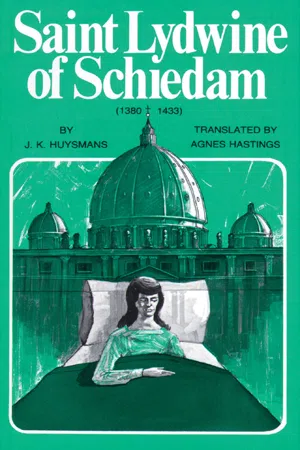
St. Lydwine was bedridden from age 15, when she broke a rib, endured a lifelong illness which was recognized to be of supernatural origin. Her body became covered with sores and abscesses and virtually came apart into three pieces-symbolically representing the condition of the Church. She ate no food except Holy Communion and experienced many mystical phenomena. An incredible story of one of the most heroic victim souls in the history of the Church.
- 252 pages
- English
- ePUB (mobile friendly)
- Available on iOS & Android
eBook - ePub
About this book
Information
Topic
Theology & ReligionSubtopic
Christian DenominationsCHAPTER I.
THE state of Europe during Lydwine's lifetime was terrible. In France, first Charles VI. reigned, then Charles VII. Lydwine was born in the same year that Charles VI., at twelve years of age, ascended the throne of France. Even at this distance of time, the years of his reign call up horrible memories; they drip with blood and reek of licence; and in the light of the old chronicles, behind the dusty veil of history, four figures pass by.
The first is a man of weak intellect, with pale face and hollow cheeks, with eyes now dull, now full of fire. He vegetates in a palace in Paris, his clothes over-run with vermin, his hair and beard swarming with lice. This wretched being, before he became demented, had been a familiar figure, debauched, irascible and weak. It is the King, Charles VI., an imbecile taking part in the wild debauches of those afflicted like himself.
The second is an intriguing woman, eccentric, unreliable and imperious, wearing a head-dress ornamented like a devil's head with two horns, and a dress cut very low in the neck, and trailing after her a figured train of great length; she shuffles as she walks, shod in slippers with points two feet long. This is the Queen of France, the Bavarian Ysabeau, who, absorbed in the writings of some unknown author, takes her place by the side of the husband she abhors.
The third is a vain gossip whom the ladies of the Court adore, and who shows himself, at one and the same time, cordial and rapacious, affable and cunning. He oppresses the people, drains the money from both countryside and town, and dissipates it in scandalous escapades. This is the Duke of Orleans, cursed of the people, and denounced from the pulpit by a monk of the Augustinian order, Jacques Legrand.
The fourth, a little wizened creature, taciturn, suspicious and cruel, is the Duke of Burgundy, familiarly known as John the Pitiless.
All four wrangle, curse each other, quarrel and make it up, executing a sort of devil's dance in the decay of a country already half ruined by the insanity of its King. France is indeed convulsed. Paris is given over to all the atrocities of civil war, with butchers and cut-throats as dictators, who bleed the bourgeois as if they were beasts. The country is over-run with bands of brigands, who overwhelm the peasants, set fire to their crops, and cast the women and children into the furnaces of the mills. There are the criminal hordes of the Armagnacs, the rapacious crowd of Burgundians, and those who stretch out their hands to the English to help them to cross the Channel. The English do, indeed, disembark near Harfleur, march on Calais, and meet the French army on the way, in the county of St. Pol, at Azincourt. They attack, and have no difficulty in overthrowing, like ninepins, the long files of heavy knights, prisoned, as it were, in sentry-boxes of armour and fixed astride their horses, which are motionless, fast stuck in the heavy clay; and, whilst that region is invaded, the Dauphin causes the Duke of Burgundy to be assassinated, who himself had had the Duke of Orleans decapitated on the very day after they had taken the communion from the hands of the same priest, and had been reconciled together. Queen Ysabeau, egged on by her need of money, sold herself to the enemy, and obliged the imbecile King to sign the treaty of Troyes; thus disinheriting her son in favour of the sovereign of England, who became heir to the crown of France. The Dauphin would not accept this deprivation, but, too weak to resist, he took to flight, and was proclaimed King by some adventurers in a manor house of Auvergne. The country was split into two camps, betrayed by the one, broken by the blows of the other, and pillaged by both. It seemed as if the kingdom of France was doomed when, at a few months' interval, the King of England, Henry V., and the King of France, Charles VI., died; but the struggle still continued between the two nations. Charles VII., timid and thoughtless, always with his back turned towards the enemy ready for flight, abandoned himself to low intrigues, whilst the enemy robbed him of his provinces one by one. There was really no saying how much would be left of France, when the heavens were moved and Joan of Arc was sent. She accomplished her mission, repulsed the strangers, led her miserable monarch to Rheims for his sacring, and expired, abandoned by him, in the flames, two years before the death of Lydwine.
Thus the condition of France at the end of the fourteenth and beginning of the fifteenth century was lamentable; for as though human enemies were not enough, other scourges were added. The black death ravaged the country and mowed down millions of her people; that disappeared and was replaced by the tac, an epidemic much feared for the terrible virulence of its cough; when this died out the plague re-appeared, and emptied Paris of fifty thousand persons in five weeks, leaving three years' famine in its train; and then again the tac returned and depopulated the towns still further.
If the condition of France was lamentable, that of England, who was torturing her, was hardly better. To the risings of the people, succeeded the revolts of the nobles. The King, Richard II., made himself odious by his debauches and robberies. He set out to quell the troubles in Ireland, but was deposed, and the Duke of Lancaster, under the title of Henry IV., was elected King in his place. Richard II. was imprisoned and possibly starved to death. The usurper's reign was passed in moderating discords and discovering plots. He burnt, on pretext of heresy, those of his subjects who had displeased him, and dragged out the feeble existence of an epileptic, tormented by the plots of his son who was eager for the succession. He died at the age of forty-seven, and this son, known till then as a drinker and a bandit, an associate of thieves and women, reveals himself, on coming to the throne, as cold and imperious, arrogant beyond measure, and of a ferocious piety. The pharisaism and cupidity of the English race are incarnate in him; he shows the harshness and prudery of the protestant, and is at once an usurer, an executioner, and a methodist parson, born out of due time. He renewed the campaign in Normandy, starved towns, falsified coinage, hanged the prisoners in the name of the Lord, and overwhelmed his victims with sermons. But this sport, in which he was to have been in at the death, grows stale when his army is decimated by the plague. He is, however, victorious at Azincourt; he massacres all those who cannot ransom themselves, and extracts enormous sums from others; and whilst their fate is in the balance, he crosses himself, mumbles prayers, and recites psalms. Then he dies at the Castle of Vincennes, leaving an infant heir some months of age. The infant's guardians—one violent and dissolute, the Duke of Gloucester; the other, vain and cunning, the Duke of Bedford—ravage France, but are completely routed by Joan of Arc, and dishonour themselves for ever in buying her, that they may throw her to the flames after a dishonourable trial.
After France and England, Flanders is taken in the flank and overwhelmed by the storm.
The history of Flanders is intimately bound up with ours, and she too was wasted by internal struggles, for the commercial rivalry between Ghent and Bruges, year after year, strewed the meadowlands with bones and made the rivers run blood.
Ghent reveals herself as a proud and obstinate city, peopled by the ultra pious and by the eternally discontented. Her trades guilds make her the bivouac of strikers, the camp in which the vile and seditious find a welcome; and all the revolutionaries of Europe are in close communication with her. Bruges seems more civilized and less opinionated, but her pride equals that of Ghent, and her love of money is even greater. She is the great emporium of Christianity, and she appropriates greedily all surrounding towns; she is the implacable arbitrator, and if it is a question of a canal which will benefit one of these townships at the expense of another, a hatred equalling that of cannibals springs up. The Count of Flanders, Louis III., tyrannical, vain and prodigal, cruel, too, and unlucky, threw himself against the people of Ghent, and tried to break their obstinacy by persecution. Their chief, Philippe d'Artevelde, marched against him, defeated him, penetrated to Bruges, and there killed for preference its richest merchants; after which he sacked the villages and despoiled the towns. The nobles of Flanders called on France for help; it was a crusade of the nobles against the working classes. Charles VI. and the Duke of Burgundy crossed the frontier, were joined by d'Artevelde at the head of an army at Roosebeke, and charged the Flemings, who had foolishly linked themselves together with chains that retreat might be impossible. The Flemings were twisted and piled one upon another, and suffocated in a very narrow space, without having been able to offer any resistance. It was a triumph of asphyxiation, a battle without injury, a massacre without wounds, a combat during which blood ran only as from casks that are tapped, from the bursting veins of their crushed faces. D'Artevelde was, happily for him, found amongst the dead, for after the victory the vilest passions were unloosed; the country was pillaged, and the women and children were murdered. Places unwilling to be destroyed bought themselves with gold : it was "your money or your life," for these nobles, who had trembled before a troop of undisciplined peasants, showed themselves inexorable. The people of Ghent had recourse to the English, who disembarked to aid them, but gleaned most of the booty left by the French, so that this miserable country became a prey both to those who attacked and those who defended her, though neither depredations nor tortures sapped her incredible energy. Ackerman succeeded d' Artevelde and, supported by a troop from across the Channel, laid siege to Ypres. Charles VI. dislodged him and took Bergues, in which he left no soul alive: then, tired of these orgies of murder, he called a truce. Upon the death of Count Louis III., Philip of Burgundy succeeded. This terrible inheritance came to him by right of his wife. He renewed hostilities and the massacres recommenced. Dam was reduced to ashes; the country called Quatre Métiers became a heap of ruins; and, as if these horrors did not suffice, religious quarrels were added to this interminable conflict. Two Popes were elected at the same time, who bombarded each other with a shower of Bulls. The Duke of Burgundy stood by one of these pontiffs and expected his subjects to follow his guidance, but they refused, and Philip became irritated and decapitated the leaders of the recalcitrant party. Once more the Flemings revolted; the churches were shut, religious offices ceased, Flanders seemed to be excommunicated, and the Duke, exhausted by these disputes, finally left in peace a people he could not control and contented himself with exacting money in exchange for their liberty of conscience.
Such was the situation in Flanders; and if we pass on into Holland we shall see her torn too by incessant strife.
At the moment of Lydwine's birth, Duke Albert, as Rudwaard or vice-regent of Hainault, governed Holland, Zeeland, and Frisia—the provinces which were united under the title of the Low Countries. He replaced the real ruler, his brother, William V., who had gone mad after his impious struggles with his mother, Margaret of Bavaria. Whilst he was under restraint the country had fallen a victim to a violent feud, and a desperate battle had taken place between the red caps or Hoecks, and the grey caps or Kabelljauws. These two parties, the Guelphs and Ghibelins of the Low Countries, were the result of the war between William and the Princess Margaret, the one upholding the son and the other the mother; but these hatreds survived the causes which engendered them, for we find them still active in the sixteenth century.
Directly he was named vice-regent, Albert laid siege to Delft, where he subdued the sedition in six weeks, and then took arms against the Duke of Gueldres and Bishop of Utrecht in a scandalous contest between father and son, which seems a fitting pendant to the rivalry between the mother and son of the last reign.
William V. died, and Duke Albert was proclaimed governor of the provinces. The country, worn by these dissensions, prepared to rest, but Duke Albert was under the influence of his mistress, Adelaïde de Poelgeest, and betrayed the Hoecks, whom he had Poelgeest, and betrayed the Hoecks, whom he had son William caused Adelaïde to be assassinated in the castle of La Haye, and then, fearing his father's vengeance, fled to France; but a rising in Frisia drew father and son together. Persuaded that the murderer was the only man capable of commanding his troops, Albert pardoned and recalled him. He disembarked at Kuinder, and the slaughter was renewed. Frisia ran with blood, but would not own herself conquered. In the year following she revolted anew, was subdued and rose again, this time defeating the armies of the Duke and forcing him to sign a treaty of peace. In courage and tenacity she might have been a second Ghent. This war was hardly over before another broke out; a vassal, the Lord of Arkel, declaring himself independent, at the moment of Albert's death. William VI., who succeeded his father, marched against the rebel, vanquished his garrisons, and obliged him to submit; but the Duke of Gueldres became mutinous, and the Frisians were once more in a ferment. Being very ill and at the end of his resources, William signed an armistice with them after they had captured the town of Utrecht, and died, leaving, besides many illegitimate children, one daughter—Jacqueline—who succeeded to her father's place.
The life of this singular princess reads like a romance. Her father married her at the age of sixteen to John, Duke of Touraine, Dauphin of France, who survived his marriage but a short time, being poisoned. Jacqueline then almost at once married her cousin, John IV., Duke of Brabant, a man of small intellect, who had no regard for her and insulted her by living publicly with another woman. She left him and fled to England, to Humphrey, Duke of Gloucester, with whom she was in love; obtained a decree from Peter the anti-Pope, pronouncing a divorce between her and the Duke of Brabant, and married the Duke of Gloucester. Hardly were they married when they had to return hurriedly to Holland to expel John of Bavaria, Bishop of Liége, Jacqueline's uncle, who had taken advantage of his niece's absence to invade the States. This prelate was defeated and retired, and Gloucester, who does not appear to have been very devoted to Jacqueline, installed her at Mons and returned to England. The unhappy lady had to struggle with a network of intrigue; her uncle, the Duke of Burgundy, held the threads, and she felt herself entangled on all sides. All were against her; her uncle, the Bishop of Liége, whom she had defeated, her second husband, John of Brabant, who seized Hainault when she was unable to come to its aid, and the Duke of Burgundy, who, resolved to annex Holland, imposed garrisons of his old campaigners from Picardy and Artois on her towns.
Jacqueline, who had counted at least on the fidelity of her subjects in Mons, was betrayed by them to the Duke of Burgundy, and imprisoned in the palace in Ghent, where she remained three months; but, profiting by a moment when the soldiers who guarded her were drunk, she fled precipitately, disguised as a man, and reaching Antwerp attacked Gouda. There she believed herself safe and called on her husband for help, but Gloucester had forgotten that she was his wife, and had married again. He refused to intervene. Jacqueline decided to defend herself alone. She fortified Gouda, which the Duke of Burgundy besieged; she pierced the dyke of the Yssel and sheltered one side of the town by inundation; then, making a sortie on the other side, she fell upon the enemy and cut him in pieces. But her triumph was of short duration, for in the following year she made an unsuccessful attempt to take Haarlem by assault and her partisans dispersed, whilst, at the instigation of the Duke of Burgundy, the true Pope declared her marriage with the Duke of Gloucester null and void, and, in spite of the decree of the anti-Pope, pronounced it an adultery.
Then all turned their backs on Jacqueline, and, abandoned by those who had been faithful to her, she resolved, in order to save her liberty, to sue for pardon to the Duke of Burgundy, and at Delft she concluded a pact with him, by the terms of which she was to be recognised as his heir, yielding him her provinces during his lifetime. Her second husband having just died, she undertook not to re-marry without the Duke of Burgundy's consent; but she was hardly free before she broke her promises, for she fell in love with Frank de Borselen, Stadtholder of Holland, and married him secretly. Philip of Burgundy, who had had her watched by spies, learnt of this union. He said nothing, but drew de Borselen into an ambush and interned him at Rupelmonde, in Flanders, then informed Jacqueline that he would hang de Borselen if she did not immediately and unconditionally surrender all her rights in the Low Countries. To save her husband she surrendered all her rights in favour of the Duke, and retired with de Borselen, the only man she appears to have really loved, to Teylingen. There, in this tower, the chronicles picture her sad and ill, unable to console herself in her misfortunes, amusing herself by modelling little earthenware jugs, and finally dying of consumption at the age of thirty-six, three years after Lydwine's death, without leaving any child by any of her four husbands.
Such briefly is the story of Jacqueline's life. What exactly was this strange woman? Accounts differ. Some represent her as an adventuress and libertine, others as tender and chivalrous, the victim of the ambitions of those around her; but, in any case, she seems to have been impulsive and unable to resist the emotions of the senses. A more or less accurate portrait of her in the pages of "La Flamboyante Colonne des Pays Bas" shows us a vigorous Dutch woman, something of a virago perhaps, but good-natured and energetic, though common and rough; probably imperious and headstrong, certainly versatile and brave.
Meanwhile poor Holland, under her government, had to bear the consequences of her love affairs. Sacked by the Burgundians, harassed by bands of Hoecks and Kabelljauws, she suffered cruelly, whilst inundations which involved entire villages increased her despair, and finally, to crown all, the plague appeared.
Was the rest of Europe more fortunate and happier? It would hardly appear so.
In Germany there reigned a pretentious drunkard, the Emperor Wenceslas, who trafficked in State affairs and appointments, whilst his vassals destroyed one another; and, in order to secure peace, it was necessary to sweep away both him and his concubines.
In Bohemia and in Hungary fierce war was waged between the Slavs and the Turkomans; there were also wholesale massacres of the Hussites; and the valley of the Danube was one vast charnel house, over which hovered the plague.
In Spain the natives and the Moors decimated each other, and a merciless hatred reigned between the provinces. In Castile, Peter the Cruel, a sort of maniac, killed his brothers, his cousin, and his wife, Blanche de Bourbon, and invented the most horrible tortures to torment his captives. In Arragon, Peter the Ceremonious stole the goods of his family and practised the most horrible cruelties on his enemies. The ruler of Navarre was a poisoner, Charles the Bad.
In Portugal, another Peter the Cruel, mad with vanity and persecutions, had the heart torn out of those who still breathed after being martyred. Once, in an access of frenzy, he even disinterred his dead mistress, seated her, dressed in royal ornaments and crowned with a royal crown, upon a royal throne, and forced all the nobles of the Court to pass in file before her and kiss the hand of the corpse.
Truly, the half-kindly madness of a Charles VI. seems almost reasonable when compared with the aberrations of these possessed beings.
In Italy there was civil war and plague, and in this general unloosing of scourges ruffians hacked each other to pieces in the streets of Rome. The family of Colonna and its satellites rose against the Pope, and, under prete...
Table of contents
- Title Page
- Copyright Page
- CONTENTS
- PREFACE
- CHAPTER I.
- CHAPTER II.
- CHAPTER III.
- CHAPTER IV.
- CHAPTER V.
- CHAPTER VI.
- CHAPTER VII.
- CHAPTER VIII.
- CHAPTER IX.
- CHAPTER X.
- CHAPTER XI.
- CHAPTER XII.
- CHAPTER XIII.
- CHAPTER XIV.
- CHAPTER XV.
- CHAPTER XVI.
- APPENDICES
- SEQUENTIA DE ALMA VIRGINE LYDWINA
- SEQUENCE DE LA BIENHEUREUSE VIERGE LYDWINE
- OFFICE PROPER TO BLESSED LYDWINE
- OFFICE OF SAINT LYDWINE
Trusted by 375,005 students
Access to over 1.5 million titles for a fair monthly price.
Study more efficiently using our study tools.
Frequently asked questions
Yes, you can cancel anytime from the Subscription tab in your account settings on the Perlego website. Your subscription will stay active until the end of your current billing period. Learn how to cancel your subscription
No, books cannot be downloaded as external files, such as PDFs, for use outside of Perlego. However, you can download books within the Perlego app for offline reading on mobile or tablet. Learn how to download books offline
Perlego offers two plans: Essential and Complete
- Essential is ideal for learners and professionals who enjoy exploring a wide range of subjects. Access the Essential Library with 800,000+ trusted titles and best-sellers across business, personal growth, and the humanities. Includes unlimited reading time and Standard Read Aloud voice.
- Complete: Perfect for advanced learners and researchers needing full, unrestricted access. Unlock 1.5M+ books across hundreds of subjects, including academic and specialized titles. The Complete Plan also includes advanced features like Premium Read Aloud and Research Assistant.
We are an online textbook subscription service, where you can get access to an entire online library for less than the price of a single book per month. With over 1.5 million books across 990+ topics, we’ve got you covered! Learn about our mission
Look out for the read-aloud symbol on your next book to see if you can listen to it. The read-aloud tool reads text aloud for you, highlighting the text as it is being read. You can pause it, speed it up and slow it down. Learn more about Read Aloud
Yes! You can use the Perlego app on both iOS and Android devices to read anytime, anywhere — even offline. Perfect for commutes or when you’re on the go.
Please note we cannot support devices running on iOS 13 and Android 7 or earlier. Learn more about using the app
Please note we cannot support devices running on iOS 13 and Android 7 or earlier. Learn more about using the app
Yes, you can access Saint Lydwine of Schiedam by J. K. Huysmans in PDF and/or ePUB format, as well as other popular books in Theology & Religion & Christian Denominations. We have over 1.5 million books available in our catalogue for you to explore.