Fr. Faber explores the hidden meanings of Our Lord's Incarnation; birth; infancy and early life and expands his theme to a wide-ranging discourse on the entire Catholic Faith from the point of view of the Sacred Infancy. Nothing that Jesus did or allowed Himself to undergo is without meaning; and Fr. Faber explores those hidden meanings with a profundity one would hardly believe possible.
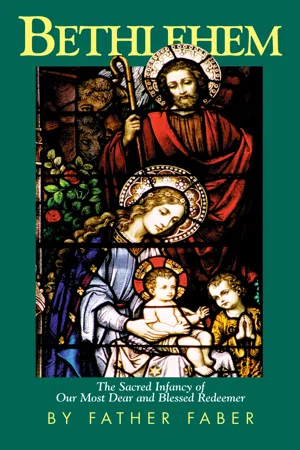
- 432 pages
- English
- ePUB (mobile friendly)
- Available on iOS & Android
eBook - ePub
About this book
Information
Topic
Theology & ReligionSubtopic
Christian DenominationsCHAPTER I
THE BOSOM OF THE ETERNAL FATHER
JESUS CHRIST yesterday, and today, and the same forever! These words of the apostle express at once the noblest and the most delightful occupation of our lives. To think, to speak, to write, perpetually of the grandeurs of Jesus,—what joy on earth is like it, when we think of what we owe to him, and of the relation in which we stand to him? Who can weary of it? The subject is continually growing before our eyes. It draws us on. It is a science the fascination of which increases the more deeply we penetrate into its depths. That which is to be our occupation in eternity usurps more and more with sweet encroachments the length and breadth of time. Earth grows into heaven, as we come to live and breathe in the atmosphere of the Incarnation. Jesus makes heaven, wherever he is, whether it be in the tabernacle, or in the heart of the communicant, just as he took the Beatific Vision with him into limbus when he died, and turned the pensive shadows of the patriarchs' home into the full glow of heaven.
But the contemplation of his grandeurs is not merely a joy. It is something beyond an ennobling occupation. It does an actual work in our souls, and a work which the grace of perseverance can make immortal. Rigoleuc has well said, "It is sufficient to look on Jesus, and to contemplate his perfections and his virtues. The very view is of itself capable of producing marvelous effects upon the soul, just as a simple look at the brazen serpent, which Moses reared in the wilderness, was enough to heal the bite of the serpents. For every thing in Jesus is not only saintly, but sanctifying also, and imprints itself on the souls which apply themselves to the consideration of it, if they do so with good dispositions. His humility makes us humble; his purity purifies us; his poverty, his patience, his sweetness, and his other virtues imprint themselves on those who contemplate them. This may take place without our reflecting at all upon ourselves, but simply by our viewing these virtues in Jesus with esteem, admiration, respect, love, and complacency." * Let it be with this hope that we now draw nigh to Bethlehem to study the mysteries of his Sacred Infancy. Love labors under the sweet impossibility of ever comprehending the majesty of our dearest Savior. We shall see more at Bethlehem than we can understand; and even what we cannot understand will fill us full of love, and it is love which makes us wise unto salvation.
There are two ways in which we can look at the mysteries of the Thirty-Three Years. We can either examine each mystery by itself, as it is revealed to us in the Gospels, or we can arrange the mysteries in classes, representing certain divisions of our Lord's life. Thus, Bethlehem, Nazareth, Galilee, Calvary, and Gennesareth, will stand for his Infancy, his Hidden Life, his Public Ministry, his Passion, and his Risen Life; and each of them will represent many events under one head. Bethlehem will comprise the actions and sufferings of twelve years, and contain within itself the Desert, Egypt, a sojourn at Nazareth, and mysteries, the scene of which was in Jerusalem. So Nazareth represents eighteen years, and Galilee three, while Calvary occupies barely three days, and Gennesareth forty. At the same time the groups of mysteries represented by these names have each of them a unity of their own. Hence it comes to pass that we may also contemplate them in two ways. For instance, we may either study the Passion by taking its several mysteries in succession, and feeding our souls in each of them by itself, or we may regard the Passion as in effect one mystery, complete in itself, and in a certain sense indivisible, and its different actions and sufferings as various disclosures of its unity.
It is in this last way that I propose to consider our Lord's Sacred Infancy. We may regard the first twelve years as forming one mystery, with a character and spirit of its own, quite distinguishable from the character and spirit of the Hidden Life or of the Public Ministry. The different subordinate mysteries, which it contains, have all the same stamp upon them, and are congenial to each other. There is no need to compare these two methods of handling our Lord's mysteries. I have not chosen one rather than the other, because it was better than the other. They are quite distinct. Perhaps the method I have selected mingles more doctrine with our devotion, and so has unconsciously attracted me. It is less common than the other method, and so leads us into less repetition. Bethlehem is a most beautiful and inviting subject, well worthy of the exclusive contemplation of a long life. We have to penetrate into the Bosom of the Eternal Father, and, shading our eyes as best we can, to behold the everlasting generation of the Word. The Bosom of Mary has to be to us, as it was to him, an "ivory Palace" of unspeakable delights. The cave at Bethlehem and the courts of Sion, the sands of the wilderness and the green Nile-bank, the bazaars of Heliopolis and the sequestered fields of Nazareth, angels singing in mid-air, shepherds watching, the three kings journeying by the star, the piteous cries of the innocents and the wailing of their inconsolable mothers, Mary and Joseph, Simeon and Anna, the rustics of Nazareth and the doctors of Jerusalem,—these have to occupy us in turn, as the scenes or the actors in ravishing mysteries, which light up for us the deep places in the character of God, and most intimately concern ourselves and our own salvation.
The Sacred Infancy is a world of its own. It is not indeed a creation apart, for none of God's creations are creations apart. They are parts of a whole. Yet there is this peculiarity in the world of the Sacred Infancy, that the fountain of all creation rises there. It is the home of the predestination of Jesus, the land of his eternal beginnings in the mind of God. It does not commence with the angelic salutation at Nazareth. It runs up into eternity. It begins with the beginnings of Jesus, and runs down to the twelfth year after his temporal generation. The Babe of Bethlehem lies in the Bosom of the Father on high, and is the cause there of all creation, and its model as well as its cause. We cannot detach his earthly childhood from these heavenly beginnings; for without them it would be unintelligible. It is a beautiful land to traverse, more wonderful than the regions childhood dreams of in its inarticulate poetry as lying somewhere beyond the gates of the golden sunset. The reasons of the Creator for having a creation, the preparations of the Creator for his entry into his own creation, the unexpected method of his coming, the beauty, spiritual, intellectual, and artistical, of his mysterious demeanor, the Immutable mutably adapting himself to the condition of a weak, mute, mortal childhood,—these are the wonders that throng our path through that divine land which we are now venturing to explore. We shall learn most of them by being simple with them; and we must be patient and attentive with the difficulties; for some difficulties there must be. At the least we shall love God a degree better at the end of our task, and one fresh degree of love for him is worth many martyrdoms; and with this hope and this conviction we will begin.
Whom shall we ask to go with us in our journey? Who shall be to us the doctor of the Sacred Infancy? Surely St. Joseph, so near to the Infant Jesus, so dear to his sinless Mother! If ever Saint was penetrated with the spirit of Bethlehem, doubtless it was he. Before the toil of the Public Ministry began, before the shadows of the Passion had begun to thicken palpably on the horizon, St. Joseph had finished his vocation. He belonged to Bethlehem and Nazareth; and God took him when Nazareth was ending. He lay in the contented tranquillity of Abraham's bosom, while Jesus was drinking his cup of sorrow, and Mary was bearing her broken heart about with her through the crowded mysteries of those three eventful years. The spirit of the Sacred Infancy is as it were his whole sanctification. No one can tell us more than he can of the young Mother's heart, and of the Heart of the Divine Child. So we must intreat him to go with us, and to help our prayers for light, and to surround us with the atmosphere of his own meek and meditative spirit; and we too must remember his presence, even when we do not mention him, so that our very thoughts and words may unawares be impregnated with the odor of his fragrant soul.
When the lark mounts up to heaven to sing its morning hymn, the sounds of labor and the cries of earth, the lowing of the cattle, the rushing of the waters, and the rustling of the leaves, grow fainter and fainter as the bird rises in the air. The wind waves the branches of the trees, but to the bird they wave noiselessly. The morning breeze bends the silvery side of the uncut grass, where its nest lies hid, till the whole field rises and falls in green and white waves, like the shallows of the sea; but it is all a silent show. No sound reaches the secluded bird in that region of still sunshine where he is pouring out those glorious hymns, of which we catch only either the prelude as he soars or the last precipitate fragments as he falls to earth from out his shrine of light. So is it with us in prayer, when we rise above our own wants or the outcries of our temptations, and soar in self-forgetting adoration toward the throne of God hidden in light inaccessible. The sounds of earth go first of all. Then the waving, soundless show seems fixed, and still, and motionless, and diminished. Next it melts into a confused faint-colored vision, and soon it lies below in a blue mist, like land uncertainly descried at sea. Then, last of all, the very attraction of earth seems gone, and our soul shoots upward, as if, like fire, its centre was above and not below. Thus must it be with us now; for we have to rise to the Bosom of the Eternal Father.
St. Joseph is kneeling by the Child in the Cave of Bethlehem. Let us draw near, and kneel there with him, and follow his thoughts afar off. It is but an hour since that Babe was born into the world, and gladdened Mary's eyes with the divine consolations of his Face. It is but nine months since he was incarnate in the inner room at Nazareth. Yet neither Nazareth nor Bethlehem were his beginnings. He was eternal years old the moment he was born. Time, which had already lived through such long cycles, and had perhaps endured through huge secular epochs before the creation of man, was younger by infinite ages than the Babe of Bethlehem. The creation of the angels, with the beauty and exultation of their first graces, the orderly worship of their hierarchies, their mysterious trial, the dreadful fall of one-third of their number, and Michael's battle with the rebels, lie dim and remote beyond the furthest mists of human history. Yet the Babe of Bethlehem is older far than that. Indeed, it was around him that all angelic history was grouped. He was at once their Creator and the pattern after which they were created, the fall of those who fell, and the perseverance of those who stood. Hereafter he will spend a three years' Ministry in Galilee and among the towns of Judah and Benjamin; yet, in truth, all the history of man's world, from the times of paradise to the hour of the Immaculate Conception, had been his Ministry. He preached before the flood. He gave his benediction to the tents of the patriarchs. He imparted grace, and saved souls, and wrought miracles in Jewry and in heathendom, for some thousands of years. But now by the sand-glasses of men he is one hour old.
This one of the heavenly bodies, which we tenant, was created to be as it were the garden, the Eden, of his Incarnation; and he adorned it in his love before Adam, the first copy of him, lived among its Asiatic shades. Perhaps it lay for ages in the glad sunshine, solitary, silent, in beautiful desolation, and he took complacence in the adorning of it. He loved perchance to see its beauty ripen, rather than to rise up at once complete. Continents sank slowly at his will, and new oceans rolled above their mountaintops or elevated steppes. New lands rose out of the bosom of the deep. Floras of marvellous foliage waved in the sun, and the wisdom and joy of the Babe of Bethlehem was in them. Faunas, strange, gigantic, terrible, possessed the waters and the land, of his fashioning, and for the delight of his glory. The central fires wrought beautifully and delicately the metals and the gems which were for the altars of the Babe of Bethlehem, for the tiara of his Vicar, or the chasubles of his priests. The rocks and marbles ripened on the planet, as the fruits ripen on a tree; and the Babe, the Wisdom of the Father, disported himself in the vast operation, the pacific uniformity, and the magnificent slowness of his own laws. The grandeur of those huge-leaved trees, the unwieldy life of those extinct monsters, the loveliness of now sunken lands, were all for him who has just now been born in Bethlehem, and were not only for him, but were also his own doing.
Bethlehem then was not his first home. We must seek him in an eternal home, if indeed he be older than the angels, the eldest-born of creatures. The dark cave within and the moonlit slope without are not like the scenery of his everlasting home. He is the Eternal Word. He is the first Word ever spoken, and he was spoken by God, and he is in all things equal to him by whom he was spoken. He was uttered from eternity, uttered without place to utter him in, without sound accompanying the utterance, and the Father who uttered him, or rather who is forever uttering him, is not prior to the Word he utters. His home has no scenery, no walls, no shape, no form, no color, no spot which can be loved with a local love. It is not in space, nor in imaginary space, nor within the world, nor at the world's edge, nor beyond it. It is the Bosom of the Father. It is amid the unlocalized fires of the Godhead. There, in the white light, inaccessible through the brilliance of its whiteness, we confusedly discern the magnificence of a Divine Person. He is unbegotten. He is not a word whom any one could utter; for there is no one to utter him, and he is besides adorably unutterable. He is not a Breath breathed forth of divine love; for there were none whose mutual love could breathe him forth, and he is besides adorably unproceeding. The Word expresses him, not because he utters him, but because he is uttered by him. The Holy Spirit is his fiery Breath, the Breath of the Father and the Son, coequal with them both, but with no procession from his blessed Self. This Divine Person, whom we confusedly discern, is like a Fountain, a fountain of golden light flowing with uncreated waters. Yet the Fountain is not a fountain without its waters, and the waters are coeval with the Fountain. Out of him flows the Son; from him and from his Word proceeds the Holy Ghost, all coequal, coeternal, consubstantial. Yet he is the First Person, and gloriously without superiority or precedence. He is the sole Fountain of Godhead, yet it is the very glory of the Fountain that its double streams are co-equal with itself. He in his adorable sublimity is the unsent inseparable Companion of the Two Divine Persons who are sent and who send themselves. Him, without figure, we picture to ourselves amid those unlocalized fires. Him, without images, we discern in the breathlessness of our far-seeing faith. Him, without light, we behold in the darkness of his blinding majesty. Him, in his outstretched immensity, we compass in the fondness of our adoring love. Him, in his nameless incomprehensibility, we sweetly understand in the knowledge that we are his sons. His Bosom, an abyss of unfathomable beauty, the shrine of unruffled peace, the furnace of the divine beatitude, is the home of the Babe of Bethlehem, his only native place.
Unbeginning is the life in that paternal Bosom. Yet what do we mean by unbeginning? It is a thought we cannot think, too real a reality to be other than a mere word to finite creatures like ourselves. It is good to try to stretch ourselves to its height and breadth; for there is no rest equal to the weariness that comes of striving to embrace the thought of God. In that Bosom the Divine Person, who is the Babe of Bethlehem, was born, who yet never began to be born, and has never done being born. Never was the Unbegotten Father with the unborn Son. Unbegotten and eternally begotten! what but faith shall distinguish between the two?—faith, or the vision which is faith's crown hereafter? As there never was a time when the Son was yet unborn, so can there never be a time when he will cease being born. It is in eternity, and not in time, that his inexplicable Generation finds room. He proceeds from the Father by way of generation. He proceeds from the understanding of the Father. He is the Father's understanding of himself, or rather he is produced by it. He is the expression of all the Father's perfections. He is not merely the similitude of the Father, because he is something more. He is consubstantial with him. Yet he is not identical with the Father, because he is a distinct Person from him. The Father knows himself, and by his knowledge of himself the Son is born amid the splendors of uncreated holiness, amid the inconceivable jubilations of the divine perfections. Thus the Generation of the Son is not a mystery done and over. It was not an event at some remote point before ever time was. That which is eternal must always be going on. That which can end must have begun. We must be careful therefore always to bear in mind that the coequal, coeternal Son is ever being begotten in the Bosom of the Father, at this moment as well as from forever. There was no moment when he was not begotten, no moment when he is not being begotten, no place through all the amplitudes of omnipresence in which his eternal Generation is not forever going on, close to us, or far away from us, outside us in outward space, inside us in the noiseless centre of our souls. Yet nowhere is the silence broken by that stupendous utterance of the Father. The omnipresent Word does not so much as vibrate on the air, when he rushes forth with the irresistible might of the Godhead. The clangor of his omnipotence is unheard. His all-embracing light coruscates through the quiet night, and the darkness remains calm and still, like the plumage of a sleeping bird. Oh, how can we ever find a home where we are out of sight and hearing of that Utterance of the Father? See how the spirits of angels and the blessed souls of men throng in, all day and night, to witness that eternal utterance, to bathe in its beatific light, and to be enchanted with its spiritual sound! This is the true birth of that Babe of Bethlehem, forever older than the hill on which Bethlehem is built, forever younger than the blossom of the wild thyme which opened its pink eye this morning on the greensward where the sheep were lying when the angels sang in heaven.
Unutterably blessed is the life within that Bosom of the Father. For while the Father is forever uttering his eternal Word, he and the Word are forever breathing forth the Holy Ghost, the uncreated fire of their mutual love and boundless jubilee, a Person distinct from themselves, yet as it were the bond of the Two, coequal, coeternal with them, the Term of God, the Limit of the Illimitable, so that God, penetrating his whole creation, is not commingled nor confused with things. Such are the immutable necessities of the Divine Life, the inevitable uncreated productions of its understanding and its will, the twofold pulse of Generation and Procession, the beating Heart of that exhaustless sea of Being, with Persons more distinct than any distinctions among creatures, and yet with a Unity which transcends all the identities of earth. Who can think of such a sanctuary, and yet not tremble with excess of love? Who can fix his eye of prayer upon it, and yet not tremble with excess of fear, lest haply he should miss of its unending vision? It was in that deep recess of an incalculable eternity that the Babe of Bethlehem dwelt, before he vouchsafed to take visible possession of the Cave of Bethlehem. It is there that we must seek his beginnings, which began not: it is thence we must date the pedigree of the Eternal, who has no ancestry: it is in the light of that darkness that we must search Bethlehem and Nazareth, Egypt and the Wilderness, to learn the mysteries of that mortal Childhood of the Eternal Word. Deep in our souls can we not see that Bosom of the Father? Yet it is beautiful beyond thought, adorable beyond the stretch of created spirit. Created things give us no parallels; they furnish us with no images, the poetry of earth is but a distraction: the definitions of the faith only catch us as we fall. Yet somehow we see that Bosom of the Father deep within ourselves, and it is familiar to us as a household sanctuary. We know that with all its immeasurable capacity of the divine life it is actually within ourselves, and we hold our breath, and seem to faint away upon it in sweetest trance of helpless love.
What manner of life was it which the Word led in the Bosom of the Father? It was a creatureless life. There were no creatures, except in the purposes and decrees of the divine mind, and in the inexhaustible storehouses of the divine wisdom. God had always determined to create, because he was always love, and love craved more room, if we may dare so to speak of him who is infinitely self-sufficient, for the exuberant generosity of his justice as well as for the incredible fertility of his wisdom. It is the justice of creation which makes it so loving a mystery. Time is an old creation, the most ancient of all creations. We look upon the myriads of many-circled ages, as on a vast ocean, which stretches out of sight, and is lost in the haze on the horizon when the angels came into being, together with the elements of the material creation. Yet the furthest age spends its billows on the shore of time, infinitely short of the creatureless life of the Word in the Bosom of the Father. The Ages seemed like a help to the comprehension of the Unbeginning; but they play us false, and only puzzle us the more. How can a life be otherwise than indescribable to us creatures who live on matter and know by images, when it was a life without world, without time, without place, without motion, without fixedness, without parallels, without comparisons, without similitudes, almost without shadows? Only in each vast department of creation, in each huge epoch of time, part of the shadow of that divine life lies for our tracing; yet, like a village at the mountain-foot, all creation lies in the shadow, but the shadow of the peak overshoots it, and is cast far beyond. Its bliss was in its unity; but, unlike created unities, it was free from the imperfection of solitude. It was the simplicity of one boundless life in the pacific jubilant companionship of Three distinct Persons. There was no hierarchy among the Persons; so that the imperfection of superiority did not attach to the Father any more than the infirmity of subordination to the Holy Ghost or to the Son. The distinctness of the Persons only enhanced the unity of the Godhead, because the Persons were unspeakably coequal.
It was a life of infinite complacency. God rested in himself. In himself his infinity was satisfied. The immensity of his own perfections lay before him, and he traversed them, so to speak, with his blessed understanding. To know himself infinite by his infinite knowledge was to be infinitely blissful. The imperfection of our human words is such, that we cannot speak of God without seeming to divide him. We must therefore bear the adorable simplicity of God in mind, while we thus discourse of the abysses of his divine life. It cannot be too often repeated that God has not many several attributes, nor even one; but he is simply God. He is not different from his perfections, nor are his perfections, strictly speaking, d...
Table of contents
- Cover Page
- Copyright Page
- PREFATORY EPISTLE
- CONTENTS
- CHAPTER I THE BOSOM OF THE ETERNAL FATHER
- CHAPTER II THE BOSOM OF MARY
- CHAPTER III THE MIDNIGHT CAVE
- CHAPTER IV THE FIRST WORSHIPERS
- CHAPTER V THE INFANT GOD
- CHAPTER VI SOUL AND BODY
- CHAPTER VII CALVARY BEFORE ITS TIME
- CHAPTER VIII HEAVEN ALREADY
- CHAPTER IX THE FEET OF THE ETERNAL FATHER
Trusted by 375,005 students
Access to over 1.5 million titles for a fair monthly price.
Study more efficiently using our study tools.
Frequently asked questions
Yes, you can cancel anytime from the Subscription tab in your account settings on the Perlego website. Your subscription will stay active until the end of your current billing period. Learn how to cancel your subscription
No, books cannot be downloaded as external files, such as PDFs, for use outside of Perlego. However, you can download books within the Perlego app for offline reading on mobile or tablet. Learn how to download books offline
Perlego offers two plans: Essential and Complete
- Essential is ideal for learners and professionals who enjoy exploring a wide range of subjects. Access the Essential Library with 800,000+ trusted titles and best-sellers across business, personal growth, and the humanities. Includes unlimited reading time and Standard Read Aloud voice.
- Complete: Perfect for advanced learners and researchers needing full, unrestricted access. Unlock 1.5M+ books across hundreds of subjects, including academic and specialized titles. The Complete Plan also includes advanced features like Premium Read Aloud and Research Assistant.
We are an online textbook subscription service, where you can get access to an entire online library for less than the price of a single book per month. With over 1.5 million books across 990+ topics, we’ve got you covered! Learn about our mission
Look out for the read-aloud symbol on your next book to see if you can listen to it. The read-aloud tool reads text aloud for you, highlighting the text as it is being read. You can pause it, speed it up and slow it down. Learn more about Read Aloud
Yes! You can use the Perlego app on both iOS and Android devices to read anytime, anywhere — even offline. Perfect for commutes or when you’re on the go.
Please note we cannot support devices running on iOS 13 and Android 7 or earlier. Learn more about using the app
Please note we cannot support devices running on iOS 13 and Android 7 or earlier. Learn more about using the app
Yes, you can access Bethlehem by Frederick Faber in PDF and/or ePUB format, as well as other popular books in Theology & Religion & Christian Denominations. We have over 1.5 million books available in our catalogue for you to explore.