A famous and fabulous apologetics book; written as the story of one man's 40-year search for Truth. How he went from being a Protestant seminary student to an agnostic to a Catholic (late in life). Answers intelligently all the basic arguments against the Faith.
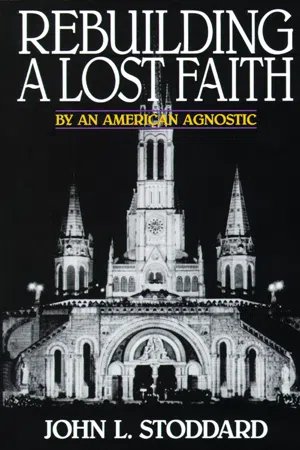
- 315 pages
- English
- ePUB (mobile friendly)
- Available on iOS & Android
eBook - ePub
About this book
Information
Topic
Theology & ReligionSubtopic
Christian DenominationsChapter 1
FROM FAITH TO RATIONALISM
Nothing would be done at all, if a man waited till he could do it so well that no one could find fault with it.
—JOHN HENRY NEWMAN.
In den Ozean schifft mit tausend Masten der Jüngling; Still, auf gerettetem Boot treibt in den Hafen der Greis.—SCHILLER.
MY EARLY training was extremely religious. Both my parents were of old Puritan stock. Their theology was Calvinistic and of the type denominationally known as "Congregational." Their lives were not made gloomy by their creed, though they were certainly serious. Family prayers, morning and evening, were observed by them, followed on Sunday evenings by the singing of some beautiful hymns, whose words and melodies are still dear to me. The musical accompaniment to these was furnished by my father, and those sweet Sabbath evenings, when the family group assembled thus in prayer and praise, remain among the most touching memories of my life.
Dear, old-time tunes of prayer and praise,
Heard first beside my mother's knee,
Your music on my spirit lays
A spell from which I should be free,
If lapse of time gave liberty.
Heard first beside my mother's knee,
Your music on my spirit lays
A spell from which I should be free,
If lapse of time gave liberty.
I listen, and the crowded years
Fade, dream-like, from my life, and lo,
I find my eyelids wet with tears,
So much I loved, so well I know
Those plaintive airs of long ago!
Fade, dream-like, from my life, and lo,
I find my eyelids wet with tears,
So much I loved, so well I know
Those plaintive airs of long ago!
My mother also used to talk to me in simple but impressive words about our Saviour, Heaven, and the truths of the Gospel; and after her death I gained through reading her journals an insight into the spirituality of her nature and her intimate life with Christ in God.
When I was twelve years old, there took place something in my parents' life which, though I could not fully understand it then, has never been forgotten. It is worth recording here, as a proof of one of the results of Protestantism, arising from its theory of the supremacy of individual judgment in matters of faith and doctrine. A new minister had been installed in our Congregational church, but not without difficulty. It was at that time customary for ministers of the Congregational, Presbyterian, Baptist and other denominations, before entering on a pastorate in any church, whose members had given them a "call," to pass a theological examination, not only in the presence of a select committee of neighboring clergymen, but also before the deacons and even the lay members of the parish. These theological inquisitors, scarcely two of whom would probably have agreed in their interpretations of either Scripture or dogma, compelled the wretched postulant to run, for several hours, a gauntlet of questions, criticisms and "observations," whose alleged object was to ascertain whether; in the judgment of this heterogeneous court, he was perfectly "sound in the faith." As a matter of course, some of the questioners always were dissatisfied with the candidate's answers, and doubts were thus aroused in the minds of listening parishioners, many of whom were incapable of weighing the arguments, and some of whom were nothing more than well-meaning religious eccentrics. Thus were the seeds of future discontent and disintegration inevitably sown. Nevertheless, the applicant was seldom rejected. Those who had found him "too Calvinistic," "old-school," "liberal," or "lax," usually gave way at last through motives of expediency, though not without some mutterings of doubt and ominous predictions. In the particular case referred to, the suspicions awakened by the examination of Rev. Mr. D. developed quickly into active opposition. Some members of his church, among whom were my parents, became alarmed at the way in which he spoke of the Saviour in his sermons. Just how he failed to satisfy them I do not now remember, but I have reason to suppose that he was thought to emphasize too much the human element in the Son of God, while laying insufficient stress on His divinity.
At all events, a schism in the church grew imminent. A formal protest was drawn up by the dissatisfied party, and the reading of this arraignment, in the presence of the unhappy minister himself, in a crowded "Friday evening prayer meeting" I well remember. It amounted to an ultimatum on the part of the complainants, who thought of course that they, as Protestants, had a right to protest. At all events, they insisted that either the Rev. Mr. D. must preach a different theology, or they would leave the church and found another of their own! Had not Luther set them a glorious example? A bitter controversy ensued, which caused a lamentable scandal among all good Christians, and excited the derision of the ungodly. Finally, a compromise of some sort was effected, but the Rev. Mr. D. soon betook himself elsewhere. Nothing could better illustrate, than this little incident, the natural process of disintegration which has been going on in Protestantism for the last four centuries—an extraordinary process truly, if Protestant sects are really representative of a Church, which Christ not only founded, but with which He promised to abide to the end of time!
When I was thirteen years of age, my mother died, leaving to me a blessed memory of piety and love. My father, also eminent in godliness, died two years later. At the time of this latter event, I was still at school, but soon left for a neighboring city, expecting to pursue a mercantile career. God willed it otherwise. During the following winter, largely through the influence of two sincerely religious friends, I passed through the spiritual crisis commonly known as "conversion." No special excitement attended it. There certainly was no "revival" in the neighborhood. But I have reason to believe that this experience, notwithstanding my subsequent apostasy, was the result of God's Spirit striving with my soul. I was at all events profoundly moved by the realization of my sinfulness and of the necessity of reconciliation with God, and I sought His forgiveness humbly through the sacrifice of Jesus Christ, the Saviour of mankind, resolving with His help to lead a Christian life.
When this great change had taken place, an ardent desire seized me to devote myself, as a minister—preferably as a missionary—to the preaching of the Gospel. This was not strange. In my ancestry ministers had been numerous. One of my father's brothers had recently died as a missionary in the Orient; another was an active and enthusiastic supporter of the cause of foreign missions. The latter, welcoming my zeal, and heartily approving my wishes, agreed to furnish me with funds sufficient to obtain a university education, and a few months later I forever abandoned a mercantile life, and reopened my books with the determination eventually to proclaim Christ and Him crucified either at home or abroad.
Soon after, with ten or twelve young people of about my own age, I made a public profession of my faith, and was received into the Congregational church of which my parents had been members. In connection with this ceremony I was baptized, as I had not received that Sacrament in childhood. This is a point worth special consideration here, for—unlike the original Church of Christ, which has always regarded Baptism as a necessary Sacrament, obligatory for children as well as for adults—the Protestant sect to which my parents belonged—and there are many like it—did not believe in Infant Baptism.
In fact, apart from the tradition of the Catholic Church, which Protestants disregard, it is difficult to find authority for this custom. In Scripture, faith is stated to be essential to the rite of Baptism, and every instance of Baptism mentioned in the Bible is of adults.
Infant Baptism was, however, practiced very early in the Church's history, and the Fathers justified it. St. Irenaeus, for example, says: "Christ came to save all, who through Him are born again to God, infants and little ones, boys, young men and the aged." (Iren. ii, 22,4). The usual Protestant belief is that Baptism bestows upon the infant a capacity for receiving this grace when it shall at the proper age have ratified the vows made for it by its sponsors. The Catholic doctrine, on the contrary, is that the grace is bestowed upon the baptized infant then and there. While many Protestants, principally Anglicans and Episcopalians, adopt this custom, fully as many reject it. Some even consider Baptism to be no Sacrament at all, but merely a rite, connected with admission into the Church! Others, although the institution was indubitably established by the Son of God, have actually condemned it as sinful! Great numbers of Protestants have, therefore, never been baptized.
It is difficult for me now to understand how devout Christians, like my parents, could have failed to recognize Baptism as an indispensable Sacrament—that is, an outward sign of an inward and spiritual grace, instituted by Christ Himself; for few of our Saviour's words are so emphatic as the following: "Verily, verily, I say unto thee, Except a man be born of water and of the Spirit, he cannot enter the kingdom of God." He likewise commissioned His Apostles to teach all nations, "baptizing them in the name of the Father, and of the Son, and of the Holy Ghost."
As for my youthful associates and myself, I am sure that we regarded our Baptism merely as a solemn ceremony, and had no notion whatever of the doctrine of the Catholic and Anglican Churches—that it confers on the adult a special sanctifying grace, remits his sins, and makes upon his soul an indelible mark, or "character." Yet of the truth that the Sacrament of Baptism is primarily intended for the remission of sins, we have abundant evidence: for St. Peter, as recorded in Acts 2:38, distinctly says: "Be baptized, every one of you, in the name of Jesus Christ, for the remission of your sins"; and the Nicene Creed states also: "I confess one Baptism for the remission of sins." But of this and many other doctrinal points we youthful neophytes knew practically nothing, for our instruction in such matters had been very superficial.
In fact, ignorance of the fundamental dogmas of Christianity is the rule, rather than the exception, among Non-Conformists. Although my parents had brought me up religiously, I personally never had received the least instruction in the catechism, and I doubt if any of my companions were better informed than myself. What we knew of the creed of our Church we had "absorbed" from sermons, family prayers and Sunday school lessons. Nor were we, as postulants, asked any questions about doctrines! As I remember the scene, each one of us in turn was requested to relate his or her "experience," which naturally was a story of religious sentiment. We merely took for granted the truth of the creed, as we found it given in the constitution of that particular church in which we pledged ourselves to Christ and to His service.
The university years that followed were characterized by nothing specially worth recording. Surrounded by religious influences, it was not difficult for the professedly Christian students of my college to lead at least a nominal Christian life. This in my own case was distinguished neither by apathy on the one hand, nor special spirituality on the other. No serious doubts disturbed me, and I looked forward to the ministry as my career, though my original wish to be a missionary to the heathen had considerably diminished. Accordingly, without remarkable enthusiam, yet equally without misgivings or regrets, I entered, in my twenty-second year, the theological seminary of ——.
My fellow "theologues" were for the most part men of excellent character, though of moderate mentality. As scholars and as speakers, most of them were evidently doomed to mediocrity. So true was this of some of them, that I often wondered whether they would ever have adopted this profession if it had not been made so easy for them. The seminary was richly endowed, and offered gratis to such students as applied for aid, not only free instruction, but also comfortable rooms and board. Moreover, after their second year of study they always could earn money by preaching to congregations temporarily without pastors. Under such circumstances, men who are graduating from college without money, and who for the first time face the world's fierce struggle for existence, are easily induced to enter the ministry. In such cases it is a great temptation to choose the line of least resistance, and this, if it be the Protestant ministry, leads almost certainly to an assured livelihood. In America, it is true, the Protestant clerical profession is, as a rule, miserably paid (see Chapter XII), and in small country parishes ministers have often to endure real hardships; yet, if a youthful graduate from a theological seminary possesses pleasing manners and average ability, he will have little difficulty in obtaining a pastorate, in which no great amount of learning and oratorical skill is necessary. Especially, if he becomes an Anglican, or in America an Episcopalian, clergyman, he can usually make a desirable marriage and enjoy a good social standing, irrespective of his intellectuality.
One of the studies of the first year at this seminary was Hebrew, and I shall never forget the pitiful efforts made by some of my associates to master the difficulties of that language. The poor fellow at the desk adjoining mine was frequently the picture of despair, when asked to conjugate a Hebrew verb, or to translate a line of Genesis. Perhaps a third of the class derived some benefit from reading thus a moiety of the Old Testament in the original, but for the rest it was a mournful tragedy, and can have been no help whatever to them in their subsequent ministry.
The study of the New Testament in Greek was, of course, more beneficial, for all of us had read considerable Greek in college, and the familiar English version of the Bible made it impossible for the dullest student to fall or flounder in translation, as frequently was the case in Hebrew. Our interest in the study of the words of Christ and the Apostles was also naturally much greater than in that of the remoter and more difficult writings of the Old Testament. Moreover, in our professor of New Testament exegesis we had a clever, stimulating teacher. Yet it was precisely in connection with this study that I found my greatest theological difficulties.
The copy of the New Testament in Greek which I used as a textbook, was the valuable edition compiled by the celebrated Dean Alford. This had, as a rule, at the top of every page two or three lines of Greek, while much of the remaining space was filled, in fine print, with comments on the textual variations of those lines, as found in different manuscripts of the New Testament! Up to that time I had known little of the literary composition and transcription of the Scriptures, nor had I realized that between the date of the oldest New Testament manuscript in our possession and the death of Jesus stretches an interval of more than three hundred years. It is true, the interval between our oldest manuscripts of the classical writers—Homer, Plato, Cicero, Horace and others—and the date of their lives is a still greater one. Nevertheless it came to me as a shock to learn that we have not a single manuscript of the Gospel which takes us nearer to the time of Christ than we are to the age of Queen Elizabeth. The disappearance of the original manuscripts of the New Testament is, of course, not surprising, for the frail papyrus on which the previous words were originally written was extremely perishable; and later copies, made on vellum, also required the greatest care to save them from destruction. Moreover, some Emperors, like Diocletian, ordered that all obtainable Christian manuscripts should be burned. Of the researches of scholars in this matter, and of their ways of bridging over that time-interval by means of quotations from writings of the Fathers, I knew then next to nothing, for no information was given us in the seminary on that subject.
I was greatly disturbed, therefore, to find that in the New Testament manuscripts which we possess there are no less than 100,000 different readings! I have since learned not to exaggerate the significance of this fact, for in reality they are for the most part unimportant, and show an absence of collusion or dissimulation in the writing of the Scriptures which amounts to a historical guarantee of their genuineness. Many of these textual differences probably occurred through the carelessness of copyists, others were caused by the creeping into the text of footnotes made by previous transcribers, while others still may have been made intentionally by conscientious men, who thought that they could thus improve the older text, or at least explain its meaning. Mistakes could also easily be made because the Scriptures of the first ten centuries after Christ were written in large capital ("uncial") characters, without Greek accents or punctuation, and even without division between the words!
More serious, however, seemed to me the absence from the oldest manuscripts of some entire passages found in the later ones. Such paragraphs were, in my edition of the Greek New Testament, enclosed in brackets, to indicate that—being found only in later manuscripts—they were considered less authentic. In such cases the oldest existing manuscripts—the "Sinaitic," formerly in St. Petersburg; the "Vaticanus," now in Rome; and the "Alexandrinus," in the British Museum—are usually regarded as the most authoritative, but not invariably; for if many of the later manuscripts contain a reading, which the earlier ones lack, their united—even if more recent—testimony is sometimes thought to be more decisive than the negative attitude of the older codices. What the precise text of the lost originals was, we have no way now of determining, save as we find quotations from them in the writings of the old Church Fathers and their pagan critics. But such omissions do not necessarily prove that the passages are of an origin later than the early Gospels. They may have been intentionally omitted for some specific reason connected with the particular church for which the copy had been made; for at certain epochs and in certain places it seems to have been thought best by the Bishops (owing perhaps to the unusual prevalence in that city of some special heresy), that certain passages, liable to be misunderstood by the local church members, should be omitted from the manuscript ordered for that community.1
Copies of the Books of the New Testament were not invariably made then on the theory that every word of the original manuscripts must be reproduced. They were transcribed for definite purposes. During the first one hundred and seventy years after the birth of Christ, although those Books were certainly regarded as sacred and inspired, the Apostolic oral tradition was still so fresh, that written authority was less frequently appealed to.
Practical difficulties also contributed to the omission of certain portions of the text. The manuscripts were always in the form of narrow rolls, which—being of necessity unrolled to be read, an...
Table of contents
- Cover Page
- Copyright Page
- CONTENTS
- Preface
- 1. From Faith to Rationalism
- 2. In the Wilderness of Rationalism
- 3. The Awakening
- 4. Searching for Light (The Existence of God)
- 5. The Moral Law
- 6. Immortality
- 7. Revelation
- 8. "What Think Ye of Christ?"
- 9. The Church of Christ
- 10. Luther
- 11. Protestantism in Germany
- 12. Protestantism in America
- 13. The Church of England
- 14. Difficulties Surmounted—Papal Infallibility
- 15. Purgatory and Indulgences
- 16. The Sacrament of Penance
- 17. Reverence Shown to The Blessed Virgin, and Prayers to Her and to the Saints
- 18. Miracles, Ancient and Modern
- 19. The Veneration of Images and Relics
- 20. Persecutions for Heresy by Catholics and Protestants
- 21. The Final Step
- 22. Some Catholic Privileges and Compensations
Trusted by 375,005 students
Access to over 1.5 million titles for a fair monthly price.
Study more efficiently using our study tools.
Frequently asked questions
Yes, you can cancel anytime from the Subscription tab in your account settings on the Perlego website. Your subscription will stay active until the end of your current billing period. Learn how to cancel your subscription
No, books cannot be downloaded as external files, such as PDFs, for use outside of Perlego. However, you can download books within the Perlego app for offline reading on mobile or tablet. Learn how to download books offline
Perlego offers two plans: Essential and Complete
- Essential is ideal for learners and professionals who enjoy exploring a wide range of subjects. Access the Essential Library with 800,000+ trusted titles and best-sellers across business, personal growth, and the humanities. Includes unlimited reading time and Standard Read Aloud voice.
- Complete: Perfect for advanced learners and researchers needing full, unrestricted access. Unlock 1.5M+ books across hundreds of subjects, including academic and specialized titles. The Complete Plan also includes advanced features like Premium Read Aloud and Research Assistant.
We are an online textbook subscription service, where you can get access to an entire online library for less than the price of a single book per month. With over 1.5 million books across 990+ topics, we’ve got you covered! Learn about our mission
Look out for the read-aloud symbol on your next book to see if you can listen to it. The read-aloud tool reads text aloud for you, highlighting the text as it is being read. You can pause it, speed it up and slow it down. Learn more about Read Aloud
Yes! You can use the Perlego app on both iOS and Android devices to read anytime, anywhere — even offline. Perfect for commutes or when you’re on the go.
Please note we cannot support devices running on iOS 13 and Android 7 or earlier. Learn more about using the app
Please note we cannot support devices running on iOS 13 and Android 7 or earlier. Learn more about using the app
Yes, you can access Rebuilding a Lost Faith by John L. Stoddard in PDF and/or ePUB format, as well as other popular books in Theology & Religion & Christian Denominations. We have over 1.5 million books available in our catalogue for you to explore.