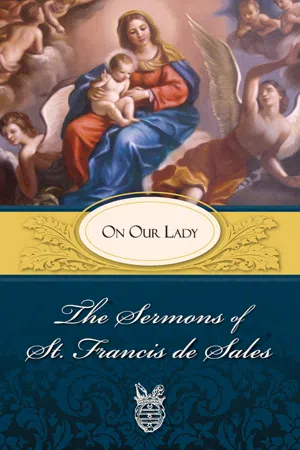
Twelve sermons on key aspects of the Christian life given during Lent, 1622--fasting, how to resist temptation, the danger of losing one's soul, living faith vs. dead or dying faith, Christian attitude toward death, proper conduct in illness, God's special providence toward those living a spiritual life, the hidden meanings of Our Lord's Passion, eternal happiness, mutual charity, etc. Impr. 230 pgs,
- 254 pages
- English
- ePUB (mobile friendly)
- Available on iOS & Android
eBook - ePub
About this book
Information
Topic
Theology & ReligionSubtopic
Christian Denominations—1—
THE ASSUMPTION OF THE BLESSED VIRGIN MARY
Sermon for the Feast of the Assumption, August 15, 1602, concerning Our Lady's life on earth after Our Lord's Ascension, Our Lady's death, the close union between Mary and her Son during His Passion, the voluntariness of Our Lord's death, the cause of Mary's death, Our Lady's exemption from the law of corruption, the "perfumes" of graces and virtues which she brought with her to Heaven, the honor due to Mary, God as the source of all Mary's graces, the true way to honor Our Lady, and the true Christian teaching on the mediation of Our Lady and the saints.
"Who is this coming up from the desert, flowing with delights, leaning upon her Lover?"—Song 8:5
The Ark of the Covenant had been kept under tents and pavilions for a long time when at length the great King Solomon placed it in the rich and magnificent Temple which he had prepared for it. [1 Kgs. 8]. The rejoicings in Jerusalem were so great at this time that the blood of the sacrifices flowed in the streets, the air was thick with clouds from so much incense and perfume, and the homes and public places resounded with the canticles and psalms sung by all with music and melodious instruments.
But, O God,1 if the reception of that ancient Ark was so solemn, what must we not think to have been that of the new Ark? I speak of the most glorious Virgin Mother of the Son of God on the day of her Assumption. O joy incomprehensible! O feast full of marvels which makes devout souls, the true daughters of Zion, cry out in admiration: "Who is this coming up from the desert?" And indeed these facts are admirable: The Mother of Life is dead; death is resurrected and ascends to the abode of life. What a feast of consolation! She has ascended for the honor of her Son and to arouse in us a great devotion. This is the subject of which I will treat with you, O my people, but I cannot do so well unless I first obtain the assistance of the Holy Spirit. Ave Maria.
In the beginning God placed in the heavens two lights. The one, because of its great brilliance, was called the greater light; the other was named the lesser—the greater one to enlighten and govern the day, the lesser to enlighten and govern the night. [Gen. 1:16]. For, though our Creator willed that there should be changes of day and night, and that the shades of night should succeed the brightness of day, being Light Himself [Jn. 1:5] He did not will that darkness and night should remain completely devoid of light. Having created the greater light to govern the day, He created a lesser light to govern the night so that the obscurity of the night's darkness might be tempered by means of its brightness.
This same God, with His holy Providence, determining to create the spiritual world of His Church, placed over it as in a divine vault of Heaven two great lights: one greater, the other lesser. The greater is His Son Jesus Christ our Saviour and Master, abyss of light, source of splendor, true Sun of justice. [Heb. 1:3; Mal. 3:20]. The lesser is the most holy Mother of this great Son, all-glorious Mother, all resplendent and truly more beautiful than the moon. [Song 6:10].
Now, this greater Light came here upon earth. The Son of God assumed our human nature. He is the true Sun which comes over our hemisphere and makes the light and the day—happy day, so long desired, which lasted for about 33 years, during which He enlightened the land of the Church by the radiance of His miracles, example, teachings, and holy words! But at length when the hour came in which this precious Sun must set and take Its radiance to the other hemisphere of the Church, Heaven and the angelic hosts, what could be expected but the obscurity of a dark night? And the night came all too quickly after the day. What were so many afflictions and persecutions which came upon the Apostles but a night?
But this night had also its light which brightened it so that the darkness was more tolerable. For the Blessed Virgin remained on earth among the disciples and the faithful. We cannot doubt this, since St. Luke in the Acts testifies that Our Lady was with the disciples on Pentecost Day and that she persevered with them in prayer and communion. [Acts 2:1-4, 1:14]. Thus, they are convicted of error who say that she died with her Son because of the words of Simeon who foretold that a sword would pierce her soul through. [Lk. 2:35]. But I will soon expound on this passage and demonstrate by its true meaning that Our Lady did not die with her Son.
Let us first consider the reasons why her Son left her in this world after His own departure. (1) This light was needed for the consolation of the faithful who were in the night of afflictions. (2) Her remaining here below gave her an opportunity to achieve an accumulation of good works so great that it could be truly said of her: Many daughters have gathered together riches, but you have surpassed them all! [Prov. 31:29, Douay]. (3) As soon as Our Lord died and ascended to Heaven, some heretics were saying that He had not had a natural and human body but only an imaginary one. The Virgin, His Mother, in remaining after Him, served as a reliable witness of the truth of His human nature, thereby already beginning to verify what we sing of her: "You, O Holy Virgin, have destroyed all heresies throughout the world." Thus did she live after the death of her Life, that is to say, of her Son, and even long after His Ascension, though the number of the years is not definitely known. But they could not have been less than 15, which would have made her 63 when she died. At least 63, I say, inasmuch as others, and with more probability, would have her live until she was 72. But that matters little. It suffices for us to know that this holy Ark of the New Covenant remained in this desert of the world under tents and pavilions after the Ascension of her Son.
If this fact is certain, as it truly is, it is equally certain that at the end this Holy Lady died—not that the Scriptures explicitly say so, for I can find no word in the Scripture that says that the Virgin died. Ecclesiastical Tradition alone assures us of the fact, and so does Holy Church, which confirms this Tradition in the prayer she uses in the Mass of this feast. It is true that Scripture teaches us in general terms that all die, and that no human being is exempt from death. But it does not say that all are dead nor even that all those who have lived have already died. On the contrary, it exempts certain ones such as Elijah, who, without dying, was carried up to Heaven in a chariot of fire, and Enoch, who was taken away by Our Lord before he tasted death [2 Kgs. 2:11; Gen. 5:24; Heb. 11:5], and also St. John the Evangelist, the one I think to be most probable according to the word of God as I have demonstrated to you before on his feast in May. [Jn. 21:22]. These three saints are not dead. Yet they are not exempt from the law of death, because if they are not dead they will die at the end time under the persecution of Antichrist, as appears in Chapter 11 of the Book of Revelation. [Rev. 11:7].
Why may we not say the same of the Mother of God, namely, that she is not yet dead but will die at some future time? Certainly, if anyone wished to maintain this opinion we could not refute it by the Scripture, and according to your principles, O adversaries of the Catholic Church, it would be well-founded. But the truth is that she died and was buried, as well as her Son and Saviour. For though the fact cannot be proved by Scripture, yet Tradition and the Church, which are infallible witnesses, assure us of it.
Certain then that she died, let us now consider what kind of death she died. What death was so foolhardy as to dare to attack the Mother of Life, the Mother whose Son had conquered death and its sting, which is sin? [1 Cor. 15:55-56]. Be attentive, my dear listeners, for this point deserves consideration. I will soon have responded to the question, but it will not be easy for me to prove and explain it well.
My answer in a word is that Our Lady, Mother of God, died of the death of her Son. The fundamental reason is that Our Lady had only one same life with her Son and thus could have but only one same death with Him. She lived only by the life of her Son. How could she die of any other death but His? They were in truth two persons, Our Lord and Our Lady, but of one heart, one soul, one spirit, one life. For if the bond of charity so bound and united the Christians of the early Church that St. Luke assures us that they were of one heart and one mind [Acts 4:32], with how much greater reason may we not say and believe that the Son and the Mother, Our Lord and Our Lady, were only one soul and one life?
Consider the great Apostle St. Paul. He felt such a union and bond of charity between his Master and himself that he professed to have no other life but that of the Saviour: The life I live now is not my own; Christ is living in me. [Gal. 2:20]. O my people, this union, this fusion and bond of hearts which made St. Paul speak such words was great, but not to be compared with that between the Heart of the Son Jesus and that of the Mother Mary. For the love which Our Lady bore to her Son far surpassed that which St. Paul bore to his Master, inasmuch as the names of mother and son are more excellent in matters of affection than the names of master and servant. Hence, if St. Paul lived only of the life of Our Lord, Our Lady also lived only of the same life, but more perfectly, more excellently, more completely.
Now if she lived of His life, she also died of His death. And indeed the good old man Simeon had long before predicted this kind of death for Our Lady when, holding her Child in his arms, he said to her: And a sword will pierce your own soul. [Lk. 2:35, Douay]. Consider the words. He does not say: "A sword will pierce your body," but he says: "your soul." What soul? "Your own soul," said the prophet. The soul of Our Lady, then, is to be pierced, but by what sword, by what dagger? The prophet does not say. Nevertheless, since there is question of the soul and not of the body, of the spirit and not of the flesh, we must not understand a material and physical sword but a spiritual sword which can attack the soul and spirit. [Heb. 4:12].
Now I find three swords which can smite the soul. (1) The sword of the word of God, which, as the Apostle says, is sharper than any two-edged sword. [Heb. 4:12]. (2) The sword of sorrow which the Church understands from the words of Simeon: Your own soul, she says, was pierced by the sword of sorrow.
Through her heart His sorrow sharing,
All His bitter anguish bearing,
Now at length the sword has passed.
All His bitter anguish bearing,
Now at length the sword has passed.
[Stabat Mater]
(3) The sword of love of which Our Lord speaks: It is not peace I have come to bring, but a sword [Matt. 10:34], which is the same as when He says: I have come to light a fire on the earth. [Lk. 12:49]. And in the Song of Songs, the Spouse2 regards love as a sword by which He has been wounded, saying: You have wounded My Heart, My sister, My spouse. [Song 4:9, Douay]. The soul of Our Lady was pierced by these three swords in the death of her Son, and principally by the last, which includes the other two.
When we strike a great and powerful blow upon an object, all that it touches receives a counter-blow. The body of Our Lady was not joined to, nor did it touch, that of her Son in the Passion. But as to her soul, it was inseparably united to the soul, heart and body of her Son, so that the blows which the blessed body of the Saviour received on the Cross caused no wound to the body of Our Lady, but they gave a mighty counter-blow to her soul, so that the prophecy of Simeon was verified. Love is accustomed to receive the counter-blows of the afflictions of the beloved.
Who is weak that I am not affected by it? Who is scandalized that I am not aflame with indignation? Who receives a blow of pain and I do not receive the counter-blow? said the holy Apostle. [2 Cor. 11:29]. Yet the soul of St. Paul did not touch the rest of the faithful so closely as the soul of Our Lady touched and was firmly attached to Our Lord. No union with His soul and with His body is greater than hers, for she was His source, His root, His Mother. It is no wonder, then, if I say that the sorrows of the Son were the swords which pierced the soul of the Mother.
Let us explain a little more clearly. An arrow aimed straight at a person, having pierced his body, may also wound those who are next to him and touching him. Our Lady's soul was joined in perfect union to the Person of her Son. Her soul was knit to her Son. Jonathan's soul became closely bound to the soul of David, says the Scripture. [1 Sam. 18:1]. The soul of Jonathan was bound or knit to that of David, so intimate was their friendship. Consequently, the thorns, the nails, the lance which pierced the head, the hands, the feet, the side of Our Lord, passed through them to pierce the soul of the Mother. Therefore I may say in all truth, O holy Virgin, that your soul was pierced with the love, with the sorrow, and with the words of your Son.
As for love, oh how deeply it wounded you when you saw a Son die whom you had so loved and adored. As for His sorrow, how keenly did it touch you, mortally wounding all your joy, your pleasure, and your consolation! As for His words, so sweet yet so bitter, they were as so much storm and wind to fan the fire of your love and your sorrows and to batter the boat of your heart, already almost broken in the tempest of a sea of so much bitterness! Love was the archer, for without it sorrow would not have had sufficient movement to attack your soul. Sorrow was the bow which shot the interior and exterior words, as so many arrows that had no other target but your heart.
Alas, how was it possible that arrows so loving were so painful? Let us not forget that the honeyed stingers of the bees are extremely painful to those who are stung by them, and it seems that the sweetness of the honey quickens the sharpness of the point. Truly, O my people, the sweeter were the words of Our Lord the more piercing they were to the Virgin His Mother, and they will be so to us also if we love her Son. What sweeter word than that which He spoke to His Mother and St. John [Jn. 19:26-27], words that were an undeniable witness to the constancy of His love, His solicitude, His affection for this holy Lady. Nevertheless, without a doubt they were words that were extremely painful for her. Nothing makes us feel more keenly the sorrow of a friend than the assurances he gives us of his love.
But if you please, let us return to our subject. It was at that moment that Our Lady's soul was pierced by the sword. And why, you say to me, did she not die at that moment? I have already said that some who maintain that she did have erred gravely, and Scripture bears witness that she was still living on the day of Pentecost and that she persevered with the Apostles in the exercise of prayer and communion. Moreover, the tradition is that she lived for many years after. But listen, does it not often happen that a stag is wounded by the hunter, yet escapes with its shaft and its wound and goes off to die many days after in a place far distant from where it received the wound? Certainly Our Lady was struck and wounded by the dart of pain in the Passion of her Son on Mount Calvary, yet she did not die immediately but bore her wound for a long time, and from it she finally died. O loving wound! O wound of charity, which was so cherished and loved by the heart you wounded!
Aristotle and Pliny relate that the wild stags and goats of Crete have a cunning trick, or rather a wonderful instinct. When pierced by an arrow, they seek out the herb, Cretan dittany, which rejects and expels the arrow from the body. But who is the Christian who has not been wounded at some time by the dart of the Saviour's Passion? Where is the heart that has not been struck, considering his Saviour scourged, tortured, bound, nailed, crowned with thorns, crucified? I do not know if I dare to say it, but the greater part of Christians resemble the men of Crete, of whom the Apostle speaks: "Cretans have ever been liars, beasts and lazy gluttons!" [Titus 1:12]. At least I can say that many resemble the wild stags of Crete. Having been wounded and struck in their soul by the Saviour's Passion, they immediately have recourse to the dittany of worldly consolations, by which the darts of divine love are rejected and erased from their memory. In contrast the holy Virgin, feeling herself wounded, cherished and carefully guarded the shafts by which she had been pierced, and never desired to reject them. This was her glory, this was her triumph; and consequently, of this she desired to die—as at the end she did. So did she die of the death of her Son, though not at the same time.
Now, ought we not stay here? This subject is so pleasing in my opinion. Our Lady died of the death of her Son. But her Son—of what death did He die? Here are new fires to inflame our hearts, O Christians! Our Lord suffered infinitely in both soul and body. There are no sorrows in this world comparable to His. See the afflictions of His heart; see the Passion of His body; look, I beg you, and see: Is any suffering like His? [Lam. 1:12]. Nevertheless, all these sorrows, all these afflictions, all these blows of the hand, of the reed, the thorns, the scourging, the hammer, the lance could not make Him die. Death had not sufficient power to render itself victorious over such a life; it had no point of access. How then did He die?
O Christians, ...
Table of contents
- Cover Page
- Copyright Page
- Dedication Page
- TABLE OF CONTENTS
- About St. Francis de Sales
- Preface
- Translator's Note
- 1. The Assumption of the Blessed Virgin Mary
- 2. Our Lady of the Snow
- 3 . The Presentation of Our Lady in the Temple
- 4. The Visitation
- 5. The Assumption of the Blessed Virgin Mary
- 6. The Presentation of Our Lady in the Temple
- 7. The Purification of the Blessed Virgin Mary
- 8. The Nativity of the Blessed Virgin Mary
- 9. The Presentation of Our Lady in the Temple
- 10. The Annunciation
- 11. The Visitation
- 12. The Purification of the Blessed Virgin Mary
- 13. The Immaculate Conception of the Blessed Virgin Mary
Trusted by 375,005 students
Access to over 1.5 million titles for a fair monthly price.
Study more efficiently using our study tools.
Frequently asked questions
Yes, you can cancel anytime from the Subscription tab in your account settings on the Perlego website. Your subscription will stay active until the end of your current billing period. Learn how to cancel your subscription
No, books cannot be downloaded as external files, such as PDFs, for use outside of Perlego. However, you can download books within the Perlego app for offline reading on mobile or tablet. Learn how to download books offline
Perlego offers two plans: Essential and Complete
- Essential is ideal for learners and professionals who enjoy exploring a wide range of subjects. Access the Essential Library with 800,000+ trusted titles and best-sellers across business, personal growth, and the humanities. Includes unlimited reading time and Standard Read Aloud voice.
- Complete: Perfect for advanced learners and researchers needing full, unrestricted access. Unlock 1.5M+ books across hundreds of subjects, including academic and specialized titles. The Complete Plan also includes advanced features like Premium Read Aloud and Research Assistant.
We are an online textbook subscription service, where you can get access to an entire online library for less than the price of a single book per month. With over 1.5 million books across 990+ topics, we’ve got you covered! Learn about our mission
Look out for the read-aloud symbol on your next book to see if you can listen to it. The read-aloud tool reads text aloud for you, highlighting the text as it is being read. You can pause it, speed it up and slow it down. Learn more about Read Aloud
Yes! You can use the Perlego app on both iOS and Android devices to read anytime, anywhere — even offline. Perfect for commutes or when you’re on the go.
Please note we cannot support devices running on iOS 13 and Android 7 or earlier. Learn more about using the app
Please note we cannot support devices running on iOS 13 and Android 7 or earlier. Learn more about using the app
Yes, you can access The Sermons of St. Francis de Sales by in PDF and/or ePUB format, as well as other popular books in Theology & Religion & Christian Denominations. We have over 1.5 million books available in our catalogue for you to explore.