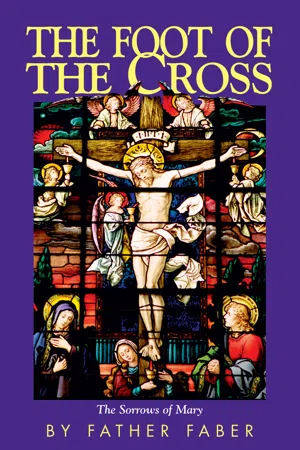
Describes Our Lady's Seven Sorrows, relating them to our own spiritual life. Tells why God permitted her sorrows, and describes the immensity of them, including their characteristics. Explains how Our Lady rejoiced in her sorrows, and demonstrates how the Church puts the sorrows before us. Gives a detailed examination of each sorrow culminating in the crucifixion and burial of Our Lord. Helps to build devotion to Our Lord by understanding the sorrows of His Mother--and experience shows that we never advance more rapidly in love of the Son than when we travel by the Mother. Whoever is growing in devotion to the Mother of God is growing in all good things. Perfect for Lent. Similar to the bookletDevotion to the Sorrowful Mother. Imprimatur.
- 405 pages
- English
- ePUB (mobile friendly)
- Available on iOS & Android
eBook - ePub
The Foot of the Cross
About this book
Information
Topic
Theology & ReligionSubtopic
Christian DenominationsCHAPTER I
THE MARTYRDOM OF MARY
THE beauty of Jesus is inexhaustible. Like the Vision of God in heaven, it is ever diversified, yet always the same, always cherished as an old and familiar joy, yet ever surprising and refreshing the spirit as being, in truth, perpetually new. He is beautiful always, beautiful everywhere, in the disfigurement of the Passion as well as in the splendor of the Resurrection, amid the horrors of the Scourging as well as amid the indescribable attractions of Bethlehem. But above all things our Blessed Lord is beautiful in His Mother. If we love Him we must love her. We must know her in order to know Him. As there is no true devotion to His Sacred Humanity, which is not mindful of His Divinity, so there is no adequate love of the Son, which disjoins Him from His Mother, and lays her aside as a mere instrument, whom God chose as He might choose an inanimate thing, without regard to its sanctity or moral fitness. Now it is our daily task to love Jesus more and more. Year follows year; the old course of feasts comes round; the well-known divisions of the Christian year overtake us, make their impression upon us, and go their way. How we have multiplied Christmases, and Holy Weeks, and Whitsuntides, and there has been something or other in each of them which makes them lie like dates in our mind! We have spent some of them in one place, and some in another, some under one set of circumstances, and some under another. Some of them, all thanks to God! have been distinguished by remarkable openings of heart in our interior life, such as to change or to intensify our devotion, and materially influence our secret relations with God. The foundations of many buildings, which did not rise above ground till long afterward, have been laid almost unconsciously in those times. Yet whatever may have been the changes which these feasts have brought or seen, they have always found us busy at one and the same work, trying to love Jesus more and more: and through all these changes, and in all this perseverance at our one work, unerring experience has told us that we never advance more rapidly in love of the Son than when we travel by the Mother, and that what we have built most solidly in Jesus has been built with Mary. There is no time lost in seeking Him, if we go at once to Mary; for He is always there, always at home. The darkness in His mysteries becomes light when we hold it to her light, which is His light as well. She is the short road to Him. She has the "grand entry" to Him. She is His Esther, and speedy and full are the answers to the petitions which her hand presents.
But Mary is a world, which we cannot take in all at one glance. We must devote ourselves to particular mysteries. We must set aside certain regions of this world of grace, and concentrate ourselves upon them. We must survey them and map them accurately, before we pass on to other regions, and then we shall learn much, which a general view would have omitted to notice, and store our souls with spiritual riches, riches both of knowledge and of love, which will draw us evermore into communion with our dearest Lord. As God's blessed will still persists in keeping us alive, and for His own gracious purposes detaining us amid all this cold weariness and these dejecting possibilities of sin, let us at least determine to occupy ourselves with nothing but God; for we have long since learned that there is truly no other occupation which is worth our while. He has a thousand Edens still, even in the bleak expanse of this salt steppe of a world, where we may work, to the sound of running waters, not without colloquies with Him in the cool time of the day; and we may wander from Eden to Eden, either as the weakness or the strength of our love impels us. For the present let us shut ourselves up in the garden of Mary's sorrows. It is one of God's choicest Edens, and we cannot work there otherwise than under the shadow of His presence, nor without the love of Jesus taking a marvellous possession of our souls. For love of Jesus is in the very viewless air of the place, in the smell of the upturned soil, in the fragrance of the flowers, in the rustling of the leaves, in the songs of the birds, in the shining of the sun, in the quiet tunes of the waterfalls as they dash down its rocky places. There for a while, for our Lord's love, we will enclose ourselves as in a cloistered place, and let the world, in which we are of no great importance, and which is even of less importance to us than we are to it, miss us for a season from our post.
The law of the Incarnation is a law of suffering. Our Blessed Lord was the man of sorrows, and by suffering He redeemed the world. His Passion was not a mystery detached from the rest of His life, but only the fitting and congruous end of it. Calvary was not unlike Bethlehem and Nazareth. It exceeded them in degree; it did not differ from them in kind. The whole of the Three-and-Thirty Years was spent in consistent suffering, though it was of various kinds, and not of uniform intensity. This same law of suffering, which belongs to Jesus, touches all who come nigh Him, and in proportion to their holiness, envelops them, and claims them wholly for itself. The Holy Innocents were, in the counsels of God, simply our Lord's contemporaries, but that is similitude enough to plunge them in a sea of suffering, and for His sake their fresh lives must bleed away in their distracted mother's arms, to be followed by eternal crowns and palms: a happy merchandise, a huge fortune swiftly made, and then so marvellously secured! The same law wound itself round each of the apostles, upon whom the indescribably blessed choice of the Incarnate Word had fallen. It was a cross to Peter and his brother, a sword to Paul, hard stones to James, the flaying-knife to Bartholomew, and the boiling oil and the long years of wearisome delay to John. But, in whatever shape it came outwardly, inwardly it was always suffering. It went with them into all lands. It overshadowed them in all vicissitudes. It walked with them along the Roman roads, as if it was their guardian angel; it strode by the side of their uneasy galleys on the stormy waters of the Mediterranean. They were apostles. They must be like their Lord. They must enter into the cloud, and the darkness of the eclipse must fall upon them on the top of some Calvary or other, from Rome to Bactria, from Spain to Hindostan. The same law has environed the martyrs of all ages. Their passions have been living shadows of the great Passion, and the blood they shed mingled its kindred stream with the Precious Blood of their Redeemer, the King of Martyrs. So with the saints. Whether they have been bishops or doctors, virgins or matrons, seculars or religious, unusual love and unusual grace have always reached them in the shape of unusual trial and unusual suffering. They too must be drawn into the cloud, and they will come out of it with their faces shining, because they have seen, and seen closely, the Face of the Crucified. It is so in its measure with all the elect. They must stand at least within the fringes of the dark cloud, or it must overshadow them in transit, perhaps more than once, in order to secure the salvation of their souls by giving them at least an adequate likeness to their Lord. What, then, must we think of His Mother, who came nighest to Him of all?
It can plainly be no wonder, if she shall suffer more than any one but Himself. The immensity of her sorrows will neither be a distress nor a surprise to us, but rather the obvious conclusion from all we know of the grand mystery of the Incarnation. The amount of her sufferings will be the index of the magnificence of His love for her. The depth of her pains will come the nearest of all things to fathom the abyss of her love for Him. Her far-rolling sea of sorrow will measure the grandeur of her holiness. The loftiness of her divine Maternity will raise her dolors close up to His gracious Passion. Her sinlessness will almost seem to enclose it within the same life-giving law of expiation. Her union with Him will render her Compassion inseparable from His Passion, even while for a thousand reasons it is so manifestly distinguishable from it. The Woman clothed with the Sun will be wrapped round and round with the bright darkness of that same terrible destiny, which He vouchsafed first to appoint and then to accept as the great law of His Incarnation. We must be prepared to find Mary's dolors beyond the reach of our imagination, above the possibility of our description. We can only gaze upon them with such instruments as faith and love supply, and note the beauty and the strangeness of many phenomena which we can only imperfectly comprehend. Especially can we thus increase our devotion to the Passion, many unknown regions of which are momentarily lighted up for us by the contact of her dolors, just as in the occultation of Jupiter, the luminous, tearlike planet, as it touches the dark portion of the moon, scatters a momentary line of light along the unseen edge, like a revelation, and then by its disappearance proves the reality of that which we cannot see.
But, before we ask St. John the Evangelist to hold us by the hand, and go down with us into the depths of that broken heart, which he, the saint of the Sacred Heart, knew better than others, we must take a general view of our Blessed Lady's dolors, just as we familiarize ourselves with the general outlines of the geography of a country before we endeavor to master its details. There are seven points, on which it is necessary for us to have some information, before we can study with advantage the separate mysteries of her surpassing sorrow. We must know, as far at least as lies in our power, the immensity of her dolors, why God permitted them, what were the fountains of them, and what their characteristics, how it was that she could rejoice in them, in what way the Church puts them before us, and what should be the spirit of our devotion to them. These are questions which need answering; and the answers to them, however imperfect, will serve as a sort of introduction to the subject.
SECTION I
THE IMMENSITY OF OUR LADY'S DOLORS
When we think how we can best describe our Lady's dolors, it gradually dawns upon us that they are in fact indescribable. We see but the outside show of them, and there are no adequate figures by which even that can be represented. He who looks over the wide Atlantic sees a waste of waters with a white horizon on every side; but that waste of waters tells nothing either of the multitudinous manifold life which it contains within its bosom, nor of the fairy-like ocean-gardens of vivid, painted weeds, its woods of purple, deep thickets of most golden green, grottoes of fantastic rock with tufted palmlike yellow trees overhanging, and the blue water flowing all round, parklike vistas of glossy, spotted, arborescent herbs, or leagues on leagues of rose-colored forests teeming with strange, beautiful, heretofore unimaginable life. So is it with the sea of sorrows which rolls over the secret depths of the Immaculate Heart of the Mother of God. What we see is amazing, yet it hardly indicates what is below. How then shall we say what her woes are like? Holy men have tried to do so, and they have done it by calling her the co-redemptress of the world, and speaking of her sorrows as they blended with the Precious Blood, and the two made but one sacrifice for the sins of the world. There is a deep truth, and a most substantial one, hidden under these great words, and yet they may easily be understood in a sense in which they would not be true. They are the expressions of an excellent devotion, striving to assist the feebleness of our understandings to a true conception of Mary's grandeurs. They are accuracies, not exaggerations. Yet they need cautious wording and careful explanation. We shall consider them in the ninth chapter; and in the rest of the treatise we shall travel to our end by some other road, not only because we dare not trust ourselves to such a method of procedure, but also because it is against our habits and predilections, and in matters of devotion what does not come natural is not persuasive. We will prefer therefore to approximate to our subject, inevitably falling short, rather than to overshoot it, making things indistinct by too strong a light, and dissatisfying by a feeling of unreality like a sunset in the hands of an unskilful painter. We shall come at last to the same end, in a manner which is not only most fitted to our own infirmity, but also most calculated to win the confidence of our readers.
The first thing, then, which strikes us about our Lady's dolors is their immensity, not in its literal meaning, but in the sense in which we commonly use it with reference to created things. It is to her sorrows that the Church applies those words of Jeremias,* O all ye that pass by the way, attend, and see if there be any sorrow like to my sorrow. To what shall I compare thee, and to what shall I liken thee, O daughter of Jerusalem? To what shall I equal thee, that I may comfort thee, O virgin daughter of Zion? for great as the sea is thy broken-heartedness: who shall heal thee? Mary's love is spoken of as that which many waters could not quench. In like manner the saints and doctors of the Church have spoken of the greatness of her sorrows. St. Anselm† says, Whatever cruelty was exercised upon the bodies of the martyrs was light, or rather it was as nothing, compared to the cruelty of Mary's passion. St. Bernardine of Siena‡ says that so great was the dolor of the Blessed Virgin that if it was subdivided and parcelled out among all creatures capable of suffering, they would perish instantly. An angel§ revealed to St. Bridget that if our Lord had not miraculously supported His Mother, it would not have been possible for her to live through her martyrdom. It would be easy to multiply similar passages, both from the revelations of the saints and the writings of the doctors of the Church.
But the immensity of Mary's dolors is especially shown in this, that they exceeded all martyrdom. Not only was there never any martyr, however prolonged and complicated his tortures may have been, who equalled her in suffering; but the united agonies of all the martyrs, variety and intensity all duly allowed for, did not approach to the anguish of her martyrdom. No thoughtful man will ever speak lightly of the mystery of bodily pain. Possibly in that respect his own experience may have shamed him into wisdom. It was in a great measure through bodily pain that the world was redeemed; and is it not mainly by the same process that we ourselves are being sanctified at this hour? It is the unerring justice of God which places on the heads of the martyrs that peculiar crown which belongs to those who, in the heroism of physical endurance, have laid down their lives for Christ. But even in respect of corporeal anguish Mary exceeded the martyrs. Her whole being was drenched with bitterness. The swords in her soul reached to every nerve and fibre in her frame, and we can hardly doubt but that her sinless body, with its exquisite perfections, was delicately framed for suffering beyond all others but that of her Son. Moreover, in the case of the martyrs, they had long looked at their flesh as their enemy and their hinderance on the heavenward road. They had punished it, mortified it, cruelly kept it under, until they had come to regard it with a kind of holy hatred. Hers was sinless. It was the marvellous mine, the purest, sublimest matter that the world knew, out of which our Lord's Sacred Flesh and Precious Blood had been obtained, and she could know nothing of that exulting revenge with which heroic sanctity triumphs in the sufferings of the flesh. But what is the grand support of the martyrs in their tortures? It is that their minds are full of light and radiance. It is that their inward eye is bent on Jesus, by whose beauty and glory they are fortified. It is this which puts out the fires, or makes them pleasant as the flapping of the warm wind in spring. It is this which makes the scourges fall so soft and smooth, and causes the lash to cheer like wine. It is this which makes the sharpness of the steel so dull to the divided flesh and wounded fibres. What is within them is stronger than that which is without them. It is not that their agonies are not real, but that they are tempered, counteracted, almost metamorphosed, by the succors which their soul supplies, from the influx of grace and love wherewith their generous Master is at that moment filling them to overflowing. But where is Mary to look, with her soul's eye, for consolation? Nay, her soul's eye must look where her body's eye is fixed already. It is bent on Jesus; and it is that very sight which is her torture. She sees His Human Nature; and she is the mother, the mother beyond all other mothers, loving as never mother loved before, as all mothers together could not love, if they might compact their myriad loves into one intensest nameless act. He is her Son, and such a Son, and in so marvellous a way her Son. He is her treasure and her all. What a fund of mystery—keen, quick, deadly, unequalled—was there in that sight! And yet there was far more than that. There was His Divine Nature.
We talk of mothers making idols of their sons; that is, worshipping them, turning them from creatures into creators, regarding them as truly their last end and true beatitude, so giving their hearts to them as they have no right to give them to any one but God. This Mary could not do, and yet in another sense might well do. For Jesus could be no idol, and yet must of necessity be worshipped as the Eternal God. None saw this as Mary did. No angel worshipped Him with such sublimely abject adoration as she did. No saint, not even the dear Magdalen, ever hung over His feet with such mortal yearning, with such human fondness. Yes! He is God,—she saw that through the darkness of the eclipse. But then the blood,—the spittings, the earth-stains, the unseemly scars, the livid, many-colored bruises,—what did all that mean on a Person only and eternally divine? It is vain to think of giving a name to such misery as then flooded her soul. Jesus, the joy of the martyrs, is the executioner of His mother. Twice over, to say the least, if not a third time also, did He crucify her; once by His Human Nature, once by His Divine, if indeed Body and Soul did not make two crucifixions from the Human Nature only. No martyrdom was ever like this. No given number of martyrdoms approach to a comparison with it. It is a sum of sorrow which material units, ever so many added together, ever so often multiplied, do not go to form. It is a question of kind as well as of degree; and hers was a kind of sorrow which has only certain affinities to any other kinds of sorrow, and is simply without a name, except the name which the simple children of the Church call it by, the Dolors of Mary.
Her dolors may also be called immense, because of the proportions which they bore to other things in her; for even immensity must have proportions in its way. If she was to sorrow perfectly,—if after Jesus, and because of Jesus, she was to have a pre-eminence of sorrow,—then her sorrows must be proportioned to her greatness. But she was the Mother of God! Who will take the altitude of that greatness? St. Thomas tried to do so, and said that omnipotence itself could not contrive a greater greatness. It had done its utmost, though it has no utmost, when it had imagined and effected the dignity of the Divine Motherhood. What are we to a saint, or a saint to the highest angel, or the highest angel to Mary? Perhaps we are nearer—it is to be suspected that we are much nearer—to Michael or Raphael, than they are to Mary; yet it is weary even for a strong mind to think how far off we are from those tremendous intelligences and uncomprehended sanctities. Yet a sorrow proportioned to our capacities, and even indulgently measured to our grace, can be something so terrific that it makes us dizzy to think of what God might will about us. And then, what can those spirits bear, and yet perish not, who have left the world wrongly, and fallen out of time when there was no root of eternity within them? Their strength is laden now in their hopeless home, yet not overladen; and who thinks of their burden without forthwith hiding his thoughts in God, lest something should happen to him, he knows not what? Yet Mary's soul was as immortal, as indestructible, as their spirits, and stronger far; and her body was miraculously supported by the same omnipotence which confers an imperishable resurrection. Nay, it was perhaps the same blessed Sacrament unconsumed within her, and in all of us the seed of a glorious resurrection, which was the miracle that kept her standing and alive at the foot of the bleeding Cross. What then must that sorrow have been which was proportioned to her greatness, to the greatness of the Mother of God, to her vast strength to bear, to her manifold capability of suffering? If we pause and think, we shall see how little our thinking comes to.
But her dolors must have been proportioned also to her sanctity. The trials of the saints have always an analogy with their holiness, and match it in degree as well as adapt themselves to it in its kind. If Mary's sorrow was the work of God, and was to do work for Him,—if it was meritorious, if it closely resembled our Lord's, if it hung to His, subordinately, yet inseparably, if it was populous with supernatural actions, if it multiplied her graces,—then must it have been suitable to the excellences of her soul, and proportioned to her sanctity. But that arithmetic of Mary's merits has long been a bewildering question; bewildering, not because a shadow of doubt hangs over, but for the want of ciphers to write it down in—of factors whereby to work the gigantic multiplication. The holiness of the Mother of God was not absolutely illimitable; and this is the lowest thing which can be said about it. If then we cast the most cursory glance over the number of her graces, their kinds, and their degrees, if starting at the Immaculate Conception we make a sort of reckoning up to the Incarnation, using angels' figures because men's have failed us long ago; and then if we think, however briefly, of the way in which at the moment of the Incarnation our figures fell over into the infinite, or something very like it; and then if we contemplate, stupidly and wildly as we must do, the velocity of indefinable grace during three-and-thirty years, all thickly strewn with infinite mysteries, we may form some idea, not of the amount of sanctity ready to bear its proportionate amount of sorrow at the foot of the Cross, but of the impossibility of our forming any clear idea of such a sanctity at all. So that we go away with a most overwhelming impression, but it is an impression like a faith, of the enormous weight of suffering which such a sanctity required, in order to engross it, to match it, to accelerate it, to complete it, to crown it, and to augment it by another infinity.
Neither can we doubt that her sorrows were proportioned to her enlightenment. Knowledge always puts an edge on grief. Sensibility gives it additional acuteness. For the most part, when we suffer we hardly know half our actual misfortune, because we hardly understand more than half of it. Neither are we generally in full possession of ourselves. Some part of us is deadened and dulled by the blow which has been dealt us, and all that portion of our soul is a refuge to us from the sensitiveness and vigilance of the rest. A child weeps when his mother dies; but alas! how many a long year it takes to teach both boy and man what a mother's loss really means! Now, our Lady's whole being was flooded with light. Not only did a reason and intelligence of the most consummate perfection illuminate every faculty, and secure the utmost excellence in the exercise of it, but she lived within herself in a very atmosphere of supernatural air and light. In her dolors this light was a torture to her. We may well suppose ...
Table of contents
- Title Page
- Copyright Page
- Dedication Page
- CONTENTS
- PREFACE
- CHAPTER I: The Martyrdom of Mary
- CHAPTER II: The First Dolor
- CHAPTER III: The Second Dolor
- CHAPTER IV: The Third Dolor
- CHAPTER V: The Fourth Dolor
- CHAPTER VI: The Fifth Dolor
- CHAPTER VII: The Sixth Dolor
- CHAPTER VIII: The Seventh Dolor
- CHAPTER IX: The Compassion of Mary
Trusted by 375,005 students
Access to over 1.5 million titles for a fair monthly price.
Study more efficiently using our study tools.
Frequently asked questions
Yes, you can cancel anytime from the Subscription tab in your account settings on the Perlego website. Your subscription will stay active until the end of your current billing period. Learn how to cancel your subscription
No, books cannot be downloaded as external files, such as PDFs, for use outside of Perlego. However, you can download books within the Perlego app for offline reading on mobile or tablet. Learn how to download books offline
Perlego offers two plans: Essential and Complete
- Essential is ideal for learners and professionals who enjoy exploring a wide range of subjects. Access the Essential Library with 800,000+ trusted titles and best-sellers across business, personal growth, and the humanities. Includes unlimited reading time and Standard Read Aloud voice.
- Complete: Perfect for advanced learners and researchers needing full, unrestricted access. Unlock 1.5M+ books across hundreds of subjects, including academic and specialized titles. The Complete Plan also includes advanced features like Premium Read Aloud and Research Assistant.
We are an online textbook subscription service, where you can get access to an entire online library for less than the price of a single book per month. With over 1.5 million books across 990+ topics, we’ve got you covered! Learn about our mission
Look out for the read-aloud symbol on your next book to see if you can listen to it. The read-aloud tool reads text aloud for you, highlighting the text as it is being read. You can pause it, speed it up and slow it down. Learn more about Read Aloud
Yes! You can use the Perlego app on both iOS and Android devices to read anytime, anywhere — even offline. Perfect for commutes or when you’re on the go.
Please note we cannot support devices running on iOS 13 and Android 7 or earlier. Learn more about using the app
Please note we cannot support devices running on iOS 13 and Android 7 or earlier. Learn more about using the app
Yes, you can access The Foot of the Cross by Frederick William Faber in PDF and/or ePUB format, as well as other popular books in Theology & Religion & Christian Denominations. We have over 1.5 million books available in our catalogue for you to explore.