The sons of St. Dominic were the first to preach the Gospel in the land of the Incas. They had shared the perils of the Peruvian adventure with Pizarro in the same boat in which he and his men sailed south through the Pacific. Missionaries of many other orders followed them: Franciscans, Augustinians, Mercedarians, Jesuits. But divine Providence reserved for the first missionary workers the finest fruits of the seed of the Gospel sown between the seacoast and the forbidding heights of the Andes.
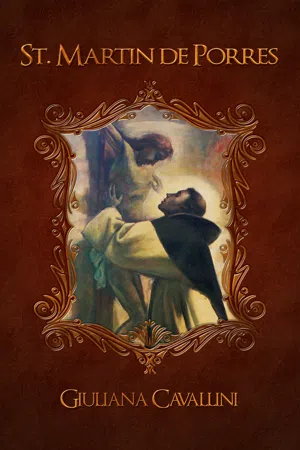
- 254 pages
- English
- ePUB (mobile friendly)
- Available on iOS & Android
eBook - ePub
About this book
Information
Topic
Theology & ReligionSubtopic
Christian DenominationsChapter 1
“Her ways are beautiful ways: and all her paths are peaceable.” (Prov. 3:17).
St. Martin de Porres was born in Lima, Peru, on December 9, 1579.
There is no need to describe Lima nor to outline its history. Those who are uncertain of its geographical position need only consult a map of South America. If one follows the outline of the western coast from north to south, Lima will be found about one-third the way down the length of the continent, near its port, Callao.
The story of the first decade of the Spanish conquest is such a mixture of daring and cruelty that admiration for these intrepid pioneers is cut short by horror at their inhumanity. The first white men to arrive on the shores of the New World were, it is true, fearless in facing and overcoming the thousand unknown dangers presented by a deadly climate and a savage land infested with wild animals and with insects even more dangerous than the beasts. But at the same time, thirst for gold made them masters of cruelty, contrasting strangely with that character of heralds of the Gospel, in which they gloried, and probably with sincere intentions.
It is almost a miracle that the Catholic faith was established among the Indians in spite of the brutality practiced by the conquistadors.
When Hatuey, chief of Cuba, was offered baptism at the very moment that the invaders, dissatisfied with the gold he had offered to sate their cupidity, were preparing to burn him alive, he asked the missionary priest, “Will the white Christians also enter into paradise?” Receiving an affirmative reply, he is said to have retorted, “Then I prefer to do without it!”1
But the Indians soon found staunch defenders. In 1510, twelve Friars Preachers founded a monastery on the island of Santo Domingo, and on a Sunday of the same year, one of them, Father Anthony de Montesino, denounced the cruelty of the Spaniards from the pulpit: “Because of the cruelty and tyranny you have inflicted upon an innocent and peaceful people, you are farther from salvation than the Moslems who deny the name of Our Lord Jesus Christ!” And he declared that neither he nor his fellow priests would give absolution to those who mistreated the natives.
Indifferent to all protests and threats, Father Montesino continued to preach constantly on the same theme until the day he embarked upon a ship leaving for Spain so that he could plead the cause of the Indians before the King. It was not easy to gain an audience with King Ferdinand; all those interested in the unlimited plundering of the land across the sea impeded him. It seems that finally Father Anthony (a man whose courageous heart was matched by his athlete’s physique) gained entrance to the King’s presence by sheer force, throwing aside an attendant stationed at the door to prevent his entering. The first laws for the protection of the rights of the Indians, known as the Laws of Burgos of 1514, resulted from his audience with the King.
But the preaching of Father Anthony had an even greater effect. It aroused the interest of Bartholomew de Las Casas, then a diocesan priest, but later to become a Dominican and a bishop. He would dedicate his whole life to the cause of the Indians and would become a model for all defenders of the natives against the tyranny of the whites.2
The new laws, which were to crown the efforts of Las Casas in 1542, were not yet promulgated when Pizarro and Almagro, with few men but great daring, came down from Panama in a small boat, journeying southward towards the fabled land of the Incas. It is sad, but not surprising, that the conquest of Peru was marked by the same scenes of horror that had been staged in regions conquered in the preceding years. The inhabitants of Peru had reached a high degree of culture and their system of government was perfectly organized. The contrast between the brutal methods of conquest and the customs of a population far from primitive was therefore all the more striking. In fact, in some respects the Peruvians were more civilized than the Europeans who used violent means to substitute their authority for that of the Incas.3
In a few years the whole country was conquered for the Spanish. On the feast of the Epiphany, 1535, Pizarro laid the foundation of the new capital, destined to replace the old capital of Cuzco, which was situated in the mountains and too far from the seaport. This new capital was at first called “City of the Kings,” in memory of the day of its foundation, but later the commemoration of the Three Kings was supplanted by the vivid and sonorous presence of the river which passes through the city, the Rimac. And from “Rimac” the name “Lima” was derived.4
The first years of the history of Lima were tormented ones, filled with the struggle not only between the Spaniards and the natives, but between the Spaniards themselves. The thirst for power and wealth, which made the conquerors capable of any cruelty that could open the door to treasure, led them to fight against one another in order to attain the posts of honor and profit. The city was not yet seven years old when Pizarro was murdered in his own palace, victim of a plot headed by the son of the same James de Almagro who had been Pizarro’s companion in the conquest of Peru, and of whose death Pizarro cannot be held innocent.
Nevertheless, with the rapidity with which every seed brought from the Old World seemed to develop in the New, Lima swiftly acquired enough calm to become a center of culture as well as the political and commercial capital. In 1551 the Dominicans founded a university there, the University of St. Mark, the first to be established in all the territory of the two Americas. Lima had been founded only sixteen years previously.
The sons of St. Dominic were the first to preach the Gospel in the land of the Incas. They had shared the perils of the Peruvian adventure with Pizarro in the same boat in which he and his men sailed south through the Pacific. Missionaries of many other orders followed them: Franciscans, Augustinians, Mercedarians, Jesuits. But Divine Providence reserved for the first missionary workers the finest fruits of the seed of the Gospel sown between the seacoast and the forbidding heights of the Andes.
The first bishop was a Dominican, Vincent de Valverde. The first center of culture was Dominican, the University of St. Mark. And, far more important than all else, the first saint was a Dominican, St. Rose of Lima.
But even before the waters of baptism had infused, together with sanctifying grace, the seed of sanctity into the soul of little Rose of Santa María—in fact, seven years before—another privileged soul, destined to reach the heights of perfection in the Order of Friars Preachers, received the gift of supernatural life at the same baptismal font in the church of St. Sebastian in Lima.
Martin was the son of John de Porres, a noble Spanish gentleman and Knight of the Order of Alcántara, and of Anna Velázquez a free black woman. When the father saw that the infant’s skin was black, he did not wish to acknowledge the baby as his son. The baptismal registry carries the entry, “Martin, son of an unknown father.” But later, John repented and legally acknowledged Martin and Joan, the daughter born two years later.5
Martin’s first years were spent with his mother and little sister. Since he was quick-witted, Anna sometimes sent him to do the shopping. Martin left with the money and the empty basket. Often—but not always—he returned without any money and the basket still empty. There were so many poor in Lima, and Martin could not refuse those who asked for charity.
And how much time he took to go to the market! He could spend half the morning disposing of a few pennies. Not because he stopped along the way to play with other lads his age, but because if he came across a church, he went in to greet his heavenly Father, who had made him His son, while his own earthly father had repudiated him. He passed from the light of the street to the mysterious and prayerful shadows of the church, and going the length of the spacious nave with the light step of a child, he knelt before the altar. There he stayed, absorbed in prayer, his huge eyes, wide open and showing very white in his black face, fixed on the crucifix or on a picture of the Virgin, wrapped in the silence of the soaring arches and in the profound peace so different from the noisy squalor of his own home.
But at home he had to settle accounts with his mother, who, having very little money, could not approve the generosity of her little son. “See, it’s your fault that today we have nothing to eat; not only you, but also your little sister and myself!”
Martin took his punishment in silence. If he wept, it was over his mother’s difficulties. And at the first opportunity, he repeated the offense.6
In the meantime, the little circle of acquaintance of Anna Velázquez began to notice the child, so intelligent and so good. There were perhaps those who shook their heads and criticized John de Porres who, rich though he was, left the mother and children to live in misery.
At that period John de Porres did not live in Lima, but in Guayaquil, Ecuador, where he had a government post. He went to Lima only from time to time. After one of these visits to Lima, he returned to Guayaquil with the two children and kept them with him, treating them as a father should treat his own children. In addition to engaging competent teachers for them, he himself completed their education by daily contact, spending with them whatever free hours he could spare from his official duties.
Thus it happened that on one occasion, when taking a walk with Martin and Joan, John de Porres met one of his uncles, James de Miranda, who asked him who the two children were. He answered frankly, “They are my children, and those of Anna Velázquez. I have them with me here, and I am seeing to their education.”7
Martin was then eight years old, Joan six.
This serene interlude did not last long, perhaps not more than four years. It was interrupted and ended when John de Porres left Ecuador to govern Panama. Joan was entrusted to the care of the uncle, James de Miranda, and John took Martin back to Lima to his mother. He wanted the boy to be confirmed before his own departure for Panama. Before leaving Lima, John gave Anna sufficient funds to permit Martin to complete his education and to learn a trade, and also enough money to ensure their being freed from privation.
Chapter 2
“The wisdom of a discreet man is to understand his way.” (Prov. 14:8).
AT THE AGE of twelve or a little more, Martin had to make his first important decision, the choice of a trade which would help him earn a living for himself and his mother, since his little sister was being provided for by their great-uncle, James de Miranda.
It is possible that he made his decision with the affectionate approval of his father before the latter left Lima, weighing with him the factors for and against the various possibilities. But it does not appear that John de Porres imposed his paternal authority upon the will of his son; it seems rather that Martin made his choice freely, in accordance with his own inclinations and desires.
As a consequence of this free choice, Martin went to the shop of Marcel de Rivero to learn to be a barber, which in those days meant not only cutting hair and beards, but also letting blood, treating wounds and fractures, and even prescribing medicine for the more ordinary cases of illness. A barbero or cirujano was, in fact, at the same time a barber, surgeon, doctor and pharmacist.
Martin applied himself arduously to the study of his profession. Perhaps he foresaw how useful it would be in helping the poor. Along with much good will, a degree of intelligence above the ordinary began to be apparent in him. Soon Marcel de Rivero had not much more to teach him, and several times when he had to be absent from the shop, he left Martin in charge of the “first aid” room.
On one of these occasions, Martin saw three or four men coming into the consulting room, carrying an Indian who had been badly beaten and was bleeding from numerous wounds received in a street brawl. Upon learning that the doctor was not there, their faces fell. Entrust a man in that condition to a mere boy, an apprentice? But all their misgivings vanished when they saw Martin set to work with assurance and skill. Martin washed the wounds and bound them up skillfully, then refreshed the man, who was exhausted from the loss of blood, with a glass of good wine. They were still more satisfied when, after a few days, the Indian returned to his work, as well and as strong as before.1
Because of this and other similar incidents, the fame of the young native student began to spread throughout Lima, as he showed he possessed an ability not inferior to that of his teacher from overseas. And such was the skill of the student that, little by little, the clients came to prefer his eye and his hand to the eye and hand of the professor.
Martin could have earned a great deal of money and lived in comfort with his mother. But the same charity which drove him, as a small child, to give to the poor the money his mother had entrusted to him to buy their daily bread, now moved him to devote himself to the poor. He refused money almost with horror. It does not seem, however, that his professional disinterestedness aroused the same indignation in his mother as the thoughtless charity of his childhood had done. Since John de Porres had assumed responsibility for the little family, they were no longer in need, and Anna Velázquez, who, like her son, had a good heart, was not a woman to wish for superfluities when she had the necessities.2
Nor did she object to the habit Martin had acquired when very young of visiting the churches alon...
Table of contents
- Cover Page
- Copyright Page
- CONTENTS
- Official Approbation of the Dominican Order
- Preface
- Chapter 1
- Chapter 13
- Bibliography
- Notes
Trusted by 375,005 students
Access to over 1.5 million titles for a fair monthly price.
Study more efficiently using our study tools.
Frequently asked questions
Yes, you can cancel anytime from the Subscription tab in your account settings on the Perlego website. Your subscription will stay active until the end of your current billing period. Learn how to cancel your subscription
No, books cannot be downloaded as external files, such as PDFs, for use outside of Perlego. However, you can download books within the Perlego app for offline reading on mobile or tablet. Learn how to download books offline
Perlego offers two plans: Essential and Complete
- Essential is ideal for learners and professionals who enjoy exploring a wide range of subjects. Access the Essential Library with 800,000+ trusted titles and best-sellers across business, personal growth, and the humanities. Includes unlimited reading time and Standard Read Aloud voice.
- Complete: Perfect for advanced learners and researchers needing full, unrestricted access. Unlock 1.5M+ books across hundreds of subjects, including academic and specialized titles. The Complete Plan also includes advanced features like Premium Read Aloud and Research Assistant.
We are an online textbook subscription service, where you can get access to an entire online library for less than the price of a single book per month. With over 1.5 million books across 990+ topics, we’ve got you covered! Learn about our mission
Look out for the read-aloud symbol on your next book to see if you can listen to it. The read-aloud tool reads text aloud for you, highlighting the text as it is being read. You can pause it, speed it up and slow it down. Learn more about Read Aloud
Yes! You can use the Perlego app on both iOS and Android devices to read anytime, anywhere — even offline. Perfect for commutes or when you’re on the go.
Please note we cannot support devices running on iOS 13 and Android 7 or earlier. Learn more about using the app
Please note we cannot support devices running on iOS 13 and Android 7 or earlier. Learn more about using the app
Yes, you can access St. Martin De Porres by Giuliana Cavallini in PDF and/or ePUB format, as well as other popular books in Theology & Religion & Christian Denominations. We have over 1.5 million books available in our catalogue for you to explore.