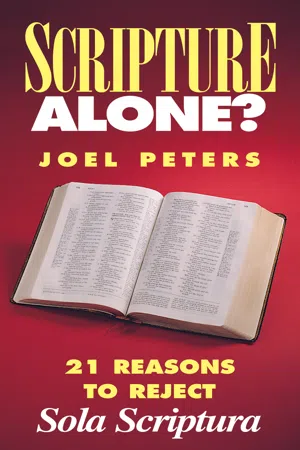
Here are the classic reasons why the Protestant dogma of Sola Scriptura - "Scripture Alone" - is absolutely wrong, is unscriptural, man-made and prevents Protestants from ever having a firm doctrinal foundation. The book shows that: Christ gave us Tradition and the teaching authority of His Church; the first Christians did not have a complete Bible and Scripture itself states that it is insufficient of itself calling the Church and not the Bible "the pillar and ground of the truth." 72 pgs,
- 77 pages
- English
- ePUB (mobile friendly)
- Available on iOS & Android
eBook - ePub
About this book
Information
Topic
Theology & ReligionSubtopic
Christian DenominationsSCRIPTURE ALONE?
What Is Sola Scriptura?
“We believe in the Bible alone and the Bible in its entirety as the sole rule of faith for the Christian!”
You may have heard these words or something very similar to them from a Fundamentalist or Evangelical Protestant. They are, in essence, the meaning of the doctrine of Sola Scriptura, or “Scripture alone,” which alleges that the Bible—as interpreted by the individual believer—is the only source of religious authority and is the Christian’s sole rule of faith or criterion regarding what is to be believed. By this doctrine, which is one of the foundational beliefs of Protestantism, a Protestant denies that there is any other source of religious authority or divine Revelation to humanity.
The Catholic, on the other hand, holds that the immediate or direct rule of faith is the teaching of the Church; the Church in turn takes her teaching from divine Revelation—both the written Word, called Sacred Scripture, and the oral or unwritten Word, known as “Tradition.” The teaching authority or “Magisterium” of the Catholic Church (headed by the Pope), although not itself a source of divine Revelation, nevertheless has a God-given mission to interpret and teach both Scripture and Tradition. Scripture and Tradition are the sources of Christian doctrine, the Christian’s remote or indirect rule of faith.
Obviously these two views on what constitutes the Christian’s rule of faith are opposed to each other, and anyone who sincerely seeks to follow Christ must be sure that he follows the one that is true.
The doctrine of Sola Scriptura originated with Martin Luther, the 16th-century German monk who broke away from the Roman Catholic Church and started the Protestant “Reformation.”1 In response to some abuses that had been occurring within the Catholic Church, Luther became a vocal opponent of certain practices. As far as these abuses were concerned, they were real and Luther was justified in reacting. However, as a series of confrontations between him and the Catholic hierarchy developed, the issues became more centered on the question of Church authority and—from Luther’s perspective—whether or not the teaching of the Catholic Church was a legitimate rule of faith for Christians.
As the confrontations between Luther and the Church’s hierarchy ensued and tensions mounted, Luther accused the Catholic Church of having corrupted Christian doctrine and having distorted Biblical truths, and he more and more came to believe that the Bible, as interpreted by the individual believer, was the only true religious authority for a Christian. He eventually rejected Tradition as well as the teaching authority of the Catholic Church (with the Pope at its head) as having legitimate religious authority.
An honest inquirer must ask, then, whether Luther’s doctrine of “Scripture alone” was a genuine restoration of a Biblical truth or rather the promulgation of an individual’s personal views on Christian authority. Luther was clearly passionate about his beliefs, and he was successful in spreading them, but these facts in and of themselves do not guarantee that what he taught was correct. Since one’s spiritual well-being, and even one’s eternal destiny, is at stake, the Christian believer needs to be absolutely sure in this matter.
Following are twenty-one considerations which will help the reader scrutinize Luther’s doctrine of Sola Scriptura from Biblical, historical and logical bases and which show that it is not in fact a genuine Biblical truth, but rather a man-made doctrine.
1. The Doctrine of Sola Scriptura Is Not Taught Anywhere in the Bible.
Perhaps the most striking reason for rejecting this doctrine is that there is not one verse anywhere in the Bible in which it is taught, and it therefore becomes a self-refuting doctrine.
Protestants often point to verses such as 2 Timothy 3:16-17 or The Apocalypse (Revelation) 22:18-19 in defense of Sola Scriptura, but close examination of these two passages easily demonstrates that they do not support the doctrine at all.
In 2 Timothy 3:16-17 we read, “All scripture, inspired of God, is profitable to teach, to reprove, to correct, to instruct in justice, that the man of God may be perfect, furnished to every good work.” There are five considerations which undermine the Sola Scriptura interpretation of this passage:
1) The Greek word ophelimos (“profitable”) used in verse 16 means “useful” and not “sufficient.” An example of this difference would be to say that water is useful for our existence—even necessary—but it is not sufficient; that is, it is not the only thing we need to survive. We also need food, clothing, shelter, etc. Likewise, Scripture is useful in the life of the believer, but it was never meant to be the only source of Christian teaching, the only thing needed for believers.
2) The Greek word pasa, which is often rendered as “all,” actually means “every,” and it has the sense of referring to each and every one of the class denoted by the noun connected with it.2 In other words, the Greek reads in a way which indicates that each and every “Scripture” is profitable. If the doctrine of Sola Scriptura were true, then based on the Greek in verse 16, each and every book of the Bible could stand on its own as the sole rule of faith, a position which is obviously absurd.
3) The “Scripture” that St. Paul is referring to here is the Old Testament, a fact which is made plain by his reference to the Scriptures’ being known by Timothy from “infancy” (verse 15). The New Testament as we know it did not yet exist, or at best it was incomplete, so it simply could not have been included in St. Paul’s understanding of what was meant by the term “scripture.” If we take St. Paul’s words at face value, Sola Scriptura would therefore mean that the Old Testament is the Christian’s sole rule of faith. This is a premise that all Christians would reject.
Protestants may respond to this issue by arguing that St. Paul is not here discussing the canon of the Bible (the authoritative list of which books are included in the Bible), but rather the nature of Scripture. While there is some validity to this assertion, the issue of canon is also relevant here, for the following reason: Before we can talk about the nature of Scripture as being theopneustos or “inspired” (literally, “God-breathed”), it is imperative that we identify with certainty those books we mean when we say “Scripture”; otherwise, the wrong writings may be labeled as “inspired.” St. Paul’s words here obviously took on a new dimension when the New Testament was completed, as Christians eventually considered it, too, to be “Scripture.” It can be argued, then, that the Biblical canon is also the issue here, as St. Paul—writing under the inspiration of the Holy Spirit—emphasizes the fact that all (and not just some) Scripture is inspired. The question that begs to be asked, however, is this: “How can we be sure we have all the correct writings?” Obviously, we can only know the answer if we know what the canon of the Bible is. Such a question poses a problem for the Protestant, but not for the Catholic, as the latter has an infallible authority to answer it.
4) The Greek word artios, here translated “perfect,” may at first glance make it seem that the Scriptures are indeed all that is needed. “After all,” one may ask, “if the Scriptures make the man of God perfect, what else could be needed? Doesn’t the very word ‘perfect’ imply that nothing is lacking?”
Well, the difficulty with such an interpretation is that the text here does not say that it is solely by means of the Scriptures that the man of God is made “perfect.” The text—if anything—indicates precisely the opposite to be true, namely, that the Scriptures operate in conjunction with other things. Notice that it is not just anyone who is made perfect, but rather the “man of God”—which means a minister of Christ (cf. 1 Tim. 6:11), a clergyman. The fact that this individual is a minister of Christ presupposes that he has already had training and teaching which prepared him to assume his office. This being the case, the Scriptures would be merely one item in a series of items which make this man of God “perfect.” The Scriptures may complete his list of necessary items or they may be one prominent item on the list, but surely they are not the only item on his list nor intended to be all that he needs.
By way of analogy, consider a medical doctor. In this context we might say something like, “The Physician’s Desk Reference [a standard medical reference book] makes our General Practitioner perfect, so that he may be ready to treat any medical situation.” Obviously such a statement does not mean that all a doctor needs is his PDR. It is either the last item on his list or just one prominent item. The doctor also needs his stethoscope, his blood pressure gauge, his training, etc. These other items are presupposed by the fact that we are talking about a doctor rather than a non-medical person. So it would be incorrect to assume that if the PDR makes the doctor “perfect,” it is the only thing which makes him so.
Also, taking this word “perfect” as meaning “the only necessary item” results in a biblical contradiction, for in James 1:4 we read that patience—rather than the Scriptures—makes one perfect: “And patience hath a perfect work; that you may be perfect and entire, failing in nothing.” Now it is true that a different Greek word (teleios) is used here for “perfect,” but the fact remains that the basic meaning is the same. Now, if one rightly acknowledges that patience is clearly not the only thing a Christian needs in order to be perfect, then a consistent interpretive method would compel one to acknowledge likewise that the Scriptures are not the only thing a “man of God” needs in order to be perfect.
5) The Greek word exartizo in verse 17, here translated “furnished” (other Bible versions read something like “fully equipped” or “thoroughly furnished”) is referred to by Protestants as “proof” of Sola Scriptura, since this word—again—may be taken as implying that nothing else is needed for the “man of God.” However, even though the man of God may be “furnished” or “thoroughly equipped,” this fact in and of itself does not guarantee that he knows how to interpret correctly and apply any given Scripture passage. The clergyman must also be taught how to correctly use the Scriptures, even though he may already be “furnished” with them.
Consider again a medical analogy. Picture a medical student at the beginning of an internship. He might have at his disposal all the equipment necessary to perform an operation (i.e., he is “thoroughly equipped” or “furnished” for a surgical procedure), but until he spends time with the doctors, who are the resident authorities, observing their techniques, learning their skills, and practicing some procedures of his own, the surgical instruments at his disposal are essentially useless. In fact, if he does not learn how to use these instruments properly, they can actually become dangerous in his hands.
So it is with the “man of God” and the Scriptures. The Scriptures, like the surgical instruments, are life-giving only when properly used. When improperly used, the exact opposite results can occur. In one case they could bring physical ruin or even death; in the other case they could bring spiritual ruin or even spiritual death. Since the Bible admonishes us to handle rightly or rightly divide the word of truth (cf. 2 Tim. 2:15), it is therefore possible to handle incorrectly or wrongly divide it—much like an untrained medical student who incorrectly wields his surgical instruments.
Regarding The Apocalypse (Revelation) 22:18-19, there are two considerations which undermine the Sola Scriptura interpretation of these verses. The passage—almost the very last in the Bible—reads: “For I testify to every one that heareth the words of the prophecy of this book: If any man shall add to these things, God shall add unto him the plagues written in this book. And if any man shall take away from the words of the book of this prophecy, God shall take away his part out of the book of life, and out of the holy city, and from these things that are written in this book.”
1) When these verses say that nothing is to be added to or taken from the “words of the prophecy of this book,” they are not referring to Sacred Tradition being “added” to Sacred Scripture. It is obvious from the context that the “book” being referred to here is Revelation or The Apocalypse and not the whole Bible. We know this because St. John says that anyone who is guilty of adding to “this book” will be cursed with the plagues “written in this book,” namely the plagues he described earlier in his own book, Revelation. To assert otherwise is to do violence to the text and to distort its plain meaning, especially since the Bible as we know it did not exist when this passage was written and therefore could not be what was meant.3
In defense of their interpretation of these verses, Protestants will often contend that God knew in advance what the canon of Scripture would be, with Revelation being the last book of the Bible, and thus He “sealed” that canon with the words of verses 18-19. But this interpretation involves reading a meaning into the text. Furthermore, if such an assertion were true, how is it that the Christian knows unmistakably that Revelation 22:18-19 is “sealing” the canon unless an infallible teaching authority assures him that this is the correct interpretation of that verse? But if such an infallible authority exists, then ...
Table of contents
- Cover Page
- Copyright Page
- About the Author
- CONTENTS
- What Is Sola Scriptura?
- Notes
Trusted by 375,005 students
Access to over 1.5 million titles for a fair monthly price.
Study more efficiently using our study tools.
Frequently asked questions
Yes, you can cancel anytime from the Subscription tab in your account settings on the Perlego website. Your subscription will stay active until the end of your current billing period. Learn how to cancel your subscription
No, books cannot be downloaded as external files, such as PDFs, for use outside of Perlego. However, you can download books within the Perlego app for offline reading on mobile or tablet. Learn how to download books offline
Perlego offers two plans: Essential and Complete
- Essential is ideal for learners and professionals who enjoy exploring a wide range of subjects. Access the Essential Library with 800,000+ trusted titles and best-sellers across business, personal growth, and the humanities. Includes unlimited reading time and Standard Read Aloud voice.
- Complete: Perfect for advanced learners and researchers needing full, unrestricted access. Unlock 1.5M+ books across hundreds of subjects, including academic and specialized titles. The Complete Plan also includes advanced features like Premium Read Aloud and Research Assistant.
We are an online textbook subscription service, where you can get access to an entire online library for less than the price of a single book per month. With over 1.5 million books across 990+ topics, we’ve got you covered! Learn about our mission
Look out for the read-aloud symbol on your next book to see if you can listen to it. The read-aloud tool reads text aloud for you, highlighting the text as it is being read. You can pause it, speed it up and slow it down. Learn more about Read Aloud
Yes! You can use the Perlego app on both iOS and Android devices to read anytime, anywhere — even offline. Perfect for commutes or when you’re on the go.
Please note we cannot support devices running on iOS 13 and Android 7 or earlier. Learn more about using the app
Please note we cannot support devices running on iOS 13 and Android 7 or earlier. Learn more about using the app
Yes, you can access Scripture Alone? by Joel Peters in PDF and/or ePUB format, as well as other popular books in Theology & Religion & Christian Denominations. We have over 1.5 million books available in our catalogue for you to explore.