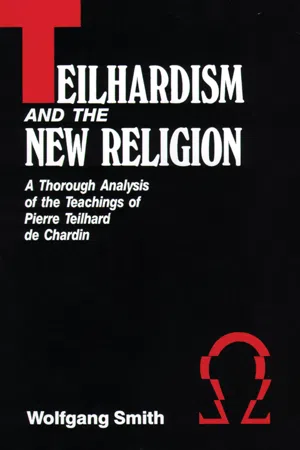
Teilhardian ideas are at the root of the "new religion" laying waste the Catholic Church today. This brilliant scientist, mathematician and philosopher shows Teilhard's theory of the physical and spiritual evolution of all things (including God) to be scientifically fraudulent and philosophically impossible. Also explodes the theory of biological evolution. Absolutely refutes the notion that Catholic teaching should evolve in order to keep up with science. A brilliant work! 272 pgs,
eBook - ePub
Teilhardism And The New Religion
A Thorough Analysis of the Teachings of Pierre Teilhard de Chardin
- 272 pages
- English
- ePUB (mobile friendly)
- Available on iOS & Android
eBook - ePub
Teilhardism And The New Religion
A Thorough Analysis of the Teachings of Pierre Teilhard de Chardin
About this book
Information
Topic
Theology & ReligionSubtopic
Christian DenominationsChapter VI
The God of Evolution
There has been much debate over the question of Teilhard's theological orthodoxy. The first thing to be done, of course, is to ascertain precisely where Teilhard stands on the basic issues; and this, as we know, is not an easy task. "Imprecision or contradiction in definition is one of the constant problems in the study of the Teilhard canon,"1 observes George Simpson. It is hardly surprising, therefore, that opinions have varied greatly as to what, exactly, Teilhard did say regarding the nature and attributes of God.
To be sure, he exhibits pantheistic tendencies. But just how far does he go in that direction? There are those (like the Dominican Guerard de Lauriers, for instance) who maintain that Teilhard espoused "a veritable metaphysical monism," a monism "so radical that it removes being"2; whereas other theologians (such as Henri de Lubac) are given to pleading the case of Teilhardian orthodoxy. "Père Teilhard, one need hardly say, believed in God," writes de Lubac in answer to de Lauriers; "but he believed also, and affirmed, that, transcending the world, 'God could dispense with the world,' that he was self-sufficing; that the inevitability that we see in the world is only 'a consequence upon the free will of the Creator.' That in itself is enough to dismiss the accusation."3
But in fact it is not: for it happens that elsewhere Teilhard flatly contradicts these orthodox-sounding affirmations which his distinguished confrere has adduced. Thus, in an essay entitled "Suggestions for a New Theology," for instance, Teilhard makes it a point to reproach the traditional doctrine precisely for its belief in the absolute self-sufficiency of God: "God could, it appeared, dispense with the universe,"4 he charges. His point is that this time-honored belief has now become outmoded and needs to be given up. Or again, in one of his latest works he goes so far as to say that "In truth, it is not the sense of contingence of the created but the sense of the mutual completion of the world and God which gives life to Christianity."5 We are told, in other words, that just as the world has need of God, so also God has need of the world: a far cry, indeed, from the position that "God could dispense with the world."
Nor does the case stand any better when it comes to the stipulated "free will of the Creator." Here, too, de Lubac seems to forget that Teilhard has often enough expressed himself on the opposite side of the issue. He does so, for example, in one of his very early compositions (dated 1919) when he asks: "In making God personal and free, Non-being absolute, the Creation gratuitous, and the Fall accidental, are we not in danger of making the Universe intolerable and the value of souls (on which we lay so much emphasis!) inexplicable?"6 One can hardly fail to sense how much of Teilhard's later theological thought is implicit in this interesting sentence, written when Teilhard was just a few years out of the seminary (he was ordained in 1912).
Which brings us to another question: the "evolution" of Teilhard's theological beliefs. To be sure, the Teilhardian writings, spread out as they are over a period of some forty years, do exhibit a certain development of ideas. So far as theological questions are concerned, moreover, there is an unmistakable drift in the direction of increasingly unorthodox positions. And as a matter of fact, Teilhard himself alludes with evident satisfaction to a certain falling off from the traditional Christian outlook. Thus, in The Heart of Matter (written five years before his death) he speaks condescendingly of an earlier phase during which he was supposedly still under the influence of certain traditional conceptions, or subject to "those odd effects of inhibition," as he puts it, "that so often prevent us from recognizing what is staring us in the face."7 Moreover, it was during this stage preceding his final "emancipation" that Teilhard composed his most nearly orthodox pieces: the principal works which are unfailingly cited by de Lubac and others as proof of Teilhard's theological innocence. "I can see quite clearly," Teilhard tells us (looking back upon these early years), "how the inspiration behind 'The Mass on the World' and Le Milieu Divine and their writing belong to that somewhat self-centered and self-enclosed period of my inner life."8
Yet we must not make too much of this presumed evolution of Teilhard's theological thought. For already in some of his earliest writings, as we have seen, he had expressed distinct misgivings concerning fundamental tenets of orthodox theology, such as the absolute freedom of God and the gratuitous nature of creation. It is clear that the seeds of divergence were there from the start. Only it would appear that Teilhard was somewhat less sure of himself in his younger years, and not as free in the expression of his more heterodox views. There is also evidence of a certain lingering orthodoxy which may have coexisted somehow with his less-than-orthodox opinions, and which at times came to the fore in passages of rare beauty. Are these to be counted, perhaps, among those "odd effects of inhibition" to which, in his later years, Teilhard alludes? All that we know for certain, in any event, is that Teilhard did become progressively less orthodox, and more radical in the expression of his beliefs.

Every theologian worthy of the name has conceived of God as immutable. It is only the created thing, the creature, that is subject to transformation. "They shall be changed," says the Psalmist, "but thou art the same." (Ps. 101:27, 28). Not that God remains somehow fixed, like a stone. The point, rather, is that God is not at all affected by time. His Being, unlike our own, is not spread out, as it were, over a temporal continuum. How could it be? How could the Author of time be subject to change? "Before Abraham was, I am" (John 8:58): not "I was," but "I am." Clearly, by this quite startling use of the present tense, Christ has proclaimed a great truth: He has given us to understand that the "I am" which He declared to the Jews is in truth none other than the "ego sum qui sum" which God had previously declared unto Moses from the Burning Bush (Ex. 3:14). It betokens a mode of Being beyond the pale of time, a mode which belongs to God alone. And let us by all means observe that this is not simply a matter of speculative interest, but a truth that is vital to the Christian Faith. For as St. Augustine has pointed out,9 there is indeed a connection between the pronouncement of John 8:58 and the dire warning sounded in John 8:24: "If ye believe not that I am [ego sum], ye shall die in your sins."10
It will be of great interest, therefore, to see what an "evolutionist theology" has to say on that point. Where exactly does Teilhard stand? Does he submit to the orthodox view that God is "above time," that He is immutable? It would be quite absurd to claim that he does; not, at any rate, after he had freed himself from "those odd effects of inhibition" which in his earlier years had supposedly prevented him from seeing the light. For as Teilhard himself tells us with reference to that transitional period of comparative orthodoxy, "I failed to understand that as God 'metamorphized' the World from the depths of matter to the peaks of Spirit, so in addition the World must inevitably and to the same degree 'endomorphize' God." And by way of further clarification, he adds: "As a direct consequence of the unitive process by which God is revealed to us, he in some way 'transforms himself as he incorporates us."11
Here, in this late work (The Heart of Matter, 1950), it does indeed appear that Teilhard has cast off all his "inhibitions." He goes out of his way, in fact, to make his unorthodox point with the utmost clarity. "All around us, and within our own selves, God is in process of 'changing,' " he declares; "his brilliance increases, and the glow of his coloring grows richer."12 This is no doubt what three years later he referred to as "the mutual completion of the world and God which gives life to Christianity." Not just the world, but God, too, is changing, and becoming more perfect; that is obviously the message. "I see in the World a mysterious product of completion and fulfillment for the Absolute Being himself,"13 Teilhard tells us. Never mind that Christ Himself declares unto us: "Be ye perfect, even as your Father in heaven is perfect" (present tense, once again!); perhaps this Gospel teaching belongs to an earlier phase of human evolution, antedating Darwin and "the discovery of Time." In any case, we are now told dogmatically that "the Absolute Being" is not yet fully perfect, that God Himself depends upon Evolution for His "completion and fulfillment"—as if this fact alone would not suffice to render "the Absolute Being" less than absolute!
It must not be supposed, moreover, that when Teilhard seems to attribute change or transformation to God, he is in fact referring only to the human nature of Christ, or to His Mystical Body. For if that were the case, why would he speak of God and "the Absolute Being," instead of Christ, or the Pleroma? Granting that Teilhard is not much given to sharp theological distinctions, it must nonetheless be assumed that he knows very well how to distinguish between two clearly distinguishable ideas when he wants to. What is perhaps still more to the point, however, is that the conception of a mutable or "evolving" God is entirely in line with Teilhard's rejection of the traditional Christian doctrine concerning creation and participated being, and with his famous theory of "creative union" which is supposed to replace these "antiquated" ideas. Thus, when he tells us that "There is ultimately no unity without unification,"14 the implication is clear: this can only mean that God Himself has no other unity than that which is given to Him by way of the evolutive process. And so, too, God's unity is not yet complete: He too must await "the end of the world" when all shall be fulfilled.
By this time Teilhard has manifestly repudiated the position expressed earlier in "The Mass on the World" when he wrote that "The world travails, not to bring forth from within itself some supreme reality, but to find its consummation through a union with a pre-existent Being."15 Or are we perhaps to suppose that even in this seemingly orthodox affirmation there is a hidden implication to the effect that the pre-existent Being becomes somehow enlarged by virtue of the anticipated union? This too is conceivable; for it will be recalled that in 1919 (four years before "The Mass on the World") Teilhard had already expressed reservations relating to the traditional conception of participated being. Yet we must also remember that according to his own testimony it was only much later that he came to realize what he took to be the full truth: the idea, namely, that just as God "metamorphized" the world, "so in addition the World must inevitably and to the same degree 'end...
Table of contents
- Cover Page
- Copyright Page
- Dedication Page
- Contents
- About Teilhard de Chardin
- Preface
- Acknowledgments
- List of Abbreviations
- I.Evolution: A Closer Look
- II.The Cartesian Connection
- III.Complexity/Consciousness: Law or Myth?
- IV.In Search of Creative Union
- V.The Omega Hypothesis
- VI.The God of Evolution
- VII.Biblical Fall and Evolutionist Ascent
- VIII.The Idea of Progress
- IX.Socialization and Super-Organism
- X.The New Religion
- Appendix: Gnosticism Today
Trusted by 375,005 students
Access to over 1.5 million titles for a fair monthly price.
Study more efficiently using our study tools.
Frequently asked questions
Yes, you can cancel anytime from the Subscription tab in your account settings on the Perlego website. Your subscription will stay active until the end of your current billing period. Learn how to cancel your subscription
No, books cannot be downloaded as external files, such as PDFs, for use outside of Perlego. However, you can download books within the Perlego app for offline reading on mobile or tablet. Learn how to download books offline
Perlego offers two plans: Essential and Complete
- Essential is ideal for learners and professionals who enjoy exploring a wide range of subjects. Access the Essential Library with 800,000+ trusted titles and best-sellers across business, personal growth, and the humanities. Includes unlimited reading time and Standard Read Aloud voice.
- Complete: Perfect for advanced learners and researchers needing full, unrestricted access. Unlock 1.5M+ books across hundreds of subjects, including academic and specialized titles. The Complete Plan also includes advanced features like Premium Read Aloud and Research Assistant.
We are an online textbook subscription service, where you can get access to an entire online library for less than the price of a single book per month. With over 1.5 million books across 990+ topics, we’ve got you covered! Learn about our mission
Look out for the read-aloud symbol on your next book to see if you can listen to it. The read-aloud tool reads text aloud for you, highlighting the text as it is being read. You can pause it, speed it up and slow it down. Learn more about Read Aloud
Yes! You can use the Perlego app on both iOS and Android devices to read anytime, anywhere — even offline. Perfect for commutes or when you’re on the go.
Please note we cannot support devices running on iOS 13 and Android 7 or earlier. Learn more about using the app
Please note we cannot support devices running on iOS 13 and Android 7 or earlier. Learn more about using the app
Yes, you can access Teilhardism And The New Religion by Dr. Wolfgang Smith in PDF and/or ePUB format, as well as other popular books in Theology & Religion & Christian Denominations. We have over 1.5 million books available in our catalogue for you to explore.