At last! An expose of who caused the turmoil in the Church today. Names names. The author is a busy parish priest who was so concerned he just had to write this book.
eBook - ePub
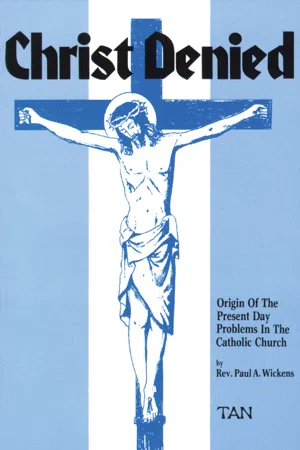
Christ Denied
Orgin of the Present Day Problems in the Catholic Church
- 51 pages
- English
- ePUB (mobile friendly)
- Available on iOS & Android
eBook - ePub
About this book
Information
Topic
Theology & ReligionSubtopic
Christian DenominationsChrist Denied
Chapter 1
Origin Of The Present Day Problems In The Catholic Church
Like the women of Jerusalem who wept at the sight of Jesus on the road to Calvary, the Catholic people mourn and lament the sight of the wounded Church today.
On Easter Sunday morn, Mary Magdelene, having seen the empty tomb, anxiously cried out: "They have taken my Lord away, and I do not know where they have placed him." This, too, applies to the Church in the 1980's.
How and from where did all the destructive changes in the Church during the last 15 years come about? It all happened so quickly: the uncomfortable at first, then harmful, innovations that have led to undreamed-of diminution in the life of the Mystical Body. Why! It almost seemed like yesterday our churches were reverent and crowded, our convents and seminaries were full. Discipline, morality and sanctification through Christ and The Holy Eucharist were eagerly sought after!
One wonders how the erroneous trends in modern theology gained so much momentum, and how these trends spread so rapidly into all levels of Church life.
These trends eventually led to a moral permissiveness and a disregard for objective ethical norms, all of which contradict the Divine Law, and have resulted in an obvious decline in true Catholicism. Truths, taught by our Savior, Jesus Christ, have fallen like dominoes.
The Citadel is under attack, yet the hierarchy, in America and Europe, seems unwilling to rectify the situation.
We will, with God's help, demonstrate in this treatise that the loss of faith and the weakening of morality can be traced back, intellectually and spiritually, to the unacceptance of the reality of Adam and Eve as first parents, and ultimately to disbelief in a Personal, Triune God. These unbeliefs are embodied in the works of a man called Pierre Teilhard de Chardin.
Meet George Tyrrell and Teilhard de Chardin
In the summer of 1901, the students at the French Seminary were obliged, by civil edict, to leave France and continue their theological studies elsewhere. The French government was anti-clerical; laws were passed against religious orders. (In the final analysis, there was more danger to the integrity of The Church from the religious orders themselves than from the persecuting government.)
At any rate, since the Jesuits were a prime target, they were ordered out of the country. Where did they seek exile but across the Channel in England. Among the French seminarians involved in the transfer was none other than a young candidate for the priesthood, Teilhard de Chardin (of whom we shall devote considerable space later on).
De Chardin and his classmates moved into a Jesuit community at Jersey. There in England, the Jesuits were very much influenced, in fact, dominated, by an Irish Jesuit called George Tyrrell. This influence was so powerful that one might say, without being terribly unfair, that there was then only one Jesuit in England—and that Jesuit was George Tyrrell.
In recent years, we have become interested in Tyrrell, and confess that we are inclined to blame everything on him instead of all the other people we have blamed at different times for originating the present difficulties in the Catholic Church.
Tyrrell: An Influential Modernist
A fearful heresy was spreading through the seminaries at that time, the turn of the century, and the man who was the acknowledged ring-leader was Rev. George Tyrrell, S.J. He was a very, very busy man: lecturing at Oxford very often, holding teaching positions of influence, helping to write a Jesuit monthly magazine. (All told, he submitted just under one hundred articles.) He wrote endlessly about his notions of spirituality and the inner life. So far, so good! But Tyrrell had one major problem: he probably did not believe in God. A caricature of God, perhaps. But not a God meaning "the Triune God of Revelation; Supreme Being, Independent, with Free Will and Intellect, to Whom we are obliged to worship externally as well as internally." For sure he did not believe in two things: the Virgin Birth and The Resurrection of Christ.
Like most pious garden-variety heretics, he devised a form of spirituality which satisfied his own whims, and which he was most anxious to recommend to other people. To this end, Fr. Tyrrell was indefatigable, perpetually on the move, giving retreats and conferences (and study days, no doubt) and sermons, while editing magazines and writing books. The intended goal of his labors was to promote this new brand of spirituality, viz, a "how-to" course on being very, very Christian. On the surface, through a skillful verbal mixture of truth and error, the movement seemed to be calling Catholics to a refreshing and purer love of Christ. But in Tyrrell's own mind, and in the understanding of those close to him, the bases of the Catholic religion were myths which (according to him) now had been exposed and should be abandoned.
Note: Rev. Richard P. McBrien, a leading liberal (American version) recently has published a two-volume work entitled "Catholicism" (Winston Press, $29.95), in which he defends Tyrrell, and castigates Pope Pius X for admonishing him in 1907 for his unorthodoxy. Fr. McBrien goes a step further, incredibly, by cataloguing Tyrrell with St. John of the Cross, St. Peter Canisius, and St. Robert Bellarmine.
Historically, in point of fact, according to the Catholic Encyclopedia, Father Tyrrell eventually was asked by his own Jesuit Superior to publicly repudiate an heretical article he had written. When Tyrrell refused he was suspended "A DIVINIS," and was dismissed from the Society of Jesus.
He then searched for a bishop who would adopt him into his diocese. Though unsuccessful, Fr. Tyrrell kept on writing and producing articles inimical to orthodoxy. Because of his flagrant criticism of St. Pius X's condemnation of Modernism (1907), he was excommunicated by name (NOMINATIM), his case reserved to The Holy See.
Some years later he died, of Bright's Disease, unrepentant to the end, and was refused burial, by the Church, in a Catholic cemetery.
Chapter 2
Other Early Influences
From the first century, there have always been in the Christian Church little pockets of skepticism. Fallen nature, the pride of life, and concupiscence persistently badger all men—believers being no exception to the rule.
In modern times, this skeptical thinking became popular in Germany in the 18th century1 and eventually spread over the border into France. By the end of the 19th century it had gained considerable acceptance there, and its chief disciple was a French Jesuit, Henri Bremond. Father George Tyrrell, whom we have just discussed, was a close friend of Bremond, and consequently much affected by his modernist/ liberal rationale.
The point we wish to expostulate here is that Henri Bremond, the well-known skeptic who corrupted Tyrrell, was a teacher at the College de Mongre, the high school that Teilhard attended. At age 14, de Chardin was taught and influenced by Bremond, so one can see that from his earliest years he was exposed to grave errors of thought.
Parenthetically, when de Chardin died in 1955, his works, which were condemned by The Church, were put into print and given wide circulation, contra legem. The publishers of his works took great pains to make it appear that Teilhard had developed his "original and revolutionary" ideas during World War I, or during his long sojourn in China. This is sheer nonsense. De Chardin's ideas were nothing new, really. He picked up his notions in high school, and during his seminary training in England. These heretical ideas were already circulating when Teilhard was only a youngster, and had been around for many years before that.
To prove our case, be reminded that between 1893 and 1899 (the year de Chardin entered the Seminary) the Pope had been compelled to issue four different encyclicals which condemned this skepticism about basic truths, and the skepticism about the Bible itself. In 1907 (July 3) the Holy Office released the famous decree Lamentabili, containing 65 propositions against Modernism, and on Sept. 8, 1907, Pope Pius X, in his encyclical Pascendi, warned the Catholic world to beware of the venomous effects of Modernism.
From the Vatican's strong reaction, we get some idea of th...
Table of contents
- Cover Page
- Copyright Page
- Dedication Page
- CONTENTS
- Introduction
- Christ Denied
- Epilogue I
- Epilogue II
- Appendix A
- Appendix B
Trusted by 375,005 students
Access to over 1.5 million titles for a fair monthly price.
Study more efficiently using our study tools.
Frequently asked questions
Yes, you can cancel anytime from the Subscription tab in your account settings on the Perlego website. Your subscription will stay active until the end of your current billing period. Learn how to cancel your subscription
No, books cannot be downloaded as external files, such as PDFs, for use outside of Perlego. However, you can download books within the Perlego app for offline reading on mobile or tablet. Learn how to download books offline
Perlego offers two plans: Essential and Complete
- Essential is ideal for learners and professionals who enjoy exploring a wide range of subjects. Access the Essential Library with 800,000+ trusted titles and best-sellers across business, personal growth, and the humanities. Includes unlimited reading time and Standard Read Aloud voice.
- Complete: Perfect for advanced learners and researchers needing full, unrestricted access. Unlock 1.5M+ books across hundreds of subjects, including academic and specialized titles. The Complete Plan also includes advanced features like Premium Read Aloud and Research Assistant.
We are an online textbook subscription service, where you can get access to an entire online library for less than the price of a single book per month. With over 1.5 million books across 990+ topics, we’ve got you covered! Learn about our mission
Look out for the read-aloud symbol on your next book to see if you can listen to it. The read-aloud tool reads text aloud for you, highlighting the text as it is being read. You can pause it, speed it up and slow it down. Learn more about Read Aloud
Yes! You can use the Perlego app on both iOS and Android devices to read anytime, anywhere — even offline. Perfect for commutes or when you’re on the go.
Please note we cannot support devices running on iOS 13 and Android 7 or earlier. Learn more about using the app
Please note we cannot support devices running on iOS 13 and Android 7 or earlier. Learn more about using the app
Yes, you can access Christ Denied by Rev. Fr. Paul Wickens in PDF and/or ePUB format, as well as other popular books in Theology & Religion & Christian Denominations. We have over 1.5 million books available in our catalogue for you to explore.