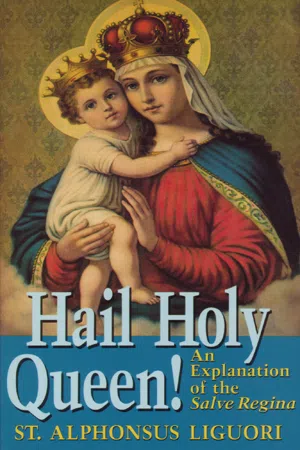
The first part of St. Alphonsus' masterpiece; The Glories of Mary; collected from the Saints; Doctors of the Church and other holy authors. Amazing statements on Our Lady's God-given role in securing our salvation; with remarkable stories of miracles and graces she obtained. Shows that devotion to Mary is a most certain mark of eternal salvation! Gives profound encouragement and firm hope for eternal victory through Mary; the Mother of God--who can obtain from her Divine Son anything she asks. Impr. 237 pgs;
- 238 pages
- English
- ePUB (mobile friendly)
- Available on iOS & Android
eBook - ePub
About this book
Information
Topic
Theology & ReligionSubtopic
Christian DenominationsEXPLANATION OF THE SALVE REGINA.

CHAPTER I.
Salve, Regina, Mater Misericordœ!
HAIL, HOLY QUEEN, MOTHER OF MERCY!
MARY, OUR QUEEN, OUR MOTHER.
I. How great should be our Confidence in Mary, who is the Queen of Mercy.
As the glorious Virgin Mary has been raised to the dignity of Mother of the King of kings, it is not without reason that the Church honors her, and wishes her to be honored by all, with the glorious title of Queen.
"If the Son is a king," says St. Athanasius, "the Mother who begot Him is rightly and truly considered a Queen and Sovereign."* "No sooner had Mary," says St. Bernardine of Siena, "consented to be Mother of the Eternal Word, than she merited by this consent to be made Queen of the world and of all creatures."† "Since the flesh of Mary" remarks the Abbot Arnold of Chartres, "was not different from that of Jesus, how can the royal dignity of the Son be denied to the Mother?"* "Hence we must consider the glory of the Son, not only as being common to His Mother, but as one with her."†
And if Jesus is the King of the universe, Mary is also its Queen. "And as Queen," says the Abbot Rupert, "she possesses, by right, the whole kingdom of her Son."‡ Hence St. Bernardine of Siena concludes that "as many creatures as there are who serve God, so many they are who serve Mary: for as angels and men, and all things that are in heaven and on earth, are subject to the empire of God, so are they also under the dominion of Mary!"§ The Abbot Guerricus, addressing himself to the divine Mother on this subject, says: "Continue, Mary, continue to dispose with confidence of the riches of thy Son; act as Queen, Mother, and Spouse of the King: for to thee belongs dominion and power over all creatures!"∥;
Mary, then is a queen: but, for our common consolation, be it known that she is a Queen so sweet, clement, and so ready to help us in our miseries, that the holy Church wills that we should salute her in this prayer under the title of Queen of mercy.
"The title of queen," remarks Blessed Albert the Great,¶ "differs from that of empress, which implies severity and rigor in signifying compassion and charity towards the poor." "The greatness of kings and queens," says Seneca, "consists in relieving the wretched";** and whereas tyrants, when they reign, have their own good in view, kings should have that of their subjects at heart. For this reason it is that, at their consecration, kings have their heads annointed with oil, which is the symbol of mercy, to denote that, as kings, they should, above all things, nourish in their hearts feelings of compassion and benevolence towards their subjects.
Kings should, then, occupy themselves principally in works of mercy, but not so as to forget the just punishments that are to be inflicted on the guilty. It is, however, not thus with Mary, who, although a Queen, is not a queen of justice, intent on the punishment of the wicked, but a queen of mercy, intent only on commiserating and pardoning sinners. And this is the reason for which the Church requires that we should expressly call her "the Queen of mercy." The great Chancellor of Paris, John Gerson, in his commentary on the words of David, "These two things have I heard, that power belongeth to God, and mercy to Thee, O Lord,"* says that the kingdom of God, consisting in justice and mercy, was divided by Our Lord: the kingdom of justice He reserved for Himself, and that of mercy He yielded to Mary, ordaining at the same time that all mercies that are dispensed to men should pass through the hands of Mary, and be disposed of by her at will. These are Gerson's own words: "The kingdom of God consists in power and mercy; reserving power to Himself, He, in some way, yielded the empire of mercy to His Mother."† This is confirmed by St. Thomas, in his preface to the Canonical Epistles, saying, "that when the Blessed Virgin conceived the Eternal Word in her womb, and brought Him forth, she obtained half the kingdom of God; so that she is Queen of mercy, as Jesus Christ is King of justice."
The Eternal Father made Jesus Christ the King of justice, and consequently universal Judge of the world: and therefore the Royal Prophet sings: "Give to the King Thy judgment, O God, and to the King's Son Thy justice."* Here a learned interpreter takes up the sentence, and says: "O Lord, Thou hast given justice to Thy Son, because Thou hast given mercy to the King's Mother." And, on this subject, St. Bonaventure, paraphrasing the words of David, thus interprets them: "Give to the King Thy judgment, O God, and Thy mercy to the Queen His Mother." Ernest, Archbishop of Prague, also remarks, "that the Eternal Father gave the office of judge and avenger to the Son, and that of showing mercy and relieving the necessitous to the Mother."† This was foretold by the prophet David himself; for he says that God (so to speak) consecrated Mary Queen of mercy, anointing her with the oil of gladness: "God hath anointed thee with the oil of gladness."‡ In order that we miserable children of Adam might rejoice, remembering that in heaven we have this great Queen, overflowing with the unction of mercy and compassion towards us; and thus we can say with St. Bonaventure, "O Mary, thou art full of the unction of mercy, and of the oil of compassion;"§ therefore God has anointed thee with the oil of gladness.
And how beautifully does not Blessed Albert the Great apply to this subject the history of Queen Esther, who was herself a great type of our Queen Mary!
We read, in the fourth chapter of the Book of Esther, that in the reign of Assuerus a decree was issued, by which all Jews were condemned to death. Mardochai, who was one of the condemned, addressed himself to Esther, in order that she might interpose with Assuerus and obtain the revocation of the decree, and thus be the salvation of all. At first Esther declined the office, fearing that such a request might irritate the king still more; but Mardochai reproved her, sending her word that she was not to think of saving only herself, for God had placed her on the throne to obtain the salvation of all the Jews: "Think not that thou mayest save thy life only, because thou art in the king's house, more than all the Jews."* Thus did Mardochai address Queen Esther. And so can we poor sinners address our Queen Mary, should she show any repugnance to obtain of God our delivery from the chastisement we have justly deserved: "Think not, O Lady, that God has raised thee to the dignity of Queen of the world, only to provide for thy good; but in order that, being so great, thou mightest be better able to compassionate and assist us miserable creatures."
As soon as Assuerus saw Esther standing before him, he asked her, with love, what she came to seek. "What is thy request?" The Queen replied, "If I have found favor in thy sight, O King, give me my people, for which I request."† Assuerus granted her request, and immediately ordered the revocation of the decree. And now, if Assuerus, through love for Esther, granted, at her request, salvation to the Jews, how can God refuse the prayers of Mary, loving her immensely as He does, when she prays for poor miserable sinners, who recommend themselves to her, and says to him, "My King and my God, if ever I have found favor in Thy sight" (though the divine Mother well knows that she was the blessed, the holy one, the only one of the human race who found the grace lost by all mankind; well does she know that she is the beloved one of her Lord, loved more than all the saints and angels together), "give me my people for which I ask"? "If Thou lovest me", she says, "give me, O Lord, these sinners, for whom I entreat Thee." Is it possible that God should refuse her? And who is ignorant of the power of the prayers of Mary with God? "The law of clemency is on her tongue."* Each of her prayers is, as it were, an established law for Our Lord, that He should show mercy to all for whom she intercedes. St. Bernard asks why the Church calls Mary "the Queen of mercy." And he replies, that "it is because we believe that she opens the abyss of the mercy of God to whomsoever she wills, when she wills, and as she wills; so that there is no sinner, however great, who is lost if Mary protects him."†
But perhaps we may fear that Mary would not deign to interpose for some sinners, because they are so overloaded with crimes? Or perhaps we ought to be overawed at the majesty and holiness of this great Queen? "No," says St. Gregory VII.; "for the higher and more holy she is the greater is her sweetness and compassion towards sinners who have recourse to her with the desire to amend their lives."‡ Kings and queens, with their ostentation of majesty, inspire terror, and cause their subjects to fear to approach them: but what fear, says St. Bernard, can the miserable have to approach this Queen of mercy for she inspires no terror, and shows no severity, to those who come to her, but is all sweetness and gentleness. "Why should human frailty fear to go to Mary? In her there is no austerity, nothing terrible: she is all sweetness, offering milk and wool to all."* Mary is not only willing to give, but she herself offers milk and wool to all: the milk of mercy to animate our confidence, and the wool of her protection against the thunderbolts of divine justice.
Suetonius† relates of the Emperor Titus that he could never refuse a favor, so much so that he sometimes promised more than he could grant, and when admonished of this he replied, that a prince should never send away dissatisfied any person whom he admitted to his audience. Titus spoke thus, but in reality he must often have deceived or failed in his promises. Our Queen cannot deceive, and can obtain all that she wills for her clients. Moreover, "Our Lord has given her so benign and compassionate a heart," says Lanspergius, "that she cannot send away any one dissatisfied who prays to her."‡ But how, to use the words of St. Bonaventure, canst thou, O Mary, who art the Queen of mercy, refuse to succor the miserable? And "who," asks the saint, "are the subjects for mercy if not the miserable? And since thou art the Queen of mercy," he continues, "and I am the most miserable of sinners, it follows that I am the first of thy subjects. How, then, O Lady, canst thou do otherwise than exercise thy mercy on me?"§ Have pity on us, then, O Queen of mercy, and take charge of our salvation.
"Say not, O holy Virgin," exclaims St. George of Nicomedia, "that thou canst not assist us on account of the number of our sins, for thy power and thy compassion are such that no number of sins, however great, can outweigh them. Nothing resists thy power, for our common Creator, honoring thee as His Mother, considers thy glory as His own;" and the Son, "exulting in it, fulfils thy petition as if He were paying a debt;"* meaning thereby that although Mary is under an infinite obligation to the Son for having chosen her to be His Mother, yet it cannot be denied that the Son is under great obligation to her for having given Him His humanity; and therefore Jesus, to pay, as it were, what He owes to Mary, and glorying in her glory, honors her in a special manner by listening to and granting all her petitions.
How great, then, should be our confidence in this Queen, knowing her great power with God, and that she is so rich and full of mercy that there is no one living on the earth who does not partake of her compassion and favor. This was revealed by our blessed Lady herself to St. Bridget, saying, "I am the Queen of heaven and the Mother of mercy; I am the joy of the just, and the door through which sinners are brought to God. There is no sinner on earth so accursed as to be deprived of my mercy; for all, if they receive nothing else through my intercession, receive the grace of being less tempted by the devils than they would otherwise have been." "No one," she adds, "unless the irrevocable sentence has been pronounced" (that is, the one pronounced on the damned), "is so cast off by God that he will not return to Him, and enjoy His mercy, if he invokes my aid."† "I am called by all the Mother of mercy, and truly the mercy of my Son towards men has made me thus merciful towards them;"* and she concludes by saying, "And therefore miserable will he be, and miserable will he be to all eternity, who, in this life, having it in his power to invoke me, who am so compassionate to all, and so desirous to assist sinners, is miserable enough not to invoke me, and so is damned."†
Let us, then, have recourse, and always have recourse, to this most sweet Queen, if we would be certain of salvation; and if we are alarmed and disheartened at the sight of our sins, let us remember that it is in order to save the greatest and most abandoned sinners, who recommend themselves to her, that Mary is made the Queen of mercy. Such have to be her crown in heaven; according to the words addressed to her by her divine Spouse: "Come from Libanus, my spouse; come from Libanus, come: thou shalt be crowned; . . . from the dens of the lions from the mountains of the leopards."‡ And what are these dens of beasts but miserable sinners, whose souls have become the home of sin, the most frightful monster that can be found? "With such souls," says the Abbot Rupert, addressing our blessed Lady, "saved by thy means, O great Queen Mary, wilt thou be crowned in heaven; for their salvation will form a diadem worthy of, and well-becoming, a Queen of mercy."§
Prayer.
O Mother of my God, and my Lady Mary; as a beggar, all wounded and sore, presents himself before a great queen, so do I present myself before thee, who art the Queen of heaven and earth. From the lofty throne on which thou sittest, disdain not, I implore thee, to cast thine eyes on me, a poor sinner. God has made thee so rich that thou mightest assist the poor, and has constituted thee Queen of Mercy in order that thou mightest relieve the miserable. Behold me then, and pity me: behold me and abandon me not, until thou seest me changed from a sinner into a saint. I know well that I merit nothing; nay more, that I deserve, on account of my ingratitude, to be deprived of the graces that, through thy means, I have already received from God. But thou, who art the Queen of Mercy, seekest not merits, but miseries, in order to help the needy. But who is more needy than I? O exalted Virgin, well do I know that thou, who art Queen of the universe, art already my queen; yet am I determined to dedicate myself more especially to thy service, in order that thou mayest dispose of me as thou pleasest. Therefore do I address thee in the words of St. Bonaventure: "Do thou govern me, O my Queen, and leave me not to myself."* Command me; employ me as thou wilt, and chastise me when I do not obey; for the chastisements that come from thy hands will be to me pledges of salvation. I would rather be thy servant than the ruler of the earth. "I am thine; save me."† Accept me, O Mary, for thine own, and as thine, take charge of my salvation. I will no longer be mine; to thee do I give myself. If, during the time past I have served thee ill, and lost so many occasions of honoring thee, for the future I will be one of thy most loving and faithful servants. I am determined that from this day forward no one shall surpass me in honoring and loving thee, my most amiable Queen. This I promise; and this, with thy help, I hope to execute. Amen.
II. How much our Confidence in Mary should be Increased because she is our Mother.
It is not without a meaning, or by chance, that Mary's clients call her Mother; and indeed they seem unable to invoke her under any other name, and never tire of calling her Mother. Mother, yes! for she is truly our Mother; not indeed carnally, but spiritually; of our souls and of our salvation.
Sin, by depriving our souls of divine grace, deprived them also of life. Jesus our Redeemer, with an excess of mercy and love, came to restore this life by His own death on the cross, as He Himself declared: "I am come that they may have life, and may...
Table of contents
- Cover Page
- Copyright Page
- CONTENTS.
- EXPLANATION OF THE SALVE REGINA.
- CHAPTER II. Vita, Dulcedo.
- CHAPTER III. Spes nostra! salve.
- CHAPTER IV. Ad te clamamus, exsules filii Eva.
- CHAPTER V. Ad te suspiramus, gementes et flentes in hac lacrymarum valle.
- CHAPTER VI. Eia ergo, Advocata nostra!
- CHAPTER VII. Illos tuos misericordes oculos ad nos converte.
- CHAPTER VIII. Et Jesum, benedictum Fructum ventris tui nobis post hoc exilium ostende.
- CHAPTER IX. O Clemens, O Pia!
- CHAPTER X. O dulcis Virgo Maria.
- Practices of Devotion in Honor of the divine Mother..
- Pravers to the Blessed Virgin Mary
Trusted by 375,005 students
Access to over 1.5 million titles for a fair monthly price.
Study more efficiently using our study tools.
Frequently asked questions
Yes, you can cancel anytime from the Subscription tab in your account settings on the Perlego website. Your subscription will stay active until the end of your current billing period. Learn how to cancel your subscription
No, books cannot be downloaded as external files, such as PDFs, for use outside of Perlego. However, you can download books within the Perlego app for offline reading on mobile or tablet. Learn how to download books offline
Perlego offers two plans: Essential and Complete
- Essential is ideal for learners and professionals who enjoy exploring a wide range of subjects. Access the Essential Library with 800,000+ trusted titles and best-sellers across business, personal growth, and the humanities. Includes unlimited reading time and Standard Read Aloud voice.
- Complete: Perfect for advanced learners and researchers needing full, unrestricted access. Unlock 1.5M+ books across hundreds of subjects, including academic and specialized titles. The Complete Plan also includes advanced features like Premium Read Aloud and Research Assistant.
We are an online textbook subscription service, where you can get access to an entire online library for less than the price of a single book per month. With over 1.5 million books across 990+ topics, we’ve got you covered! Learn about our mission
Look out for the read-aloud symbol on your next book to see if you can listen to it. The read-aloud tool reads text aloud for you, highlighting the text as it is being read. You can pause it, speed it up and slow it down. Learn more about Read Aloud
Yes! You can use the Perlego app on both iOS and Android devices to read anytime, anywhere — even offline. Perfect for commutes or when you’re on the go.
Please note we cannot support devices running on iOS 13 and Android 7 or earlier. Learn more about using the app
Please note we cannot support devices running on iOS 13 and Android 7 or earlier. Learn more about using the app
Yes, you can access Hail Holy Queen! by St. Alphonsus Liguori in PDF and/or ePUB format, as well as other popular books in Theology & Religion & Christian Denominations. We have over 1.5 million books available in our catalogue for you to explore.