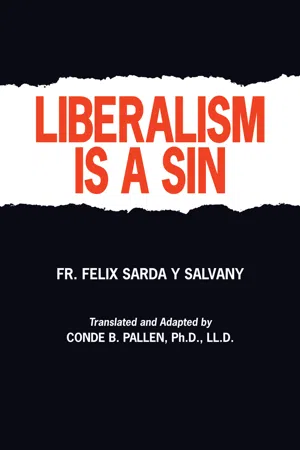
Refutes every aspect of the deadly error that one religion is as good as another and that a person has a moral right to choose whichever religion suits him best. Cuts through the foggy religious thinking rampant today! Impr. 204 pgs,
- 204 pages
- English
- ePUB (mobile friendly)
- Available on iOS & Android
eBook - ePub
Liberalism Is A Sin
About this book
Information
Topic
Theology & ReligionSubtopic
Conservatism & LiberalismCHAPTER 1
What Begets Liberalism
Physical science tells us that floating through the atmosphere are innumerable disease germs seeking a suitable nidus in which to settle and propagate and that we are constantly breathing these germs into the lungs. If the system be depleted or weakened, the dangerous microbe takes up its abode with us, and propagating its own kind with astonishing rapidity, undermines and ravages our health. The only safeguard against the encroachments of this insidious enemy, which we cannot escape, is a vigorous and healthy body with adequate powers of resistance to repel the invader.
It is equally true that we are subject to like infectious attacks in the spiritual order. Swarming in the atmosphere of our spiritual lives are innumerable deadly germs, ever ready to fasten upon the depleted and weakened soul and, propagating its leprous contagion through every faculty, destroy the spiritual life. Against the menace of this ever-threatening danger, whose advances we cannot avoid in our present circumstances, the ever-healthy soul alone can be prepared. To escape the contagion, the power of resistance must be equal to the emergencies of the attack, and that power will be in proportion to our spiritual health. To be prepared is to be armed, but to be prepared is not sufficient; we must possess the interior strength to throw off the germ. There must be no condition in the soul to make a suitable nidus for an enemy so insidious and so efficacious as to need only the slightest point of contact whence to spread its deadly contagion.
It is not only through the avenues of disordered passions that this spiritual disease may gain an entrance; it may make its inroad through the intellect, and this under a disguise often calculated to deceive the unwary and incautious. The Trojans admitted the enemy into their walls under the impression that they were actually securing a valuable acquisition to their safety, and today their fatal experience has come down to us in the proverb: "Beware of the Greeks when they bring gifts." Intellectual torpidity, inexperience, ignorance, indifference, and complaisance, or even virtues, such as, benevolence, generosity, and pity may be the unsuspected way open to the foe, and lo, we are surprised to find him in possession of the citadel!
That we may know our danger, we must appreciate the possible shapes in which it may come. Here is just the difficulty; the uniform of the enemy is so various, changeable, sometimes even of our own colors, that if we rely upon the outward semblance alone, we shall be more often deceived than certain of his identity. But before laying down any test by which we may distinguish friend from foe in a warfare so subtly fought within the precincts of our own souls, let us first reconnoiter the respective positions of either camp, and to do this best, we shall consider the origin and sources of the danger which surrounds us, for we may be asked: "Where is this foe described as so intangible as scarcely to be apprehended by ordinary mortals?" Or it may be urged: "Is the danger as proximate, as frequent and [as] fearful as you allege? Whence is it anyhow? Point it out! If we know from what direction the enemy comes, we may better appreciate the peril."
As we are addressing ourselves to those who live amidst the peculiar circumstances of our American life, and as the spiritual and moral conditions which obtain in this country make up the moral and spiritual atmosphere in which we have our being, it is in the relation of our surroundings to ourselves as well as of ourselves to our surroundings that we shall find the answer to our question. Let us then consider these surroundings in a general way for the moment.
First, as to some patent facts: The population of this country is at present something over 260 million. [1990 census]. Of these, 60 million are Catholics, and according to their claim, 80 million are Protestants, leaving a population of 120 million or more who do not profess any form of Christianity at all.
Among the 80 million Protestants, every shade and variety of belief in the Christian dispensation finds easy lodgment—from the belief in the Incarnation and Consubstantiation [the erroneous Lutheran belief that in the Eucharist the substance of the body and blood of Christ co-exist in and with the substance of the bread and wine, as opposed to the Catholic teaching of Transubstantiation, wherein the substance of the bread and wine are changed into the substance of Jesus Christ, who is thereafter present "body, blood, soul and divinity" under the appearances of bread and wine] to the rejection of the divinity of Christ altogether in the vacuous creed of Unitarianism. In this scale of heresy, the adjustments of creeds are loose and easy. Lack of any decisive authority renders any exact standard of belief impossible. A Protestant may freely range from one end of the scale to the other and still be considered orthodox according to Protestant estimation. A loose, indefinite belief in Christ, either as God redeeming the world or even as a great ethical teacher (not God Himself, though sent by God), suffices to place the Protestant within the compass of his own standard of orthodoxy. Any specific expression of dogma or of particular truths bound up in the acceptance of Christianity is not required; or if required by any one sect or denomination, can find no authoritative exaction, for the differences between the sects, in the last resort, become mere differences of private opinion, dependent upon nothing but the caprice or choice of the individual.
Outside of these various bodies of loosely professed Christians stands a still larger mass of our population who are either absolutely indifferent to Christianity as a creed or positively reject it. In practice, the distinction is of little moment whether they hold themselves merely indifferent or positively hostile. In other words, we have here to reckon with a body, to all practical purposes, that is infidel. This mass comprises over 45 percent of our population, holding itself aloof from Christianity, and in some instances virulently antagonistic to it. In distinct religious opposition to this mass of infidelity and Protestantism [now in excess of 76 percent of our population, but currently enhanced to an even more frightening percentage by the vast majority of Catholics today—1993—who either do not practice their faith at all or who are ignorant of its teachings (especially with regard to morality) or in practice simply disregard those teachings—bringing the total of practical non-believing and infidel people to probably just over 90 percent, if we can presume there to be today approximately 25 million believing, practicing Catholics], Catholics find themselves sharply and radically opposed. Heresy and infidelity are irreconcilable with Catholicity. "He that is not with me is against me" (Matt. 12:30) are the words of Our Lord Himself, for denial of Catholic truth is the radical and common element of both heresy and infidelity. The difference between them is merely a matter of degree. One denies less, the other more. Protestantism, with its sliding scale of creeds, is simply an inclined plane into the abyss of positive unbelief. It is always virtual infidelity, its final outcome open infidelity, as the 120 million unbelievers in this country stand witness.
We live in the midst of this religious anarchy. Some 235 million of our population can, in one sense or other, be considered anti-Catholic [1990 figures]. From this mass—heretical and infidel—exhales an atmosphere filled with germs poisonous and fatal to Catholic life, if permitted to take root in the Catholic heart. The mere force of gravitation, which the larger mass ever exercises upon the smaller, is a power which the most energetic vigor alone can resist. Under this dangerous influence, a deadly inertia is apt to creep over the souls of the incautious and is only to be overcome by the liveliest exercise of Catholic faith. To live without enervation amidst an heretical and infidel population requires a robust religious constitution. And to this danger we are daily exposed, ever coming into contact in a thousand ways, in almost every relation of life, with anti-Catholic thought and customs. But outside of this spiritual inertia, our non-Catholic surroundings—a danger rather passive than active in its influence—beget a still greater menace.
It is natural that Protestantism and infidelity should find public expression. What our 200 million non-Catholic population thinks in these matters naturally seeks and finds open expression. They have their organs and their literature where we find their current opinions publicly uttered. Their views upon religion, morality, politics, the constitution of society are perpetually marshaled before us. In the pulpit and in the press they are reiterated day after day. In magazine and newspaper they constantly speak from every line. Our literature is permeated and saturated with non-Catholic dogmatism. On all sides do we find this opposing spirit. We cannot escape from it. It enfolds and embraces us. Its breath is perpetually in our faces. It enters in by eye and ear. From birth to death, it enslaves us in its offensive garments. It now soothes and flatters, now hates and curses, now threatens, now praises. But it is most dangerous when it comes to us under the form of "liberality." It is especially powerful for seduction in this guise. And it is under this aspect that we wish to consider it. For it is as Liberalism that Protestantism and Infidelity make their most devastating inroads upon the domain of the Faith.
Out of these non-Catholic and anti-Catholic conditions thus predominating amongst us springs this monster of our times, Liberalism!
CHAPTER 2
What Is Liberalism?
Protestantism naturally begets toleration of error. Rejecting the principle of authority in religion, it has neither criterion nor definition of faith. On the principle that every individual or sect may interpret the deposit of Revelation according to the dictates of private judgment, it gives birth to endless differences and contradictions. Impelled by the law of its own impotence, through lack of any decisive voice of authority in matters of faith, it is forced to recognize as valid and orthodox any belief that springs from the exercise of private judgment. Therefore does it finally arrive, by force of its own premises, at the conclusion that one creed is as good as another; it then seeks to shelter its inconsistency under the false plea of liberty of conscience. Belief is not imposed by a legitimately and divinely constituted authority, but springs directly and freely from the unrestricted exercise of the individual's reason or caprice upon the subject-matter of Revelation. The individual or sect interprets as it pleases—rejecting or accepting what it chooses. This is popularly called liberty of conscience. Accepting this principle, Infidelity, on the same plea, rejects all Revelation, and Protestantism, which handed over the premise, is powerless to protest against the conclusion; for it is clear that one who, under the plea of rational liberty, has the right to repudiate any part of Revelation that may displease him, cannot logically quarrel with one who, on the same ground, repudiates the whole. If one creed is as good as another, on the plea of rational liberty, on the same plea, no creed is as good as any. Taking the field with this fatal weapon of Rationalism, Infidelity has stormed and taken the very citadel of Protestantism, helpless against the foe of its own making.
As a result, we find amongst the people of this country (excepting well formed Catholics, of course) that authoritative and positive religion has met with utter disaster and that religious beliefs or unbeliefs have come to be mere matters of opinion, wherein there are always essential differences, each one being free to make or unmake his own creed—or accept no creed.
Such is the mainspring of the heresy constantly dinned into our ears, flooding our current literature and our press. It is against this that we have to be perpetually vigilant, the more so because it insidiously attacks us on the grounds of a false charity and in the name of a false liberty. Nor does it appeal to us only on the ground of religious toleration.
The principle ramifies in many directions, striking root into our domestic, civil, and political life, whose vigor and health depend upon the nourishing and sustaining power of religion. For religion is the bond which unites us to God, the Source and End of all good; and Infidelity, whether virtual, as in Protestantism, or explicit, as in Agnosticism, severs the bond which binds men to God and seeks to build human society on the foundations of man's absolute independence. Hence we find Liberalism laying down as the basis of its propaganda the following principles:
1. The absolute sovereignty of the individual in his entire independence of God and God's authority.
2. The absolute sovereignty of society in its entire independence of everything which does not proceed from itself.
3. Absolute civil sovereignty in the implied right of the people to make their own laws in entire independence and utter disregard of any other criterion than the popular will expressed at the polls and in parliamentary majorities.
4. Absolute freedom of thought in politics, morals, or in religion. The unrestrained liberty of the press.
Such are the radical principles of Liberalism. In the assumption of the absolute sovereignty of the individual, that is, his entire independence of God, we find the common source of all the others. To express them all in one term, they are, in the order of ideas, RATIONALISM, or the doctrine of the absolute sovereignty of human reason. Here human reason is made the measure and sum of truth. Hence we have individual, social, and political Rationalism, the corrupt fountainhead of liberalist principles [which are]: absolute freedom of worship, the supremacy of the State, secular education repudiating any connection with religion, marriage sanctioned and legitimatized by the State alone, etc.; in one word, which synthesizes all, we have SECULARIZATION, which denies religion any active intervention in the concerns of public and of private life, whatever they be. This is veritable social atheism.
Such is the source of liberalism in the order of ideas; such, in consequence of our Protestant and infidel surroundings, is the intellectual atmosphere which we are perpetually breathing into our souls. Nor do these principles remain simply in the speculative order, poised forever in the region of thought. Men are not mere contemplatives. Doctrines and beliefs inevitably precipitate themselves into action. The speculation of today becomes the deed of tomorrow, for men, by force of the law of their nature, are ever acting out what they think. Rationalism, therefore, takes concrete shape in the order of facts. It finds palpable expression and action in the press, in legislation, and in social life. The secular press reeks with it, proclaiming with almost unanimous vociferation, absolute division between public life and religion. It has become the shibboleth of journalism, and the editor who will not recognize it in his daily screed soon feels the dagger of popular disapproval. In secularized marriage and in our divorce laws, it cleaves the very roots of domestic society; in secularized education, the cardinal principle of our public school system, it propagates itself in the hearts of the future citizens and the future parents; in compulsory school laws, it forces in the entering wedge of socialism; in the speech and intercourse of social life, it is constantly asserting itself with growing reiteration; in secret societies, organized in a spirit destructive of religion and often for the express purpose of exterminating Catholicity, it menaces our institutions and places the country in the hands of conspirators, whose methods and designs, beyond the reach of the public eye, constitute a tyranny of darkness.
In a thousand ways does the principle of Rationalism find its action and expression in social and civil life, and however diversified be its manifestation, there is in it always a unity and a system of opposition to Catholicity. Whether concerted or not, it ever acts in the same direction, and whatever special school within the genus of Liberalism professes it or puts it into action—be it in society, in domestic life, or in politics—the same essential characteristics will be found in all its protean shapes—opposition to the Church—and it will ever be found stigmatizing the most ardent defenders of the Faith as reactionaries, clericals, Ultramontanes [See p. 92, par. 1], etc.
Wherever found, whatever its uniform, Liberalism in its practical action is ever a systematic warfare upon the Church. Whether it intrigue, whether it legislate, whether it orate or assassinate, whether it call itself Liberty or Government or the State or Humanity or Reason, or whatnot, its fundamental characteristic is an uncompromising opposition to the Church.
Liberalism is a world complete in itself; it has its maxims, its fashions, its art, its literature, its diplomacy, its laws, its conspiracies, its ambuscades. It is the world of Lucifer, disguised in our times under the name of Liberalism, in radical opposition and in perpetual warfare against that society composed of the Children of God, the Church of Jesus Christ.
CHAPTER 3
Liberalism Is a Sin
Liberalism, whether in the doctrinal or practical order, is a sin. In the doctrinal order, it is heresy, and consequently a mortal sin against faith. In the practical order, it is a sin against the commandments of God and of the Church, for it virtually transgresses all commandments. To be more precise: in the doctrinal order, Liberalism strikes at the very foundations of faith; it is heresy radical and universal, because WITHIN IT ARE COMPREHENDED ALL HERESIES. In the practical order it is a radical and universal infraction of the divine law, since it sanctions and authorizes all infractions of that law.
Liberalism is a heresy in the doctrinal order because heresy is the formal and obstinate denial of all Christian dogmas in general. It repudiates dogma altogether and substitutes opinion, whether that opinion be doctrinal or the negation of doctrine. Consequently, it denies every doctrine in particular. If we were to examine in detail all the doctrines or dogmas which, within the range of Liberalism, have been denied, we would find every Christian dogma in one way or another rejected—from the dogma of the Incarnation to that of Infallibility.
...Table of contents
- Cover Page
- Copyright Page
- CONTENTS
- Preface
- Publisher's Preface
- Foreword: Why Liberalism Can Exist
- 1. What Begets Liberalism
- 2. What Is Liberalism?
- 3. Liberalism Is a Sin
- 4. The Gravity of the Sin of Liberalism
- 5. The Degrees of Liberalism
- 6. Catholic Liberalism or Liberal Catholicism
- 7. Intrinsic Causes of Liberal Catholicism
- 8. Shadow and Penumbra
- 9. Two Kinds of Liberalism
- 10. Liberalism of all Shades Condemned by the Church
- 11. The Solemn Condemnation of Liberalism by the Syllabus
- 12. Like Liberalism but Not Liberalism, Liberalism but Not Like It
- 13. The Name "Liberalism"
- 14. Liberalism and Free-Thought
- 15. Can a Liberal Be in Good Faith?
- 16. The Symptoms of Liberalism
- 17. Christian Prudence and Liberalism
- 18. Liberalism and Literature
- 19. Charity and Liberalism
- 20. Polemical Charity and Liberalism
- 21. Personal Polemics and Liberalism
- 22. A Liberal Objection to Ultramontane Methods
- 23. The Civilta Cattolica's Charity to Liberals
- 24. A Liberal Sophism and the Church's Diplomacy
- 25. How Catholics Fall into Liberalism
- 26. Permanent Causes of Liberalism
- 27. How to Avoid Liberalism
- 28. How to Distinguish Catholic from Liberal Works
- 29. Liberalism and Journalism
- 30. Can Catholics and Liberals Ever Unite?
- 31. An Illusion of Liberal Catholics
- 32. Liberalism and Authority in Particular Cases
- 33. Liberalism as It Is in This Country
Trusted by 375,005 students
Access to over 1.5 million titles for a fair monthly price.
Study more efficiently using our study tools.
Frequently asked questions
Yes, you can cancel anytime from the Subscription tab in your account settings on the Perlego website. Your subscription will stay active until the end of your current billing period. Learn how to cancel your subscription
No, books cannot be downloaded as external files, such as PDFs, for use outside of Perlego. However, you can download books within the Perlego app for offline reading on mobile or tablet. Learn how to download books offline
Perlego offers two plans: Essential and Complete
- Essential is ideal for learners and professionals who enjoy exploring a wide range of subjects. Access the Essential Library with 800,000+ trusted titles and best-sellers across business, personal growth, and the humanities. Includes unlimited reading time and Standard Read Aloud voice.
- Complete: Perfect for advanced learners and researchers needing full, unrestricted access. Unlock 1.5M+ books across hundreds of subjects, including academic and specialized titles. The Complete Plan also includes advanced features like Premium Read Aloud and Research Assistant.
We are an online textbook subscription service, where you can get access to an entire online library for less than the price of a single book per month. With over 1.5 million books across 990+ topics, we’ve got you covered! Learn about our mission
Look out for the read-aloud symbol on your next book to see if you can listen to it. The read-aloud tool reads text aloud for you, highlighting the text as it is being read. You can pause it, speed it up and slow it down. Learn more about Read Aloud
Yes! You can use the Perlego app on both iOS and Android devices to read anytime, anywhere — even offline. Perfect for commutes or when you’re on the go.
Please note we cannot support devices running on iOS 13 and Android 7 or earlier. Learn more about using the app
Please note we cannot support devices running on iOS 13 and Android 7 or earlier. Learn more about using the app
Yes, you can access Liberalism Is A Sin by Rev. Fr. Felix Sarda Salvany in PDF and/or ePUB format, as well as other popular books in Theology & Religion & Conservatism & Liberalism. We have over 1.5 million books available in our catalogue for you to explore.