A book every Catholic should read because according to the ordinary course of Divine Providence, man cannot be saved without praying. Shows the necessity of prayer for the just & for sinners, the power of the prayer of children and of the just, the conditions and qualities of prayer, etc. Impr. 240 pgs,
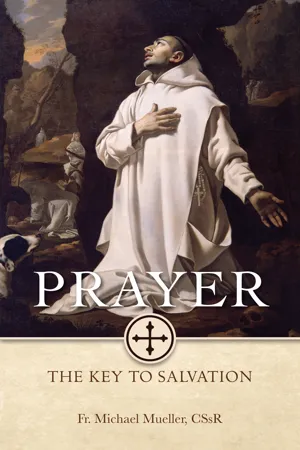
- 240 pages
- English
- ePUB (mobile friendly)
- Available on iOS & Android
eBook - ePub
About this book
Information
Topic
Theology & ReligionSubtopic
Christian DenominationsChapter 1
INTRODUCTION
"Evil communications corrupt good manners," is a proverb as old as human experience. Why is it that association with the great and good improves our manners and our morals? I meet a great and good man; I hold intercourse or communion with him, and am never after what I was before. I feel that a virtue has gone forth from him and entered into my life, so that I am not, and can never be again, the man I was before I met him. What is the explanation of this fact? How happens it that I am benefited by my intercourse with the good, and injured by the intercourse with the bad? How is it that one man is able to influence another, whether for good or for evil? What is the meaning of influence itself? Influence, inflowing, flowing in—what is this but the fact that our life is the joint product of subject and object? Man lives, and can live only by communion with that which is not himself. This must be said of every living dependent existence. Only God can live in, from, and by Himself alone, uninfluenced and unaffected by anything distinguishable from His own being. But man is not God, is not being in himself, is not complete being, and must find out of himself both his being and his completeness. He lives not in and from himself alone, but does and must live in and by the life of another.
Cut off man from all communion with external nature, and he dies, for he has no sustenance for his body, and he must starve; cut him off from all communion with moral nature, and he dies, starves, morally; cut him off from all moral communion with a life above his own, and he stagnates, and can make no progress. All this everybody knows and concedes. Then to elevate man, to give him a higher and nobler life, you must give him a higher and nobler object, a higher and nobler life with which to commune. To elevate his subjective life, you must elevate his objective life. From the object must flow into him a higher virtue, an elevating element.
To illustrate: What is the good of each being? It is that which makes the being better and more perfect. It is clear that inferior beings cannot make superior ones better and more perfect. Now the soul, being immortal, is superior to all earthly or perishable things. These, then, cannot make the soul better and more perfect, but rather worse than she is; for he who seeks what is worse than himself makes himself worse than he was before. Therefore, the good—the life of the soul—can be only that which is better and more excellent than the soul herself is. Now God alone is this Good—He being Supreme Goodness Itself. He who possesses God may be said to possess the goodness of all other things, for whatever goodness they possess they have from God. It follows, then, most clearly that the closer our union is with God, or the more intimate our relation to Him is in this life, the more contentment of mind and the greater happiness of soul shall we enjoy.
Now communion between God and man is possible, for like communes with like. Now man has in his own nature a likeness to God. Human reason is the likeness in man of the Divine reason, and hence nothing hinders intercommunion between the reason of God and the reason of man. Though Divine reason, as the object, is independent of the human, and does not live by communion with it, yet the human reason lives only by communion with the Divine, as in all cases the subject lives only by communion with the object, and not reciprocally the object by communion with the subject. By this communion the subject partakes of the object, the human reason of the Divine reason, which is infinite, absolute truth.
Human reason, then, to live, to be, and to remain enlightened, must be and remain in communion with the Divine reason—with God. The more intimate its communion with God is, the more it will be enlightened, happy, and contented. Now this happy communion between the human and Divine reason—between the soul and God—remains established as long as the human reason acknowledges its dependence on the Divine reason, or as long as man obeys God's will, considers God as his Supreme Lord and Good, and the only Source of all true happiness.
When God made man, He might, by an act of His will, have decreed that the human reason should forever obey Him by an unvarying fixed law, as the stars do.
But God has His complacency in the homage of our free will, and so He made us free men, and not puppets, that nod the head and bend the knee as the wires are pulled. The Holy Scripture says of everything made by God: "And God saw that it was good." Man alone did not receive this praise. Why? It is because man has it in his power to become bad; he is free to choose good or evil, to side with God or with the devil, to follow truth or falsehood—light or darkness—to embrace virtue or vice. It is from this twofold liberty that have risen, from the beginning of the world, two powers, two elements continually combating each other—the good and the bad—the followers and children of God, and the adherents and friends of the devil. St. Michael the Archangel, and Lucifer, the prince of the apostate angels, combat each other in Heaven; Cain and Abel in the family of Adam; Isaac and Ismael in that of Abraham; Jacob and Esau in that of Isaac; Joseph and his brethren in the family of Jacob; Solomon and Absalom in that of David; St. Peter and Judas in the company of Our Lord Jesus Christ; the Apostles and the Roman emperors in the Church of Christ; orthodox faith, or the Catholic Church, and heresy and infidelity, in the kingdom of God on earth; the just and the wicked, in all places; in fact, where is that country, that city, that village, or that family, howsoever small it may be, where these two elements or powers are not found in opposition?
Now it is only the followers of God that enjoy true liberty and happiness. To have the power or liberty to choose evil—to pass over to the devil and enlist and serve under his standard—is no power or liberty at all; it is a mark of weakness and misery, not of perfection. To illustrate: God is Supreme Liberty, and can do all things, yet He cannot sin. To have the power of sinning implies the possibility of becoming a slave of sin. Now the more this power of sinning in a man is increased or lessened, the more is also increased or lessened this possibility of slavery.
To illustrate: Ask a man whose heart is set on earthly gain, ask him what he thinks of those who renounce all to follow Christ and purchase Heaven; ask him, I say, whether they do wisely? Certainly he will answer, "They do wisely." Ask him again why he himself does not do what he commends in others; he will answer, "It is because I cannot." "Why can you not?" "Because avarice will not let me." It is because he is not free; he is not master of himself, nor of what he possesses. If he is truly master of himself and of what he has, let him lay it out to his own advantage; let him exchange earthly for heavenly goods; if he cannot, let him confess that he is not his own master, but a slave to his money.
It is, then, quite certain that the greatness of our liberty is in proportion to the power which our will has to will and to do what God wishes us to do. But let it be remembered that the greater this power is, the greater is also the goodness and perfection of our will; and the greater the perfection of our will, the greater is also the perfection of all its good actions; for the goodness and merit of our actions is in proportion to the goodness of our will. To illustrate: A man who is hardened in sin offends God more grievously when he sins, than another who sins out of frailty, or from a sudden outburst of passion, because he sins by a will determined to evil, which is to sin against the Holy Ghost; so, in like manner, all those good actions which proceed from a will quite determined to what is good, are doubtless of far greater perfection and merit than any others can be. The greater the artist, the more valuable is his work. So, before God, the better the will, the better and more meritorious are all its good actions.
A soul earnestly endeavoring to practice perfect obedience to the Divine will becomes, by degrees, so united with God as not to be able to will except what God wills; but not to be able to will except what God wills, is, as it were, to be what God is, with whom to will and to be is but one and the same thing; for to whomsoever power is given to become a child of God, to him is also given power, not indeed to be God Himself, but to be what God is.
To a soul thus disposed, the Lord grants such great favors as it is impossible to describe. He gives her a faith so lively, a confidence so firm, a charity so ardent, a zeal for the salvation of her neighbor so burning, a degree of prayer so sublime, a prudence so unusual, a courage in all difficulties so invincible, a peace so profound, a humility and simplicity of heart so admirable, and sometimes even a spirit so prophetic, together with a gift of performing miracles so extraordinary as to make everyone exclaim: "Truly, that soul can say with St. Paul, 'I live, now not I, but Christ liveth in me.' " (Gal. 2:20).
It was for his obedience to the will of God that Abel obtained from the Lord the testimony that he was just; that Henoch was translated by God, in order that he should not see death. On account of his obedience to the will of God, Noah and his family were saved from the deluge; Abraham became the father of many nations; Joseph was raised to the highest dignity at the court of the King of Egypt. Moses became the great servant, prophet, and lawgiver of the land, and the great performer of miracles with the people of God. Obedience to the will of God was, for the Jews, at all times, an impregnable rampart against all their enemies; it turned a Saul, a persecutor of the Church, into a Paul, the Apostle of the Gentiles; it turned the early Christians into martyrs, for martyrdom does not consist in suffering and dying for the Faith; it consists, rather, in the conformity of the martyr's will to the Divine will, which requires such a kind of death and not another.
On the contrary, disobedience turned the rebellious angels out of Heaven; it turned our first parents, Adam and Eve, out of Paradise; it made Cain a vagabond and a fugitive on earth; it drowned the human race in the waters of the deluge; it burned up the inhabitants of Sodom and Gomorrha. Disobedience to the will of God led the Jews often into captivity; it drowned Pharaoh and all his host in the Red Sea; it turned Nabuchodonosor into a wild beast, it laid the city of Jerusalem in ashes; it has ruined, and will still ruin, whole nations, empires, and kingdoms; it will finally put an end to the world, when all those who always rebelled against the will of God will, in an instant, be hurled into the everlasting flames of Hell, by these irresistible words of the Almighty: "Depart from me, ye cursed, into everlasting fire, which was prepared for the devil and his angels," there to obey the laws of God's justice forever. Man, then, when in opposition to God's will, is altogether out of his place. A tool which no longer corresponds to the end for which it was made is cast away; a wheel in a machinery which prevents others from working is taken out and replaced by another; a limb in the body which becomes burdensome and endangers the functions and life of the others, is cut off and thrown away; a servant who does no longer his master's will is discharged; a rebellious citizen, violating the laws of the state, is put into prison; a child, in an unreasonable opposition to his parents, is disinherited. Thus men naturally hate and reject what is unreasonable or useless, or opposed to, and destructive of, good order, whether natural or moral. What more natural, then, than that the Lord of Heaven and earth, the Author of good sense and of good order, should bear an implacable hatred to disobedience to His holy will?
The man in opposition to the will of God suffers as many pangs as a limb which has been dislocated; he is continually tormented by evil spirits, who have power over a soul that is out of its proper sphere of action; he is no longer under the protection of God, since he has withdrawn from His will, the rule for man's guidance, and has voluntarily left His watchful Providence. God sent Jonah, the prophet, to Nineveh, and he wished to go to Tarsus. He was buffeted by the tempest, cast into the sea, and swallowed by a monster of the deep! Behold what shall come on those who abandon God's will to follow their own passions and inclinations. They shall be tossed, like Jonah, by continual tempests; they will remain like one in a lethargy, in the hold of their vessels, unconscious of sickness or danger, until they perish in the stormy sea, and are swallowed up in Hell! "Know thou, and see that it is a bitter and fearful thing for thee to have left the Lord thy God, when He desired to lead thee in the way of salvation, and that My fear is not with thee, saith the Lord God of Hosts."
God grants to the devil great power over the disobedient. As the Lord permitted a lion to kill a prophet in Juda in punishment for his disobedience to the voice of the Lord, so, in the same manner, He permits the infernal lion to assail the proud and the disobedient, everywhere, with the most filthy temptations, which they feel themselves too weak to resist, and thus fall a prey to his rage. Unless they repent soon, like Jonas, of their sin of idolatry, as it were, they will not be saved, as was the prophet, but will perish in the waves of temptations, and sink into the fathomless abyss of Hell.
Now why is it that many are good, and others are bad; that many follow God, and are saved, and others do not follow Him, and are damned? The answer to this question will be found in the following pages.
Chapter 2
ON THE NECESSITY OF PRAYER IN GENERAL
There is an important truth of which thousands of men are ignorant; or if they know it, they reflect upon it seldom, and with but little fruit. Yet the knowledge of this truth is almost as necessary for all those who have attained the age of reason, as the knowledge of the mysteries of the Trinity and Incarnation. The importance of this great truth seems to be a mystery not merely to the heathen, Jews and heretics, but even to the greater part of Christians; nay, even to many of those who have consecrated themselves to God. We often hear in sermons, and read in pious books, of the necessity of avoiding bad company, of hating sin, of forgiving injuries, and of being reconciled to our enemies; but seldom are we taught this great truth, or, if it is sometimes spoken of, it is rarely done in a manner calculated to leave upon our minds a lasting impression of its great importance and necessity. Now this important truth is, that according to the ordinary course of Divine providence, man cannot be saved without prayer.
In order to understand this truth in its full extent, we must consider:
First. That we cannot be saved unless we fulfill the will of God.
Secondly. That we are unable to do God's will unless we are assisted by Divine grace.
Thirdly. That we obtain this grace by prayer alone; that consequently we must pray in order to be saved.
First. I say we cannot be saved unless we fulfill the will of God. The Lord declared His will in express terms when He said to Adam: "And of the tree of knowledge of good and evil thou shalt not eat; for in what day soever thou shalt eat of it, thou shalt die the death." (Gen. 2:17).
By this commandment man was clearly given to understand that the continuation of his happiness, for time and eternity, depended upon his obedience to the will of God. To be free from irregular affections and disorderly passions, and to transmit his happiness to his posterity, was entirely in his power. If he made a right use of his liberty, by always following the law of God; if he preserved unsullied the image and likeness of his Creator and heavenly Father; if, in fine, he made a proper use of the creatures confided to his care, he would then receive the crown of life everlasting in reward for his fidelity. But if he swerved even for a moment from this loving will of God, he would subject himself to the law of God's justice, which would not fail to execute the threatened punishment.
But did God, perhaps, afterwards, in consideration of the abundant merits of the Redemption, lay down other and easier conditions for man's happiness and salvation? No. He did not change these conditions in the least. Man's happiness still depended on his obedience to the Divine will. "Now if thou wilt hear the voice of the Lord thy God, to do and keep all his commandments, the Lord thy God will make thee higher than all the nations of the earth, and all these blessings shall come unto thee and overtake thee, yet so if thou hear his precepts." (Deut. 28:1-2). And our Divine Saviour says: "You are my friends, if you do the things that I command you." (John 15:14). And again: "Not every one that saith to me Lord, Lord, shall enter into the kingdom of heaven, but he that doth the will of my Father who is in heaven shall enter the kingdom of heaven." (Matt. 7:21). He Himself gave the example, having been obedient even unto the death of the Cross, thereby teaching all men that their salvation depends on their persevering obedience to the will of their heavenly Father.
Jesus Christ, the Redeemer, appointed the Apostles, and especially Peter, to succeed Him in His office of teaching the will of God. Where Peter and the other Apostles are found in their lawful successors, there only is the true and entire will of God taught; and those only who embrace and follow it faithfully, have well-founded hopes of salvation. They who follow any other rule in acquiring salvation deceive themselves. Instead of God's will, they do their own, or they follow the suggestions of the devil, or those of evil-minded, perverse teachers, who substitute their own will and opinions for the will of God; they imitate Adam and Eve, who believed the devil's suggestions rather than the infallible word of God.
But to be always mindful of God's will; always to honor, appreciate and love it above all things; always to embrace and follow it punctually and promptly; always to understand clearly, that whatever is contrary to God's will can never be good or meritorious, but must bring death to the soul; to return to His Divine will after having strayed away from it—all this is not the work of our weak nature, but is entirely the effect of Divine grace; for, if faith teaches us that God made all things very good, it also teaches us that they cannot remain so without God's assistance; otherwise they would cease to be dependent on Him. This is true of all God's creatures, but especially of man who, being endowed with free will, has it in his power to obey or transgress the law of God.
On this account Jesus Christ says: "Without Me you can do nothing." On these words, St. Augustine remarks that Jesus Christ did not say: "Without Me you cannot bring anything to perfection"; but He said: "You cannot even do anything." He means to say that without His grace we are not even able to commence any good work. "If this light of faith," said Our Lord to St. Catherine of Siena, "shineth on thee, thou wilt understand that I, thy God, know better how to promote thy welfare, and that I have a greater desire to do so than thou thyself, and that thou, without My grace, neither wouldst nor couldst promote it."
This very thing is taught by St. Paul. In his Second Epistle to the Corinthian...
Table of contents
- Cover Page
- Copyright Page
- PROTEST OF THE AUTHOR
- CONTENTS
- Oblation
- 1. Introduction
- 2. On the Necessity of Prayer in General
- 3. On the Necessity of Prayer for Sinners
- 4. On the Necessity of Prayer for the Just
- 5. On the Necessity of Prayer for Seminarians
- 6. On the Efficacy of the Prayers of the Just
- 7. On the Power of the Prayer of Children
- 8. On the Conditions and Qualities of Prayer
- 9. How to Acquire the Spirit of Prayer
- 10. On the Praises of Prayer
- 11. On the Practice of Meditation
- The Methods of Conversing Continually and Familiarly with God
- Prayer To Be Said Every Day To Obtain the Graces Necessary for Salvation
Trusted by 375,005 students
Access to over 1.5 million titles for a fair monthly price.
Study more efficiently using our study tools.
Frequently asked questions
Yes, you can cancel anytime from the Subscription tab in your account settings on the Perlego website. Your subscription will stay active until the end of your current billing period. Learn how to cancel your subscription
No, books cannot be downloaded as external files, such as PDFs, for use outside of Perlego. However, you can download books within the Perlego app for offline reading on mobile or tablet. Learn how to download books offline
Perlego offers two plans: Essential and Complete
- Essential is ideal for learners and professionals who enjoy exploring a wide range of subjects. Access the Essential Library with 800,000+ trusted titles and best-sellers across business, personal growth, and the humanities. Includes unlimited reading time and Standard Read Aloud voice.
- Complete: Perfect for advanced learners and researchers needing full, unrestricted access. Unlock 1.5M+ books across hundreds of subjects, including academic and specialized titles. The Complete Plan also includes advanced features like Premium Read Aloud and Research Assistant.
We are an online textbook subscription service, where you can get access to an entire online library for less than the price of a single book per month. With over 1.5 million books across 990+ topics, we’ve got you covered! Learn about our mission
Look out for the read-aloud symbol on your next book to see if you can listen to it. The read-aloud tool reads text aloud for you, highlighting the text as it is being read. You can pause it, speed it up and slow it down. Learn more about Read Aloud
Yes! You can use the Perlego app on both iOS and Android devices to read anytime, anywhere — even offline. Perfect for commutes or when you’re on the go.
Please note we cannot support devices running on iOS 13 and Android 7 or earlier. Learn more about using the app
Please note we cannot support devices running on iOS 13 and Android 7 or earlier. Learn more about using the app
Yes, you can access Prayer by Father Michael Mueller, C.SS.R in PDF and/or ePUB format, as well as other popular books in Theology & Religion & Christian Denominations. We have over 1.5 million books available in our catalogue for you to explore.