From Martinique to Tours, France, his life was guided toward successfully promoting this devotion. World famous for his miracles. One of the best books we have ever published! Companion book: The Golden Arrow. 231 pgs,
eBook - ePub
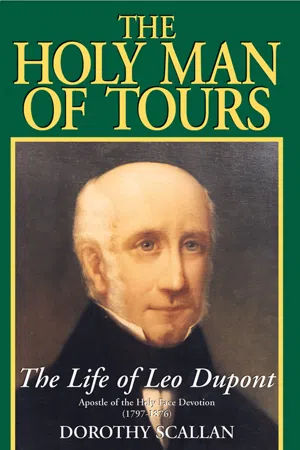
The Holy Man of Tours
The Life of Leo Dupont (1797-1876), Apostle of the Holy Face Devotion
- 231 pages
- English
- ePUB (mobile friendly)
- Available on iOS & Android
eBook - ePub
The Holy Man of Tours
The Life of Leo Dupont (1797-1876), Apostle of the Holy Face Devotion
About this book
Information
Topic
Teología y religiónSubtopic
Denominaciones cristianas1

IT WAS early spring in Martinique in the year 1805, and through the open windows of a small schoolhouse came the chirping of many birds. A gentle breeze blew sweet scents from peach groves and orange trees, and it was little wonder that the class of small boys, as they tediously wrote on their slates, grew restless hoping that the school-bell would ring out an end to their captivity. Martinique in the springtime was lovely, and the children were longing for the outdoors; but the bell did not ring, and the afternoon dragged on, and with it irksome study.
Suddenly the schoolmaster, Mr. Rochelle, rose and walked to the door. "I shall leave you to yourselves for a while. Continue your lessons until I return," he said as he closed the door behind him.
He was not gone very long, when the youngsters put down their slates and began to play—loudly talking, laughing, whistling and enjoying themselves with wild enthusiasm. Their hilarity reached the ears of the schoolmaster at the other end of the building. Mr. Rochelle at once retraced his steps, but the boys, recognizing his hurried pace, were too quick for him and they became silent, so that when the flushed Mr. Rochelle opened the door, no one moved.
"Now, boys, I heard the disorder of this class at the other end of the building. I see you are all suddenly perfectly quiet, but you have not deceived me. I demand to know who were the boys who misbehaved while I was away. The guilty ones will rise and come to the front."
As Mr. Rochelle looked from right to left, he noticed that in the second row, at the fourth desk, one boy promptly rose and, looking straight ahead, marched up to the front. The schoolmaster waited a few moments and then made a second appeal urging the guilty ones to come forward. But no one joined the solitary penitent who, standing alone, peered uncomfortably at the teacher, expecting the worst.
"So, Leo Dupont, you admit that you have been a bad boy. I would expect better things from you, for it seems to me you are big enough to know better. Just how old are you?"
"I am eight years old, master," the boy admitted cheerlessly.
"Eight years old! Really, Leo, your mother will be very grieved to learn of the conduct of her son. Are you not ashamed to admit that you are the only mischievous boy in the whole class? Look at all your schoolmates here, sitting quietly at their desks. They have evidently conducted themselves so well during my absence that now they have nothing to confess. But you, Leo, have been the one black sheep among all these nice, little white lambs . . . ."
The guilty boys began to shuffle restlessly at their desks, their roving eyes betraying the guilt asserting itself in their hearts. But still they clung to their benches, refusing to admit their misbehavior. The large clock on the wall ticked away loud minutes like a clanging doom, warning the youngsters to confess before it was too late. Then the school bell rang. Relief registered on all faces, but it became evident that Mr. Rochelle was not quite ready to dismiss the class.
Pausing for a moment, he looked inquiringly into the faces of the youngsters at their desks and then announced calmly, "Ordinarily, when the bell rings, classes are dismissed—that is, provided there has been no misbehavior. But today it is a different story," he announced, biting his lips.
The room became tense with silence. All eyes were fixed on the threatening schoolmaster, who turned to Leo and said, "My little friend, since you have been so naughty today, I do not believe you deserve to remain in the company of all these good boys. So go for your hat, take your books, and be on your way home. The rest of the children will stay here."
Confused and puzzled, Leo nevertheless did as he was told.
When the door closed behind him, the angry schoolmaster turned flashing eyes at the class, and severely scolded the boys for their dishonesty. "Boys, it is human to make a mistake. It is pardonable to grow restless and noisy once in a while. But to be false, to refuse to admit your guilt, that is something else—that is something I intend to punish. Little Leo Dupont is much younger than many of you boys, and yet he was the only real man among you. He rose and admitted getting into mischief. From a boy like that I expect great things."
Leo left the schoolhouse, unaware of the praise heaped upon him. He walked out into the sunshine, toward the large gate where he was met by the mulatto servant, Henri, who called daily to drive him home from school in a carriage. "But, Mastah Leo, why is yo all alone by yerself today? Where is all 'em classmates of yours?" inquired Henri, as he took Leo's books and slate, and helped the youngster into the shiny carriage.
Leo, still confused, did not know what to say, but finally managed a reply. "The schoolmaster had the rest of the boys stay at school," he said in a monotone.
"They must 'ed be bad boys. And you must 'ed be th' only good 'un today," said the faithful servant approvingly. "Yer mother will be mighty proud of yo, Mastah Leo. She'll be mighty proud to find out her boy was th' onliest one what was good today, while all th' others wus bad."
Hearing this, Leo was more puzzled than ever. He tried to explain that he was not good, that he had admitted being mischievous — but to no avail. Henri was beyond these mental gymnastics. He only spurred on the horses to get Leo home in extra-good time, for he felt he had good news for Madame Marie Louise Dupont, the widowed mother of little Leo. When the carriage drew up before the massive door of the imposing Dupont mansion, which towered majestically over one of the richest sugar plantations on the island of Martinique, Henri at once went in search of Madame Dupont.
"Mastah Leo is been a powerful good boy, Madame! All 'is classmates done hafta stay after school but him!"
Madame Dupont kissed her son and took him to the large refectory for some afternoon refreshments. "What is this good news I hear about you, Leo?" she asked.
Leo explained as well as he could what had taken place. Madame Dupont saw through the schoolmaster's method and although she said nothing of it to Leo, she was happy to find honesty blooming in the heart of this cherished son.
Madame Dupont was an exemplary Christian as well as a lady of high birth. She came from a noble and wealthy Martinique family, the Gaigneron de Marolles, and had been happily married to the illustrious Nicholas Dupont, who, weary of revolutionary excesses in his beloved France, had come to Martinique to make his home. Though of short duration, their marriage had been blessed with two sons, Leo, now aged eight, and Theobald, aged four. Widowed at an early age, with wealth and position, Madame Dupont turned all her efforts to the rearing of her two sons. To them she held up Christian virtues as the highest ideals; not only did she teach by word, but by example as well. Thus Leo, even at the tender age of eight, began to show those traits of honesty and candor that were to thrive and blossom into high principles as he advanced to young manhood.
Several years later, when the regular course of studies at the village school in Martinique was completed, Madame Dupont decided to send her son to school in the United States.
"Leo," she confided to him one day, "the reason I want you to go to school in the free land of the United States is that you shall learn there the importance of dignified political liberty and freedom of religious worship. I cannot send you to school in Paris because the times are too unsettled and Paris is too much a center of religious persecution. But as soon as conditions appear somewhat normal, I want you, of course, to study in Paris, and then to return to live here in Martinique, where you will in time inherit the family fortune. I shall miss you keenly while you are gone."
"But, Mother, I shall be back shortly," said Leo in that heartening way of his, a manner which endeared him not only to his mother but to all who knew him.
Leo spent two profitable years studying in the United States, after which he went to France, where he was joined by his mother and his younger brother. It was a joyous reunion, made still happier by the news which Madame Dupont had for Leo.
"Son, your uncle, Count Marolles, has invited us to spend our summer vacation at his castle in Chissay."
"Great! When do we leave?"
"Tomorrow morning — that is, if you think you can be ready by then," replied his mother, teasingly.
At the castle in Chissay there was an endless round of enjoyable family life that summer. Count Marolles, like his sister, Marie Louise Dupont, was distinguished for his Christian refinement. His entire estate breathed warm hospitality, and Madame Dupont and her two sons entered into all that took place there: Mass on Sundays and holy days, the sacraments, and family devotions, as well as riding, driving, dancing, swimming, and other sports. And no one entered into the activities at the castle with as much gusto as Leo, now fourteen years old.
Then one day, a sudden apprehension fell over the castle. There was an accident on the grounds of the vast estate. Leo and his cousin Alfred were whiling away an early summer afternoon, while the count, Madame Dupont, and the others were taking their siesta.
"Let's climb up on the gates," suggested Alfred. "It's a lot of fun swinging on them," he added. No sooner had he spoken than he perched himself on the top of one of the huge iron gates that opened on the driveway leading to the castle. Atop the seven-foot gate, Alfred began to swing. Below, Leo stood and watched, leaning against a post. After a while he, too, decided to join in the fun; he climbed onto the other gate and began swinging. For a time all went on well, until Alfred was struck with another idea. "Leo, I'm going to swing right through to the other side this time. So take away your hand," he said as he pushed forward.
Leo looked at his cousin dubiously and refused to move his hand from the edge of the gate.
"Why don't you take away your hand, Leo? Next time I swing, I'll push harder, and if you don't move your hand, your fingers will get caught," shouted Alfred.
"Why should you swing so hard that you should deliberately get my hand caught by the gate?" asked Leo.
"Well, I will, I tell you, Leo. I certainly will! So hurry and take your hand away."
Something inside Leo seemed to contract. He looked at his cousin and said, "I don't think you have the nerve to swing the gate over my hand. You just couldn't do such a thing to me!"
"What makes you say that, Leo? I warn you for the last time to take your hand away or you'll be sorry!"
"I won't take it away!"
"All right, then. Here I come!"
A moment later the heavy gate swung violently forward and closed on Leo's thumb.
Alfred ran to tell his father about the accident. A physician was summoned. So badly was Leo's thumb crushed that Madame Dupont wept as she complained to her brother, "What shall become of my son, who is so obstinate and self-willed that he opens himself to deliberate suffering, and even maiming? What, indeed, shall become of him?" she cried.
Her brother, taking her tear-stained face in his hands, said, "I do not fear for Leo, my sister. It is for Alfred that I am concerned. Leo, you must remember, may have shown self-will, but only where he would be made to suffer from his act of self-will. With my son, Alfred, however, it is another matter. How could he deliberately ride over the thumb of his cousin? Have I ever given him such an example of cruelty? Leo could not imagine that Alfred would deliberately do him harm. Leo, my dear sister, believed in the humaneness of Alfred. Be happy, Marie Louise, that you have a son who somehow believes his neighbor to be better than his neighbor really is. Children will be children, but from this incident I see Leo emerging a man, a resolute man, who will one day forge a strong and determined will to achieve something great. One thing is sure. Leo will never, like my son Alfred, use his will stubbornly to swing iron gates onto living flesh, to inflict pain and suffering on another. It is my son who needs prayers. Leo will be all right."
2

AT THE age of nineteen Leo Dupont was a very attractive young man. His mother, who had in the meantime contracted a second marriage with Mr. Arnaud, a well-to-do landowner, was eager to see her son complete his education in Paris. Since the family wealth, to which Leo would fall heir, consisted of vast sugar plantations in Martinique, it was deemed advisable for Leo to pursue a course of studies that would launch him upon a lawyer's career, so that after his return he could fill some honorable post in the government of the French colony.
On the eve of his departure for Paris, Madame Arnaud had a confidential talk with him. "Leo, you are going away with Theobald to study in Paris. I am giving you your first annual allowance," she said, handing him checks and currency which at present value would be equal to $10,000.
Leo kissed his mother's hand, and then both her cheeks, as he had been trained to do from childhood. "May God reward you, Mother," he said and then deposited the money in a leather wallet.
Madame Arnaud motioned to him to be seated at her side, for she had something more to say. "Leo, this sum of money, which shall be your annual income while you and Theobald are at Paris, should be sufficient to purchase the comforts to which you have been accustomed at home. You are no longer a boy like your brother Theobald. You are now a young man in your twentieth year and it is to you I now address myself with grave parental authority. You understand that whatever you need you can have from me, for you have inherited great wealth from your father — a fortune that will soon come entirely into your possession. Morever, my personal wealth is also considerable, and it, too, will some day be yours. So, you are an independent young man who needs to court no one's favor for the purpose of gain. Use this independence for noble ends. If an impoverished or underprivileged person sometimes stoops to lie, to cheat, to misrepresent, to overreach, or otherwise to conduct himself dishonorably, he may excuse himself by saying that he was penniless and only wanted to advance himself; although it is always great folly to risk eternal happiness for perishable earthly gain. You will have no such problems."
Madame Arnaud paused for a moment, as if to survey the elegant surroundings, as if to be sure that she was making a correct estimate. She cast her eyes around the large room, looked up at the portrait of her deceased husband that hung in a massive gold frame over the marble fireplace, and then continued with striking self-assurance, "No, my son, you need not court the favor of the wealthy to advance yourself materially. You can stand shoulder to shoulder with any of them. You are heir to half a million dollars, Leo, and that is a grave responsibility as it is also a high privilege. You can use your fortune well, or you can abuse it. Your father bequeathed to you vast wealth, but remember, God gave you life and an immortal soul and He will exact from you a strict account on the final day. See to it, therefore, that you can face God with a clear conscience every night before you go to bed. Paris is reputed to be a wicked city, but it is also ...
Table of contents
- Cover Page
- Copyright Page
- Dedication Page
- CONTENTS
- Chapter 1
- Chapter 2
- Chapter 3
- Chapter 4
- Chapter 5
- Chapter 6
- Chapter 7
- Chapter 8
- Chapter 9
- Chapter 10
- Chapter 11
- Chapter 12
- Chapter 13
- Chapter 14
- Chapter 15
- Chapter 16
- Chapter 17
- Chapter 18
- Chapter 19
- Chapter 20
- Chapter 21
- Chapter 22
- Chapter 23
- Chapter 24
- Chapter 25
- Chapter 26
- Chapter 27
- BIBLIOGRAPHY
- THE "GOLDEN ARROW" PRAYER
Trusted by 375,005 students
Access to over 1.5 million titles for a fair monthly price.
Study more efficiently using our study tools.
Frequently asked questions
Yes, you can cancel anytime from the Subscription tab in your account settings on the Perlego website. Your subscription will stay active until the end of your current billing period. Learn how to cancel your subscription
No, books cannot be downloaded as external files, such as PDFs, for use outside of Perlego. However, you can download books within the Perlego app for offline reading on mobile or tablet. Learn how to download books offline
Perlego offers two plans: Essential and Complete
- Essential is ideal for learners and professionals who enjoy exploring a wide range of subjects. Access the Essential Library with 800,000+ trusted titles and best-sellers across business, personal growth, and the humanities. Includes unlimited reading time and Standard Read Aloud voice.
- Complete: Perfect for advanced learners and researchers needing full, unrestricted access. Unlock 1.5M+ books across hundreds of subjects, including academic and specialized titles. The Complete Plan also includes advanced features like Premium Read Aloud and Research Assistant.
We are an online textbook subscription service, where you can get access to an entire online library for less than the price of a single book per month. With over 1.5 million books across 990+ topics, we’ve got you covered! Learn about our mission
Look out for the read-aloud symbol on your next book to see if you can listen to it. The read-aloud tool reads text aloud for you, highlighting the text as it is being read. You can pause it, speed it up and slow it down. Learn more about Read Aloud
Yes! You can use the Perlego app on both iOS and Android devices to read anytime, anywhere — even offline. Perfect for commutes or when you’re on the go.
Please note we cannot support devices running on iOS 13 and Android 7 or earlier. Learn more about using the app
Please note we cannot support devices running on iOS 13 and Android 7 or earlier. Learn more about using the app
Yes, you can access The Holy Man of Tours by Dorothy Scallan in PDF and/or ePUB format, as well as other popular books in Teología y religión & Denominaciones cristianas. We have over 1.5 million books available in our catalogue for you to explore.