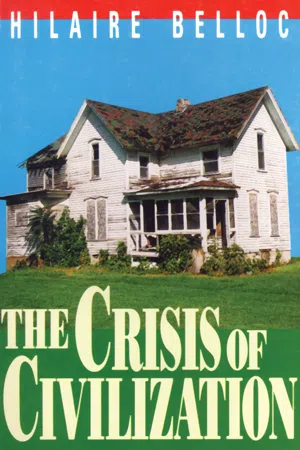
Here the great Belloc shows that ever since the disaster of the Protestant Reformation, Western civilization (which was formed by the Catholic Faith) has been coming apart--since Calvinism opened the door to usury, unbridled competition, the domination of the mind by money, and ultimately the return of slavery. Belloc says our 2 choices are a return to Catholicism or chaos! Essential for anyone who would understand our world today!
- 208 pages
- English
- ePUB (mobile friendly)
- Available on iOS & Android
eBook - ePub
The Crisis Of Civilization
About this book
Information
Topic
Theology & ReligionSubtopic
Christian Denominations1
THE FOUNDATION OF CHRISTENDOM
I would lay it down at the beginning that the present crisis in our civilization is the gravest affecting that civilization since first it took on its essential character, between 1900 and 1600 years ago.
During the whole of that very long period of time there has been present upon this earth and in that district of the world which seems to have been set apart for the leadership thereof a well-defined recognizable culture, to which our forefathers gave the appropriate name—Christendom. It arose upon a certain foundation, the pagan Graeco-Roman Empire of antiquity; it developed through the impact and influence upon this of the Catholic Church; it grew in spiritual character and energy throughout some 500 years in the midst of which Catholicism had already become the accepted philosophy, morals and religion of our blood. It even expanded beyond the boundaries of that highly civilized antique state wherein it arose, it transformed the heathen beyond the boundaries of that state, spreading to include outer parts of it which the original Roman policy had not directly ruled; it suffered attack from without and grave material decline from within, but it survived.
It not only survived but flowered after a long ordeal during the Dark Ages, and was perhaps at its highest in the centuries immediately following, the 11th, 12th, 13th, 14th, and 15th, which we call the Middle Ages. Having so expanded, withstood its first perils and grown established, it suffered 400 years ago a peril of disruption. It was nearly destroyed by internal faction; dispute upon its primary and creative doctrines wrecked in part at least its main institutions. But so much of it yet again survived as to maintain the continuity of culture. Christendom, though at war within itself during the 16th and 17th centuries, was still Christendom; the primary doctrines and their consequent social habits (whereby Europe and her expansion overseas lived) still stood in the general mind of men. But the struggle had been heavy, the loss of unity and therefore of personality in that great body was increasingly apparent.
At first a minority only lost the full Christian traditions, and till the late 18th century the mass of Europe itself and the colonies which Europe had planted beyond the ocean still lived by the rules, if not of Faith, at any rate, of accepted conduct which they had inherited from so great a past.
But the process of dissolution continued. During the 19th century the core of the affair was diluted and grew weaker; certain prime established things which had formed the structure of Christendom were shaken. Within two generations they were tottering. The characteristic unity of Christendom was already more than half forgotten; each of its parts, now wholly separate, had already long arrogated to itself complete sovereignty, and therefore implicitly denied the corporate life of the whole; while within the structure institutions which were bound into the common heritage, cementing it and giving it unity, were dissolving.
Marriage was beginning to be challenged, therefore the family; property still stood, but its moral basis was questioned. Civil authority had gone the way of spiritual, its basis was disputed and its security failing. The ancient canon of morals, the chief characteristic of Christendom, in sexual and personal as in general and civil relations, was challenged, doubted and confused. It was losing its vigor, changing from an unquestioned fixity to a debated mass of fluid opinion. All this process reached its climax in our own time.
Meanwhile there has necessarily proceeded side by side with the general decay of the ancient and once apparently permanent moral structure, a social and economic change springing from the same roots, but of more immediate consequence, because it directly affects the lives of men in a fashion that each can appreciate and with which all were directly and vividly concerned.
The livelihood of men had become insecure; over wide departments of many nations in the most part of Society there had arisen insecurity and destitution on such a scale that life threatened to be soon intolerable for its victims. Even as this awful challenge to human life approached its climax, all hope of dealing with it by a commonly accepted philosophy seemed to have been lost.
In other words, that by which the leaders of mankind had lived, that by which the white civilization had been what it was, that from which what had been for so long most properly called Christendom, had drawn its personality, its will, its honor, its very self, was and is melting away.
It is with justice then that we speak of the Crisis of Our Civilization. It is with justice that we apply that very grave term to the moment in which we have the misfortune or the combative glory to live.
So emphatic a description of the menace under which we lie may seem exaggerated to those who have not considered the contrast between today and the long centuries of accepted morals preceding it. It is not exaggerated. It is in due proportion and true. We are in peril here and now of losing all that by which and for which our fathers lived, and which we still know to be, though in apparently active dissolution, our inheritance.
In the presence of any great crisis the task in hand is the solution thereof; and as this crisis is the greatest of all historically known to us, the task before us is also the greatest and the arrival at a solution the most practical end which men of our blood have ever had set before them.
Throughout the world European and Transoceanic, uncertain efforts inspired by the necessity of arriving at some solution are beginning in a confused fashion. They differ in character, the two main schools in those who pursue these efforts are opposed and in mortal conflict—yet at some solution we must arrive and arrive in common. It is the business of this book to examine the nature of the problem and discover, if it be possible, the policy to be applied which may successfully dissipate the mortal threat overhanging us. The Sphinx has asked us its final and weightiest riddle; we must find an answer to it or die.
A crisis is of its nature a strain; it connotes unstable equilibrium. The settling of a crisis, the recovery of fixed and acceptable conditions, is the resolution of that strain. The strain arises from unstable equilibrium between the component parts and circumstances of anything: the unstable equilibrium must be reduced again to stability under pain of destruction. Thus in the nervous system of the human being there may arise a strain under which the faculties of intelligence and of will, the judgment of the senses, the whole balanced affair, falls into disarray. The strain will be resolved by the restoration of the coordinated faculties; that is, by the cure of the sufferer and his reestablishment in sanity; or it will be resolved by a breakdown which we call madness, which is the death and end of sanity. A chemical combination when it is unstable must either be resolved by the separation of its component parts or the rearrangement of them in a stable form; or by letting the instability of them resolve itself in the disaster of an explosion, whereby that which was ceases to be.
Or take a building, a tall tower for example, which becomes unstable, leaning over at a perilous angle. We may pull it down in time and rebuild it or shore it up sufficiently to permit of strengthening its structure until it shall be fully established again; or we may act too late or unwisely, so that through our delay or blunder the mass will fall to the ground, cease to be what it was and be lost. Under any crisis (that is under any special strain), in order to act wisely and prevent the threatened disaster, we must discover two things: first, how serious it is, for only when we know that can we say whether this or that perhaps drastic and painful effort is worthwhile. Next, what are the causes at work which have produced the increasing tension.
Now in the case of the modern strain, in the case of this "final crisis of our civilization," wherein the quarrel between the dispossessed and the possessed, the exploited and the exploiter, the sufferer from injustice and the beneficiary therefrom threaten to pull down our world, there can be no question as to the seriousness of the issue. It is of maximum seriousness, it is as serious as it can be, and what is more it is immediate. It is upon us.
But as to its cause, that is another matter: it is because men dispute so much upon its cause that they differ so much as to the remedy. Yet unless we are right upon the cause and can choose the applicable remedy, we perish. Now how shall we make up our minds upon the cause, how shall we judge the inmost character of the thing with which we have to deal?
There is but one main method of approach, and that method is to follow and appreciate the history of the thing now in danger of death—our society. To understand how Christendom came to be and what is indeed the inmost principle whereby it was for so long that which it was, and only at this long last has come to sudden failure, we must follow its growth and maintenance. The problem is organic; we must appreciate the nature of the living thing in order to cure it, now that it is in mortal sickness. That nature we can only know by seeing how it was born, and grew, and lived.
What then was the story of Christendom, and why has that story now come to be threatened with an end? History upon all this is our guide; the history of what we were explains what we are.
Now in approaching any historical statement, especially upon approaching one concerned with a long historical process, and more particularly in approaching one of a wide scope such as this, there are certain rules to be observed; national and religious bias even more than the inevitable limitations of the individual student tend to warp the truth. But we can get as near an approximation of the truth as is reasonable to expect by keeping in mind certain postulates from which the rules of right historical judgment are to be drawn. Whether in the question I am now undertaking I have duly observed these rules it will be for those who read to judge; but I have attempted to observe them and I desire to state them thus at the outset, because they seem to me of the first importance. We are about to answer the main question, "What happened?" We are about to attempt the drawing of a large outline which shall be true: which corresponds to reality.
As it seems to me, there are four main postulates in approaching any great social development historically.
The first postulate is this: "Truth Lies in Proportion." You do not tell an historical truth by merely stating a known fact; nor even by stating a number of facts in a certain and true order. You can tell it justly only by stating the known things in the order of their values.
It has been objected by unthinking men that history is necessarily uncertain because it necessarily consists in the facts selected by the narrator, and since he can leave out what he chooses the result may be almost anything. But this is to presuppose that the man who is telling the story is not desirous of presenting the truth. Suppose he be so desirous, he will only achieve his object by a just selection: that is by selection according to the order of value, giving chief weight to what is most important in connection with his narrative, less weight to what is less important, and omitting as he is bound to omit within any limits, however large, what is least important. This is especially clear in the case of general statement on so large a matter as the establishment of a civilization, its origin, character and development. But how and why it is proportion that determines history may be seen by a particular example.
Suppose a man who knows nothing of English literature says to you, "Who is William Shakespeare? I see his name continually; who and what was he?" If you answer, "He was a man of the middle class of society born near Stratford-on-Avon some three centuries and a half ago. He proceeded to London as a young man and there became an actor"—you are stating truths, but you are not stating the truth. You are not putting in your statement the main fact first. The true answer of course is, "William Shakespeare is the greatest writer of English, the greatest English poet, and among the very first poets of ancient and modern times." If your limits allow you to expand this statement, you can next give his date, after that go into the nature of his work, then deal with his social position, with the amount of his known writing, and so forth. You could fill in the outline in as much detail as your space permits—but you must put the first things first and the second things second. If from ignorance, or as is more probable from affection for this or that, you give wrong values, emphasizing the lesser at the expense of the greater, you are not writing true history. You must of course in the process of your narration admit some word at least to show why such and such an element is more important than another; in other words, you must help to convince those whom you address of your good faith and competence; but anyhow, the main point is that historical truth lies (as does all judgment, that is a right appreciation of anything) upon a due grasp of proportion.
My second postulate will be less easily accepted than my first: it is that religion is the main determining element in the formation of a culture or civilization.
Some would use the word "philosophy" rather than religion. But a social philosophy, that is, an attitude with regard to the universe held by great numbers of men in common for long spaces of time and throughout a whole society, is inevitably and necessarily clothed with forms; it will always and necessarily have some liturgy of its own, some ritual, some symbols, even though it does not consciously affirm any transcendental doctrines. For example, the modern worship of the nation, the modern philosophy whereby our prime duty is regarded as being our duty to the State of which we are members—the general modern conception that affection for and loyalty towards our country is the chief political duty of man—is indeed a philosophy. But it is also in practice a religion, it has its symbols, its revered officers, its regular sequence of public ritual and all the rest of it. And if this is true of a mere philosophy, a mere mundane attitude towards visible and ephemeral things, it is quite certainly true of any positive strongly held conviction upon the Divine element in the arrangements of mankind.
A group of human beings which believes, in general and firmly, that good or evil-doing in this life are followed by corresponding consequences after death, that the individual soul is immortal, that God is one and the common omnipotent Father of all, will behave in one way; and a group which denies all reality in ideas of the sort will behave in another. A group which concentrates its spiritual vision upon the image of terrifying and even maleficent powers will behave thus and thus; another group, which upon the whole contemplates more genial powers friendly to man and in tune with beauty, will act otherwise. The whole of a human group is given its savor and character by the spirit which thus inhabits it; and that spirit may justly be called in nearly every case a religion—although if the term be preferred it may (in cases where the sense of mystery is weak) be termed a philosophy.
But whatever name they give it, on that religion or philosophy the character of those who hold it in common will be founded, as will the character of their philosophy or culture as a whole. If such and such things are held in awe, others in abhorrence, and others again presumed indifferent, such and such is the result upon Society as a whole. Change the elements, regard with abhorrence what was formerly thought of with indifference, with indifference what was formerly held sacred, and the whole character of your polity is transformed. This we can see today by comparing at least a part of the new world developing before our eyes with the work of the last generation: that older world the sanctions and sentiments of which so many are now abandoning.
Efforts have been made to give to some other element than this element of religion (or philosophy) the determining character in a civilization. Thus, many seek that determining character in race or blood: it is one of the most fashionable theories of the time in which we live. Others propose economic circumstances as the determining element and say that a polity is what it is through the way in which wealth is produced and distributed therein. But these and all other explanations are really no more than the restatement of a philosophy or religion. The man who makes race everything (as do many Germans today) is merely preaching a religion of race. The man who makes economic circumstance everything is merely preaching the religion of materialism. Indeed, to do them justice, both consciously proclaim this truth: that a culture is formed by its religion. The German Nazi enthusiast for Germanic excellence, one might almost say for Germanic divinity, proclaims his confidence therein as a doctrine which cannot be overemphasized. The Marxian Communist, in proclaiming economic circumstance to be everything in forming a culture, does not disguise his open and emphatic materialism.
This second postulate, that religion is the making of a culture, will upon a sufficient examination, I think, be granted; and if it is at first unfamiliar and therefore doubted, that is because we are accustomed to think of religion as a private matter, whereas, in social fact, it is a public one. Things really held to be sacred are held sacred throughout the society which is affected by them.
My third postulate is that the evidence on which we base our historical conclusion must include much more than documents; much more than recorded statements. We have also tradition. Memories passed on from one generation to another tend of course to be distorted, and if they are written down very late will often contain false elements of mere legend. But, on the other hand, tradition is sincere (which the written evidence of one witness very often is not), and it is broad-based. Over and over again a tradition which the learned, depending upon documents alone have ridiculed, turns out upon the discovery of further corroboration to be true.
Thus after all the guesswork and various readings of the Homeric poems, recently discovered papyri in general confirm the traditional readings. Or again, there remained for centuries in the popular speech of Paris the term "araines" (variously and later spelled—"arenes"), attaching to a particular quarter of the town. Learned guesswork did its best with that term and could make little of it; what was at any rate generally agreed upon was that it could have nothing to do with the Roman word "arena," because there was no trace of a Roman amphitheater in Paris. Well, in quite modern times during the construction of the Rue Monge, the foundations of the first tiers of such an amphitheater were laid bare, and popular tradition thus confirmed.
These are only two instances where a hundred could be cited by any widely read man from memory alone; and a thousand or more could be established by research.
This postulate, warning us against the now happily decreasing tendency to base all history upon document alone, is especially con...
Table of contents
- Title Page
- Copyright Page
- Table of Contents
- Introduction
- 1. The Foundation of Christendom
- 2. Christendom Established
- 3. The Reformation and Its Immediate Consequences
- 4. The Ultimate Consequences of the Reformation
- 5. Restoration
- ABOUT THE AUTHOR
Trusted by 375,005 students
Access to over 1.5 million titles for a fair monthly price.
Study more efficiently using our study tools.
Frequently asked questions
Yes, you can cancel anytime from the Subscription tab in your account settings on the Perlego website. Your subscription will stay active until the end of your current billing period. Learn how to cancel your subscription
No, books cannot be downloaded as external files, such as PDFs, for use outside of Perlego. However, you can download books within the Perlego app for offline reading on mobile or tablet. Learn how to download books offline
Perlego offers two plans: Essential and Complete
- Essential is ideal for learners and professionals who enjoy exploring a wide range of subjects. Access the Essential Library with 800,000+ trusted titles and best-sellers across business, personal growth, and the humanities. Includes unlimited reading time and Standard Read Aloud voice.
- Complete: Perfect for advanced learners and researchers needing full, unrestricted access. Unlock 1.5M+ books across hundreds of subjects, including academic and specialized titles. The Complete Plan also includes advanced features like Premium Read Aloud and Research Assistant.
We are an online textbook subscription service, where you can get access to an entire online library for less than the price of a single book per month. With over 1.5 million books across 990+ topics, we’ve got you covered! Learn about our mission
Look out for the read-aloud symbol on your next book to see if you can listen to it. The read-aloud tool reads text aloud for you, highlighting the text as it is being read. You can pause it, speed it up and slow it down. Learn more about Read Aloud
Yes! You can use the Perlego app on both iOS and Android devices to read anytime, anywhere — even offline. Perfect for commutes or when you’re on the go.
Please note we cannot support devices running on iOS 13 and Android 7 or earlier. Learn more about using the app
Please note we cannot support devices running on iOS 13 and Android 7 or earlier. Learn more about using the app
Yes, you can access The Crisis Of Civilization by Hilaire Belloc in PDF and/or ePUB format, as well as other popular books in Theology & Religion & Christian Denominations. We have over 1.5 million books available in our catalogue for you to explore.