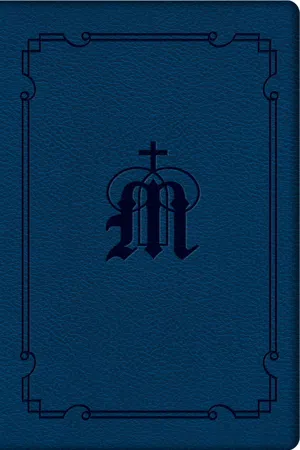
In the school of Mary, says St. John Paul II, we are "led to contemplate the beauty on the face of Christ and to experience the depths of his love." Mary--refuge of sinners, help of the sick, cause of our joy--is the model for all believers.The Manual for Marian Devotion will deepen your relationship with Mary and, in doing so, draw you closer to her Son.Part One, "Preparing for Marian Devotion, " answers the following questions: • What is Mary's place in God's plan? Why is she so important?• What has the Church taught about Mary?• How has Marian devotion changed history?• How should I cultivate devotion to Mary?Part Two, "Aids for Marian Devotion, " provides these essential resources: • inspiration for Marian devotion from the Scriptures and the saints• excerpts from Church documents addressing Mary's role• accounts of Marian miracles and messages through the ages• Marian prayers and hymns from the Church's rich liturgical and devotional patrimony• Marian poetryThe Manual for Marian Devotion is designed to be small enough to travel with you everywhere: use it to nourish your love of Mary with the Scriptures and stories of the saints, and turn to its prayers throughout the day.
- 253 pages
- English
- ePUB (mobile friendly)
- Available on iOS & Android
eBook - ePub
About this book
Information
Topic
Theology & ReligionSubtopic
Christian DenominationsPART ONE
Preparing for Marian Devotion
1
MARY IN GOD’S PLAN
The original cell of all redeemed mankind is Mary, in whom first took place the purification and sanctification through Christ and impregnation by the Holy Spirit. Before the Son of Man was born of the Virgin, the Son of God conceived of this very virgin as one full of grace, and He created the Church in and with her.
ST. TERESA BENEDICT OF THE CROSS
Mary’s place is at the center of God’s plan. Christ’s story is hers; she is mother to God’s people. As we enter more deeply into the mystery of Christ’s life, death, and resurrection, we find Mary walking before us. She is the one chosen from all eternity to bring God’s Son into the world, and she is the perfect believer who teaches us to love her Son.
Mary in the Old Testament
When God established the human race, He created a man and a woman, Adam and Eve. This first couple distanced themselves from God through sin, and so the Father planned to restore humanity through a different man and woman: Jesus, our redeemer, and Mary, His mother. Even as the Son of God purposefully became Incarnate as a male, he affirmed feminine dignity by giving Mary a special role in the Incarnation and Redemption. Just as Christ is the New Adam (1 Cor 15:45), Mary is the New Eve. Second-century Church Father St. Irenaeus writes, “The knot of Eve’s disobedience was untied by Mary’s obedience.”1 We glimpse Mary’s special role immediately after the fall of Adam and Eve when God tells the serpent: “I will put enmity between you and the woman, and between your seed and her seed; he shall bruise your head, and you shall bruise his heel” (Gn 3:15). This verse is known as the “Protoevangelium,” or “first Gospel,” because it is God’s first promise to send a redeemer. In the struggle between Satan and Christ, Mary plays a leading role: She will crush Satan’s head through the actions of her seed, her Son. Because of this verse, art often portrays Mary standing with her foot upon the head of a serpent.
During the centuries when God was preparing His people to bring forth a redeemer, many strong and holy women prefigured Mary. Important among these were Sarah, Abraham’s wife, who miraculously conceived Isaac in her old age (Gn 21), and Hannah, who bore the prophet Samuel after many years of barrenness. Hannah’s song of gratitude to God, which begins, “My heart exults in the Lord; my strength is exalted in the Lord” (1 Sm 2:1), points to Mary’s own Magnificat, recorded in the first chapter of Luke. The heroism of women such as Judith, Esther, and Jael, who helped save their people, likewise foreshadows Mary’s faith and courage.
Mary also fulfills the vocation of Israel as a whole. The prophets of the Old Testament often describe Israel as a bride. She is called to belong to God, enjoying His protection, becoming fruitful through His power, and remaining faithful to Him. Speaking through the prophet Jeremiah, God describes this call in the context of Israel’s exodus from Egypt: “I remember the devotion of your youth, your love as a bride, how you followed me in the wilderness” (Jer 2:2). Unfortunately, through idolatry and injustice, the people of Israel often proved unfaithful. As they look to the promised salvation, the prophets foretell a renewal of faithful Israel. God speaks through Hosea to Israel: “And I will betroth you to me forever; I will betroth you to me in righteousness and in justice, in steadfast love, and in mercy” (Hos 2:19).
This promise of a faithful Israel is realized in Mary, true daughter of Israel. She lives the dedicated vocation of Israel perfectly, bringing forth not sons who perpetuate Israel’s physical existence but the Son of God who redeems the whole world. The Church, the New Israel, begins with her.
Studying the Old Testament through the eyes of faith, medieval theologians saw Mary in words like these from the Song of Songs: “Who is this that looks forth like the dawn, fair as the moon, bright as the sun, terrible as an army with banners?” (Sg 6:10). “Fair” in her sinlessness, Mary is “terrible as an army” as she defies the devil’s power. She crushes the serpent’s head daily through her children’s struggle against him.
The medievals also saw Mary in the passages of the Old Testament where wisdom is personified as a woman. Of course, Christ is the eternal wisdom of God, the uncreated pattern for creation (1 Cor 1:24). Yet wisdom is often spoken of in the Old Testament as created: “Wisdom was created before all things . . . he saw her and apportioned her” (Sir 1:4, 9). Understood as an ordering principle within creation, wisdom describes Mary, who is the most perfect of created beings. If God’s purpose in creating the universe is to prepare a holy people to share His life, Mary is the culmination of His plan for creation. She is the foremost member of the Church and the pattern for all believers.
Mary in the New Testament
The Annunciation
In the Gospels, Mary’s role, dimly hinted at in the Jewish Scriptures, comes into full light. At the Annunciation, the angel Gabriel approaches Mary to ask her to be the Mother of God’s Son. He addresses her not by her name but by a title, “Hail, full of grace, the Lord is with you!” (Lk 1:26). This title points to her unique holiness: Mary already shares in the fruits of Christ’s redemptive death. The annunciation invites Mary to obedience and faith, and she responds wholeheartedly. With her “fiat,” her “Let it be to me according to your word” (Lk 1:38), she receives the Word of God into her heart and the Son of God into her womb, truly becoming the Mother of God. As others come to believe in Christ, they share in Mary’s faith, which remains at the heart of the Church.
The Visitation
The first action Mary takes after accepting the Word into her body is to bring Him to her cousin Elizabeth. This mission of mercy to her elderly cousin teaches us that our proximity to Christ should always issue forth in apostolic zeal. The exchange between the two pregnant women has inspired beautiful meditation and art over the centuries. Little John leaps for joy within Elizabeth’s womb, and Elizabeth exclaims, “Why is this granted me, that the mother of my Lord should come to me?” Church Fathers such as St. Ambrose saw this as the moment when John received grace through the physical proximity of his God. The similarity of language between this passage and 2 Samuel 6, where David asks “How can the ark of the Lord come to me?” and later dances before the ark, suggests Mary as the new Ark of the Covenant.
In response to Elizabeth’s greeting, Mary pours forth the Magnificat, a song of praise that is today enthroned like a jewel among the readings and prayers that make up the Church’s daily Evening Prayer. In the Magnificat, Mary prophesies that her unique role will give joy to many believers throughout the centuries: “For behold, henceforth all generations will call me blessed; for he who is mighty has done great things for me, and holy is his name” (Lk 1:48–49). From her time forward, all those who praise the Lord for saving His people will bless the name of Mary.
Christ’s Life and Ministry
Mary’s motherhood of Christ is the central mystery of her role in God’s plan, yet from this flows a continuing cooperative role. Mary cooperates in God’s plan when she watches over Jesus throughout the many years of her hidden life in Nazareth. We know very few details of the Holy Family’s life during this period, but the Gospels tell us that Joseph worked as a carpenter and that Christ was “obedient” to him and to Mary (Lk 2:51). These two likewise lived in obedience to the Jewish law, presenting their infant Son in the Temple after forty days—as prescribed in Exodus 13 and Numbers 18—and travelling to Jerusalem for the various annual feasts. It was on one of these trips, when He was twelve, that Jesus stayed behind in Jerusalem without His parents’ knowledge, displaying unusual wisdom as He discoursed with the scholars of the law in the Temple. Meanwhile, with an anguish that prefigured Mary’s suffering during the three days following Christ’s death, she and Joseph searched for their Son. Sin distances us from Christ, and Mary, though sinless, also experienced the pain of losing Him. Upon their reunion, Jesus returned with His parents to Nazareth.
During the “hidden years” of work and family life in this small town, Mary represents the patience of the Church, who, in turn, patiently encourages the growth of Christ’s life in her members. At the wedding at Cana, it is her petition to Jesus to remedy the lack of wine that signals Him to begin His public ministry of healing and teaching. This ministry will culminate in Christ’s redemptive death and resurrection. The link between the two episodes is highlighted by Christ’s addressing her in both instances as “woman.”
As at Cana, Mary continues to encourage us to “do whatever He tells you.” Whenever we follow her advice, Her Son transforms the ordinary water of our feeble human efforts into wine, abundant, delightful, and exhilarating.
At the Cross and Beyond
Mary’s faith shines most brightly when she stands beside Jesus at the foot of the cross. Here, Mary offers her own sufferings in union with Christ’s for the salvation of all peoples. Christ, looking down on her, sees the fruit of His redeeming death already before Him. He entrusts John, His beloved disciple, to Mary, saying to her, “Woman, behold, your son!” and to John, “Behold, your mother!” (Jn 19:26–27). With this, Jesus gives His mother to be a mother to the whole Church, a maternity she exercises through the merits of her suffering, as well as through her prayer and presence.
The Scriptures are silent about Mary’s experience of Christ’s resurrection, but fifty days later, the Apostles are gathered with her in the upper room as they await the Spirit promised by Christ (Acts 1:14). With what anticipation must she have awaited their experience of the Spirit who had filled her womb with the Creator of the universe! At Pentecost, the Church receives that same Spirit as the beginning of its mission to preach the Gospel. Mary does not go forth to preach like the Apostles but remains a source of strength and faith at the heart of the Church.
Mary appears again in the Book of Revelation, “a woman clothed with the sun, with the moon under her feet, and on her head a crown of twelve stars” (Rv 12:1). The “woman” of Revelation births a son who will rule the nations. She continues to exercise her motherly concern as many other children join the cosmic struggle between Christ and Satan. The twelve stars adorning her crown represent both the twelve tribes of Israel and the twelve Apostles, whose preaching crowns the Church, of which she is the model. Taken up by Christ into heaven, she remains engaged in the struggle of the Church militant.
2
MARIAN DOCTRINES
Blessed are you among women, and blessed is the fruit of your womb! And why is this granted me, that the mother of my Lord should come to me? For behold, when the voice of your greeting came to my ears, the babe in my womb leaped for joy. And blessed is she who believed that there would be a fulfilment of what was spoken to her from the Lord.
LUKE 1:42–45
The four Marian dogmas formally defined by the Catholic Church blossom from the scriptural witness to Mary’s identity and role. Mary’s close association with Christ in the plan of redemption means that every Marian dogma teaches us more deeply who Christ is and who we are called to be.
Mother of God
The declaration of the most important Marian dogma, that Mary is the Mother of God, emerged from the furnace of a fifth-century theological controversy over the nature of Christ. The bishop of Constantinople, Nestorius, strongly emphasized the distinction between the divine and human natures in Christ. Mary, he said, was mother not of the whole person of Jesus but only of his humanity. Therefore, Nestorius discouraged the faithful from calling her “Mother of God”; he recommended instead the title “Mother of Christ.” Nestorius’s flock was incensed, and disputes broke out between Nestorians, who called Mary Christotokos, or Christ-bearer, and those who insisted on her revered title, Theotokos, or God-bearer.
In 431, an ecumenical council was convened in Ephesus to discuss the question. The Council Fathers ultimately affirmed the unity of Christ: two natures in one divine person. Since motherhood is a relation to a person, not a nature, Mary is the Mother of God the Word, not merely of His human nature. Thus the Council solemnly confirmed her title Theotokos, Mother of God. The people of Ephesus, wild with joy at the victory of orthodoxy, processed through the streets shouting triumphantly, “Theotokos! Theotokos!”
To say that Mary is the Mother of God affirms that the human nature that came to be in her womb truly belongs to the person of the Son of God. It does not mean that she is in any way the origin of Christ’s divine nature or a cause of God. Mary’s motherhood of God’s Son lies at the heart of her vocation; it is the first grace to which all other graces given her are related.
Perpetual Virginity
One of those graces is perpetual virginity, the second Marian dogma. The Church teaches that Mary conceived Christ miraculously, through the power of the Holy Spirit. Mary herself inquired about this miracle, asking the angel Gabriel, “How can this be, since I have no relations with a man?” to which Gabriel answered, “The Holy Spirit will come upon you, and the power of the Most High will overshadow you” (Lk 1:34–35). The dogma also means that Mary preserved her virginity throughout her life. The miracle of Mary’s perpetual virginity is a secondary miracle following upon the Incarnation, so her heart, memory, and body all attest to the wonderful way in which the Son of God became man in her. In her virginity, Mary is an image of the Church, which preserves whole and untarnished the faith entrusted to her by Christ.
This dogma is firmly rooted in the Church’s tradition. Early theologians and Church councils repeatedly affirmed Mary’s virginity. The Nicene Creed identifies Mary as a “virgin,” and the Second Council of Constantinople in 533 called her “ever-Virgin.” The Church’s understanding was deepened and clarified by a fourth-century dispute on the subject. Opponents of Mary’s perpetual virginity cited New Testament passages mentioning Christ’s “brothers and sisters” as well as a statement in Matthew 1:25 that Joseph did not have relations with Mary “until” she bore Christ, implying that he did so afterward. In response, St. Jerome penned his treatise The Perpetual Virginity of Blessed Mary, presenting arguments that remain co...
Table of contents
- Cover
- Title Page
- Copyright Page
- Dedication
- Contents
- How to Use This Manual
- Part One: Preparing for Marian Devotion
- Part Two: Aids for Marian Devotion
- For Further Reading
Trusted by 375,005 students
Access to over 1.5 million titles for a fair monthly price.
Study more efficiently using our study tools.
Frequently asked questions
Yes, you can cancel anytime from the Subscription tab in your account settings on the Perlego website. Your subscription will stay active until the end of your current billing period. Learn how to cancel your subscription
No, books cannot be downloaded as external files, such as PDFs, for use outside of Perlego. However, you can download books within the Perlego app for offline reading on mobile or tablet. Learn how to download books offline
Perlego offers two plans: Essential and Complete
- Essential is ideal for learners and professionals who enjoy exploring a wide range of subjects. Access the Essential Library with 800,000+ trusted titles and best-sellers across business, personal growth, and the humanities. Includes unlimited reading time and Standard Read Aloud voice.
- Complete: Perfect for advanced learners and researchers needing full, unrestricted access. Unlock 1.5M+ books across hundreds of subjects, including academic and specialized titles. The Complete Plan also includes advanced features like Premium Read Aloud and Research Assistant.
We are an online textbook subscription service, where you can get access to an entire online library for less than the price of a single book per month. With over 1.5 million books across 990+ topics, we’ve got you covered! Learn about our mission
Look out for the read-aloud symbol on your next book to see if you can listen to it. The read-aloud tool reads text aloud for you, highlighting the text as it is being read. You can pause it, speed it up and slow it down. Learn more about Read Aloud
Yes! You can use the Perlego app on both iOS and Android devices to read anytime, anywhere — even offline. Perfect for commutes or when you’re on the go.
Please note we cannot support devices running on iOS 13 and Android 7 or earlier. Learn more about using the app
Please note we cannot support devices running on iOS 13 and Android 7 or earlier. Learn more about using the app
Yes, you can access Manual for Marian Devotion by in PDF and/or ePUB format, as well as other popular books in Theology & Religion & Christian Denominations. We have over 1.5 million books available in our catalogue for you to explore.