The short; cryptic prophecies of St. Malachy; the Primate of Ireland; made circa 1140 while on a visit at Rome; about each Pope from his time till the End of Time--all based on visions he had at the time. From what we know of recent Popes; these prophecies are accurate; based on interior evidence alone. What is so very sobering is the fact there are only 2 Popes left after Pope John Paul II!!
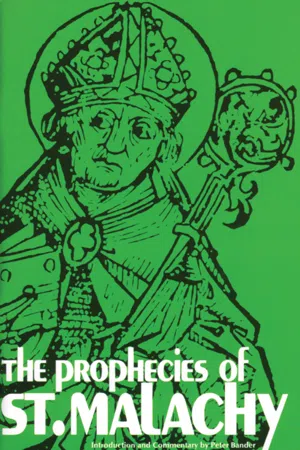
- 96 pages
- English
- ePUB (mobile friendly)
- Available on iOS & Android
eBook - ePub
The Prophecies of St. Malachy
About this book
Information
Topic
Theology & ReligionSubtopic
Christian DenominationsTHE PROPHECIES OF MALACHY
The prophecies of Malachy have almost come to an end; just three more popes and De medietate lunœ, De labore solis and Gloria Olivœ will have joined the other 108 pontiffs thus anticipated or prophesied by Malachy. For three more pontifical reigns to come, some people will speculate as to the possible identity of the next pope and, after each conclave the interpreters will have a field day. The Benedictine historian Arnold Wion was the first to mention these prophecies in his book Lignum Vitœ, published in 1559. With the briefest of introductions he inserted them after an equally brief summary of St Malachy's life. Since then a never ending controversy about the authenticity and authorship of the prophecies has led to many new editions and publications of the same, each trying to prove the author's personal belief. In the seventeenth century Father Menestrier, a famous Jesuit, put forward his hypothesis that these prophecies had originated in 1590 during the conclave which resulted in Gregory XIV becoming the elected pontiff. Fr. Menestrier goes as far as naming the forger; a member of Cardinal Simoncelli's party is supposed to have forged these prophecies in order to influence the electors in favour of his Cardinal who was the doyen of the Sacred College and, by virtue of his office and other qualities, surely a favourite for the pontificate. Cardinal Simoncelli was Bishop of Orvieto, his birthplace, and the motto given to him in the prophecies, Ex antiquitate urbis, is simply an allusion to Orvieto (Latin: Urbs vetus). Perhaps it is fair to add that Fr. Menestrier does not furnish us with evidence to substantiate his accusation. In 1871 Abbé Cucherat put forward his hypothesis; Malachy had his visions between the end of 1139 and the beginning of 1140 during his visit to Rome. He committed the visions to paper and handed the manuscript to Pope Innocent II to comfort the Holy Father in his afflictions. Innocent II placed the manuscript in the archives where they remained unread for nearly four centuries. Unfortunately Abbé Cucherat does not supply his evidence either. If we were to place the works of those who have repudiated the Prophecies of Malachy on scales and balance them against those who have accepted them, we would probably reach a fair equilibrium; however, the most important factor, namely the popularity of the prophecies, particularly among the ordinary people (as distinct from scholars), makes them as relevant to the second half of the twentieth century as they have ever been. St Malachy's family name was O'Morgair and he was born in Armagh, Ireland, in 1094, almost one thousand years ago. He was baptised in Maelmhaedhoc (this name has been Latinized as Malachy) and he studied under Imhar O'Hagan who later became the Abbot of Armagh. In 1119 he was ordained priest by St Cellach (Celsus), studied under St Malchus and in 1123 he was elected Abbot of Bangor. His spectacular career had not ended; a year later he was consecrated Bishop of Connor and in 1132 he became Primate of Armagh. However, owing to intrigues, he had to wait two years before he could finally take posesssion of the See of Armagh; even then he had to purchase the Bachal Isu (staff of Jesus) from Niall, the usurping lay-primate. He died in 1148 at Clairvaux in the arms of St Bernard.
Unlike the life of many saints, that of St Malachy is well documented because his contemporary, St Bernard of Clairvaux, acted as his biographer at the request of the Abbot of Mellifont.
St Bernard describes Malachy as distinguished for his meekness, humility, obedience, modesty and as truly diligent in his studies. He also tells us at length of Malachy foretelling the day and hour of his death. The Breviary in its office for the festival of St Malachy mentions that he was enriched with the gift of prophecy.
The interested reader who wishes to study the life of St Malachy in greater depth and detail may wish to read any of the numerous life stories which have been written. In the second half of the last century Malachy's prophecies concerning the popes were widely read and studied in Ireland; it is therefore not surprising to find some detailed accounts of the Saint's life written in those years.
Since St Malachy left his prophecies concerning the popes of the Catholic Church behind, some 900 years ago, there have been many interpreters and probably as many critics who have in their own way tried to make these prophecies palatable to the reader or denounce them as forgeries.
Two objections to the prophecies most critics have in common are first, the silence of St Bernard on the subject, and secondly the tortuous methods employed by some of Malachy's interpreters in applying the various prophecies to certain popes.
The fact that St Bernard of Clairvaux does not refer to the prophecies and catalogue them among Malachy's other writings simply confirms to me that his character assessment of the Saint which describes Malachy as humble, meek and modest, was true to form.
Bearing in mind the nature of Malachy's prophecies, one sees soon that they do not conform to the pattern of Old and New Testament prophecies; they are not warnings of imminent dangers or threats to mankind; they do not point to any actual disaster (not really, because the destruction of Rome is 112 Popes ahead of his time!). There is no guidance, just a monotonous litany of Latin words or phrases, each symbolising a successive pope.
The second criticism against Malachy's vision concerns the tortuous methods adopted by some interpreters in applying them to some of the Popes. In the case of Clement XI (1700-1721) to whom Malachy had given the motto Flores circumdati (surrounded with flowers), his followers even struck a medal during his reign which bore this motto. After all, Malachy's prophecies have been publicly known since 1559 and it is reasonable to assume that those who designed the medal knew of them.
However, it is fair to say that the vast majority of Malachy's predictions about successive Popes is amazingly accurate — always remembering that he gives only a minimum of information.
The first three pontiffs mentioned in his vision, Ex castro Tiberis, Inimicus expulsus and Ex magnitudine montis were Celestine II, Lucius II and Eugene III; their respective reigns, 1143-1144, 1144-1145 and 1145-1153 fell within the life time of Malachy.
Circumstantial evidence points, therefore, to a time before 1143 when Malachy had his visions. His visit to Pope Innocent II in 1139 appears to have resulted in unfulfilled requests; the Pope refused to grant Malachy permission to spend the remainder of his life at the monastery of Clairvaux; he promised to grant Malachy the Pallium for the diocese of Armagh and Tuam (a See lately erected by Celsus) but failed to keep his promise.
Perhaps it was Malachy's preoccupation with the Papacy, that sparked off his visions. Who knows? Perhaps he was given the privilege of seeing before him the long line of popes to come, the timelessness of his Church, the strife and struggle during the period of antipopes, until finally Petrus Romanus will reign and feed his flock amid tribulations.
Some interpreters have suggested that Malachy does not specifically mention that no other pope would reign between Gloria Olivœ (no. 111) and Petrus Romanus, who will be the last (given as no. 112); they suppose that Malachy just gave the next one thousand years and then mentioned the last pope to bring his prophecies to a conclusion. Far be it from me to join them in their speculations.
We have now reached Flos florum; Pope Paul VI has indeed Flos florum, the Fleur-de-Lis in his coat of arms. Out of 92 popes whose arms are published by the Vatican, Pope Paul VI is the thirteenth with such a bearing. In some cases there appears to be a discrepancy between the arms published by the Vatican and those given by Panvinio. Those coats of arms published by the Vatican and reproduced in this book are of course the papal crests; Panvinio tends to refer to the family coat of arms of the particular pope. These two are often quite different and bear no relation to one another. For example Clement IV, described by Malachy as Draco depressus (The dragon crushed) is given a coat of arms with six Fleurs-de-Lis; Panvinio describes his arms as an 'eagle clawing a dragon', which is almost tailor-made for the prophecy.
I have so far refused to be drawn into any speculation or interpretation; yet, in the course of my brief research on this fascinating subject I have pondered on one who is yet to come. I don't know whether it will be during my own life on earth, or if I will have my curiosity satisfied elsewhere. The Pope who will reign under the motto De labore solis arouses my special interest. In 1856 one interpreter, who signs himself 'a son of St Jarbath', is not quite sure how to translate this Latin legend. He cannot find any explanation if he were to translate it as '...
Table of contents
- Title Page
- Copyright Page
- CONTENTS
- FOREWORD
- PREFACE
- PUBLISHER'S PREFACE
- THE PROPHECIES OF MALACHY
Trusted by 375,005 students
Access to over 1.5 million titles for a fair monthly price.
Study more efficiently using our study tools.
Frequently asked questions
Yes, you can cancel anytime from the Subscription tab in your account settings on the Perlego website. Your subscription will stay active until the end of your current billing period. Learn how to cancel your subscription
No, books cannot be downloaded as external files, such as PDFs, for use outside of Perlego. However, you can download books within the Perlego app for offline reading on mobile or tablet. Learn how to download books offline
Perlego offers two plans: Essential and Complete
- Essential is ideal for learners and professionals who enjoy exploring a wide range of subjects. Access the Essential Library with 800,000+ trusted titles and best-sellers across business, personal growth, and the humanities. Includes unlimited reading time and Standard Read Aloud voice.
- Complete: Perfect for advanced learners and researchers needing full, unrestricted access. Unlock 1.5M+ books across hundreds of subjects, including academic and specialized titles. The Complete Plan also includes advanced features like Premium Read Aloud and Research Assistant.
We are an online textbook subscription service, where you can get access to an entire online library for less than the price of a single book per month. With over 1.5 million books across 990+ topics, we’ve got you covered! Learn about our mission
Look out for the read-aloud symbol on your next book to see if you can listen to it. The read-aloud tool reads text aloud for you, highlighting the text as it is being read. You can pause it, speed it up and slow it down. Learn more about Read Aloud
Yes! You can use the Perlego app on both iOS and Android devices to read anytime, anywhere — even offline. Perfect for commutes or when you’re on the go.
Please note we cannot support devices running on iOS 13 and Android 7 or earlier. Learn more about using the app
Please note we cannot support devices running on iOS 13 and Android 7 or earlier. Learn more about using the app
Yes, you can access The Prophecies of St. Malachy by Peter Bander in PDF and/or ePUB format, as well as other popular books in Theology & Religion & Christian Denominations. We have over 1.5 million books available in our catalogue for you to explore.