An easily understood though exhaustive study of the spiritual life that is full of learning and that quotes copiously from the Bible; Saints; Fathers and Doctors of the Church and classic spiritual writers. Embued with holiness; the author makes his work come alive with its simplicity and understanding. A veritable encyclopedia of what the Saints and other mystical souls have told us. Remarkably easy to read and to understand.
eBook - ePub
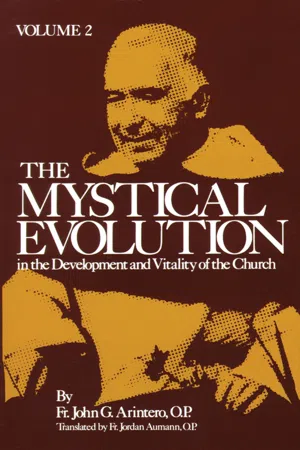
The Mystical Evolution In the Development and Vitality of the Church
Volume 2
- 876 pages
- English
- ePUB (mobile friendly)
- Available on iOS & Android
eBook - ePub
About this book
Information
Topic
Theology & ReligionSubtopic
Christian DenominationsPART TWO
THE MYSTICAL EVOLUTION OF THE INDIVIDUAL
CHAPTER I
General Process of Renewal and Deification

WE have seen what constitutes the divine life of grace which our Lord Jesus Christ brought us from heaven. We have seen the loftiest operations of this life and the various means of increasing it in each member of the Savior and in the whole mystical body of His Church.
We now come to study, as far as is possible, the marvelous history of the deification of the individual, or rather, the process of the growth of the divine germ of grace in each Christian soul. If we know the amplitude of grace, we shall be able to augment it as we ought, endeavoring with all our strength ultimately to remove the obstacles which impede it or render its working difficult and taking care that in critical periods we do not fail through carelessness or weakness. Continually growing in charity, we shall be able to contribute efficaciously to the formation of the mystical body as a whole.
Now that we know the gift of God, we are obliged to desire Him wholeheartedly and to beg incessantly that it be given to us to drink of the mysterious living water 1 which irrigates and makes fruitful the garden of our hearts.2 Now that we have found the hidden mystical treasure, we must prepare ourselves to exchange for it all the goods of this world.3 Since we have been enriched with the divine talents, it is our duty to cultivate them, to put them to good use, and to negotiate with them in order to make them increase both for the service of our Master and for the profit of our souls.4 For that reason, we must ask Him to give us prudence in all things and to fill us with His Spirit of wisdom by which we shall be able worthily to appreciate His gifts.5 In order to use these gifts well it is expedient that we know what is meant by "good traffic" and that we take care that our "lamp shall not be put out in the night."6
We must, then, study the process of development of the precious seed of divine grace and see what careful attention it requires in each particular instance. We must learn how to prepare and cultivate the field of our heart wherein this seed is sown. We must root out every kind of evil weed so that it will not suffocate the good plant of grace and we must cultivate it carefully so that it will grow prosperously.
SPIRITUAL RENEWAL AND MORTIFICATION
The entire process of the supernatural life consists in ridding ourselves of the old man with all his acts and clothing ourselves with the new.7 The old man is the fallen and degenerate Adam; the new man is Jesus Christ, Son of God and our Savior, the perfect man, the principle of our supernatural life and the restorer of humanity.8 The old man in us is nature vitiated by the sin of Adam and the countless defects which it has accumulated, leaving it so misshapen, so prone to evil, so assailed by wicked propensities, that it feels itself incapable of fulfilling even the natural law. The new man in us is nature regenerated, rectified, enriched, and reanimated by the Spirit of Jesus Christ.
Our spiritual progress consists in acquiring the most perfect purity of heart and the most complete submission and docility to the motions and influxes of the Holy Ghost which prompt and inspire us with the sentiments of our Savior and impress His divine image on us. If we do not resist Him by our indocility, nor choke and impede His action by the impurity of our worldly desires, He will renew the face of our earth and will transform us from glory to glory.
The ideal of the Christian, then, is to dispossess himself of self in order to reproduce the living image of the new man; to act in all things as a true son of God, living and working according to His Spirit and following His motion and direction without the least resistance. The Christian will manifest himself the more a true son of God as he is more animated by His Spirit.9
But to arrive at this true and glorious liberty of the sons of God, it is necessary to break the heavy chains of the evil inclinations which enslave us, to root out all vices and sinful habits, and to tame and restrain completely our rebellious and disordered passions. We must watch over the most hidden movements and sentiments of our hearts, rectify all that is crooked, resist all suggestions of evil, and smother the concupiscence of self-love, so that we shall have no other desires or interests than those of Jesus Christ.10 By lovingly uniting ourselves to Him in a perfect conformity of wills, we shall be transformed and made one with Him, living entirely in His Spirit.11 When the Spirit of our Lord reigns in us, we shall enjoy full and perfect liberty. Ubi Spiritus Domini, ibi libertas.12
From this we can understand how great and laborious must be our preparation for the way of the Lord 13 which leads to a most loving union with God and the perfect manifestation of His life within us.
He is purity itself and sanctity by His essence; He is absolute honesty and simplicity. But as for us, "from the sole of the foot unto the top of the head, there is no soundness therein."14 Everything in us is more or less stained by original sin, by hereditary vices which have been accumulated, and more especially by personal sins which, however light they may be, contaminate and pervert the soul.15
It is to be admitted that, as the physiologists say, with every vicious or disordered act, there is set up an "evil organization of neurons" and there is formed a "circuit" which tends automatically to reproduce itself later, even independent of the will. With the repetition of bad actions, those evil "organizations" are strengthened and they finally become hereditary. So it is that by the evil deeds of our progenitors, and more especially by our own evil acts, the ravages of original sin are aggravated and the wave of evil is strengthened and increased.16 However light many of those acts may seem, when considered as having accumulated their effects for thousands of years, we can understand how true it is that there is nothing healthy in us. Disorderly tendencies have been rooted in the very depths of our being and there is not in our whole organism the smallest sensitive or motor element which is not in some way contaminated. Moreover, the vices of the body extend beyond the body itself and are felt in the very potencies of the soul, if, indeed, they are not already rooted in those potencies, as happens in the case of voluntary faults.
It is necessary to exercise extreme violence in order to purify, simplify, and sanctify our entire being and to renew and direct that complicated maze according to the simple divine norms by which the senses and appetites are subject to reason and this, in turn, to the divine Spirit so that our union with God is perfect. Only in this way can our being be rectified, corrected, and brought back to its normal status, to a position where it can be enriched and transformed.
This mortification is not a killing, but a healing; a rectification and a renewal. If our nature were completely healthy and well balanced, it would spontaneously submit to the superior norm which ennobles it, just as all the physical energies in a perfect organism are subjected to the plan of life: organic life to sensitive life, and this latter to rational life. But when there is an imperfection of any kind, the inferior powers readily become insubordinate and instead of the relative autonomy which they enjoy, they tend to absolute sovereignty and even tyranny. Therefore it is necessary to keep these lower powers in subjection so that they will observe right order.
Whenever the inferior appetites of a man become insubordinate and act contrary to reason (and this usually occurs by the very fact that reason itself seeks to be completely autonomous), then that man must do violence to himself and even to reason itself, by submitting it to faith,17 so that in all things the Spirit of God may reign anew.18
The rationalists, although they call themselves reformed Christians, do not understand the privation and violence done to nature, for they live in a dream world of pure naturalism. As a result, they seek always to justify human nature as if it possessed the same integrity now as it did when it first came forth from the hand of God. But if they would even slightly examine human nature as we now possess it, they would find in it innumerable disorderly and uncontrolled tendencies which are more animal than human. They would then learn the necessity of self-violence if a man is to live not only as a Christian but even as a true man.19
If these unlawful tendencies were subjected to reason, then reason itself, which is made to feel its weakness, deficiency, and irregularity in many things, would, for its own good, cease to aspire to a chimerical and destructive independence and would joyfully accept the infallible norms of the supreme Reason. As it approached to God and became more and more enlightened, it would discover in itself thousands of other imperfections and impurities of which it was not aware formerly. It would realize that, short of absolute sanctity, no creature is sufficiently pure. It would see the necessity for God to purify reason with the fire of His power and to fortify it with the strength of His Spirit of renewal. Therefore nature as it is in itself, cannot be canonized.
That to which we do violence in our nature is not the basically good structure which came from the hands of God, but those disorderly tendencies which have been connaturalized by human faults. Once these tendencies are under control, the natural life is purified to such an extent that it can be developed without offering any resistance to the Spirit and without impeding the growth of the supernatural life. We do not seek to destroy or bury the natural gifts which we have received from God, but we do seek to restore them to their primitive purity so that they may be better developed at the same time that, transformed by grace, they are raised to a divine order to produce fruits of life eternal.20
The first step that we must take in our renewal is that of doing violence to ourselves in order to renounce all disordered tastes and appetites. We must subject and mortify our senses so that they will not lead us to evil, and we must castigate our body and reduce it to submission so that it will not covet anything contrary to the spirit. In this way alone can we truly begin the spiritual way.
This continual mortification, so despised and disdained by worldly persons today and little appreciated by those who presume to be spiritual but believe that by mortification they are acting contrary to life, is absolutely indispensable if we are to reform and correct ourselves. In order to root out our evil habits and disordered inclinations, in order to purify and reintegrate our nature so that it may live healthily as God created it and not be vitiated as it is through sin, mortification is of prime importance. This self-violence will completely choke the seed of evil so that it cannot fructify and thus smother the good. By destroying the seed of concupiscence, it will free us from the slavery of sin.21 Mortification cultivates the soil of our heart so that the divine seed grows therein without hindrance and produces abundant fruit. Finally, mortification controls and subjugates our bodies with all their sensitive faculties so that they resist not, but are obedient to reason, and reason itself is so directed that it is entirely submissive to the Spirit.
Only thus shall we avoid saddening the Holy Ghost who dwells in us. We shall, rather, obey Him in all things and cooperate with His every operation and all His loving inspirations until we have been totally renewed. Far from perishing because of mortification, our nature will become revivified in health and purity and enriched with grace. For God does not wish to kill us, but to vivify us. He desires not the death of the sinner, but that he should be converted and live. It was for that reason that He sent His Son "to seek and save that which was lost."22 Although mortification outwardly appears painful and bitter, actually it is joyful, consoling, delightful, and filled with ineffable delights.
It matters little that the worldly and the carnal do not understand these things nor wish to understand them. Those who are spiritual understand them very well. The presumptuous wisdom of the worldly ones is pure stupidity and is inimical to God, for it is impossible to please God by living according to the flesh. Carnal prudence is death, but that of the Spirit is life and peace. Therefore, if we live according to the flesh, we shall surely die; but if, in obedience to the Spirit, we mortify the inclinations of the flesh, we shall live.23
This, indeed, is the teaching of St. Paul in his Epistle to the Romans, when he writes:
For they that are according to the flesh, mind the things that are of the flesh; but they that are according to the spirit, mind the things that are of the spirit. For the wisdom of the flesh is death; but the wisdom of the Spirit is life and peace. Because the wisdom of the flesh is an enemy to God; for it is not subject to the law of God, neither can it be. And they who are in the flesh, cannot please God. But you are not in the flesh, but in the Spirit, if so be that the Spirit of God dwell in you. Now if any man have not the Spirit of Christ, he is none of His. And if Christ be in you, the body indeed is dead, because of sin; but the spirit liveth, because of justification. And if the Spirit of him that raised up Jesus from the dead, dwell in you; He that raised up Jesus Christ from the dead, shall quicken also your mortal bodies, because of His Spirit that dwelleth in you.24
To cure a corporal infirmity, doctors prescribe diets and purges and distasteful medicines and even the use of iron and fire. So also "he that loveth his life shall lose it, and he that hateth his life in this world, keepeth it unto life eternal," for, "unless the grain of wheat falling into the ground die, itself remaineth alone. But if it die, it bringeth forth much fruit."25
If mortif...
Table of contents
- Title Page
- Copyright Page
- Contents
- PART II THE MYSTICAL EVOLUTION OF THE INDIVIDUAL
- PART III MYSTICAL EVOLUTION OF THE ENTIRE CHURCH
Trusted by 375,005 students
Access to over 1.5 million titles for a fair monthly price.
Study more efficiently using our study tools.
Frequently asked questions
Yes, you can cancel anytime from the Subscription tab in your account settings on the Perlego website. Your subscription will stay active until the end of your current billing period. Learn how to cancel your subscription
No, books cannot be downloaded as external files, such as PDFs, for use outside of Perlego. However, you can download books within the Perlego app for offline reading on mobile or tablet. Learn how to download books offline
We are an online textbook subscription service, where you can get access to an entire online library for less than the price of a single book per month. With over 1.5 million books across 990+ topics, we’ve got you covered! Learn about our mission
Look out for the read-aloud symbol on your next book to see if you can listen to it. The read-aloud tool reads text aloud for you, highlighting the text as it is being read. You can pause it, speed it up and slow it down. Learn more about Read Aloud
Yes! You can use the Perlego app on both iOS and Android devices to read anytime, anywhere — even offline. Perfect for commutes or when you’re on the go.
Please note we cannot support devices running on iOS 13 and Android 7 or earlier. Learn more about using the app
Please note we cannot support devices running on iOS 13 and Android 7 or earlier. Learn more about using the app
Yes, you can access The Mystical Evolution In the Development and Vitality of the Church by John G. Arintero in PDF and/or ePUB format, as well as other popular books in Theology & Religion & Christian Denominations. We have over 1.5 million books available in our catalogue for you to explore.