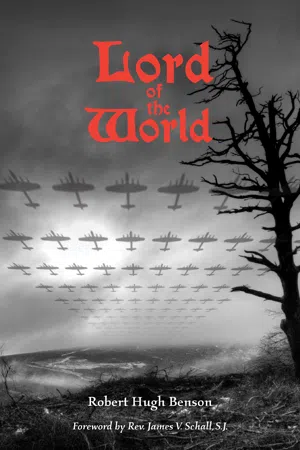
It is a world seemingly without conflict. There are no battles, no religion. Imagine!And yet, all is not well. There is a war going on. The godlessness of the world, disguised in comfortable Humanism, gnaws at the minds and souls of the people. Euthanasia is rampant, a way to escape a sterile and meaningless world. Only the ghettoized, underground Catholic Church and its few remaining adherents struggle to keep Christianity alive.Pushed to the edges of society, their biggest and most important conflict comes in the form of Julian Felsenburgh, the leader of the new world order... and an Anti-Christ.It is left to Father Percy Franklin and the small band of remaining Catholics to fight this, perhaps, final battle of Good vs. Evil; Christ vs. Anti-Christ.Written more than 100 years ago, Lord of the World remains just as profound today as it did when it was first published.
- 292 pages
- English
- ePUB (mobile friendly)
- Available on iOS & Android
eBook - ePub
Lord of the World
About this book
Information
Topic
Teologia e religioneSubtopic
Denominazioni cristianeBOOK II—THE ENCOUNTER
CHAPTER I
I
OLIVER BRAND was seated at his desk, on the evening of the next day, reading the leading article of the New People, evening edition.
“We have had time,” he read, “to recover ourselves a little from the intoxication of last night. Before embarking on prophecy, it will be as well to recall the facts. Up to yesterday evening our anxiety with regard to the Eastern crisis continued; and when twenty-one o’clock struck there were not more than forty persons in London—the English delegates, that is to say—who knew positively that the danger was over. Between that moment and half-an-hour later the Government took a few discreet steps: a select number of persons were informed; the police were called out, with half-a-dozen regiments, to preserve order; Paul’s House was cleared; the railroad companies were warned; and at the half hour precisely the announcement was made by means of electric placards in every quarter of London, as well as in all large provincial towns. We have not space now to adequately describe the admirable manner in which the public authorities did their duty; it is enough to say that not more than seventy fatalities took place in the whole of London; nor is it our business to criticise the action of the Government, in choosing this mode of making the announcement.
“By twenty-two o’clock Paul’s House was filled in every corner, the Old Choir was reserved for members of Parliament and public officials, the quarter-dome galleries were filled with ladies, and to the rest of the floor the public was freely admitted. The volor-police also inform us now that for about the distance of one mile in every direction round this centre every thoroughfare was blocked with pedestrians, and, two hours later, as we all know, practically all the main streets of the whole of London were in the same condition.
“It was an excellent choice by which Mr. OLIVER BRAND was selected as the first speaker. His arm was still in bandages; and the appeal of his figure as well as his passionate words struck the first explicit note of the evening. A report of his words will be found in another column. In their turns, the PRIME MINISTER, Mr. SNOWFORD, the FIRST MINISTER OF THE ADMIRALTY, the SECRETARY FOR EASTERN AFFAIRS, and LORD PEMBERTON, all spoke a few words, corroborating the extraordinary news. At a quarter before twenty-three, the noise of cheering outside announced the arrival of the American delegates from Paris, and one by one these ascended the platform by the south gates of the Old Choir. Each spoke in turn. It is impossible to appreciate words spoken at such a moment as this; but perhaps it is not invidious to name Mr. MARKHAM as the orator who above all others appealed to those who were privileged to hear him. It was he, too, who told us explicitly what others had merely mentioned, to the effect that the success of the American efforts was entirely due to Mr. JULIAN FELSENBURGH. As yet Mr. FELSENBURGH had not arrived; but in answer to a roar of inquiry, Mr. MARKHAM announced that this gentleman would be amongst them in a few minutes. He then proceeded to describe to us, so far as was possible in a few sentences, the methods by which Mr. FELSENBURGH had accomplished what is probably the most astonishing task known to history. It seems from his words that Mr. FELSENBURGH (whose biography, so far as it is known, we give in another column) is probably the greatest orator that the world has ever known—we use these words deliberately. All languages seem the same to him; he delivered speeches during the eight months through which the Eastern Convention lasted, in no less than fifteen tongues. Of his manner in speaking we shall have a few remarks to make presently. He showed also, Mr. MARKHAM told us, the most astonishing knowledge, not only of human nature, but of every trait under which that divine thing manifests itself. He appeared acquainted with the history, the prejudices, the fears, the hopes, the expectations of all the innumerable sects and castes of the East to whom it was his business to speak. In fact, as Mr. MARKHAM said, he is probably the first perfect product of that new cosmopolitan creation to which the world has laboured throughout its history. In no less than nine places—Damascus, Irkutsk, Constantinople, Calcutta, Benares, Nanking, among them—he was hailed as Messiah by a Mohammedan mob. Finally, in America, where this extraordinary figure has arisen, all speak well of him. He has been guilty of none of those crimes—there is not one that convicts him of sin—those crimes of the Yellow Press, of corruption, of commercial or political bullying which have so stained the past of all those old politicians who made the sister continent what she has become. Mr. FELSENBURGH has not even formed a party. He, and not his underlings, have conquered. Those who were present in Paul’s House on this occasion will understand us when we say that the effect of those words was indescribable.
“When Mr. MARKHAM sat down, there was a silence; then in order to quiet the rising excitement, the organist struck the first chords of the Masonic Hymn; the words were taken up, and presently not only the whole interior of the building rang with it, but outside, too, the people responded, and the city of London for a few moments became indeed a temple of the Lord.
“Now indeed we come to the most difficult part of our task, and it is better to confess at once that anything resembling journalistic descriptiveness must be resolutely laid aside. The greatest things are best told in the simplest words.
“Towards the close of the fourth verse, a figure in a plain dark suit was observed ascending the steps of the platform. For a moment this attracted no attention, but when it was seen that a sudden movement had broken out among the delegates, the singing began to falter; and it ceased altogether as the figure, after a slight inclination to right and left, passed up the further steps that led to the rostrum. Then occurred a curious incident. The organist aloft at first did not seem to understand, and continued playing, but a sound broke out from the crowd resembling a kind of groan, and instantly he ceased. But no cheering followed. Instead a profound silence dominated in an instant the huge throng; this, by some strange magnetism, communicated itself to those without the building, and when Mr. FELSENBURGH uttered his first words, it was in a stillness that was like a living thing. We leave the explanation of this phenomenon to the expert in psychology.
“Of his actual words we have nothing to say. So far as we are aware no reporter made notes at the moment; but the speech, delivered in Esperanto, was a very simple one, and very short. It consisted of a brief announcement of the great fact of Universal Brotherhood, a congratulation to all who were yet alive to witness this consummation of history; and, at the end, an ascription of praise to that Spirit of the World whose incarnation was now accomplished.
“So much we can say; but we can say nothing as to the impression of the personality who stood there. In appearance the man seemed to be about thirty-three years of age, cleanshaven, upright, with white hair and dark eyes and brows; he stood motionless with his hands on the rail, he made but one gesture that drew a kind of sob from the crowd, he spoke these words slowly, distinctly, and in a clear voice; then he stood waiting.
“There was no response but a sigh which sounded in the ears of at least one who heard it as if the whole world drew breath for the first time; and then that strange heart-shaking silence fell again. Many were weeping silently, the lips of thousands moved without a sound, and all faces were turned to that simple figure, as if the hope of every soul were centred there. So, if we may believe it, the eyes of many, centuries ago, were turned on one known now to history as JESUS OF NAZARETH.
“Mr. FELSENBURGH stood so a moment longer, then he turned down the steps, passed across the platform and disappeared.
“Of what took place outside we have received the following account from an eye-witness. The white volor, so well known now to all who were in London that night, had remained stationary outside the little south door of the Old Choir aisle, poised about twenty feet above the ground. Gradually it became known to the crowd, in those few minutes, who it was who had arrived in it, and upon Mr. FELSENBURGH’S reappearance that same strange groan sounded through the whole length of Paul’s Churchyard, followed by the same silence. The volor descended; the master stepped on board, and once more the vessel rose to a height of twenty feet. It was thought at first that some speech would be made, but none was necessary; and after a moment’s pause, the volor began that wonderful parade which London will never forget. Four times during the night Mr. FELSENBURGH went round the enormous metropolis, speaking no word; and everywhere the groan preceded and followed him, while silence accompanied his actual passage. Two hours after sunrise the white ship rose over Hampstead and disappeared towards the North; and since then he, whom we call, in truth, the Saviour of the world, has not been seen.
“And now what remains to be said?
“Comment is useless. It is enough to say in one short sentence that the new era has begun, to which prophets and kings, and the suffering, the dying, all who labour and are heavy-laden, have aspired in vain. Not only has intercontinental rivalry ceased to exist, but the strife of home dissensions has ceased also. Of him who has been the herald of its inauguration we have nothing more to say. Time alone can show what is yet left for him to do.
“But what has been done is as follows. The Eastern peril has been for ever dissipated. It is understood now, by fanatic barbarians as well as by civilized nations, that the reign of War is ended. ‘Not peace but a sword,’ said CHRIST; and bitterly true have those words proved to be. ‘Not a sword but peace’ is the retort, articulate at last, from those who have renounced CHRIST’S claims or have never accepted them. The principle of love and union learned however falteringly in the West during the last century, has been taken up in the East as well. There shall be no more an appeal to arms, but to justice; no longer a crying after a God Who hides Himself, but to Man who has learned his own Divinity. The Supernatural is dead; rather, we know now that it never yet has been alive. What remains is to work out this new lesson, to bring every action, word and thought to the bar of Love and Justice; and this will be, no doubt, the task of years. Every code must be reversed; every barrier thrown down; party must unite with party, country with country, and continent with continent. There is no longer the fear of fear, the dread of the page hereafter, or the paralysis of strife. Man has groaned long enough in the travails of birth; his blood has been poured out like water through his own foolishness; but at length he understands himself and is at peace.
“Let it be seen at least that England is not behind the nations in this work of reformation; let no national isolation, pride of race, or drunkenness of wealth hold her hands back from this enormous work. The responsibility is incalculable, but the victory certain. Let us go softly, humbled by the knowledge of our crimes in the past, confident in the hope of our achievements in the future, towards that reward which is in sight at last—the reward hidden so long by the selfishness of men, the darkness of religion, and the strife of tongues—the reward promised by one who knew not what he said and denied what he asserted—Blessed are the meek, the peacemakers, the merciful, for they shall inherit the earth, be named the children of God, and find mercy.”
Oliver, white to the lips, with his wife kneeling now beside him, turned the page and read one more short paragraph, marked as being the latest news.
“It is understood that the Government is in communication with Mr. Felsenburgh.”
II
“Ah! it is journalese,” said Oliver, at last, leaning back. “Tawdry stuff! But—but the thing!”
Mabel got up, passed across to the window-seat, and sat down. Her lips opened once or twice, but she said nothing.
“My darling,” cried the man, “have you nothing to say?”
She looked at him tremulously a moment.
“Say!” she said. “As you said, what is the use of words?”
“Tell me again,” said Oliver. “How do I know it is not a dream?”
“A dream,” she said. “Was there ever a dream like this?”
Again she got up restlessly, came across the floor, and knelt down by her husband once more, taking his hands in hers.
“My dear,” she said, “I tell you it is not a dream. It is reality at last. I was there too—do you not remember? You waited for me when all was over—when He was gone out—we saw Him together, you and I. We heard Him—you on the platform and I in the gallery. We saw Him again pass up the Embankment as we stood in the crowd. Then we came home—and we found the priest.”
Her face was transfigured as she spoke. It was as of one who saw a Divine Vision. She spoke very quietly, without excitement or hysteria. Oliver stared at her a moment; then he bent forward and kissed her gently.
“Yes, my darling; it is true. But I want to hear it again and again. Tell me again what you saw.”
“I saw the Son of Man,” she said. “Oh! there is no other phrase. The Saviour of the world, as that paper says. I knew Him in my heart as soon as I saw Him—as we all did—as soon as He stood there holding the rail. It was like a glory round his head. I understand it all now. It was He for whom we have waited so long; and He has come, bringing Peace and Goodwill in His hands. When He spoke, I knew it again. His voice was as—as the sound of the sea—as simple as that—as—as lamentable—as strong as that.—Did you not hear it?”
Oliver bowed his head.
“I can trust Him for all the rest,” went on the girl softly. “I do not know where He is, nor when He will come back, nor what He will do. I suppose there is a great deal for Him to do, before He is fully known—laws, reforms—that will be your business, my dear. And the rest of us must wait, and love, and be content.”
Oliver again lifted his face and looked at her.
“Mabel, my dear——”
“Oh! I knew it even last night,” she said, “but I did not know that I knew it till I awoke to-day and remembered. I dreamed of Him all night.… Oliver, where is He?”
He shook his head.
“Yes, I know where He is, but I am under oath——”
She nodded quickly, and stood up.
“Yes. I should not have asked that. Well, we are content to wait.”
There was silence for a moment or two. Oliver broke it.
“My dear, what do you mean when you say that He is not yet known?”
“I mean just that,” she said. “The rest only know what He has done—not what He is; but that, too, will come in time.”
“And meanwhile——”
“Meanwhile, you must work; the rest will come by and bye. Oh! Oliver, be strong and faithful.”
She kissed him quickly, and went out.
Oliver sat on without moving, staring, as his habit was, out at the wide view beyond his windows. This time yesterday he was leaving Paris, knowing the fact indeed—for the delegates had arrived an hour before—but ignorant of the Man. Now he knew the Man as well—at least he had seen Him, heard Him, and stood enchanted under the glow of His personality. He could explain it to himself no more than could any one else—unless, perhaps, it were Mabel. The others had been as he had been: awed and overcome, yet at the same time kindled in the very depths of their souls. They had come out—Snowford, Cartwright, Pemberton, and the rest—on to the steps of Paul’s House, following that strange figure. They had intended to say something, but they were dumb as they saw the sea of white faces, heard the groan and the silence, and experienced that compelling wave of magnetism that surged up like something physical, as the volor rose and started on that indescribable progress.
Once more he had seen Him, as he and Mabel stood together on the deck of the electric boat that carried them south. The white ship had passed along overhead, smooth and steady, above the heads of that vast multitude, bearing Him who, if any had the right to that title, was indeed the Saviour of the world. Then they had come home, and found the priest.
That, too, had been a shock to him; for, at first sight, it seemed that this priest was the very man he had seen ascend th...
Table of contents
- Cover Page
- Halftitle Page
- Title Page
- Copyright Page
- Dedication
- Contents
- Foreword
- Preface
- Prologue
- Book I—The Advent
- Book II—The Encounter
- Book III—The Victory
- About the Author
Trusted by 375,005 students
Access to over 1.5 million titles for a fair monthly price.
Study more efficiently using our study tools.
Frequently asked questions
Yes, you can cancel anytime from the Subscription tab in your account settings on the Perlego website. Your subscription will stay active until the end of your current billing period. Learn how to cancel your subscription
No, books cannot be downloaded as external files, such as PDFs, for use outside of Perlego. However, you can download books within the Perlego app for offline reading on mobile or tablet. Learn how to download books offline
Perlego offers two plans: Essential and Complete
- Essential is ideal for learners and professionals who enjoy exploring a wide range of subjects. Access the Essential Library with 800,000+ trusted titles and best-sellers across business, personal growth, and the humanities. Includes unlimited reading time and Standard Read Aloud voice.
- Complete: Perfect for advanced learners and researchers needing full, unrestricted access. Unlock 1.5M+ books across hundreds of subjects, including academic and specialized titles. The Complete Plan also includes advanced features like Premium Read Aloud and Research Assistant.
We are an online textbook subscription service, where you can get access to an entire online library for less than the price of a single book per month. With over 1.5 million books across 990+ topics, we’ve got you covered! Learn about our mission
Look out for the read-aloud symbol on your next book to see if you can listen to it. The read-aloud tool reads text aloud for you, highlighting the text as it is being read. You can pause it, speed it up and slow it down. Learn more about Read Aloud
Yes! You can use the Perlego app on both iOS and Android devices to read anytime, anywhere — even offline. Perfect for commutes or when you’re on the go.
Please note we cannot support devices running on iOS 13 and Android 7 or earlier. Learn more about using the app
Please note we cannot support devices running on iOS 13 and Android 7 or earlier. Learn more about using the app
Yes, you can access Lord of the World by Robert Hugh Benson in PDF and/or ePUB format, as well as other popular books in Teologia e religione & Denominazioni cristiane. We have over 1.5 million books available in our catalogue for you to explore.