What exactly is Tradition? This is the only book we know on the subject. Published in 1928 by a priest with three doctors' degrees, this book exposes all aspects of Tradition, so that once a person has read this book, he will never question the nature of Tradition again. Every priest, bishop and cardinal, every seminarian and everyone who considers himself to be an informed Catholic should also read this providential book---which is reappearing at a crucial time in the history of the Church, to help clarify our understanding about the nature of the Deposit of Faith and how we should all revere and cherish the Tradition of the Church!
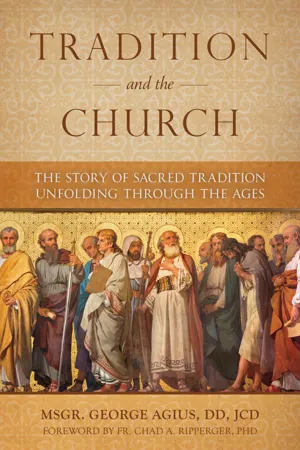
- 327 pages
- English
- ePUB (mobile friendly)
- Available on iOS & Android
eBook - ePub
Tradition And The Church
About this book
Information
Topic
Theology & ReligionSubtopic
Christian Denominations

General Notions of Tradition
1
Tradition Means Whatever is Delivered, as well As the Way and Means by Which the Object Delivered Came to Us.
THE proper source of Revelation is the word of God, which is both written and unwritten. The written is contained in Scripture; the unwritten in Tradition.
When we speak of the unwritten word of God, we do not mean that it has never been written, but that it was never written by the man to whom God revealed it. It was committed to writing afterwards by his disciples, or by others who heard it from his lips.
The word Tradition, considered in its object, means whatever is delivered or transmitted; in this sense it is called objective Tradition. If we consider, however, the act, or the way and the means by which an object is propagated and transmitted, this is called active Tradition. This active Tradition includes of necessity the object delivered to us. Likewise, the object of Tradition supposes an active Tradition, without which it could not have reached us.
We must always, therefore, take Tradition in its composite sense, that is, as made up of two parts—the act of transmission and the thing being transmitted. A tradition considered in its object loses its value without the Active Tradition that delivers it. We can neither explain nor understand a tradition without knowing the source, the act, the way and the means through which it has reached us.
In the following pages, therefore, Tradition must always be understood to mean not only the doctrine accepted, or the custom that prevailed in Apostolic times, but also the way or the means by which that doctrine or custom has come down to us.
To give an instance, Scripture does not state on what day Jesus Christ was born. But an old Tradition tells us that the Son of God, as man, was born on the 25th of December. Behold the object of a tradition. The Church accepted and set that date for its celebration. Christians—in obedience to the Church—have observed it every year since Christ ascended into Heaven. Behold the active Tradition. These are the two elements: The belief that Christ was born December 25; the teaching Church that set that date for its celebration.
The observance of Lent, the Friday abstinence, the celebration of Sunday instead of Saturday . . . on these Scripture is for the most part silent. But Tradition tells us they were observed in Apostolic times. The Church approved of them and transmitted them from generation to generation to the present day. The Apostles did not write of them. Why should they? They were taken as a matter of course. Some of the early Christians, disciples of the Apostles, or in turn, of their disciples, wrote of them to inculcate in the Christians of their day what the Apostles had taught and preached. The same applies to other disciplines and doctrines that had not been written, but were believed and practiced.
Therefore, whenever we speak of Tradition in general, we always mean this "Complex Tradition"—the object with its manner of transmission, namely, the Church, which gives it value and authority. They both go together, as philosophers say, like matter and form. It is in this sense that the Council of Trent understood and considered Tradition. It solemnly declared: "All revealed doctrine and discipline is also contained in the unwritten Traditions, which, having been received by the Apostles from the mouth of Christ Himself, or through the dictation of the Holy Ghost by the same Apostles, reached us as if they were handed to us" . . . "the same Traditions, which belong to the Faith and discipline, kept by a continued succession in the Church, we accept and venerate with a likewise affection and reverence."1
2
Traditions, Not Being All of the Same Kind Have a Different Value and Authority.
Traditions are not all of the same kind; hence, they cannot have the same value or authority. We distinguish them, first of all, by the manner in which they are transmitted. Some of them had been originally written; others came to us orally, from father to son; or in a practical way, as through the ceremonies of the Church for instance. For this reason, Traditions are either written, oral or practical. Some Traditions are called Written Traditions because the word Tradition may be taken in its widest signification, to include whatever has been delivered to us. In this sense, even the Scriptures may be called Traditions. This point, however, will be further discussed later on.
Secondly, Traditions are distinguished by the objects they convey, dogmatic or disciplinary, according to whether they refer to a fundamental doctrine of the Church, or to some rule or law to be observed by Christians. The doctrines of the Immaculate Conception and of the Assumption of the Blessed Virgin Mary into Heaven are Dogmatic Traditions. That Mary was conceived without Original Sin, in view of the merits of her Divine Son has always been believed by the Faithful, even before its solemn proclamation [in 1854] by the Church. So, too, the doctrine of the Assumption. We hope that the time is fast approaching when this touching tradition about the Mother of God will be solemnly declared and proclaimed as a Dogma of the Infallible Church.*
Some of the Disciplinary Traditions are so old that we have no record whatever of the time when they were first introduced. Such are Lent, the mixing of water with wine in the Eucharistic celebration, and the Baptism of infants.
Traditions are also characterized by their duration—some have remained in vigor to the present day. Others were short-lived. They did not stand the test of time. The belief in the Millennium is a case in point.
Certain traditions are found everywhere, whereas others are only in certain localities. For this reason, some are universal, and others local. It is evident that the Universal Tradition is more important than the local. Universality is a mark of truth.
There are Traditions which impose obligations, as for instance, abstinence. Others are simply counsels or recommendations, as for instance, the vow of poverty. Hence the distinction of preceptive or advisory traditions.
Traditions may be either constitutive or inhesive. The former [Constitutive Tradition] constitutes a doctrine by itself, which is nowhere found in Scripture; the latter [Inhesive Tradition] speaks of a doctrine that is found in Scripture. It is well-known that the Holy Eucharist is clearly described in Scripture. Still, the same Sacrament is also very well-illustrated in other traditions, especially, in The Doctrine of the Twelve Apostles [the Didache, also called The Teaching of the Twelve Apostles], a work which scholars do not place later than the year 80 A.D. Such tradition is called inhesive.
Finally, Traditions are either divine or ecclesiastical. As this distinction is particularly important, we shall discuss it now.
3
Traditions are Either Divine or Ecclesiastical.
Traditions are Divine or Ecclesiastical, as they originate either from God or from the Church.
I. Divine traditions belong generally to the Faith; Ecclesiastical, to discipline. Divine Traditions have God as their immediate cause and author. In the New Testament, the first visible promulgator was God Himself, in the person of Jesus Christ, or the Holy Ghost, who spoke through the Apostles. These Traditions are called Dominical—from the Latin word Dominus, or Lord—if they were first revealed by Christ Himself; they are called Divine-Apostolic, if revealed by the Holy Ghost through the Apostles. They all consist of dogmatic truths, commandments and institutions which God directly revealed or instituted for man.
This distinction evidently supposes that not all Revelation was completed by Christ while He dwelt among us, but that it found its completion with the death of the Apostles. After Christ's Ascension into Heaven, the Holy Ghost came down upon the Apostles, instructed and taught them, not only whatever Christ had said to them, but also all those truths which they neither heard nor knew before, nor could they understand while they lived with Christ. "But the Paraclete, the Holy Ghost, whom the Father will send in my name, he will teach you all things and bring all things to your mind, whatsoever I shall have said to you." (John 14:26). "I have yet many things to say to you, but you cannot bear them now. But when he, the Spirit of Truth, is come, he will teach you all truth. For he shall not speak of himself; but what things soever he shall hear, he shall speak; and the things that are to come, he shall show you." (John 16:12-13).
This distinction between Divine and Divine-Apostolic Traditions the [First] Vatican Council [1869-1870] indicates in the Constitution Dei Filius. "This supernatural revelation, according to the Faith of the Universal Church, declared by the Council of Trent, is contained in the written books and in the non-written Traditions, which, being received by the Apostles from the mouth of Christ, or through the dictation of the Holy Ghost, as if delivered by hand, came to us."2 As far as their origin is concerned, there is practically no difference between a Divine and a Divine-Apostolic Tradition. They all came directly from God.
II. Ecclesiastical Traditions are those that were introduced by the Apostles themselves, or in post-Apostolic times. Hence, some are called Simply-Apostolic; others Ecclesiastical.
To understand the difference, one must bear in mind the double office of the Apostles. The Apostles were first of all Apostles, in the strict sense of the word—promulgators of the truths and institutions revealed to them by God Himself. But they were also rectors and pastors of the Churches they founded. As promulgators, they wrote a part of those revelations made to them. They wrote as events and circumstances here and there induced them to write—to certain persons, or to the Churches which they had founded. They wrote occasionally. For their principal duty was to administer the Sacraments and "preach the Gospel," according to Christ's command. What they wrote forms part of the Scriptures.
That part of Revelation which as Apostles they preached only and did not write, and which was retained by their disciples, forms the Dominical or Divine-Apostolic Traditions.
But, as rectors and pastors of the Churches, they also established certain laws and rules which they deemed necessary or useful for the sanctification of the Faithful. "For to the rest, I speak, not the Lord." (1 Cor. 7:12). In this manner the Apostles must be considered as the first legislators of the Church, and such rules, laws and institutions which are not all to be found in the Scriptures comprise the Simply-Apostolic Traditions.
The Apostles, therefore, as Apostles and ambassadors of God, preached "the Gospel to every creature." (Mark 16:15). They all preached, but only some of them wrote. The others preached and did not write, but what they preached was subsequently retained by their hearers. This is what forms, as we have said, the Divine-Apostolic Traditions. Afterwards, having established here and there many Christian congregations, they made for them certain rules and laws and enacted certain precepts and institutions for their sanctification. Thus, they became the first legislators. These laws and institutions constitute the Simply-Apostolic Traditions.
When a tradition contains a doctrine that belongs to the Faith and it is proved to be of Apostolic origin, it must be considered as a Divine Tradition—Dominical or Divine-Apostolic—because it could have only God for its author. Only God could have made it possible. The Apostolicity of a certain doctrine and its di...
Table of contents
- Title Page
- Copyright Page
- Contents
- FOREWORD: TO THE SECOND EDITION
- PUBLISHER'S PREFACE
- AUTHOR'S PREFACE
- GENERAL INTRODUCTION
- CHAPTER 1. GENERAL NOTIONS OF TRADITION
- CHAPTER 2. THE CONSTITUTION OF THE CHURCH
- CHAPTER 3. ESTABLISHMENT OF DIVINE TRADITION, THAT IS, OF AN APOSTOLIC SUCCESSION: AN EVER-LIVING AND OFFICIAL BODY TO GOVERN THE CHURCH
- CHAPTER 4. NECESSITY OF AN APOSTOLIC SUCCESSION
- CHAPTER 5. TESTIMONY OF THE FIRST CENTURIES
- CHAPTER 6. EXISTENCE OF TRADITION
- CHAPTER 7. ABERRATIONS OF PROTESTANTISM
- CHAPTER 8. INCORRUPTION OF TRADITION
- CHAPTER 9. MEANS AND WAYS BY WHICH TRADITION IS SAFELY TRANSMITTED
- CHAPTER 10. THE FATHERS AND DOCTORS OF THE CHURCH
- CHAPTER 11. THE INTELLECT OF THE CHURCH
- CHAPTER 12. RELATION OF TRADITION TO SCRIPTURE
- CHAPTER 13. DEVELOPMENT OF TRADITION
- CHAPTER 14. COMPLETENESS OF REVELATION
- THE 33 DOCTORS OF THE CHURCH
Trusted by 375,005 students
Access to over 1.5 million titles for a fair monthly price.
Study more efficiently using our study tools.
Frequently asked questions
Yes, you can cancel anytime from the Subscription tab in your account settings on the Perlego website. Your subscription will stay active until the end of your current billing period. Learn how to cancel your subscription
No, books cannot be downloaded as external files, such as PDFs, for use outside of Perlego. However, you can download books within the Perlego app for offline reading on mobile or tablet. Learn how to download books offline
Perlego offers two plans: Essential and Complete
- Essential is ideal for learners and professionals who enjoy exploring a wide range of subjects. Access the Essential Library with 800,000+ trusted titles and best-sellers across business, personal growth, and the humanities. Includes unlimited reading time and Standard Read Aloud voice.
- Complete: Perfect for advanced learners and researchers needing full, unrestricted access. Unlock 1.5M+ books across hundreds of subjects, including academic and specialized titles. The Complete Plan also includes advanced features like Premium Read Aloud and Research Assistant.
We are an online textbook subscription service, where you can get access to an entire online library for less than the price of a single book per month. With over 1.5 million books across 990+ topics, we’ve got you covered! Learn about our mission
Look out for the read-aloud symbol on your next book to see if you can listen to it. The read-aloud tool reads text aloud for you, highlighting the text as it is being read. You can pause it, speed it up and slow it down. Learn more about Read Aloud
Yes! You can use the Perlego app on both iOS and Android devices to read anytime, anywhere — even offline. Perfect for commutes or when you’re on the go.
Please note we cannot support devices running on iOS 13 and Android 7 or earlier. Learn more about using the app
Please note we cannot support devices running on iOS 13 and Android 7 or earlier. Learn more about using the app
Yes, you can access Tradition And The Church by George Agius in PDF and/or ePUB format, as well as other popular books in Theology & Religion & Christian Denominations. We have over 1.5 million books available in our catalogue for you to explore.