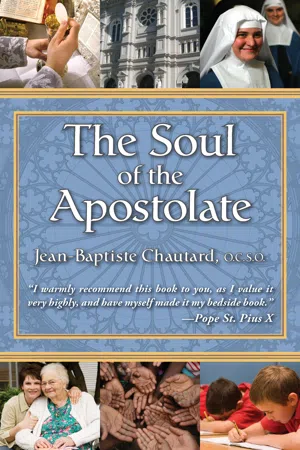
In this age of relentless activity it is easy for Christians, particularly those involved in good works, to fall into the pattern of the activist. But mere activity and material results are not sufficient for a successful apostolate.In his classic work The Soul of the Apostolate, Dom Chautard demonstrates that the very foundation of all apostolic work must be the Interior Life. The apostle of Christ will grow to become an instrument and true channel of God's graces to the world only through prayer, meditation and the cultivation of the Interior Life. When one is involved in works of spiritual or corporal charity, his work can only be truly efficacious when he anchors his Interior Life in Christ. Without Christ we can do nothing. Inside you'll learn about the: ·Pre-eminence of the Interior Life over the Active Life ·Dangers of the Active Life: for you and your apostolate ·The Devil's special temptations for those working for Our Lord ·Steps necessary in order to develop and grow in the Interior Life ·Necessity of the Interior Life to a successful and spiritually fruitful apostolateFor anyone who would work for Our Lord and His Church there is simply no book more important to read and to follow than The Soul of the Apostolate.
- 324 pages
- English
- ePUB (mobile friendly)
- Available on iOS & Android
eBook - ePub
The Soul of the Apostolate
About this book
Information
Topic
Theology & ReligionSubtopic
Christian DenominationsPART ONE
ACTIVE WORKS AND THE INTERIOR LIFE: WHAT THEY MEAN
1.GOD WANTS GOOD WORKS AND, THEREFORE, HE WANTS ZEALOUS ACTION
Sovereign liberality is inseparable from the divine Nature. God is infinite goodness. Goodness seeks nothing except to give itself and to communicate the riches which it enjoys.
The mortal life of Our Lord was nothing else but a continual manifestation of this inexhaustible liberality. The Gospel shows us the Redeemer scattering along His way the treasures of love of a Heart eager to draw all men to truth and to life.
This apostolic flame has been passed on by Jesus to His Church, which is the gift of His love, which diffuses His life, manifests His truth, and shines with the splendor of His sanctity. Burning with the selfsame love, the Mystic Spouse of Christ carries on, down through the ages, the apostolic work of her divine Model.
How admirable the plan, the universal law laid down by Providence, that it is through men, that men are to find out the way to salvation.1 Jesus Christ alone has shed the Blood that redeems the world. Alone, too, He might have put its power to work, and acted upon souls directly, as He does in the Holy Eucharist. But He wanted to have others co-operate in the distribution of His graces. Why? No doubt His divine Majesty demanded that it be so, but His loving affection for men urged Him no less. And if it is seemly for the most exalted king to govern, more often than not, through ministers, what condescension it is for God to deign to give poor creatures a share in His work and in His glory!
Born, upon the Cross, from the pierced side of the Savior, the Church, by its apostolic ministry, carries on the bountiful and redeeming action of the man-God. This ministry, willed by Jesus Christ, becomes the essential factor in the diffusion of the Church among all nations, and the ordinary instrument of its great achievements.
In the front rank of this apostolate, stands the clergy, with its hierarchy forming the main body of the army of Christ, a clergy distinguished by so many holy, zealous bishops and priests, and covered with honor and glory by the recent canonization of the saint who was Curé Ars.
Next to the official clergy, have risen, since the beginnings of Christianity, companies of volunteers, shock-troops, whose continued and abundant growth will always be one of the clearest signs of the vitality of the Church.
First of all, in the earliest centuries, came the contemplative orders, whose ceaseless prayer and fierce penances were such a powerful aid in the conversion of the pagan world. In the Middle Ages, the preaching orders sprang up, with the mendicant and military orders, and those vowed to the ransom of captives in the powers of infidels. Finally, modern times have seen the birth of crowds of teaching institutes, missionary societies, congregations of all sorts, whose mission is to spread abroad every kind of spiritual and material good.
Then, too, at every stage of her history, the Church has received valuable help from the whole body of the faithful, like those fervent Catholics, whose name today is legion, tireless workers, ardent souls who know how to unite their forces and to devote, without stint, to the cause of our common mother, their time, abilities, and fortune, often sacrificing their liberty or their very lives.
A wonderful and encouraging sight, indeed, this providential harvest of works springing up just when they are most needed and in precisely the way that the situation seems to demand! Church history clearly proves that each new need, each new emergency to be faced, has invariably meant the appearance of the institution that the circumstances required.
And so, in our own day, we see a multitude of works that were scarcely even heard of, a generation ago, rise up in opposition to evils of the most serious kind: Catechism classes for first communicants and converts, as well as for abandoned children, all types of Catholic societies, sodalities, and confraternities, laymen’s retreats for young and old of both sexes, Apostleship of Prayer, the Work of the Propagation of the Faith, Catholic action in student and military circles, Catholic press association and other works of both general and local usefulness. All these forms of apostolate are called into being by the spirit that burned in the soul of St. Paul: “But I most gladly will spend and be spent for your souls,”2 the spirit that wishes to spread abroad, everywhere, the benefits of the Blood of Christ.
May these humble pages go out to the soldiers of Christ, who, consumed as they are with zeal and ardor for their noble mission, might be exposed, because of the very activity they display, to the danger of not being, above all, men of interior life! For such men, when the day comes for this deficiency in their lives, to be punished, by failures no one seems able to explain and by serious spiritual collapse, may well be tempted to give up the fight and retire, in discouragement, behind the lines.
The thoughts developed in this book have helped us, ourselves, to fight against an excessive exteriorization through good works. May they help others, also, to escape such a mishap, and lead the stream of their courageous action into better channels. May they show that we must never leave the God of works, for the works of God, and that St. Paul’s: “Woe unto me if I preach not the Gospel”3 does not entitle us to forget: “What does it profit a man, if he gain the whole world and suffer the loss of his own soul?”4
May these modest pages also reach those fathers and mothers of families who do not consider the Introduction to the Devout Life out of date, Christian husbands and wives who feel obligated to an apostolate towards one another as well as towards their children, in order to form them in the love and imitation of the Savior. For then they will better understand the need not only of a pious, but of an interior life, if their zeal is to have any success, and if they are to fill their homes with the unction of the spirit of Jesus Christ, and with that unchanging peace which in the face of every trial will always be a characteristic of the truly Christian family.
2.GOD WILLS THAT THE LIFE-PRINCIPLE OF OUR WORK BE CHRIST HIMSELF
Science is proud of its immense success, and justly so. And yet there is one thing which always has been, and always will be, impossible to it: to create life, to produce, from a chemical laboratory, a grain of corn, a larva. The wholesale discomfiture of the defenders of spontaneous generation shows us, clearly enough, how little there is in these claims. God reserves for Himself the power of creating life.
In the vegetable and animal order, living beings can grow and multiply: but still, their fecundity only operates under definite conditions laid down by the Creator. But as soon as there is question of intellectual life, God reserves this to Himself, and He is the One who directly creates the reasoning soul. And yet there is one other realm which he guards even more jealously still, that of Supernatural life, which flows from the divine life communicated to the humanity of the Incarnate Word.
Per Dominum nostrum Jesum Christum, Per Ipsum et cum Ipso et in Ipso.5
The Incarnation and Redemption establish Jesus as the Source, and the only Source, of this divine life which all men are called upon to share. The essential activity of the Church consists in spreading this life through the Sacraments, Prayer, Preaching, and all other works connected with these.
God does nothing except through His Son. “All things were made by Him and without Him was nothing made that was made.”6 True as this is in the natural order, how much more so is it in the supernatural order, when it is a question of imparting His inner life, and causing men to share in His own nature, making them children of God.
“I am come that they may have life. In Him was life. I am the life.”7 What precision there is in these words! And what light, in the parable of the vine and the branches, in which the Master develops this truth! With what insistence he strives to impress upon the minds of the Apostles the fundamental principle that HE ALONE, JESUS, IS THE LIFE, and the consequence that, in order to share in that life and communicate it to others, they must be grafted on to the God-man.
Men, called to the honor of working with the Savior in transmitting this divine life to souls, ought to consider themselves mere channels, whose function it is to draw from this one and only source.
Failure, on the part of the apostle, to realize this principle, and the illusion that he could produce the slightest trace of supernatural life without borrowing every bit of it from Jesus Christ, would lead us to believe that his ignorance of theology was equaled only by his stupid self-conceit.
If the apostle, while recognizing in theory that the Redeemer is the primary cause of all divine life, were to forget this truth in his actions and, blinded by insane presumption, were to insult Jesus Christ by relying on his own powers, it would be a lesser disorder than the preceding, but one just as insufferable in the sight of God.
To reject the truth, or to ignore it in one’s actions, always constitutes an intellectual disorder in doctrine or in practice. It is the denial of a principle on which our conduct ought to be based. Obviously, the disorder will be still further aggravated if the clear light of truth is obscured and obstructed, in the heart of the active laborer, by his opposition, through sin or voluntary lukewarmness, to the God of all light.
Now for a man, in his practical conduct, to go about his active works as if Jesus were not his one and only life-principle, is what Cardinal Mermillod has called the “HERESY OF GOOD WORKS.” He uses this expression to stigmatize the apostle who so far forgets himself as to overlook his secondary and subordinate role, and look only to his own personal activity and talents as a basic for apostolic success. Is this not, in practice, a denial of a great part of the Tract on Grace? This conclusion is one that appalls us, at first sight. And yet a little thought will show us that it is only too true.
HERESY IN GOOD WORKS! Feverish activity taking the place of God; grace ignored; human pride trying to thrust Jesus from His throne; supernatural life, the power of prayer, the economy of our redemption relegated, at least in practice, to the realm of pure theory: all this portrays no merely imaginary situation, but one which the diagnosis of souls shows to be very common though in various degrees, in this age of naturalism, when men judge, above all, by appearances, and act as though success were primarily a matter of skillful organization.
Even setting aside revelation altogether, the plain light of sane philosophy makes it impossible for us not to pity a man who, for all his remarkable gifts, refuses to recognize God as the principle of the marvelous talents that all observe in him.
What would be the feelings of a Catholic, thoroughly instructed in his religion, at the sight of an apostle who would boast, at least implicitly, that he could do without God in communicating to souls even the smallest degree of divine life?
“He is crazy!” we would say, if we heard an apostolic worker using such words as these: “My God, just do not raise any obstacle to my work, just keep out of my way, and I guarantee to produce the best results!” Our feelings would be a mere reflection of the aversion excited in God by the spectacle of such disorder: by the spectacle of presumption carrying its pride to such limits as to wish to impart supernatural life, to produce faith, to put an end to sin, incite men to virtue, and without attributing these effects to the direct, unfailing, universal, and overwhelming action of the Blood of God, the price, the cause, and the means of all grace and of all spiritual life.
Therefore, God owes it to the Humanity of His Son to make fools of these false Christs by paralyzing the works of their pride, or by allowing them to pass away as a momentary mirage.
Setting aside everything that works upon souls ex opere operato, God owes it to the Redeemer to withdraw from the apostle who is inflated with his own importance, all His best gifts, and to reserve these for the branch that humbly recognizes that all its life-sap comes from the Divine stock.
Otherwise, if He were to bless with deep and lasting results the work filled with the poison of this virus we have called the Heresy of Good Works, God might seem to be encouraging this abuse and favorings its contagious spread.
3.WHAT IS THE INTERIOR LIFE?
In this book the words life of prayer, contemplative life will be applied, as they are in the Imitation of Christ to the state of those souls who have dedicated themselves to a Christian life which is at the same time out of the common, and accessible to all, and, in substance, obligatory for all.8
Without embarking upon a study of asceticism, let us at least remind the reader that EVERYONE is obliged to accept the following principles as absolutely certain, and base his inner life upon them.
FIRST TRUTH. Supernatural life is the life of Jesus Christ Himself in my soul, by Faith, Hope, and Charity; for Jesus is the meritorious, exemplary, and final cause of sanctifying grace, and, as Word, with the Father and the Holy Ghost, He is its efficient cause in our souls.
The presence of Our Lord by this supernatural life is not the real presence proper to Holy Communion, but a presence of vital action like that of the action of the head or heart upon the members of the body. This action lies deep within us, and God ordinarily hides it from the soul in order to increase the merit of our faith. And so, as a rule, my natural faculties have no feeling of this action going on within me, which, however, I am formally obliged to believe by faith. This action is divine, yet it does not interfere with my free will, and makes use of all secondary causes, events, persons, and things, to teach me the will of God...
Table of contents
- Title Page
- Copyright Page
- DOM CHAUTARD
- TABLE OF CONTENTS
- PROLOGUE
- 1. God Wants Good Works and, therefore, He Wants Zealous Action
- 2. God Wills That the Life-Principle of Our Work Be Christ Himself
- 3. What Is the Interior Life?
- 4. Ignorance and Neglect of This Interior Life
- 5. Reply to the First Objection: Is the Interior Life Lazy?
- 6. Reply to Another Objection: Is the Interior Life Selfish? . . . .
- 7. No Conflict between the Interior Life and the Salvation of Souls
- 1. Priority of the Interior over the Active Life in the Eyes of God
- 2. Good Works Should Be Nothing But an Overflow from the Interior Life
- 3. Active Works Must Begin and End in the Interior Life
- 4. The Active and Interior Lives Are Completely Interdependent
- 5. The Excellence of This Union
- 1. Active Works, a Means of Sanctification for Interior Souls, Become, for Others, a Menace to Their Salvation
- 2. The Active Worker Who Has No Interior Life
- 3. The Interior Life: Basis of the Holiness of the Apostolic Worker
- The Interior Life Is the Condition on Which the Fruitfulness of Active Works Depends
- 1. To Active Workers: Hints on the Interior Life
- 2. Mental Prayer: A Necessary Element of the Interior Life, and Consequently of the Apostolate
- 3. The Liturgical Life Is a Source of the Interior Life: Therefore It Is a Source of the Apostolate
- 4. Custody of the Heart Is the Keystone of the Interior Life: Hence It Is Essential in the Apostolate Resolution on Custody of the Heart
- 5. The Apostle Must Have an Ardent Devotion to Mary Immaculate
- Epilogue
- Appendix: Ten Aids to Mental Prayer
Trusted by 375,005 students
Access to over 1.5 million titles for a fair monthly price.
Study more efficiently using our study tools.
Frequently asked questions
Yes, you can cancel anytime from the Subscription tab in your account settings on the Perlego website. Your subscription will stay active until the end of your current billing period. Learn how to cancel your subscription
No, books cannot be downloaded as external files, such as PDFs, for use outside of Perlego. However, you can download books within the Perlego app for offline reading on mobile or tablet. Learn how to download books offline
Perlego offers two plans: Essential and Complete
- Essential is ideal for learners and professionals who enjoy exploring a wide range of subjects. Access the Essential Library with 800,000+ trusted titles and best-sellers across business, personal growth, and the humanities. Includes unlimited reading time and Standard Read Aloud voice.
- Complete: Perfect for advanced learners and researchers needing full, unrestricted access. Unlock 1.5M+ books across hundreds of subjects, including academic and specialized titles. The Complete Plan also includes advanced features like Premium Read Aloud and Research Assistant.
We are an online textbook subscription service, where you can get access to an entire online library for less than the price of a single book per month. With over 1.5 million books across 990+ topics, we’ve got you covered! Learn about our mission
Look out for the read-aloud symbol on your next book to see if you can listen to it. The read-aloud tool reads text aloud for you, highlighting the text as it is being read. You can pause it, speed it up and slow it down. Learn more about Read Aloud
Yes! You can use the Perlego app on both iOS and Android devices to read anytime, anywhere — even offline. Perfect for commutes or when you’re on the go.
Please note we cannot support devices running on iOS 13 and Android 7 or earlier. Learn more about using the app
Please note we cannot support devices running on iOS 13 and Android 7 or earlier. Learn more about using the app
Yes, you can access The Soul of the Apostolate by Jean-Baptiste Chautard in PDF and/or ePUB format, as well as other popular books in Theology & Religion & Christian Denominations. We have over 1.5 million books available in our catalogue for you to explore.