The "Angelic Doctor" and "Universal Doctor, " his intellect and learning were phenomenal, yet he was humble and charming. Knew the Bible by heart, remembered all he had read, could dictate to 3 secretaries at once. All the charming stories about him. Great!
- 48 pages
- English
- ePUB (mobile friendly)
- Available on iOS & Android
eBook - ePub
About this book
Information
Topic
Theology & ReligionSubtopic
Religious BiographiesCHAPTER ONE
I GO TO SCHOOL
MY NAME is Thomas, and I was born in a castle in Italy in the year 1225. My father was a rich man, the Count of Aquin, and I was his third son. Poor Father! He was a good soul and he made great plans for me. When I was six years old, he sent me to school at the Benedictine Abbey of Monte Cassino. He told my teachers I was to be a priest.
“My two oldest boys will be soldiers like myself,” he said. “I think Thomas should go into the service of the Church.”
I went off to school with my future clearly mapped out for me. I was to be a monk. More than that. My father said that when I was older I was to be Abbot of Monte Cassino, a position held for some years by his own brother. My mother, whose name was Theodora, agreed with him.
“I’m so proud of you, Thomas!” she often said. “Someday you’ll be in charge of that wonderful Abbey. Everyone will look up to you as long as you live!”
What could I say? I loved my parents and had been brought up to obey them. When I finally saw my uncle, the Abbot of Monte Cassino (he was a white-haired old man in a black robe, with a gold cross around his neck and a handsome ring on his finger), I began to wonder. What kind of an Abbot would I make? My hair was not white. I didn’t know how to read. And I had a feeling that I could never spend my whole life in one place, even in such a beautiful place as the Abbey. There were other difficulties, too. Suppose the monks did not want me for their leader when I was grown up? Suppose some other boy would make a better Abbot?
“Don’t worry about such things,” my father said. “If I wish my son Thomas to be head of the Abbey, he’ll be head of it. Never fear. Am I not Count Landulph of Aquin? Am I not a nephew of the great Emperor, Frederick Barbarossa?”
“Yes, Father,” I answered meekly. But I had a strange feeling as I said these words. I, Thomas of Aquin, would never be a Benedictine Abbot. Although I was only a six-year-old boy, I felt quite sure that some other kind of life would be mine.
I liked going to school at Monte Cassino, however. The rugged mountain where Saint Benedict and his monks had settled seven hundred years before was really beautiful. The other boys and I often watched the monks laboring in the fields. We went into the work rooms, too, and saw cloth being woven from wool, old manuscripts being copied in the library. Always there was a lot of activity going on at Monte Cassino, for long ago, when Saint Benedict had first founded his colonies of monks, he had insisted upon two things. The monks should work with their hands many hours every day. They should also spend themselves in praising God by the chanting of Psalms and other prayers. Nothing was to be preferred to this latter work.
So it was that Monte Cassino resembled a very busy but a very holy town. The monks grew everything that was necessary to feed themselves as well as the boys who studied in their school. Then, at certain hours, they went to their chapel to sing the praises of God. Sometimes, as I listened to these holy men chanting the ancient Psalms, I wondered if it might not be good to spend my life at Monte Cassino.
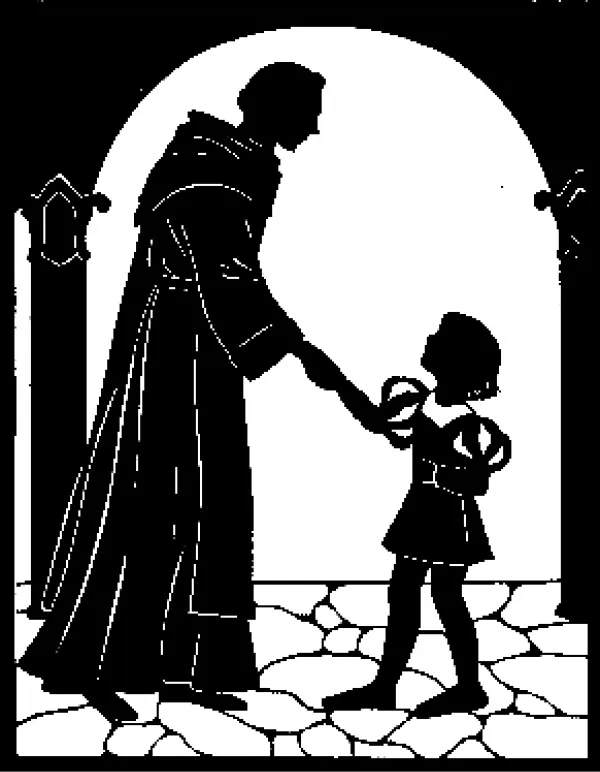
I was to be a monk, too.
Everything was so orderly and peaceful.
But as soon as such thoughts came, a strange little voice inside me would start to laugh.
“You’re not going to stay here, Thomas. Someone else will be Abbot.”
“Why?”
“Because it’s God’s Will.”
“How do you know?”
“I just know. And don’t keep asking me questions.”
I wondered who was right, my father or the little voice. It seemed as though I would stay forever at the Abbey. But when five years had passed, a great thing happened. I was sent home to Rocca Secca, to the great castle where I had been born. I was eleven years old now, and it was good to see my family once more—Father, Mother, my sisters and brothers. Mother cried a little when she saw me first, but soon she was all smiles.
“Oh, Thomas! How I’ve missed you! And how big you’ve grown! Look, Landulph, he’s really very tall for eleven!”
My father made funny noises in his throat, but his eyes were kind as he looked me up and down.
“Not bad, not bad at all,” he murmured. “The monks seem to have treated you very well.”
“Yes, Father. The Abbey is a wonderful place.”
“And what have you learned, son?”
“To read and write in Latin. And a little of many other things, Father. When am I going back?”
A peculiar look came over Father’s face. “You’re not going back, Thomas. Instead you’re going to go to school in Naples. At the University.”
Naples! The University! I could hardly believe my ears. What had made Father change his mind? Something must be wrong. Perhaps my teachers at Monte Cassino hadn’t been pleased with the way I did my lessons.
“Thomas,” said Mother very gently, “the monks tell us you’re a good student and should have every advantage. They think that in Naples …”
“They think you’ve learned everything they can teach you,” my father interrupted. “Ah, lad, we’re proud of you! Going to the University at eleven! When you get your degree you’ll be the most learned Abbot Monte Cassino ever had!”
So my little voice had been wrong! I was going back to Monte Cassino someday to rule the monks, to live far away from the noise and bustle of towns and cities. But first there was to be a course of studies at the University.
“Son, you look tired,” said Mother presently. “We mustn’t have that. Why not go to your room for a while?”
I nodded. I was tired. And puzzled, too. It seemed too much to believe that my school days at the Abbey were over. But I could see Father smiling to himself as I left the room. He, at least, was at ease about my future. He looked just the way he did when his soldiers came back from winning an important battle.
My sisters, Marietta and Theodora, were just as excited as anyone else over the news that I was going away to the University.
“It must be wonderful to be a boy and go places!” sighed Marietta. “Thomas, do you suppose we could go with you to Naples?”
“I’d love living in a big city,” put in Theodora wistfully. “Mother, could we go with Thomas?”
“Nonsense!” said Mother. “Girls like you have no reason to live in Naples. You’d just get foolish ideas there.”
Theodora laughed. “Maybe we could find ourselves husbands,” she suggested. “Probably there are many nice young men in Naples who haven’t picked out a wife yet.”
“Thomas will meet lots of them at the University,” said Marietta. “Oh, it would be just wonderful if we could go!”
Mother shook her head. “Naples is a wicked city. Perhaps even Thomas shouldn’t be going there, when he’s so young. But as for you two …”
The girls stopped their teasing. It was all a joke anyway, for they were too young to be thinking of marriage. But their excitement about my leaving home continued to increase. The whole summer I was at Rocca Secca they could talk of nothing else.
“You’ll study hard and make yourself famous, won’t you?” Marietta asked one night. “Father and Mother are so proud of you, Thomas. It would break their hearts if you were lazy.”
“Father has always said you would grow up to be Abbot of Monte Cassino,” Theodora added. “You mustn’t disappoint him.”
I thought of the little voice that continued to tell me my life would never be spent at the Abbey, but there was no use in saying anything to the girls.
“Of course I’ll work hard,” I promised. “Never fear. And you be good and see that Father and Mother aren’t disappointed in you!”
Marietta and Theodora laughed. “We can’t be anything but good in this poky old castle,” they said. “You ought to know that, Thomas.”
My brothers, Landulph and Raynald (who were much bigger than I and very good at horseback riding and fighting with swords), treated me like one of themselves during the last few weeks I spent at home.
“So our little Thomas is going away to the big city,” said Raynald one day. “That’s what happens to a boy when he’s good at books. Thomas, you’re a lucky little beggar to get such a chance!”
“Father never sent us to the University,” put in Landulph, pretending to be jealous. “A fine time we might have had there, too.”
I could not help smiling. No one hated books and study as much as these two older brothers of mine. Father had trained them to be soldiers. They would have been bored to death at the University. They knew it. And so did I.
CHAPTER TWO
I GO TO NAPLES
DEAR FATHER did not want me to go to the city alone. He hired a tutor, a young man who was to live with me in Naples, help me with my school work and keep me company. We got along very well, the tutor and I, and I was happy as a University student.
Not one of my c...
Table of contents
- FRONT COVER
- HALF TITLE PAGE
- BOOKS BY MARY FABYAN WINDEATT
- TITLE PAGE
- COPYRIGHT
- DEDICATION
- CONTENTS
- INTRODUCTION
- CHAPTER ONE: I GO TO SCHOOL
- CHAPTER TWO: I GO TO NAPLES
- CHAPTER THREE: I GO TO PRISON
- CHAPTER FOUR: I GO TO COLOGNE
- CHAPTER FIVE: I GO TO PARIS
- CHAPTER SIX: I GO TO HEAVEN
- CHAPTER SEVEN: I GO TO WORK
- PRAYERS
- MARY FABYAN WINDEATT
- BACK COVER
- CONFESSION ITS FRUITFUL PRACTICE
- TAN CLASSICS
- BECOME A TAN MISSIONARY!
- SHARE THE FAITH WITH TAN BOOKS!
- TAN BOOKS
Trusted by 375,005 students
Access to over 1.5 million titles for a fair monthly price.
Study more efficiently using our study tools.
Frequently asked questions
Yes, you can cancel anytime from the Subscription tab in your account settings on the Perlego website. Your subscription will stay active until the end of your current billing period. Learn how to cancel your subscription
No, books cannot be downloaded as external files, such as PDFs, for use outside of Perlego. However, you can download books within the Perlego app for offline reading on mobile or tablet. Learn how to download books offline
Perlego offers two plans: Essential and Complete
- Essential is ideal for learners and professionals who enjoy exploring a wide range of subjects. Access the Essential Library with 800,000+ trusted titles and best-sellers across business, personal growth, and the humanities. Includes unlimited reading time and Standard Read Aloud voice.
- Complete: Perfect for advanced learners and researchers needing full, unrestricted access. Unlock 1.5M+ books across hundreds of subjects, including academic and specialized titles. The Complete Plan also includes advanced features like Premium Read Aloud and Research Assistant.
We are an online textbook subscription service, where you can get access to an entire online library for less than the price of a single book per month. With over 1.5 million books across 990+ topics, we’ve got you covered! Learn about our mission
Look out for the read-aloud symbol on your next book to see if you can listen to it. The read-aloud tool reads text aloud for you, highlighting the text as it is being read. You can pause it, speed it up and slow it down. Learn more about Read Aloud
Yes! You can use the Perlego app on both iOS and Android devices to read anytime, anywhere — even offline. Perfect for commutes or when you’re on the go.
Please note we cannot support devices running on iOS 13 and Android 7 or earlier. Learn more about using the app
Please note we cannot support devices running on iOS 13 and Android 7 or earlier. Learn more about using the app
Yes, you can access St. Thomas Aquinas by in PDF and/or ePUB format, as well as other popular books in Theology & Religion & Religious Biographies. We have over 1.5 million books available in our catalogue for you to explore.