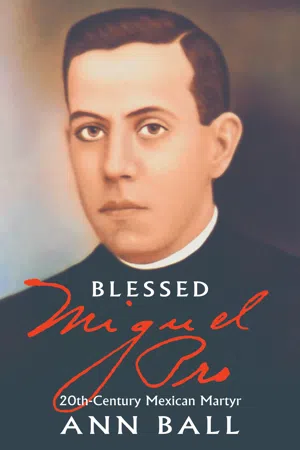
This is the inspiring story of the famous Father Miguel Pro who was executed in Mexico in 1927 for the crime of being a Catholic priest. This young Jesuit spent most of his short life in the priesthood dodging the Mexican police as he ministered to the underground Church during the Mexican Revolution. Fr Pro's quick wit and keen sense of humor were put to good use as he pedaled around Mexico City on his bicycle in various disguises, en route to administering the Sacraments, giving spiritual talks or begging food and money for the poor. But behind the disguises beat the heart of a Saint - as the Mexican people testified by turning out in throngs to pay their last respects after his martyrdom. Fr Pro offered his life for the Catholic Faith and his last words on this earth were: "Viva Cristo Rey" - Long live Christ the King! Blessed Miguel Pro makes history come alive and highlights the dramatic conflict between the Church and her enemies that continues even to this day. Every member of the family will be delighted by this fast-paced true story of a modern Catholic hero who proclaimed both in life and death the reign of Christ the King.
- 140 pages
- English
- ePUB (mobile friendly)
- Available on iOS & Android
eBook - ePub
About this book
Information
Topic
Theology & ReligionSubtopic
Christian DenominationsChapter 1
A LIVELY CHILDHOOD
There is more adventure, excitement and danger in the life of the Mexican priest Fr. Miguel Pro than in many modern spy thrillers. His life of danger began when, still only a toddler, he managed to escape the watchful eye of his nursemaid and crawl out onto a window ledge three stories above a busy street. There his horrified mother found and rescued him. A final dangerous episode would lead to his death in front of a firing squad at the age of 36.
Miguel was born on January 13, 1891, at Guadalupe, Zacatecas, near the center of one of Mexico’s richest silver mining areas. He was the third child and the first son of Don Miguel Pro and his wife Josefa Juárez. Miguel’s father, like his father before him, was a mining engineer.
Miguel was baptized three days after his birth in the Franciscan monastery’s Nápoles chapel. He was given the lengthy and impressive name José Ramon Miguel Agustín Pro Juárez. His paternal grandparents were his godparents. A family treasure, a small container of water from the Holy Land, was used at the Baptism.
When Miguel was still a baby, the family moved to Mexico City. There, in the family’s large and spacious home, Miguel took his first steps. There, too, his investigative impulses and incessant physical activity constantly drew him into mischief.
Through the open windows, the baby listened daily to the hawking cries of the street vendors. One of these vendors, a shy Aztec woman, supplied the family with delicious fruit. This woman became a particular favorite of the young Miguel and often stopped to play with him, calling him her little “soul baby.” She began to bring him treats, and one day she brought a large gourd filled with a small fruit called tojocotes. Before his family realized what he was up to, Miguel had greedily consumed half the fruit. This caused some type of poisoning, and Miguel became violently ill and congested and seemed in danger of death.
After several days, during which his Aztec friend sat sorrowfully by his bed, anguished at what her gift had wrought and pleading with the Virgin of Guadalupe for the child’s life, Miguel’s fevers left. Apparently he had also suffered a brain fever, and the small victim was left with the vacuous stare and open mouth of an imbecile.
For a year the baby was sick and could not utter a syllable. A new fever developed, following bouts with measles and whooping cough, and the threat to his life seemed even greater than it had the previous year. Miguel suffered convulsions, and the doctors announced that death was imminent. The family gathered sadly around the child’s bed to wait for the end. Suddenly, Don Miguel snatched the insensible form of his son from the crib, and holding the baby out toward an image of Our Lady of Guadalupe, he cried out, “My Mother, give me back my son!”
In the silence that followed, the startled witnesses saw the baby give an immense shudder and vomit a great bloody mass of phlegm at his father. The danger was over.
Within a few days, the baby was restored to full health. He looked at his adoring mother and said, “Mama, I want a cocol” (a variety of roll which had always been his favorite). The happy mother caught Miguel up and hugged him, crying, “Come here, my little cocol!” Years later, when he was hiding from the police, Miguel frequently signed his letters to his fellow Christians with the nickname “Cocol.”
From childhood, laughter and high spirits were hallmarks of Miguel’s personality. He was constantly in motion, physically and mentally. A born clown, Miguel was blessed with a sunny disposition and a playfulness that enriched the family’s nightly gatherings. The five-year-old Miguel would enthusiastically entertain the family by reciting verses, performing charades or directing his sisters in little skits. Seeing his son’s talent, Don Miguel presented the little boy with a tiny theater, and Miguel’s mother helped him shop for the puppets that he needed to people it. Years later, his dramatic ability remained. A friend remarked that Miguel was a born actor and could laugh one minute and cry the next. He went on to say that Miguel could laugh with one side of his face and cry with the other.
Punishment was rare in the Pro household; instead, Don Miguel encouraged the good behavior of his children with a Saturday ritual whereby some “good angels” brought small gifts to those of the children who had behaved exceptionally well that week. Those omitted from the favors of the “angels” strove to be remembered the following week. Miguel did earn a spanking, however, when at the age of five he threw a minor temper fit in a store while on an outing with his mother and sisters. Later, the very sight of the little white horse which had occasioned the fit was enough to bring tears to his eyes, and he once remarked, “For that thing I made my mother weep!”
Another occasion for discipline came about the day that Miguel destroyed his sisters’ dolls. As his excuse, Miguel gave the fact that he was carrying on a “battle”—for which he was dressed in the little general’s uniform he had received as a Christmas present—and he had stabbed and beheaded the recalcitrant dolls because they had refused to move. His father replied that, in that case, Miguel’s punishment was due to the face that Miguel had moved too much.
When Miguel was six, the family moved to the northern industrial city of Monterrey, where Miguel began formal classes in a private school run by two sisters, the Señoritas Sánchez. For the active little boy, fun and curiosity still took priority. One day he even skipped school in order to see the arrival of the snow-covered trains at the large train station in the city.
Other anecdotes, too, are recorded of Miguel’s school years. There was the time he presented a lizard to his teacher as a “gift,” the time he “charged” candy at a local store until his mother received the bill and he received his just reward, and the time he and another boy got into a real battle over a new hat that Miguel had worn to school. The other boy had ruined the new hat by pulling it down on Miguel’s head, so Miguel jumped in with ready fists. On Miguel’s return home, his mother noticed his black eye and asked what had happened. When he told her about the fight, she commented that he seemed to have gotten the worst of it. “Oh, no,” he replied, “the other boy has two black eyes!”
In 1889 Don Miguel was transferred from Monterrey back to Zacatecas, where he became the senior engineer at the Concepción del Oro mine. He was concerned by the lack of good schools in the rough mining area, but he did not want to separate his closeknit family. Seven-year-old Miguel and his five brothers and sisters happily packed for what seemed to them only a new adventure.
Housing was also lacking in Zacatecas, so the family lived for a time in the local hotel while a new home was being built. During this time, the protective parents tried to isolate their children from other travelers who were staying in the hotel, and they forbade the children to mingle with them. The inquisitive Miguel, while not failing in obedience, managed to hold hurried conversations with some bullfighters on his way to and from supper at the hotel dining room. Their brilliant costumes excited the lively little boy, who, on his return to the Pro family quarters, would mimic the bullfighters in a pleasing parody for his admiring sisters. Years later, when often evading the vigilance of Calles’ spies, Miguel sometimes recounted stories of his narrow escapes using the terms of a bullfighter to enliven the telling.
Chapter 2
FORMATIVE YEARS
On the feast of St. Joseph in 1898, Miguel, along with his older sisters Concepción and María de la Luz, made his First Communion at Concepción del Oro’s parish church. The storm of barbarism that lay ahead for the Mexican Catholics had not yet begun; so the gentle pastor, Fr. Mateo Correa, and the small communicant, Miguel Pro, had no intimation that both would one day have their names linked again, the second time being in martyrdom for Christ the King. (Fr. Correa would be martyred during the opening terror of the Calles persecution on February 6, 1927, near the city of Durango.)
Because of the lack of good schools, Don Miguel decided to attend to the children’s primary education himself, so he set aside time each night to hear the lessons which were assigned daily. From breakfast until the four o’clock Mexican dinner, the children were expected to work at their lessons. Miguel was no serious student, but he studied with his usual obedience. He quickly learned to read and write very well, and his extraordinary memory allowed him to make successful recitations even in the subjects he did not like. In the evenings, Miguel began to master the guitar and the mandolin. Eventually, under Miguel’s direction, the five oldest Pro children made up a string quintet, which gave much pleasure to the family and to visitors at the Pro home. Miguel also enjoyed poetry, and he often wrote verses as presents to family members on special occasions.
Miguel was so fond of music that whenever a band of musicians passed the house, he would drop what he was doing and run to the door. Once, after Miguel had interrupted his studies for a troupe of these roving minstrels, his father forbade him to leave his books or set foot in the street for such a thing. The obedient but ever mischievous youth held his book in his hand and walked on his knees to the door to enjoy the performance of the next musical travelers.
When Miguel was nearly eight years old, his mother suggested that he and his two older sisters help their father in his office on the Saturday paydays. All three children checked the cash that was disbursed, and the girls also helped by stamping the thumbprints that served as payroll receipts. Miguel carried drinks of water to the men as they stood in the long payroll line, and he sometimes gave them his own cookies and sweets.
Although Don Miguel had at first had qualms about the idea because his workers were often crude and quarrelsome, Doña Josefa’s plan worked admirably well. The miners respected the innocence of the children, and the help the children provided was of real assistance to their overworked father. Miguel soon became a particular pet of these workmen, and he told them that he, too, was a miner. His name for himself at this time was “el barreterillo” (“the little miner”), and in later life he sometimes referred to himself as “el pobre barretero” (“the poor miner”). This is yet another of the nicknames Miguel used in his later correspondence while a priest in hiding.
Josefa Juárez was a good and gentle influence on her son Miguel, who observed her charity to the mine workers. Her respect for the dignity and innate goodness of these rough men was transmitted to all of her children. She had a compassionate heart; she understood the restlessness and poverty of the mine workers. She saw the illnesses caused by poor diet and bad sanitation, and she worked to help alleviate them.
The miners were rough men, obstreperous and prone to drunkenness, but Doña Josefa could not forget them or their families, even while accepting the harsh realities of their lifestyle. Their situation was nothing that Don Miguel could change; he was not an owner. But he tried to make sure they received justice under the law and the prevailing practices, and he gave them as much work as the mine could support. Doña Josefa began to visit the workers’ families, taking gifts of food, medicine and clothing, and she often attended the sick herself. On her visits she always took along one or more of her older children. Miguel especially enjoyed these trips with his mother. He called the miners “mi predilectos” (“my favorites”). Although he did not know how to cure his nation of its social evils, he understood the Christian duty of making individual sacrifice—with good humor and a loving attitude—for the suffering underprivileged, and he understood the value of working for peace with justice.
Doña Josefa’s charity to the sick culminated in her development of the small Hospital de San José, which was begun to provide free services to the most poverty-stricken of the miners and their families. She gathered donations and aid, and the hospital opened in 1904. Unfortunately, after only a year and a half of operation, the new town mayor (Presidente Municipal) decreed that the hospital was too “exclusive” and must be opened to everyone (not just the poor). He also forbade the patients the right to receive the Last Sacraments at the hospital. The Pro family, naturally, withdrew from this work. Miguel understood his mother’s sorrow and tried to comfort her with childlike promises to help “her poor” when he was older.
Chapter 3
YOUNG MANHOOD
As work at the mine increased and the Pro fam ily grew to include eight children, Don Miguel could no longer spare the time to teach his children. A succession of private tutors were hired, until at last Don Miguel decided it was time for his...
Table of contents
- Front Cover
- Title Page
- Copyright Page
- Dedication
- Contents
- Declaration of Obedience
- Author’s Preface
- Acknowledgments
- Introduction
- 1. A Lively Childhood
- 2. Formative Years
- 3. Young Manhood
- 4. Mounting Political Tensions
- 5. Three Vocations
- 6. Flight from Mexico
- 7. A Priest at Last
- 8. Crosses of Body and Soul
- 9. Return to Mexico: The Church Goes Underground
- 10. The First Arrest
- 11. Works of Mercy
- 12. The Danger Increases
- 13. Capture!
- 14. Martyrdom
- 15. Favors From Heaven
- Appendix 1: Writings of Bl. Miguel Pro
- Appendix 2: Prayers
- Appendix 3: A Celebration in Honor of Bl. Miguel Pro
- Selected Bibliography
- About the Author
- Back Cover
Trusted by 375,005 students
Access to over 1.5 million titles for a fair monthly price.
Study more efficiently using our study tools.
Frequently asked questions
Yes, you can cancel anytime from the Subscription tab in your account settings on the Perlego website. Your subscription will stay active until the end of your current billing period. Learn how to cancel your subscription
No, books cannot be downloaded as external files, such as PDFs, for use outside of Perlego. However, you can download books within the Perlego app for offline reading on mobile or tablet. Learn how to download books offline
Perlego offers two plans: Essential and Complete
- Essential is ideal for learners and professionals who enjoy exploring a wide range of subjects. Access the Essential Library with 800,000+ trusted titles and best-sellers across business, personal growth, and the humanities. Includes unlimited reading time and Standard Read Aloud voice.
- Complete: Perfect for advanced learners and researchers needing full, unrestricted access. Unlock 1.5M+ books across hundreds of subjects, including academic and specialized titles. The Complete Plan also includes advanced features like Premium Read Aloud and Research Assistant.
We are an online textbook subscription service, where you can get access to an entire online library for less than the price of a single book per month. With over 1.5 million books across 990+ topics, we’ve got you covered! Learn about our mission
Look out for the read-aloud symbol on your next book to see if you can listen to it. The read-aloud tool reads text aloud for you, highlighting the text as it is being read. You can pause it, speed it up and slow it down. Learn more about Read Aloud
Yes! You can use the Perlego app on both iOS and Android devices to read anytime, anywhere — even offline. Perfect for commutes or when you’re on the go.
Please note we cannot support devices running on iOS 13 and Android 7 or earlier. Learn more about using the app
Please note we cannot support devices running on iOS 13 and Android 7 or earlier. Learn more about using the app
Yes, you can access Blessed Miguel Pro by Ann Ball in PDF and/or ePUB format, as well as other popular books in Theology & Religion & Christian Denominations. We have over 1.5 million books available in our catalogue for you to explore.