She lived 24 years and was an obscure nun for nine of those. She died in 1897 and was canonized in 1925. Yet she is known the world over by Catholics and non-Catholics alike. Her statue soon appeared in most Catholic churches in the world. With St. Joan of Arc, she shares the title "Patroness of France" and with St. Francis Xavier the honor of "Principal Patroness of all Missionaries." Her devotees acknowledge her as a second St. Jude in her powerful intercession with God. Her appeal is universal-from peasants to Popes-and people of all stations know her and call upon her for help. What factors conspired to shape St. Therese of the Child Jesus? John Beevers addresses himself to this question in The Making of a Saint. As author of an earlier biography, The Storm of Glory, and as translator of her autobiography, The Story of a Soul, he brings to his task an authority on her life unsurpassed perhaps by any writer in English. The story of this life is a marvel-a miracle-of divine grace. For the life of St. Therese is the lesson to all men of spiritual greatness to be achieved by perfect love of God and total consecration of all our actions, even the smallest, to His greater honor and glory.
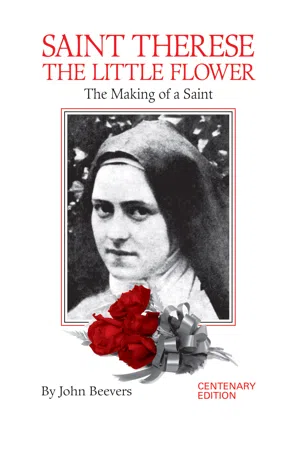
- 208 pages
- English
- ePUB (mobile friendly)
- Available on iOS & Android
eBook - ePub
About this book
Information
Topic
Theology & ReligionSubtopic
Religious BiographiesChapter 1
INTRODUCTION
A saint is not a freak. He is, as we all are, a being born with a normal share of human frailties and burdened with hereditary flaws and powers such as afflict and strengthen all the sons and daughters of Adam. He has not escaped the stain of Original Sin. And as he passes from infancy, through adolescence, to maturity, he, too, is subject to the multitude of influences that press upon us all, and he has our own same freedom to accept or reject them.
Therefore, when we study a saint, we cannot know him fully unless we know what these influences were, how he was tugged this way and that, who his parents and teachers were, the effect on him of his brothers and sisters, his friends and his acquaintances. We know, of course, that it is the grace of God which makes a saint. But we are left free to co-operate with that grace or to turn aside from it. The choice is ours. In this matter, God waives His omnipotence. He persuades. He does not compel. And often, as the stories of the saints repeatedly show, He does not always choose to act directly upon the soul. He sometimes prefers to use agents, to allow His creatures to act for Him in the work of making a saint.
So it was with the great saint of modern times, St. Thérèse of the Child Jesus. Sanctity has its mysteries which we shall never understand in this life, and it is foolish presumption to pretend we can fully explain it, either its genesis, its development, or its full flowering. We can describe, but we cannot penetrate into its fiery depths. Even the great mystical saints stammer or fail when they try to tell what they know. Yet it is only the very core of saintliness which resists all our probings, but there is much that we can understand and profitably discuss.
I have already written about St. Thérèse,* but since then much new material about her family has appeared, and we have, for the first time, the complete text of her autobiography as she wrote it. With every fresh disclosure it becomes more and more apparent that God used her family and later the community of nuns she entered as His instruments in fashioning her into a saint. She was not born with the halo of sanctity already in position. As a saint she was—always under God, it must be understood—created by her family and her fellow nuns. Today the family is no longer the key unit of civilization. Over too much of the world, the state is supreme and overrides both the natural and the supernatural rights of the family. In her person and in her teaching, St. Thérèse offers us both an example and a body of precepts which are invaluable. A knowledge and understanding of her environment, which, given her total response to grace, made her sanctity inevitable, are of equal value. That is what I attempt to offer here.
* Storm of Glory (New York: Sheed and Ward). 1950.
Chapter 2
FAMILY BACKGROUND
The roll of saints includes kings and beggars, men and women of all degrees, some with a lineage as long as their arm, others unable to name their grandparents. The family of St. Thérèse—her immediate ancestors—were not distinguished by rank, wealth or intellect, nor were they anonymous peasants, living from hand to mouth without a penny to call their own. They were people who had a small, but honorable and well-defined position in the state. Her paternal grandfather, Pierre François Martin, was born in 1777 in Normandy. When he was twenty-two, he joined the army and made soldiering his profession for the next thirty-one years. He followed Napoleon’s eagles through Prussia and Poland and fought for him in France when the Emperor’s days of power were numbered. He won promotion and, after the restoration of the Bourbons, reached the rank of captain.
At the age of forty-one, he married the eighteen-year old daughter of another army captain, also a veteran of the Grande Armée. They had five children. The third was Louis Joseph Aloys Stanislas Martin, who was to be the father of St. Thérèse. He was born in Bordeaux on August 22, 1823, and until he was seven and his father retired, the family moved from one garrison town to another, finally ending up in Strasbourg. On his retirement, Captain Pierre decided to spend the rest of his life in his native Normandy and chose Alençon for his home, a quiet little grey-stone town with the river Sarthe meandering through it.
There he became a well-known figure as, tall and straight as a ramrod, he walked through the streets in his long overcoat of military cut, wearing in his lapel the rare scarlet ribbon of a Chevalier of the Royal and Military Order of St. Louis. Through all the many rough years he had spent as a campaigning soldier he practiced his religion zealously. The chaplain of his regiment once told him that his men were astonished when, at Mass, they saw how long he continued kneeling after the Consecration. His reply was: “Tell them it’s because I really believe.”
In retirement he lived a fully Christian life, a pillar of his parish church, generous in his charity and a responsible and affectionate head of his family. One gets only a few glimpses of him, but they give the impression of a simple, straightforward man of action who had served his Emperor and his King with instant, unquestioning obedience and who delighted in giving an even more uncompromising service to the Lord of Hosts. Such was the grandfather of St. Thérèse.
Her mother came from similar stock. She was the second of the three children—two girls and a boy—of Isidore Guérin, a man of Normandy who was born in 1789, a week before the fall of the Bastille and the start of the Revolution. At nineteen he was conscripted and fought at Wagram where the Austrians were crushed by the French. Later he was drafted to serve in Spain and survived the decisive defeat of the French by Wellington at Vitoria. He married Louise Jeanne Mace in 1828, and Marie Azelia (always known as Zélie), the mother of the saint, was born on December 23, 1831. When he left the army, he joined the police and was stationed in a village near Alençon. Both he and his wife were devout Catholics.
None of her grandparents had any direct influence on St. Thérèse, but they formed her parents, rearing them in a wholly Catholic atmosphere and giving them both that certain simplicity, directness and toughness which mark a good N.C.O. or junior officer. Saints, too, have these qualities.
Thérèse, as we have just seen, was of Norman blood, and the people of Normandy, that most delightful province, have very definite characteristics. The legend that the French are a frivolous people is one of the strangest ever to gain currency. A stay in Normandy is one of the quickest and surest ways of revealing its falsity. It is a green and mellow land, but its inhabitants are neither. Their heads are hard and clear, their wills tenacious, and their beliefs deep and strongly held. They are an honest and serious people who work hard and know the exact value of a franc. He would be a most unlucky traveler who sought to be entertained with an hour or two of frivolous gaiety in Rouen or Caen. And Thérèse was a true daughter of Normandy.
The early manhood of Louis Martin is not well documented. There is no reason why it should be. His future role was unknown, and he was a youth without outstanding intelligence or talent; so, outside his family, he excited no interest. And neither then nor at any other time in his life did he like writing letters. It was hard to get more than a short business note out of him. Nor did he keep a diary. Almost all we know of him comes from the letters of his wife and the recollections of his children. From these we learn that, when he was nineteen, he spent two years in Rennes, the capital of Brittany, staying with a cousin of his father who was a watchmaker. For Louis had decided to make clocks and watches his trade. He had thought of becoming a soldier but to him, as to many Frenchmen, the glory had departed from the army with the defeat and death of Napoleon, and he was not a scholar.
Apart, too, from having a relative who was a watch-maker, a great friend of his father in Strasbourg also ran a prosperous watchmaking business. So it was not unnatural that he should take it up as a career. It was one that suited him. His nature was romantic, yet in the ordinary affairs of life he was precise, perhaps even at times a little pernickety; he was good with his hands, and he liked long hours of solitude. To sit alone at a bench, working on the delicate and intricate machinery of a watch, was a task most suitable for him.
In the autumn of 1843, he left Brittany to go to Strasbourg, breaking his journey with a brief holiday in Switzerland where he visited the monastery of the Great St. Bernard, high in the Alps. Louis stayed two years in Strasbourg where, apart from mastering the final mysteries of his craft, he learned German and, with the son of his father’s friend, made long trips through the countryside of Alsace. They both loved swimming, and on one occasion, Louis nearly lost his own life in saving that of his friend.
He was just twenty-two when he made an attempt to abandon the world for the cloister. In September, 1845, he left Strasbourg to pay a second visit to the monastery of the Great St. Bernard, this time, however, not as a tourist but as a would-be postulant. The prior received him kindly, but when he questioned him about his education and found that he knew no Latin, he declared that it would be impossible to admit him without a fair working knowledge of the language of the Church and advised him to return home and acquire it.
Back in Alençon, Louis confided in his parish priest, who told him how to set about the task. So grammars and textbooks were bought, and he paid a tutor for a hundred and twenty lessons. But it all came to nothing, and by the beginning of 1847 his studies were abandoned. Louis Martin was an able mechanic and shrewd businessman, but he was quite without any academic talent. Providentially so, for had he been able to master Cicero’s way with the subjunctive and the ablative absolute, the Augustinian canons would have gained a monk and the world have lost a saint.
After this failure, he went to Paris and stayed there nearly three years. Towards the end of 1850, he was back in Alençon where he acquired a large house and shop in a quiet part of town, setting up as a jeweler as well as a watchmaker. His parents came to live with him and there, for nearly nine years, he led a hard-working and almost solitary life. When he was not attending to his business, he took long walks deep into the countryside or, more often, exercised his skill as a fisherman, which was considerable. (He was also a fair shot.) Most of the fish he caught were given to the convent of Poor Clares in the town.
The desire for solitude grew upon him and, after some years, he bought a small property on the edge of Alençon. Known as the Pavilion, it was a six-sided, three-storied tower with a room on each floor. It stood in a secluded garden, and there Louis used to withdraw to read and meditate. It was sparsely furnished: a table and a chair or two in the ground-floor room, a few books, and on the wall a crucifix and sentences painted there by Louis: “God sees me.” “Eternity draws near and we don’t give it a thought.” “Blessed are they who keep the law of the Lord.” It stands today, almost unchanged.
The one thing he had no thought of was marriage, yet less than fifteen months after his purchase of the Pavilion he was a married man with Zélie Guérin as his wife.
Zélie’s childhood was not a happy one. She herself said her mother was too severe and that her youth had been as gloomy as a funeral. Mrs. Guérin, though a pious woman, seemed to lack all knowledge of how to handle children. She never, for example, allowed Zélie to have a doll, and she inflicted on the household an austerity which was Puritan rather than Catholic, yet she pampered and spoiled her son, probably because he was born ten years after Zélie, long after she had ceased to hope for a boy. Zélie and her sister went to school at the Convent of the Perpetual Adoration in Alençon; their parents had moved to the town in 1844. She was a good pupil, bright and hardworking.
Like her future husband, she wished to enter religion, and again like him, she was turned away. Her desire was to become a Sister of St. Vincent de Paul, and it would seem that she had every qualification: she was deeply religious, energetic and tireless, and overflowing with compassion for the sick and the poor. Yet when she sought admission, the sister superior at once told her that it was not the will of God that she should enter the ranks of the sisters. This blunt rejection saddened her, but she accepted it with resignation, turned to God and said: “Lord, since I am not worthy to be Your bride, I shall marry to fulfill Your holy will. Then, I beseech You, give me many children and let them all be consecrated to You.”
Meanwhile she had to earn her living, and as she was accustomed to do with all her problems, she laid this one at the feet of the Blessed Virgin. Our Lady did not delay. On December 8—the Feast of the Immaculate Conception—1851, Zélie, while busy at a task which absorbed all her attention, heard within herself the command: “Go and make Point d’Alençon lace.” Alençon was world-famous for its lace. It was made, of course, by hand, the product of a cottage industry.
The system was this: a woman would set herself up as a maker of the lace. She would produce patterns and seek to gain orders from the great Paris fashion houses. With these orders safely in hand, she would then distribute the patterns to girls she employed but who worked in their own homes. The lace was made in fairly small pieces, and as they were completed, they were brought to the employer, who joined them together to make the required lengths and sent them off to Paris. It was extremely expensive material, costing about thirty dollars a yard.
After this interior command, Zélie at once began to attend the lace-making school run by the town authorities. Towards the end of 1853, she started her business in a ground-floor room of her parents’ house in the Rue Saint-Blaise. Every Thursday morning the girls who worked for her came with the lace they had made in the preceding week and went off with fresh work to be done. Her task was to examine the lace, repair any flaws, and assemble it to match her orders. She proved to be an excellent businesswoman and her affairs prospered.
For over four years she lived an uneventful life of hard work, and she enjoyed it: “I’m rarely happier than when I’m sitting by the window with my Point d’Alençon.” But with the coming of 1858 all changed. In the spring of that year her sister entered the Visitation Convent in Le Mans. Zélie loved her deeply, and to lose her continual companionship was a heavy blow. Meanwhile, Louis Martin was continuing his quiet, self-contained existence among his clocks and watches, being gently nagged from time to time by his mother, who was increasingly concerned because he gave no sign of wishing to marry and rear a family.
She herself had gone several times on one errand or another to the lace-making school and had noticed Zélie, a young woman with dark hair parted in the middle and drawn into a knot on her neck. Her deep brown eyes were always lively and vivacious, and though she was clothed cheaply, yet it was with a neat elegance, and she worked and spoke with a quick precision that indicated an energetic and able personality. To Louis’ mother she seemed the very girl she would like to have as a daughter-in-law. But how to interest Louis?
One day Zélie was crossing one of the town’s bridges when, as a man passed her, she heard again that voice which had directed her to lace-making. This time the words were: “That is the one I have prepared for you.” She made discreet inquiries about him, found that his name was Louis Martin and learned where he lived and what he did. How the couple met and how the reluctance of Louis was overcome is not known.
Looking at it from a purely human viewpoint, it is an incomprehensible business. Louis and Zélie had both wanted the life of a religious. Louis, a personable and prosperous man, would have had not the slightest difficulty in getting married, yet he never made any move towards it. And a woman in Alençon, of considerable wealth and influence, developed so great an admiration for Zélie that she wanted to take her to Paris, launch her there, and see to it that she married well. But Zélie thanked her, smiled, and refused to go.
Yet within three months of their chance encounter on the bridge, she and Louis were married—just after midnight on July 13, 1858. The place was the church of Notre-Dame in Alençon; the time is strange to us, but in the France of their day it was not unusual. Far more unusual was the fact that, on the morning after her midnight wedding, Zélie caught the early train to Le Mans and saw her sister in the Visitation Convent. And there she wept. Nearly twenty years later she vividly remembered her emotion and could say that she wept more than she had ever done before or was ever to do again. “That day I shed all my tears” are the words she uses. She saw her sister where she herself longed to be and realized that now the conventual life could never be hers. She felt she had lost a great treasure and she sobbed her heart out. What went on in Louis’ mind at this tearful start to his married life we do not know, though Zélie says: “He understood and did his best to comfort me.”
Zélie was quite ignorant of the so-called “facts of life,” so she may not have known what her husband was talking about when he suggested that they should live together as brother and sister. She, of course, left her parents and set up her lace-making business in Louis’ house. His parents occupied one floor and the newly-married couple had the rest of the house to themselves. As her wedding-portion, Zélie had brought with her two thousand five hundred dollars; Louis’ capital was nearly twice that and, besides cash, he owned his house and shop and the Pavilion. Both their businesses were thriving, so they were comfortably well off.
For ten months they lived a life in which sex played no part. They must, however, have wanted children from the very first, for they adopted a small boy. It was not a legal adoption. It seems that they offered to look after the boy and that his parents—who presumably had a large family—were willi...
Table of contents
- Front Cover
- Title Page
- Copyright Page
- Table of Contents
- About the Author
- Chapter 1. Introduction
- Chapter 2. Family Background
- Chapter 3. The Martins—Zélie
- Chapter 4. A New Life—Lisieux—Louis
- Chapter 5. Religious Formation
- Chapter 6. Les Buissonnets—School—Her Sisters Join Religion
- Chapter 7. The Effort to Enter Carmel
- Chapter 8. The Carmel of Lisieux—Sister Thérèse
- Chapter 9. The Story of a Soul
- Chapter 10. “Spiritual Childhood”—A Prophecy
- Chapter 11. The Providence of Pictures
- Chapter 12. A Missionary for the Church
- Chapter 13. Summing Up
Trusted by 375,005 students
Access to over 1.5 million titles for a fair monthly price.
Study more efficiently using our study tools.
Frequently asked questions
Yes, you can cancel anytime from the Subscription tab in your account settings on the Perlego website. Your subscription will stay active until the end of your current billing period. Learn how to cancel your subscription
No, books cannot be downloaded as external files, such as PDFs, for use outside of Perlego. However, you can download books within the Perlego app for offline reading on mobile or tablet. Learn how to download books offline
Perlego offers two plans: Essential and Complete
- Essential is ideal for learners and professionals who enjoy exploring a wide range of subjects. Access the Essential Library with 800,000+ trusted titles and best-sellers across business, personal growth, and the humanities. Includes unlimited reading time and Standard Read Aloud voice.
- Complete: Perfect for advanced learners and researchers needing full, unrestricted access. Unlock 1.5M+ books across hundreds of subjects, including academic and specialized titles. The Complete Plan also includes advanced features like Premium Read Aloud and Research Assistant.
We are an online textbook subscription service, where you can get access to an entire online library for less than the price of a single book per month. With over 1.5 million books across 990+ topics, we’ve got you covered! Learn about our mission
Look out for the read-aloud symbol on your next book to see if you can listen to it. The read-aloud tool reads text aloud for you, highlighting the text as it is being read. You can pause it, speed it up and slow it down. Learn more about Read Aloud
Yes! You can use the Perlego app on both iOS and Android devices to read anytime, anywhere — even offline. Perfect for commutes or when you’re on the go.
Please note we cannot support devices running on iOS 13 and Android 7 or earlier. Learn more about using the app
Please note we cannot support devices running on iOS 13 and Android 7 or earlier. Learn more about using the app
Yes, you can access St. Thérèse the Little Flower by John Beevers in PDF and/or ePUB format, as well as other popular books in Theology & Religion & Religious Biographies. We have over 1.5 million books available in our catalogue for you to explore.