You would never dream so much is known about Purgatory! Not only is the basic teaching of the Church given here, but also countless true stories of apparitions and revelations on Purgatory from the lives of St. Margaret Mary, St. Gertrude, St. Bridget of Sweden, the Cure of Ars, St. Lidwina of Schiedam, etc.
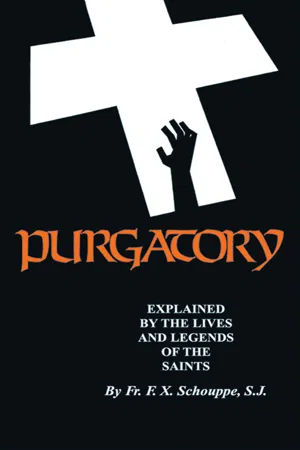
- 475 pages
- English
- ePUB (mobile friendly)
- Available on iOS & Android
eBook - ePub
About this book
Information
Topic
Theology & ReligionSubtopic
Christian DenominationsPart One
Purgatory, The Mystery of God’s Justice
Chapter 1
Purgatory in the Divine Plan.
PURGATORY occupies an important place in our holy religion: it forms one of the principal parts of the work of Jesus Christ, and plays an essential rôle in the economy of the salvation of man.
Let us call to mind that the Holy Church of God, considered as a whole, is composed of three parts: The Church Militant, the Church Triumphant, and the Church Suffering or Purgatory. This triple Church constitutes the mystical body of Jesus Christ, and the souls in Purgatory are no less His members than are the faithful upon earth and the elect in Heaven. In the Gospel, the Church is ordinarily called the Kingdom of Heaven; now Purgatory, just as the heavenly and terrestrial Church, is a province of this vast kingdom.
The three sister Churches have incessant relations with each other, a continual communication which we call the Communion of Saints. These relations have no other object than to conduct souls to eternal glory, the final term to which all the elect tend. The three Churches mutually assist in peopling Heaven, which is the permanent city, the glorious Jerusalem.
What then is the work which we, members of the Church Militant, have to do for the souls in Purgatory? We have to alleviate their sufferings. God has placed in our hands the key of this mysterious prison: it is prayer for the dead, devotion to the souls in Purgatory.
Chapter 2
Prayer for the Dead—Fear and Confidence.
PRAYER for the departed, sacrifices, and suffrages for the dead form a part of Christian worship, and devotion towards the souls in Purgatory is a devotion which the Holy Ghost infuses with charity into the hearts of the faithful. It is a holy and wholesome thought, says Holy Scripture, to pray for the dead, that they may be loosed from sins. (2 Mach. 12:46).
In order to be perfect, devotion to the souls in Purgatory must be animated both by a spirit of fear and a spirit of confidence. On the one hand, the Sanctity of God and His Justice inspires us with a salutary fear; on the other, His infinite Mercy gives us boundless confidence.
God is Sanctity itself, much more so than the sun is light, and no shadow of sin can endure before His face. Thine eyes are pure, says the prophet, and thou canst not look on iniquity. (Hab. 1:13). When iniquity manifests itself in creatures, the Sanctity of God exacts expiation, and when this expiation is made in all the rigor of justice, it is terrible. It is for this reason that the Scripture says again, Holy and terrible is His name (Ps. 110); as though it would say, His Justice is terrible because His Sanctity is infinite.
The Justice of God is terrible, and it punishes with extreme rigor even the most trivial faults. The reason is that these faults, light in our eyes, are in nowise so before God. The least sin displeases Him infinitely, and, on account of the infinite Sanctity which is offended, the slightest transgression assumes enormous proportions, and demands enormous atonement. This explains the terrible severity of the pains of the other life, and should penetrate us with a holy fear.
This fear of Purgatory is a salutary fear; its effect is not only to animate us with a charitable compassion towards the poor suffering souls, but also with a vigilant zeal for our own spiritual welfare. Think of the fire of Purgatory, and you will endeavor to avoid the least faults; think of the fire of Purgatory, and you will practice penance, that you may satisfy Divine Justice in this world rather than in the next.
Let us, however, guard against excessive fear, and not lose confidence. Let us not forget the Mercy of God, which is not less infinite than His Justice. Thy mercy, Lord, is great above the Heavens, says the prophet (Ps. 107); and elsewhere, The Lord is gracious and merciful: patient, and plenteous in mercy. (Ps. 144). This ineffable mercy should calm the most lively apprehensions, and fill us with a holy confidence, according to the words, In te, Domine, speravi, non confundar in æternum—“In Thee, O Lord, I have hoped; let me never be put to confusion.” (Ps. 70).
If we are animated with this double sentiment, if our confidence in God’s Mercy is equal to the fear with which His Justice inspires us, we shall have the true spirit of devotion to the souls in Purgatory.
This double sentiment springs naturally from the dogma of Purgatory rightly understood—a dogma which contains the double mystery of Justice and Mercy: of Justice which punishes, of Mercy which pardons. It is from this double point of view that we are about to consider Purgatory and illustrate its doctrine.
Chapter 3
The Word Purgatory—Catholic Doctrine—Council of Trent—Controverted Questions.
THE word Purgatory is sometimes taken to mean a place, sometimes as an intermediate state between Hell and Heaven. It is, properly speaking, the condition of souls which, at the moment of death, are in the state of grace, but which have not completely expiated their faults, nor attained the degree of purity necessary to enjoy the vision of God.
Purgatory is, then, a transitory state which terminates in a life of everlasting happiness. It is not a trial by which merit may be gained or lost, but a state of atonement and expiation. The soul has arrived at the term of its earthly career; that life was a time of trial, a time of merit for the soul, a time of mercy on the part of God. This time once expired, nothing but justice is to be expected from God, whilst the soul can neither gain nor lose merit. She remains in the state in which death found her; and since it found her in the state of sanctifying grace, she is certain of never forfeiting that happy state, and of arriving at the eternal possession of God. Nevertheless, since she is burdened with certain debts of temporal punishment, she must satisfy Divine Justice by enduring this punishment in all its rigor.
Such is the signification of the word Purgatory, and the condition of the souls which are there.
On this subject the Church proposes two truths clearly defined as dogmas of faith: first, that there is a Purgatory; second, that the souls which are in Purgatory may be assisted by the suffrages of the faithful, especially by the Holy Sacrifice of the Mass.
Besides these two dogmatic points, there are several doctrinal questions which the Church has not decided, and which are more or less clearly solved by the Doctors. These questions relate 1) to the location of Purgatory; 2) to the nature of the sufferings; 3) to the number and condition of the souls which are in Purgatory; 4) to the certainty which they have of their beatitude; 5) to the duration of their sufferings; 6) to the intervention of the living in their behalf, and the application of the suffrages of the Church.
Chapter 4
Location of Purgatory—Doctrine of Theologians—Catechism of the Council of Trent—St. Thomas.
ALTHOUGH faith tells us nothing definite regarding the location of Purgatory, the most common opinion, that which most accords with the language of Scripture, and which is the most generally received among theologians, places it in the bowels of the earth, not far from the Hell of the reprobates. Theologians are almost unanimous, says Bellarmine, in teaching that Purgatory, at least the ordinary place of expiation, is situated in the interior of the earth, that the souls in Purgatory and the reprobate are in the same subterranean space in the deep abyss which the Scripture calls Hell. (Catech. Rom., chap. 6, § 1).
When we say in the Apostles’ Creed that after His death Jesus Christ descended into Hell, the name Hell, says the Catechism of the Council of Trent, signifies those hidden places where the souls are detained which have not yet reached eternal beatitude. But these prisons are of different kinds. One is a dark and gloomy dungeon, where the damned are continually tormented by evil spirits, and by a fire which is never extinguished. This place, which is Hell properly so called, is also named Gehenna and abyss.
There is another Hell, which contains the fire of Purgatory. There the souls of the just suffer for a certain time, that they may become entirely purified before being admitted into their heavenly fatherland, where nothing defiled can ever enter.
A third Hell was that into which the souls of the saints who died before the coming of Jesus Christ were received, and in which they enjoyed peaceful repose, exempt from pain, consoled and sustained by the hope of their redemption. They were those holy souls which awaited Jesus Christ in Abraham’s bosom, and which were delivered when Christ descended into Hell. Our Saviour suddenly diffused among them a brilliant light, which filled them with infinite joy, and gave them sovereign beatitude, which is the vision of God. Then was fulfilled the promise of Jesus to the good thief: This day thou shalt be with me in Paradise.
“A very probable opinion,” says St. Thomas, “and one which, moreover, corresponds with the words of the saints in particular revelation, is that Purgatory has a double place for expiation. The first will be destined for the generality of souls, and is situated below, near to Hell; the second will be for particular cases, and it is from thence that so many apparitions occur.” (Suppl., part. 3, ques. ult.).
The holy Doctor admits, then, like so many others who share his opinions, that sometimes Divine Justice assigns a special place of purification to certain souls, and even permits them to appear either to instruct the living or to procure for the departed the suffrages of which they stand in need; sometimes also for other motives worthy of the wisdom and mercy of God.
Such is the general view concerning the location of Purgatory. Since we are not writing a controversial treatise, we add neither proofs nor refutations; these can be seen in authors such as Suarez and Bellarmine. We will content ourselves by remarking that the opinion concerning a subterranean Hell has nothing to fear from modern science. A science purely natural is incompetent in questions which belong, as does this one, to the supernatural order. Moreover, we know that spirits may be in a place occupied by bodies, as though these bodies did not exist. Whatever, then, the interior of the earth may be, whether it be entirely of fire, as geologists commonly say, or whether it be in any other state, there is nothing to prevent its serving as a sojourn of spirits, even of spirits clothed with a risen body. The Apostle St. Paul teaches us that the air is filled with a multitude of evil spirits: We have to combat, says he, against the spirits of wickedness in the high places. (Eph. 6:12).
On the other hand, we know that the good angels who protect us are no less numerous in the world. Now, if angels and other spirits can inhabit our atmosphere, whilst the physical world is not in the least degree changed, why cannot the souls of the dead dwell in the bosom of the earth?
Chapter 5
Location of Purgatory—Revelations of the Saints—St. Teresa—St. Louis Bertrand—St. Mary Magdalen de Pazzi.
ST. TERESA had great charity towards the souls in Purgatory, and assisted them as much as lay in her power by her prayers and good works. In recompense, God frequently showed her the souls she had delivered; she saw them at the moment of their release from suffering and of their entrance into Heaven. Now, they generally came forth from the bosom of the earth. “I received tidings,” she writes, “of the death of a Religious who had formerly been Provincial of that province, and afterwards of another. I was acquainted with him, and he had rendered me great service. This intelligence caused me great uneasiness. Although this man was commendable for many virtues, I was apprehensive for the salvation of his soul, because he had been Superior for the space of twenty years, and I always fear much for those who are charged with the care of souls. Much grieved, I went to an oratory; there I conjured our Divine Lord to apply to this Religious the little good I had done during my life, and to supply the rest by His infinite merits, in order that this soul might be freed from Purgatory.
“Whilst I besought this grace with all the fervor of which I was capable, I saw on my right side this soul come forth from the depths of the earth and ascend into Heaven in transports of joy. Although this priest was advanced in years, he appeared to me with the features of a man who had not yet attained the age of thirty, and with a countenance resplendent with light.
“This vision, though very short, left me inundated with joy, and without a shadow of doubt as to the truth of what I had seen. As I was separated by a great distance from the place where this servant of God had ended his days, it was some time before I learned the particulars of his edifying death; all those who were witnesses of it could not behold without admiration how he preserved consciousness to the last moment, the tears he shed, and the sentiments of humility with which he surrendered his soul to God.
“A Religious of my community, a great servant of God, had been dead not quite two days. We were saying the Office for the Dead for her in choir, a sister was reading the lesson, and I was standing to say the versicle. When half of the lesson had been said, I saw the soul of this Religious come forth from the depths of the earth, like the one of which I have just spoken, and go to Heaven.
“In this same monastery there died, at the age of eighteen or twenty years, another Religious, a true model of fervor, regularity, and virtue. Her life had been but a tissue of maladies and sufferings patiently endured. I had no doubt, after having seen her live thus, that she had more than sufficient merits to exempt her from Purgatory. Nevertheless, whilst I was at Office, before she was interred, and about a quarter of an hour after her death, I saw her soul likewise issue from the earth and rise to Heaven.” Behold what St. Teresa writes.
A like instance is recorded in the Life of St. Louis Bertrand, of the Order of St. Dominic. This Life, written by Father Antist, a Religious of the same Order, and who lived with the saint, is inserted in the Acta Sanctorum on the 10th of October. In the year 1557, whilst St. Louis Bertrand resided at the convent of Valentia, the pest broke out in that city. The terrible plague spread rapidly, threatening to exterminate the inhabitants, and each one trembled for his life. A Religious of the community, wishing to prepare himself fervently for death, made a general Confession of his whole life to the saint; and on leaving him said, “Father, if it should now please God to call me, I shall return and make known to you my condition in the other life.” He died a short time afterwards, and the following night he appeared to the saint. He told him that he was detained in Purgatory on account of a few slight faults which remained to be expiated, and begged the saint to recommend him to the community. St. Louis communicated the request immediately to the Prior, who hastened to recommend the soul of the departed to the prayers and Holy Sacrifices of the brethren assembled in chapter.
Six days later, a man of the town, who knew nothing of what had passed at the convent, came to make his Confession to Father Louis, and told him “that the soul of Father Clement had appeared to him. He saw, he said, the earth open, and the soul of the deceased Father come forth all glorious; it resembled, he added, a resplendent star, which rose through the air towards Heaven.”
We read in the Life of St. Magdalen de Pazzi, written by her confessor, Father Cepari, of the Company of Jesus, that this servant of God was made witness of the deliverance of a soul under the following circumstances: One of her sisters in religion had died some time previous, when the saint being one day in prayer before the Blessed Sacrament, saw issue from the earth the soul of that sister, still captive in the dungeons of Purgatory. She was enveloped in a mantle of flames, under w...
Table of contents
- Front Cover
- Half Title Page
- Title Page
- Copyright Page
- Dedication
- Contents
- Publisher’s Preface
- Author’s Preface
- Translator’s Preface
- Part One PURGATORY—THE MYSTERY OF GOD’S JUSTICE
- Part Two PURGATORY—THE MYSTERY OF GOD’S MERCY
- Appendix1—Indulgences
- Appendix2—The Brown Scapular
- Appendix3—Prayers for the Poor Souls
- Back Cover
- A COLLECTION OF CLASSIC ARTWORK
- WHAT WILL HELL BE LIKE?
- Tan Classics
- Become a Tan Missionary!
- Share the Faith with Tan Books!
- Tan Books
Trusted by 375,005 students
Access to over 1.5 million titles for a fair monthly price.
Study more efficiently using our study tools.
Frequently asked questions
Yes, you can cancel anytime from the Subscription tab in your account settings on the Perlego website. Your subscription will stay active until the end of your current billing period. Learn how to cancel your subscription
No, books cannot be downloaded as external files, such as PDFs, for use outside of Perlego. However, you can download books within the Perlego app for offline reading on mobile or tablet. Learn how to download books offline
We are an online textbook subscription service, where you can get access to an entire online library for less than the price of a single book per month. With over 1.5 million books across 990+ topics, we’ve got you covered! Learn about our mission
Look out for the read-aloud symbol on your next book to see if you can listen to it. The read-aloud tool reads text aloud for you, highlighting the text as it is being read. You can pause it, speed it up and slow it down. Learn more about Read Aloud
Yes! You can use the Perlego app on both iOS and Android devices to read anytime, anywhere — even offline. Perfect for commutes or when you’re on the go.
Please note we cannot support devices running on iOS 13 and Android 7 or earlier. Learn more about using the app
Please note we cannot support devices running on iOS 13 and Android 7 or earlier. Learn more about using the app
Yes, you can access Purgatory by Rev. Fr. F. X. Schouppe, S.J. in PDF and/or ePUB format, as well as other popular books in Theology & Religion & Christian Denominations. We have over 1.5 million books available in our catalogue for you to explore.