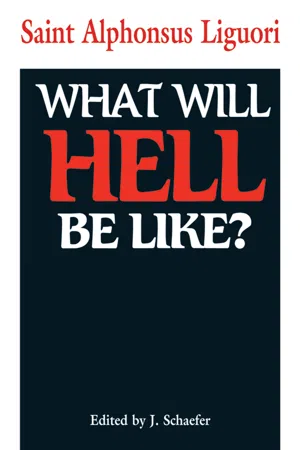
Selections from St. Alphonsus' writings. Covers virtually every aspect of Hell. Shows it exists, describes its torments, proves it is eternal, demonstrates it is not unjust and answers a host of questions. Best short antidote for today's irreligion that we know.
- 32 pages
- English
- ePUB (mobile friendly)
- Available on iOS & Android
eBook - ePub
What Will Hell Be Like?
About this book
Information
Topic
Theology & ReligionSubtopic
Christian DenominationsWhat Will Hell Be Like?
THOUGH many of the pagans were true atheists, considering Hell a fable invented to frighten the wicked, the more renowned of the ancient philosophers such as Socrates, Xenophon, Aristotle, Plato and others had no difficulty in admitting the existence of a future life—a Heaven where the good would be rewarded, and a Hell where the evil are to be punished. Only the most perverted of men will deny that there is a God, the Creator and Governor of all things. Such men would prefer to deny the existence of God than to face the just chastisement of their own misdeeds.
We Expect Reward or Punishment
On the one hand, men know perfectly well that God is a just rewarder of good, and at the same time they behold in the world countless wicked men who live in the midst of prosperity, while many of the virtuous live out their lives in the midst of affliction and misfortune. Hence, most people are convinced that after this mortal life, there exists another world in which vice is to be chastised and virtue rewarded as it deserves.
Teaching of Pagan Philosophers
The most famous of the pagan philosophers did not hesitate to teach that there exists in the other life a Heaven and a Hell. Xenophon and Socrates, for instance, remarked that, “Rewards are in store for those who please God, and punishments for those who displease Him.” The same sentiments are expressed by Plato, Plutarch and others. While I refrain from quoting passages from these philosophers, I cannot pass over in silence two beautiful passages of the great orator, Cicero. In the first, he exclaims: “I wish to have no part with those who have recently begun to teach that souls die along with bodies, and that all is destroyed by death. Of far more weight with me is the authority of the ancient philosophers and of our own ancestors. They paid religious homage to the dead, and considered that their entrance into Heaven should be made easy for every good and just man.” The second passage is even more to the point: “Those souls, which have been soiled by the vices of this life, will take the false road which separates them from the company of the gods; on the other hand, those who have preserved themselves pure and chaste, will find easy admittance to the divinity, the source of their existence.”
Belief of Pagans
Among the fables of pagan peoples, there are numerous tales which, though they are fictitious, nevertheless attest to the belief of these people in the existence of a place of punishment in the future life. For us Christians, however, this belief of ancient pagans, and their philosophers, is but a substantiating argument. For we have the word of God Himself, attesting to the existence of Hell in countless passages of Sacred Scripture.
Where Is Hell Located?
The question as to the place where Hell is situated has been a matter of conjecture among the Fathers of the Church and theologians. St. John Chrysostom, for instance, was of the opinion that it is situated outside the bounds of this universe. More commonly and with more reason, other theologians think that Hell is situated within the earth itself. Some have even gone so far as to declare that it is near the surface of the globe, basing their opinion, rather quaintly, upon the existence of many volcanic mountains such as Vesuvius, the Volcanic Isles, Mt. Etna and others.
Catholic Teaching
Aside from these debatable opinions, a group of heretics known as the Ubiquitists maintained that Hell is not restricted to any determined place, but is to be found everywhere, since God has not destined any special place for the damned. This opinion, however, is evidently false, and contrary to the common belief of the Catholic Church which teaches us that God has established a definite place for the demons and the reprobate, as is evident from several texts of Sacred Scripture. St. Jerome deduces this specifically from a passage in the book of Numbers (Num. 16:31-33). Here is described the fate of Dathan and Abiron who were precipitated into Hell, falling into a chasm which opened under their very feet. At the same time a great flame burst from the earth and killed two hundred and fifty men who were accomplices in their sin. Moreover, in many passages of Sacred Scripture, the word “descend” is used in reference to Hell, indicating that Hell is situated in the bowels of the earth.
Hell Is a Definite Place
This assertion is confirmed by a passage of St. Luke (16:22): “But the rich man also died and was buried in hell.” The sacred text employs the word “buried,” because burials are made within the earth. Moreover, the rich man himself describes Hell as a “place of torment” (Lk. 16:28), confirming the opinion that Hell is a determined and definite place. In another place it is called a “lake”; “Thou hast saved me from those descending into the lake” (Ps. 29:3); and elsewhere, a pool: “And the devil who deceived them was cast into the pool of fire and brimstone.” (Apoc. 20:9). It is evident, therefore, that Hell is a determined place, and most probably situated within the earth. But as to where, precisely, it is situated, whether at the very center of the earth or nearer to the surface, cannot be determined from any revealed document. St. Thomas also declared that the dimensions of Hell, which will be the dwelling place of the damned after the resurrection, cannot be determined.
Pains of Hell
Let us now treat of the pains of Hell, and first of all, of that of sense. St. Thomas proves that the fire of Hell is a corporeal and material fire, though for the most part he does not write of the fire which torments the souls separated from their bodies, but of that which the damned are to endure after their corporeal resurrection. Many heretics have maintained that the fire of Hell is not material, but only metaphorical or imaginary fire. There are numerous texts in Sacred Scripture, however, which demonstrate that the fire of Hell is a true, material and corporeal fire. We read, for instance, in the book of Deuteronomy: “A fire is kindled in my wrath, and shall burn even to the lowest hell.” (Deut. 32:22). And in the book of Job: “A fire that is not kindled shall devour him” (Job 20:26), revealing that this fire of Hell needs not to be nourished, but, once enkindled by God, burns eternally. There are a number of passages in the book of Isaias referring to this fire of Hell: “Which of you can dwell with devouring fire? which of you shall dwell with everlasting burnings?” (33:14); “Their worm shall not die, and their fire shall not be quenched, and they shall be a loathsome sight to all flesh.” (66:24). “He will give fire, and worms into their flesh, that they may burn, and may feel forever.” (Judith 16:21).
Fire of Hell
In the parable of the Gospel, the rich man buried in Hell cries out to Lazarus, “I am tormented in this flame.” (Lk. 16:24). He says, “in this flame,” to show that the fire of Hell is a fire of a particular type, a fire prepared expressly to avenge the injuries which sin has done to God by carnal pleasures. For, as the book of Ecclesiasticus remarks, “the vengeance on the flesh of the ungodly is fire and worms.” (Eccl. 7:19). Hence, St. Thomas argues that this fire will be the instrument of the avenging justice of Almighty God.
Can a Spiritual Soul Feel Fire?
But here a difficulty is posed: how is it possible for corporeal fire to torment the spiritual soul? In answer to this question, we can only say that we know that it can be done. Perhaps the answer lies in this explanation of many theologians. The material fire of Hell will be given an extraordinary power by God, whereby it will be able to bind the spiritual soul to its place of torment, thus causing the soul untold humiliation and pain.
Punishment by Cold
In this same fire, St. Thomas remarks, the bodies of the damned, in addition to the intense heat, will endure bitter cold, passing from one to the other, without knowing a moment of relief. Thus do Scripture scholars explain the passage of the book of Job: “Let him pass from the snow water to excessive heat, and his sin even to hell.” (Job 24:19). Hence, St. Jerome says, the damned in Hell endure all their torments in this one fire.
Remorse of Conscience
In addition to their sufferings from the heat and cold of the fire of Hell, Sacred Scripture enumerates a number of other torments which will afflict the damned. One of these is the “worm,” to which the Scriptures refer frequently. Some commentators have explained this “worm” as a material thing, which will feed upon, without consuming, the flesh of the damned. But most theologians explain it metaphorically as the remorse of conscience which will afflict the damned in the fire and darkness of Hell. Forever will they have imprinted on their memories the results of their sins; forever will they repeat the words ascribed to them in the book of Wisdom: “We have erred from the way of truth, we wearied ourselves in the way of iniquity and destruction and have walked through hard ways. What hath pride profited us? or what advantage hath the boasting of riches brought us? . . . Such things as these the sinners said in hell.” (Wis. 5:6-14).
Suffering from Devils and Darkness
Added to their own remorse of conscience, the damned will also be tormented by the reproaches of the demons. This will be one of the most cruel punishments of the damned: the devils, who are their enemies, will continually mock them and remind them of their sins. Nor will the sufferings of the bodies of the damned cease here. They will also be afflicted by the terrible darkness of Hell, described by the holy man, Job: “Before I go, and return no more, to a land that is dark and covered with the mist of death: a land of misery and darkness, where the shadow of death, and no order, but everlasting horror dwelleth.” (Job 10:22).
Pain of Loss of God
A certain author has written, but with little foundation, that the pain of loss is the same for all the reprobate. But it seems far more probable to me and to the majority of theologians that, though the damned are equally deprived of God, this pain will, nevertheless, afflict each according to the measure of his faults and the knowledge he will have in Hell of the God whom he has lost. For it is difficult to believe that one who has lost God by one mortal sin will be tormented in the same degree as one who has lost Him by a hundred sins. It is equally inconceivable to me, for instance, how one who has been in the state of sin for but one day, can be called upon to bear the same degree of punishment as he who has remained in this state for a whole year. For just as he who has loved God more ardently during his life, will enjoy Him more in Heaven, because of the knowledge of the immense good which he will then possess, so also will the damned, who has deprived himself of his God, be more severely tormented in realizing more deeply the great good which he has lost.
Teaching of St. Thomas
St. Thomas describes for us perfectly in what will consist the happiness of the elect and the torment of the reprobate. Insofar as his intellect is concerned, the Saint remarks, man will find complete joy in the vision of God; but, insofar as his affections are concerned, he will find complete satisfaction in the permanent union of his will with the infinite goodness of God. On the other hand, the torment of the damned will consist in being deprived of all divine light in his intellect, and in finding his affections obstinately turned away from the Divine Goodness. Elsewhere the saintly Doctor teaches that, though the punishment of the fire will be more terrifying, this separation from God is, however, a greater torment than that of the fire.
God Makes Heaven
In short, it is God who will be our paradise, for He embraces all goods in Himself, as He Himself once declared to Moses: “I will show thee all good.” (Ex. 33:19). Such was also the promise which He made to Abraham because of his merits: “Fear not, Abram, I am thy protector, and thy reward exceedingly great.” (Gen. 15:1). And what greater reward can He promise than Himself, who is the one good embracing all other goods?
God Makes Hell
It is also God who will make Hell, for, as St. Bernard remarks, He Himself will be the chastisement of the damned. For just as the elect will be supremely happy because God is for him, and he is for God, so also will the reprobate be unhappy, because God is no longer for him, and he is no longer for God. Let us listen to the threat which God made against those who refused to belong to Him during this life: “Call his name, Not my people’; for you are not my people, and I will not be yours.” (Osee 1:9). It is in this, then, that the torment of the damned will consist; it consists in the first sentence which Jesus Christ will pronounce over His enemies: “Depart from me into everlasting fire.” This eternal separation will constitute Hell for the damned.
Eternal Choice Is Made During Life
For the present, sinners, blinded by the apparent goods of this earth, choose to live far from God and to turn their backs upon Him. And should God, who cannot dwell with sin, wish to enter into their hearts by expelling sin from them, they are not ashamed to repel Him, exclaiming: “Depart from us, we desire not the knowledge of thy ways.” (Job 21:14). Depart from us, we do not wish to follow Your ways, but our own, our passions, our pleasures. The great multitude of those, says Sacred Scripture, “who sleep in the dust of the earth, shall awake; some unto life everlasting, and others unto reproach, to see it always?’ (Dan. 12:2). Yes, these unfortunates now sleep in the dust of their blindness; but, in the other life, unfortunately for them, they will awaken and realize the immense good which they have lost in voluntarily losing God.
Greatest Pain of Hell
The sword which shall pierce them with the greatest sorrow will be the thought of having lost God, and of having lost Him through their own fault. Unfortunates that they are! They now seek to lose sight of God, but once fallen into Hell, they will no longer be able to cease thinking of Him, and in this will their chastisement consist.
St. Augustine says that in Hell, the damned will be forced to think of nothing but God, and that will cause them terrible torment. And St. Bona-venture, expressing the same sentiments, says that no thought will torment the damned more than the thought of God. The Lord will grant to them such a vivid knowledge of their offended God, His goodness so unworthily spurned, and consequently, of the chastisement which their crimes have merited, that this knowledge will cause them a suffering greater than that of all the other punishments of Hell.
We read in the book of Ezechiel: “Over the heads of the living creatures was the likeness of the firmament, as the appearance of crystal terrible to behold, and stretched out over their heads above.” (1:22). Explaining these words, one author says that the damned will have continually before their eyes a terrible crystal or mirror: with the assistance of some fatal light, they will behold, on one hand, the immense good which they have lost in voluntarily losing divine grace, and, on the other, they will view the justly wrathful face of God; and this torment will surpass by a million times all the other punishments of Hell.
On this same subject, the author Cajetan makes the following reflection upon the words of David: “The wicked shall be turned into hell, all the nations that forget God.” (Ps. 9:18). The Prophet, says this ...
Table of contents
- Cover Page
- Copyright Page
- Contents
- What Will Hell Be Like?
Trusted by 375,005 students
Access to over 1.5 million titles for a fair monthly price.
Study more efficiently using our study tools.
Frequently asked questions
Yes, you can cancel anytime from the Subscription tab in your account settings on the Perlego website. Your subscription will stay active until the end of your current billing period. Learn how to cancel your subscription
No, books cannot be downloaded as external files, such as PDFs, for use outside of Perlego. However, you can download books within the Perlego app for offline reading on mobile or tablet. Learn how to download books offline
Perlego offers two plans: Essential and Complete
- Essential is ideal for learners and professionals who enjoy exploring a wide range of subjects. Access the Essential Library with 800,000+ trusted titles and best-sellers across business, personal growth, and the humanities. Includes unlimited reading time and Standard Read Aloud voice.
- Complete: Perfect for advanced learners and researchers needing full, unrestricted access. Unlock 1.5M+ books across hundreds of subjects, including academic and specialized titles. The Complete Plan also includes advanced features like Premium Read Aloud and Research Assistant.
We are an online textbook subscription service, where you can get access to an entire online library for less than the price of a single book per month. With over 1.5 million books across 990+ topics, we’ve got you covered! Learn about our mission
Look out for the read-aloud symbol on your next book to see if you can listen to it. The read-aloud tool reads text aloud for you, highlighting the text as it is being read. You can pause it, speed it up and slow it down. Learn more about Read Aloud
Yes! You can use the Perlego app on both iOS and Android devices to read anytime, anywhere — even offline. Perfect for commutes or when you’re on the go.
Please note we cannot support devices running on iOS 13 and Android 7 or earlier. Learn more about using the app
Please note we cannot support devices running on iOS 13 and Android 7 or earlier. Learn more about using the app
Yes, you can access What Will Hell Be Like? by St. Alphonsus Liguori in PDF and/or ePUB format, as well as other popular books in Theology & Religion & Christian Denominations. We have over 1.5 million books available in our catalogue for you to explore.