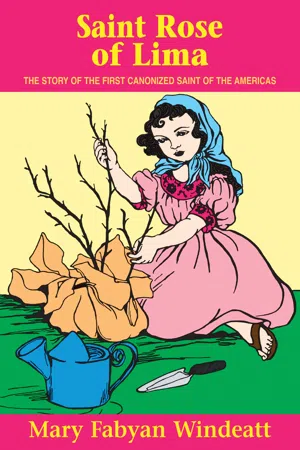
St. Rose of Lima (1586-1617), Patroness of the Americas, is the first canonized saint of the New World. She was the tenth of thirteen children, and her mother experienced no pain at her birth. Though exquisitely beautiful (hence her nickname, Rose), she refused to marry, and while helping support her family by needlework and growing flowers, she practiced heroic charity and lived as a Dominican Tertiary in her parents' home. Rose tenderly cared for the sick, even those with repulsive wounds, and she often obtained miraculous cures for people from the Child Jesus. On other occasions, she worked miracles in order to feed the members of her family, and became known as "Mother of the Poor." Rose continually prayed and offered her sufferings for the conversion of the idolatrous Incas. In the year 1615, through her prayers, the Blessed Sacrament and the people of Lima were spared attack by savage pirates. St. Rose was a friend and confidant of St. Martin de Porres, who lived in the same city. Her mystical experiences caused an ecclesiastical inquiry.Though dead at only 31, St. Rose's love of God was so intense that she was recognized as a saint in her own time and was canonized by the Church just 54 years later, in 1671. St. Rose of Lima has captured the imagination of the world and stands as one of the most popular saints in the history of the Church.
eBook - ePub
St. Rose of Lima
The Story of the First Canonized Saint of the Americas
- 320 pages
- English
- ePUB (mobile friendly)
- Available on iOS & Android
eBook - ePub
About this book
Trusted by 375,005 students
Access to over 1 million titles for a fair monthly price.
Study more efficiently using our study tools.
Information
Topic
Theology & ReligionSubtopic
Christian DenominationsCHAPTER 1
WHAT’S IN A NAME?
IT WAS a July day in the city of Lima, with the sun hiding behind the thick blanket of mist which generally covers the coasts of Peru and Chile from June until September. Maria de Oliva Flores shivered as she went out into the large garden behind her house. Such days as these, with no sunlight, did not please her. The air was heavy and damp. She felt like sleeping all the time.
“Marianna! Are you out here?”
From the other end of the garden, out of sight among the trees and flowers, came a girl’s voice. “Sí, señora. I am with little Isabel.”
Maria de Oliva turned into a narrow path, bending her head as she passed under a spreading fig tree. She might have known. Marianna, the Indian servant girl, always came out here after lunch with the baby of the Flores family. Three-month-old Isabel was definitely Marianna’s favorite. Now Maria quickened her steps as she came to where Marianna was sitting beside the child’s cradle. There was a proud smile on her face as she lifted the lace covering and looked down at her youngest child.
“Marianna, I’ve had many children, but I believe Isabel is the sweetest of all. Such pretty dark hair and eyes! And those little pink cheeks….”
The young Indian girl smiled, her white teeth flashing in the bronze of her face. “Isabel is like a flower, señora. And so good! I’ve never seen such a lovely baby.”
“Like a flower, Marianna? What flower?”
“A rose, señora. A beautiful pink rose. Just look at her now, smiling at us as though she knew what we were saying!”
Maria de Oliva was quiet a moment. This child had been born three months ago—on April 30, the feast of Saint Catherine of Siena. On May 25 she had been baptized by Father Anthony Polanco at the Church of San Sebastián and given the name Isabel. This had been to please her grandmother, Isabel de Herrera, Maria de Oliva’s own mother. But did that name really suit the child? Wouldn’t it be better to call her Rose, after the flower she resembled so much?
Marianna busied herself with her mending. The Flores family was not wealthy. With several children to feed and clothe, Gaspar Flores could afford only one servant. That meant Marianna had little free time. But she did not mind; now that little Isabel had come, it was especially good to be part of the Flores household.
“When this baby grows up, she will be the prettiest girl in Lima,” said Marianna. “She will bring us good luck.”
“We can use it,” sighed Maria. “Sometimes it’s a very hard struggle to make ends meet. Let’s hope that Rose marries a wealthy man.”
“Rose, señora?”
“That’s right. I’m not going to call her Isabel any more. Rose suits her better. I know her grandmother won’t mind if we change it.”
Isabel de Herrera did mind, however. Her pride had been greatly flattered when Maria de Oliva had named her pretty little daughter after her, and she refused to hear of a change.
“She was called Isabel in Baptism, Maria. Why do you want to alter things now?”
“Because I think the name of Rose is better suited to her. Mother, please don’t make things difficult for me!”
Isabel de Herrera had a hot temper. “Difficult? What are you talking about? The child’s name is Isabel. That’s all there is to it!”
“It’s Rose!”
“It’s Isabel!”
“Rose, I tell you!”
“Isabel!”
Sometimes Gaspar Flores lost patience with his wife and mother-in-law. “Call the child anything you like,” he pleaded, “only let a man have some peace in his own house. Please!”
One year passed, two years, four years, and still the small Flores child was the center of a bitter struggle.
“It’s certainly very foolish,” said the neighbors.
“That poor little girl is afraid to answer to Rose because it displeases her grandmother. And she doesn’t know what to do when anyone calls her Isabel because then her mother is angry. Why doesn’t Gaspar put his foot down?”
But Gaspar Flores felt powerless. He felt that he could do little with his wife, much less with his mother-in-law.
“God help us all!” he often prayed.
One day Maria de Oliva, who was given to sudden fits of energy, decided to teach her little girl to read and write.
“Rose, you’re nearly five years old. I think you could learn the alphabet. Look—this is the letter A. This one is B. And here is C. It’s really very simple.”
Rose found a piece of paper and some colored chalk. This was going to be nice! Bernardina, her oldest sister, knew all about reading and writing. So did Jane and Andrew and Anthony and Matthew. Even seven-year-old Ferdinand could write his name quite well. Perhaps, thought Rose, she could catch up with her brothers and sisters if she worked hard.
After half an hour of copying letters, however, Rose’s small fingers grew stiff.
“I’m tired and so are you,” announced Maria de Oliva. “We’ll have another lesson tomorrow. Now I want you to promise me something.”
“Yes, Mother?”
“You’re not to answer to any other name but Rose. No—it doesn’t matter if your grandmother is cross. Your name is Rose Flores and nothing else. Understand?”
Rose nodded. The trouble about her name had always made her sad. She hated to see people quarreling, particularly her mother and grandmother. Ever since she could remember, however, there had been arguments between the two. Even though Maria insisted that she had once had a vision in which she saw a beautiful pink rose floating over Rose’s cradle, Isabel de Herrera would not believe it.
“That rose was a sign from Heaven telling me to change the child’s name.” said Maria de Oliva. “I’m absolutely convinced of it.”
“A sign from Heaven, indeed!” the older woman cried out. “It was nothing but your own imagination!”
Maria soon grew tired of teaching her small daughter to read and write. She didn’t have much patience, even at the best of times. And there was no one else to be interested in the child’s great desire to learn.
“You’re only a very little girl,” Marianna comforted her one day. “There’s plenty of time for you to learn reading and writing. As far as that goes, people can be quite happy without knowing how to do either of them. There’s just one thing that’s really important.”
“What?” asked Rose eagerly.
“Knowing what is good and doing it. You’ll never have any real trouble if you remember that, my child.”
Marianna’s words pleased Rose and she often turned them over in her mind. God was good. The more one thought about Him, the better one came to know Him. After that, being good and dying good were the simplest things in the world. Still, though, it would be nice to know a few things so that one might be useful to other people.
“I’m going to pray,” the little girl told herself. “Since no one has time to teach me things, I’m going to ask God to do it. He can do anything, can’t He?”
Maria de Oliva had a statue of the Christ Child in her room. As was the Peruvian custom, the statue had a robe of its very own. This one was of red velvet with gold trimmings. Every day Rose knelt down before the little statue and said a prayer.
“Lord, help me to know and love You,” she said very softly. “And please teach me to read and write!”
Maria de Oliva didn’t know about these little prayers of Rose’s. She had a lot to do to run her big house, and sometimes the work made her tired and cross.
“It won’t always be like this,” she thought. “Someday the children will marry, perhaps quite well. Then I’ll be able to take things easier.”
One morning Maria was baking bread. The kitchen was hot and steamy, and she was not in the mood to talk to anyone.
“Don’t bother me now,” she said, as Rose pushed open the door. “Go and play with Ferdinand until dinner time.”
“But Mother! Don’t you want to hear something wonderful? I know how to read and write!”
Maria de Oliva pounded the big mound of dough before her. “You mustn’t make up stories.” she said. “You’re not a baby anymore. You ought to know that to tell a lie is a sin.”
“I’m not telling a lie, Mother. I know how to read and write! Really and truly! Look!”
Maria glanced at the paper which Rose held out to her. It was covered with words, neatly written in a large round hand. For a five-year-old child, the writing was very good.
“Someone’s been helping you!” she said, a little sharply. “Your father or your grandmother.”

“Mother, I know how to read and write!”
Rose shook her head. “Nobody helped me, Mother. Only the little Christ Child. You’re always so busy I didn’t want to bother you, so I just asked Him to help me. And He did!”
Some of the flush faded from Maria’s heated face. “Go and bring me a book,” she ordered sternly. “Any book. We’ll soon see if you’re telling the truth.”
In a few minutes Rose was back with a big green volume. “Look, Mother, there are four words in gold letters on the cover. I can read every one of them.”
Maria de Oliva stared. If this child of hers was really telling the truth….
“Well? What are those four words?”
Rose smiled. This was a wonderful day. She would remember it as long as she lived. The four golden words on the cover of the green book were Saint Catherine Of Siena. Inside there were many more words, telling the life story of the great Italian saint upon whose feast day she had been born. And she could read every one of them!
CHAPTER 2
COME, HOLY GHOST!
THERE was much excitement in the Flores household at the news that five-year-old Rose had learned to read and write. No one seemed inclined to believe, however, that the Infant Jesus had been her teacher.
“Some youngsters have too much imagination,” declared Maria de Oliva. “I’m afraid our Rose is one of them.”
“You mean Isabel, don’t you?” said her mother pointedly. “That’s her real name. As for me, I feel there may be some truth in what she says. After all, who can say what God will do for a little child who loves Him?”
As the months passed, the incident was almost forgotten. When it was remembered, people said it was less a matter of prayer than of natural skill. Rose Flores was a clever child. She had simply picked up reading and writing by herself, the way she had picked up music. Couldn’t she play little tunes on the guitar and harp? Hadn’t she been heard singing her own verses, down at the back of the garden, when she thought no one was around? The whole thing was so simple. There had been no miracle, really. The child was just naturally bright.
Rose knew the truth, however. Of herself she was nothing—God was everything. She would never forget that. She would ask His help all through her life. He would listen to her, as He had done about the reading and writing, just because she was so weak and helpless.
Time passed. Rose had her sixth birthday, her eighth, her tenth. By now there were eleven children in the Flores family. The big house on the street named after Saint Dominic, the Street of Santo Domingo, was a very crowded place. Rose’s father, Gaspar ...
Table of contents
- Front Cover
- Half Title
- Title Page
- Copyright Page
- Dedication Page
- Contents
- Acknowledgement
- CHAPTER 1: What's in a Name?
- CHAPTER 2: Come, Holy Ghost!
- CHAPTER 3: The Secret
- CHAPTER 4: Another Visitor
- CHAPTER 5: Two Stories
- CHAPTER 6: A Saint Comes to Lima
- CHAPTER 7: A Friend in Need
- CHAPTER 8: Farewell to Santo Domingo
- CHAPTER 9: A Daughter of Saint Dominic
- CHAPTER 10: The Hermit
- CHAPTER 11: A New Home
- CHAPTER 12: The Pride of Peru
- CHAPTER 13: Heroines in Black and White
- Back Cover
- CONFESSION ITS FRUITFUL PRACTICE
- TAN CLASSICS
- BECOME A TAN MISSIONARY!
- SHARE THE FAITH WITH TAN BOOKS!
- TAN BOOKS
Frequently asked questions
Yes, you can cancel anytime from the Subscription tab in your account settings on the Perlego website. Your subscription will stay active until the end of your current billing period. Learn how to cancel your subscription
No, books cannot be downloaded as external files, such as PDFs, for use outside of Perlego. However, you can download books within the Perlego app for offline reading on mobile or tablet. Learn how to download books offline
Perlego offers two plans: Essential and Complete
- Essential is ideal for learners and professionals who enjoy exploring a wide range of subjects. Access the Essential Library with 800,000+ trusted titles and best-sellers across business, personal growth, and the humanities. Includes unlimited reading time and Standard Read Aloud voice.
- Complete: Perfect for advanced learners and researchers needing full, unrestricted access. Unlock 1.4M+ books across hundreds of subjects, including academic and specialized titles. The Complete Plan also includes advanced features like Premium Read Aloud and Research Assistant.
We are an online textbook subscription service, where you can get access to an entire online library for less than the price of a single book per month. With over 1 million books across 990+ topics, we’ve got you covered! Learn about our mission
Look out for the read-aloud symbol on your next book to see if you can listen to it. The read-aloud tool reads text aloud for you, highlighting the text as it is being read. You can pause it, speed it up and slow it down. Learn more about Read Aloud
Yes! You can use the Perlego app on both iOS and Android devices to read anytime, anywhere — even offline. Perfect for commutes or when you’re on the go.
Please note we cannot support devices running on iOS 13 and Android 7 or earlier. Learn more about using the app
Please note we cannot support devices running on iOS 13 and Android 7 or earlier. Learn more about using the app
Yes, you can access St. Rose of Lima by Mary Fabyan Windeatt in PDF and/or ePUB format, as well as other popular books in Theology & Religion & Christian Denominations. We have over one million books available in our catalogue for you to explore.