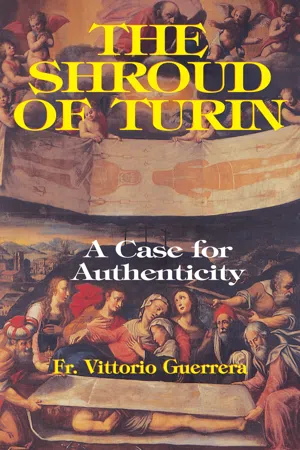
A fast-paced book that is easy to read; The Shroud of Turin is guaranteed to interest everyone and give convincing proof--despite the recent propaganda to the contrary--that the Shroud of Turin is the actual burial cloth of Our Lord Jesus Christ. Filled with facts of science and history; you are guaranteed to learn a lot! Well researched and well written. This book is small and doesn't take too long to read -- makes a great gift!
- 191 pages
- English
- ePUB (mobile friendly)
- Available on iOS & Android
eBook - ePub
About this book
Information
Topic
Theology & ReligionSubtopic
Christian Denominations–1–
History of the Shroud
THE Shroud of Turin is a linen cloth of ivory color measuring fourteen feet three inches long by three feet seven inches wide or eight cubits long by two cubits wide, according to first-century Jewish measurements. (A cubit is equivalent to 21.7 inches.) The cloth is made of a three-to-one herringbone weave with a “Z” twist. Parallel to one side of the cloth is sewn a six-inch-wide strip of the same weave pattern. It is generally believed that this piece was added to the Shroud in order to insert a rod to facilitate its exposition. The Shroud bears the frontal and dorsal image of a naked, crucified, bearded man, approximately five feet eleven inches tall, between the ages of 30-35, weighing about 175 pounds. Many people believe that this Shroud is the burial cloth of Jesus Christ.
The history of the Shroud can be traced with assurance to the mid-fourteenth century. Prior to that period, little is known with absolute certainty concerning its whereabouts. A third century Syrian text mentions a cloth that is associated with the miraculous cure of King Abgar V, ruler of Edessa (13-59 A.D.), now called Urfa, in southeastern Turkey. This story was translated almost verbatim by Eusebius, bishop of Caesarea, in his Ecclesiastical History in 325 A.D.1 According to the story, Abgar suffered from an ailment, perhaps leprosy. Having heard about the healing powers of Jesus, he sent a certain Ananias around the year 31-32 A.D. with a letter to Jesus requesting that He come and heal him. Jesus replied that He was unable to go, but promised to send one of His disciples. It was not until after His death and Resurrection that one of the seventy-two disciples, Thaddeus, brought a cloth to Abgar bearing an image of the face of Jesus. Upon seeing this cloth, Abgar was cured, and the Christian Faith was established in the city. (Actually, the first Christian king of Edessa was Abgar VIII, who ruled from 177-212.) Although the Syrian text mentions a cloth, for reasons unknown, Eusebius makes no reference to it; rather, he states that Abgar saw a vision when he looked at Thaddeus. “Immediately on his entrance there appeared to Abgar a great vision on the face of the Apostle Thaddeus. When Abgar saw this, he did reverence to Thaddeus, and wonder seized all who stood about, for they themselves did not see the vision, which appeared to Abgar alone.”2
While the Syrian account refers to Thaddeus as one of the seventy-two disciples of the Lord (cf. Luke 10:1), he soon came to be associated with Jude Thaddeus, the apostle who was a cousin of Jesus (cf. Matt. 13:55; Mark 6:3). One of the earliest Byzantine icons to depict Thaddeus holding the Image of Edessa, as the cloth was referred to there, was painted in 550 A.D. and is located at St. Catherine Monastery on Mount Sinai. In the Western tradition, St. Jude is often represented holding an image of the face of Jesus over his heart. It has been suggested by the British historian Ian Wilson that the Image of Edessa was actually the Shroud folded in such a way that only the face was visible. Early replicas of the Image were portrayed as an elongated trellis frame with a circle in the middle that depicted the face. A sixth-century text called The Acts of Thaddeus refers to such an image as a tetradiplon, a Greek word which literally means “doubled in four” or, put another way, folded in eight layers.3 Interestingly, this Greek word is not used for any other object. Dr. John Jackson, an Air Force physicist who was part of the 1978 Shroud of Turin Research Project, “found that doubling the cloth in four did indeed expose the face area. Furthermore, Jackson found an eight-fold pattern of folds. . . .”4
After the death of King Abgar V, his son Man’nu reverted to paganism and persecuted the Christians of Edessa. At that time the cloth disappeared. Most likely it was hidden for safekeeping, and was not seen again for five hundred years. During the centuries that followed the disappearance of the cloth, Edessa suffered intermittent floods, the most devastating one taking place in 525 A.D. when the river Daisan flooded the city. According to a contemporary writer, Procopius of Caesarea, extensive damage was done to buildings, and many were destroyed. “It levelled to the ground a large part of the outworks and of the circuit-wall and covered practically the whole city, doing irreparable damage. For in a moment it wiped out completely the finest of the buildings and caused the death of one third of the population.”5 The future emperor Justinian (527-565), nephew of the aged Justinian I, quickly dispatched engineers to rebuild the city. According to popular tradition, the cloth was found in a niche above Edessa’s west gate during the reconstruction of a wall.6 The reason for the historical silence concerning this discovery could be due to the fact that “Edessa was predominantly Monophysite in A.D. 525, and it is difficult to envisage this faction welcoming the discovery of a relic that seemed to confound their beliefs.”7 (Monophysitism is the heretical concept that Jesus had only one nature, i.e., the divine. As such, Monophysites would be opposed to any physical representation of Christ.)
The cloth was later placed in a chapel of the new Cathedral of Hagia Sophia, where it was kept in a reliquary. When the city was threatened during the Persian siege under King Chosroes Nirhirvan in 544 A.D., the citizens of Edessa brought out the Image, and the attackers retreated. This story can be found in the writings of the Syrian historian Evagrius (527-600).8 It was he who first referred to the cloth as acheiropoietos (“not made by human hands”).
The relic managed to survive during the turbulent period of the iconoclast controversy of the eighth and ninth centuries, when Emperor Leo III (714-741) issued a decree calling for the destruction of all religious icons as being idolatrous and heretical. The Catholic Church never condoned iconoclasm, but rather condemned it. Pope Stephen III spoke in favor of the use of sacred images in a Lateran synod in 769.9 Later, in 787, the Second Council of Nicea endorsed the veneration of images, and particular mention was made of the Image of Edessa as being one “not made by human hands.”10 It was referred to as one of the main arguments by the Fathers of the Church to defend the legitimacy of the use of sacred images.
The story of how the Image came to Constantinople is rather peculiar. It is said that in 943, the Byzantine Emperor Romanus Lecapenus requested that the cloth be brought to him to protect his city from enemy invasion. He sent General John Curcuas to Edessa with a proposition for the emir. In exchange for the famous relic, Lecapenus offered 12,000 pieces of silver, the release of 200 Moslem prisoners, and the promise that Edessa would be spared attack.11 Needless to say, it was an offer the Moslem ruler could not refuse.
When the cloth arrived in Constantinople on the Feast of the Dormition (or Assumption) of the Blessed Virgin Mary on August 15, 944, it was received in the church at Blachernae. The cloth was referred to as the “Mandylion,” coming from an Arabic word which means “veil” or “handkerchief.” The name first appears about the year 990 in a biography of the Greek ascetic, Paul of Mt. Latros, in which it is stated that he was given a vision of the icon.
A tenth-century Byzantine writer relates that on the evening of the Mandylion’s arrival in Constantinople, Emperor Romanus Lecapenus, his two sons and future son-in-law Constantine, who was a young boy at the time, had a private showing of the Image. According to Constantine, the Image was a “moist secretion without colors or the art of a painting.”12 Another author, Symeon Magister, writing about the same time, said that the Emperor’s sons were disappointed because they were only able to distinguish a faint image of a face on the cloth.
There is extant a Greek manuscript discovered by Dr. Gino Zaninotto in 1986 of a sermon given on August 16, 944 by Gregory, archdeacon and administrator of Hagia Sophia Cathedral, where the Mandylion was placed by the Ecumenical Patriarch Theophylartos for the veneration of the faithful.13 There it was crowned with the imperial crown and placed on the Emperor’s throne to show the sovereignty of Christ the Pantocrator. In his sermon, Gregory exhorts: “The splendour—and may everyone be inspired by this description—was impressed during the agony only by the drops of sweat that poured forth from the face which is the source of life, dropping down like drops of blood, as from the finger of God. These are really the beauties that have produced the colouration of the imprint of Christ, which was further embellished by the drops of blood that issued of His own side”14 [emphasis added]. This is convincing evidence that the Mandylion was not simply a cloth bearing the image of the face of Christ, but that it was the Shroud folded as a tetradiplon.15
Some Orthodox Christians contend that the Shroud and the Mandylion are not one and the same. Their main objection is that the Mandylion shows the live face of Jesus, whereas the Shroud depicts a dead Jesus. One reason for this seeming discrepancy may be due to the fact that the early Christians were reluctant to portray a dead Christ. Since the Shroud was rarely displayed full-length, when artists made copies of the Holy Face from the Mandylion, they portrayed Christ with His eyes open. We do find that, as early as the sixth century, many facial features found on the Shroud are reproduced in paintings. Artists often depicted the face in a frame surrounded by an ornamental trellis. If the Mandylion were indeed the Shroud folded in such a way so that only the face was exposed, it would be natural to depict Jesus alive with His eyes open. According to Fr. Edward Wuenschel C.Ss. R., one of the pioneer historians of the Shroud, realistic representations of the crucifixion did not become common until the thirteenth century, and even then, mainly in the Western Church.16
One year after the Mandylion was brought to Hagia Sophia, in 945, Byzantine Emperor Constantine Porphyrogenitos commissioned a hymn to be composed which recounted the history of the Mandylion. This emperor established August 16, the anniversary of the solemn exposition of the cloth, as the Feast of the Holy Mandylion in the Orthodox Church. It is said that in 1011 a replica of the Mandylion was sent to Rome, where it became known as the “Veil of Veronica,” and that Pope Sergius IV had an altar consecrated for it in the chapel of Pope John VII in St. Peter’s. The appellation of the “Veil of Veronica” to the Mandylion is itself shrouded in legend. According to pious tradition, when Jesus was making His way to Calvary, a woman of Jerusalem offered Him her veil to wipe the sweat and blood from His face. After she had pressed it against His face, she noticed that His image was imprinted on the cloth. This scene is depicted in the sixth station of the Way of the Cross. Although the New Testament does not relate this account nor make any mention of this woman’s name, tradition gives her the name “Veronica.” This name derives from two Latin/Greek words: vera, meaning “true,” and eicona, meaning “likeness” or “image.” Therefore, the Veronica is a “true image” of the Holy Face. Another copy of the Veil of Veronica is venerated in the Church of St. Bartholomew of the Armenians in Genoa. This was reportedly given to a Genoese captain, Leonardo Mantaldo, by Byzantine Emperor John V Palaelogos in 1362.
Following the solemn exposition on August 16, 944, the Mandylion was moved to the Pharos Chapel in the Boucoleon Palace and rarely displayed. Testimonies from the eleventh and twelfth centuries attest to its presence in Constantinople. In 1080, Alexis I Comnenus implored the aid of Emperor Henry IV and Robert of Flanders in defending “the linens found in the tomb after his Resurrection.”17 Other distinguished leaders who saw the Mandylion were King Louis VII of France in 1147, Bishop William of Tyre, and King Amaury of Jerusalem in 1171.
Nicholas Mesarites, the custodian of the cloth kept in the Pharos Chapel, described how he had to defend the relics against a mob in a palace revolution in 1201. He writes: “In this chapel Christ rises again, and the sindon with the burial linens is the clear proof. . . . The burial sindon of Christ: this is of linen, of cheap and easily obtainable material, still smelling fragrant of myrrh, defying decay, because it wrapped the mysterious, naked, dead body after the Passion. . . .”18
In 1204, Constantinople was sacked during the Fourth Crusade led by Boniface, the Marquess of Montferrat. For three days the brutish warriors, most of whom were Frenchmen, mercilessly attacked Christians in the city. They stole gold, silver and sacred relics. Robert de Clari, a knight from Picardy, took part in the capture of the city, which ultimately fell on April 1...
Table of contents
- Front Cover
- Title Page
- Copyright Page
- Contents
- Acknowledgments
- Preface
- 1. History of the Shroud
- 2. Popes and the Shroud
- 3. Scripture and the Shroud
- 4. The Sudarium of Oviedo
- 5. Scientific Studies: 1898-1973
- 6. The 1978 STURP Study
- 7. The Case Against Authenticity
- 8. The Case For Authenticity
- 9. 1988 Carbon-14 Controversy
- 10. Post-1988 Research
- Afterword
- Notes
- Back Cover
Trusted by 375,005 students
Access to over 1.5 million titles for a fair monthly price.
Study more efficiently using our study tools.
Frequently asked questions
Yes, you can cancel anytime from the Subscription tab in your account settings on the Perlego website. Your subscription will stay active until the end of your current billing period. Learn how to cancel your subscription
No, books cannot be downloaded as external files, such as PDFs, for use outside of Perlego. However, you can download books within the Perlego app for offline reading on mobile or tablet. Learn how to download books offline
Perlego offers two plans: Essential and Complete
- Essential is ideal for learners and professionals who enjoy exploring a wide range of subjects. Access the Essential Library with 800,000+ trusted titles and best-sellers across business, personal growth, and the humanities. Includes unlimited reading time and Standard Read Aloud voice.
- Complete: Perfect for advanced learners and researchers needing full, unrestricted access. Unlock 1.5M+ books across hundreds of subjects, including academic and specialized titles. The Complete Plan also includes advanced features like Premium Read Aloud and Research Assistant.
We are an online textbook subscription service, where you can get access to an entire online library for less than the price of a single book per month. With over 1.5 million books across 990+ topics, we’ve got you covered! Learn about our mission
Look out for the read-aloud symbol on your next book to see if you can listen to it. The read-aloud tool reads text aloud for you, highlighting the text as it is being read. You can pause it, speed it up and slow it down. Learn more about Read Aloud
Yes! You can use the Perlego app on both iOS and Android devices to read anytime, anywhere — even offline. Perfect for commutes or when you’re on the go.
Please note we cannot support devices running on iOS 13 and Android 7 or earlier. Learn more about using the app
Please note we cannot support devices running on iOS 13 and Android 7 or earlier. Learn more about using the app
Yes, you can access The Shroud of Turin by Rev. Fr. Vittorio Guerrera in PDF and/or ePUB format, as well as other popular books in Theology & Religion & Christian Denominations. We have over 1.5 million books available in our catalogue for you to explore.