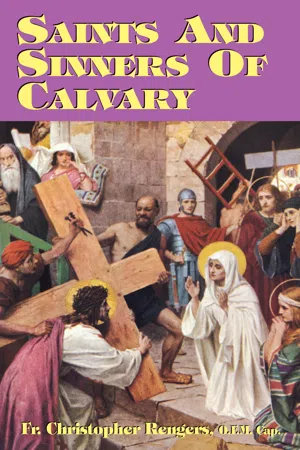
Nothing connected with the Passion and Death of Christ was purely accidental. And although Our Saviour was unquestionably the central figure of Calvary, many other persons - by God's Providence - took part in the living drama of the first Good Friday. These persons too provide instruction for our own lives. Impr. 141 pgs,
- 141 pages
- English
- ePUB (mobile friendly)
- Available on iOS & Android
eBook - ePub
Saints and Sinners of Calvary
About this book
Information
Topic
Theology & ReligionSubtopic
Christian Denominations1
JUDAS
IN the city of Kerioth, Judea, a boy grew up, perhaps about the same age as Christ. His mother’s name is not known. His father’s name was Simon. In the course of time the family moved from Kerioth into the upper district of Palestine which is known as Galilee. But when the boy grew up into manhood, he was always called “the man from Kerioth.”
We do not really know any details of his early life. We do know that after Our Lord had prayed the entire night alone on a mountain, He came down at daybreak and chose this man to be one of the twelve Apostles. He was chosen from among many disciples to be one of the select band of Twelve; he was chosen after thought and prayer. Today his name could be in the lists of Saints, along with St. Peter, St. John, St. James and the other Apostles. But it is not. Instead his name stands for that of a traitor. The man from Kerioth—Ishkerioth, is not known today as St. Judas, but as Judas Iscariot.
He Had a Vocation
The story of Judas is a sad story, the saddest of all history, for it is the story of one who was called to and destined for the highest place and fell to the lowest. Christ made no mistake when He included Judas among the Twelve. Our Lord was a keen judge of character, humanly speaking, and He had prayed over His choice. As God, He knew that this man from Kerioth had a vocation, a calling to apostleship and sainthood. Later, when St. Peter called for another to take Judas’ place, he said that Judas had been numbered among the Apostles and allotted a share in the ministry. Matthias was chosen, and he fulfilled the duties God had intended for Judas. Matthias is known as St. Matthias and is considered an Apostle, though he was chosen after the death of Christ.
As an Apostle, Judas had the advantage of intimate association with our Saviour. He ate with Him, conversed with Him, heard His magnetic sermons, saw Him cure the sick, raise the dead and feed the multitude on a few loaves and fishes. Judas, in fact, was sent forth with the other eleven Apostles to cure the sick, to raise the dead and to preach the message of Christ.
In the little circle of the Apostles he was given a special office. This little band, with Jesus as their leader, lived somewhat as a family and kept their funds in common. Judas was the treasurer or keeper of the purse. When supplies were needed, he was the one who took care of paying the bills. To be given this task was to be shown a special mark of trust and affection. So Judas was a favored man, blessed with the companionship and love of Our Lord, showered with opportunities and graces.
He Was Not Suspected
Every time his name is mentioned in the Gospels, the fact that he was the one who betrayed Christ is also mentioned. After the deed was accomplished, no one could forget it. Yet none of the Apostles, who knew him so well, was suspicious beforehand. At the Last Supper, Our Lord said sorrowfully that one of those present would betray Him. “Amen, amen I say to you, one of you shall betray me.” (John 13:21). If Judas or any of the Apostles had been definitely suspected, all would have looked at him. Yet the Apostles looked at one another, wondering of whom it was that He spoke. In fact, they began to ask: “Is it I, Lord?” (Matt. 26:22). St. John was at the table next to Jesus. St. Peter beckoned to John and told him to ask who it was. In answer to John, Our Lord said that the betrayer would be the one to whom He would give a morsel of bread after dipping it. He gave the morsel to Judas.
Perhaps this announcement and the giving of the morsel was one last grace offered to Judas, who should have realized once more the divine knowledge of his Master, who already knew what he planned to do. Evidently, even after all this, some of the other Apostles did not suspect Judas, because when he left, they thought that he had been told to go out and buy something more for the meal, or to give money to the poor. Thus, Judas to the very last hour fitted in and was accepted by the other Apostles as one of themselves, equally devoted to Christ. He was the man from Kerioth who had migrated to Galilee; the others were native Galileans. Otherwise, to all outward appearances, he was one of them.
Judas Crushes Conscience
Judas went out from the banquet table. He had already made contact with the enemies of his Master. He had a few days previously gone during the night to the house of Caiphas where these enemies were meeting and offered to help them. “What will you give me, and I will deliver him unto you?” (Matt. 26:15) Judas had asked. The enemies of Christ wanted very much to do something drastic, especially after His recent denouncement of them, but they were afraid to apprehend Him in broad daylight. They welcomed the help of an insider who could lead a group of soldiers to apprehend Jesus under cover of night, someone who would know just where to find Him.
The price they offered, however, was relatively cheap: thirty pieces of silver, the value commonly attributed to a slave. This was worth maybe one thousand dollars. Judas took this, but some Scripture scholars think that he was really playing for bigger game. He was tired of hearing of the Kingdom of Heaven being established and nothing being done about it. He perhaps wanted to force the issue and make Christ utterly defeat His enemies or else be unmasked as an imposter.
When Judas left the hall of the Last Supper, he was likely enraged at being found out. Whatever struggles had been still going on in his soul, he now crushed. As St. John says, Satan entered into him. He crushed the last struggles of conscience and went back to the Jewish leaders to arrange with them for the seizure and arrest of Christ.
The Infamous Kiss
At Judas’ suggestion that the time was good for carrying out their plans, the chief priests hurriedly assembled a group of their servants and obtained, in addition, a cohort of soldiers from the Roman procurator, and set out. Judas knew where to lead them—into the Garden of Gethsemani. He then went ahead alone. The others were to follow and watch which man he singled out by giving that touching token of friendship, a kiss. This was customary among men in those days, at least on certain occasions.
Perhaps, as some think, Judas kissed Our Lord not because it was the ordinary way of greeting Him, but as though he were coming back penitent and had to show an extraordinary sign of loving repentance. If so, the act is all the more abominable. At any rate, it was a tender sign of friendship that, on this occasion, was the signal of deliverance to the enemy.
Judas said: “Hail, Rabbi!” (“Hail, Master,”) and kissed Our Lord. Jesus did not repel the traitorous Apostle. He accepted the embrace and asked: “Judas, dost thou betray the Son of man with a kiss?” (Luke 22:48). These patient, gentle words must have been the final spoken appeal of Christ to call the Apostle to true repentance. Judas stepped aside, and the drama of the arrest, the trial and execution of Our Lord began.
Repentance without Hope
Things moved swiftly for Judas. We do not know what all went on in his mind. Whether he expected Our Lord to free Himself or not can only be guessed. But when Judas saw Christ delivered over to Pilate, remorse and regret at his own deed overcame him. If Judas had been a cold-blooded, hardened criminal, he would simply have shrugged and turned his back on everything.
The good side of his character came to the fore. He went to the Temple and accused himself: “I have sinned in betraying innocent blood.” His short-term friends were the cold-blooded criminals. They shrugged: “What is that to us? Look thou to it.” (Matt. 27:4). Then Judas flung the pieces of silver on the floor of the temple. That for which he had bargained he now loathed. Yes, Judas repented, he recognized his sin. More than that, he confessed it publicly and he gave up the money.
The Jewish leaders scrupled about putting the money into the Temple treasury because it was the price of blood. So, with the money which they gathered up off the floor, they bought a potter’s field, to be used as a burial place for strangers. This cemetery is known by the name “field of blood,” or “Haceldama,” a name it keeps to the present day.
Judas repented, but there was something lacking in his repentance. He lacked confidence and hope in God. Perhaps he also lacked humility. Had he gone back and asked for forgiveness from Our Lord, he would have received it. But he went out and hanged himself from a tree in despair. Either the rope or the limb of the tree broke, and his body fell to the ground; it was so jolted—or perhaps it struck some sharp object—that his bowels gushed out. Here is the earthly end of the man from Kerioth, the one called to be an Apostle, probably also a martyr, and a saint. We cannot say if he is forever damned in Hell. But Our Lord did say: “Woe to that man by whom the Son of man shall be betrayed: it were better for him, if that man had not been born.” (Matt. 26:24).
A Fearful Warning
Looking back on this sad story, we can learn much about the mystery of how God deals with men. God may give a vocation and many graces, but He does not force the free will of man. We can learn that though we have had many advantages of education in the True Faith and of union with Christ through the Sacraments, we may still fall to the lowest depths. Here is the terrible warning in the story of Judas: If one of the chosen Twelve could fall, could not I too fall from faith and grace?
St. Ambrose said that in the fall of Judas we can see that when even those high in the Church fall, the structure of the Church itself and divine truth will not fail. From time to time, scandals make the front pages of newspapers. Priests forsake their calling, attempt marriage in defiance of their vow, write or speak against the Church, commit other grievous offenses. If we want to condemn the Church because of these happenings, then we should logically condemn Christ for the fall of Judas.
A Great Fall Is Not Sudden
There is one other point to note. No man suddenly becomes bad. Judas had been failing already. The first indication of this came when Our Lord foretold the institution of the Holy Eucharist: “The bread that I will give, is my flesh, for the life of the world.” (John 6:52). Perhaps, like some of the disciples who did not believe this and thus left, no longer to follow Christ, Judas also did not believe what his Master had said. In any case, it was at this time that Christ said: “Have not I chosen you twelve; and one of you is a devil?” (John 6:71). There was no outward sign of rebellion by Judas, but Our Lord knew the hearts of men.
At the time Mary Magdalen poured the ointment over Jesus’ feet, Judas protested, asking why the ointment had not been sold and the money given to the poor. But St. John remarks that Judas said this, not because he was interested in the poor, but because he was a thief and had charge of the money. Judas was apparently taking some of the common fund and putting it away for himself. So, by avarice, theft, and perhaps by lack of faith in the promise of the Eucharist, Judas was preparing for his final downfall. As St. Augustine said, Judas followed Christ with his feet, but not with his heart.
This is the story of every apostasy. No one who leaves the Catholic Church, or who openly flaunts its laws, does so suddenly. He prepares by a gradual apostasy of the heart. There is a neglect of grace; there are often many sins: sins of self-pity, of intemperance, of impurity; sins of putting money above all else. The road out of the Catholic Church is very often paved with the chips of broken commandments. At least the road out of the Church is never purely intellectual, but paved by the sins of the one who apostatizes.
We cannot point the finger of judgment at any individual apostate, and it is possible for emotional instability to play a part in this act. Such may be the case with some poor individuals who become angry over a small injustice or the personality quirks of someone in authority in the Church, and therefore leave the Church. But while recognizing the possibility of internal factors that may lessen a person’s culpability, the fact remains that nobody really betrays Christ completely by abandoning the Faith who has not already often done so partially.
We must therefore strive to make certain of our vocation and calling. We must beware of our continued lapses into sin, of our coldness and indifference to religion, of our too great attachment to worldly wealth. Our Lord must be followed, not only with our feet but also with our hearts. If we do this, i.e., follow Him completely, then we will not suffer the tragedy of Judas by apostatizing, but will follow Christ faithfully to the end.
2
ST. PETER
THE Prince of the Apostles was outspoken and impetuous. Simon—who would be called Peter (meaning “Rock”)—was always ready to jump in to make a statement or to do something to show his love and loyalty. He was an enthusiast. When his brother Andrew came home one day to tell him that he had found the expected Messias, Peter wasted no time, but went immediately with Andrew to see Jesus. At this first meeting, Christ looked at Peter and said: “Thou art Simon the son of Jona: thou shalt be called Cephas, which is interpreted Peter.” (John 1:42).
The character of St. Peter is well exemplified by the incident of the walking on water. The Apostles were returning over the Sea of Galilee against a contrary sea, with rough waters. They rowed from evening until about three in the morning, only to make a few miles. Finally, Jesus appeared in the distance, walking on the waters. He walked as though He were going to pass by. The Apostles, who were perplexed before this, now feared greatly, thinking they must be seeing a ghost. In their fear they could not help shouting out to express their anxiety. No doubt Peter also joined in this chorus. But just as soon as Christ had spoken one word of comfort and assurance, a wave of courage surged within Peter so strongly that he asked for a guarantee: “Lord,” he said, “if it be thou, bid me come to thee upon the waters.” (Matt. 14:28). Our Lord answ...
Table of contents
- Front Cover
- Half Title Page
- Title Page
- Copyright Page
- Dedication
- Preface
- Contents
- 1. Judas
- 2. St. Peter
- 3. The Enemies of Christ
- 4. St. John the Apostle
- 5. Simon of Cyrene
- 6. St. Mary Magdalen
- 7. The Devoted Women
- 8. Mary, The Mother of Our Lord
- 9. Herod Antipas
- 10. Pontius Pilate
- Author
- Tan Books
- Back Cover
- A COLLECTION OF CLASSIC ARTWORK
- Brief Life of Christ
- Tan Classics
- Become a Tan Missionary!
- Share the Faith with Tan Books!
- Tan Books
Trusted by 375,005 students
Access to over 1.5 million titles for a fair monthly price.
Study more efficiently using our study tools.
Frequently asked questions
Yes, you can cancel anytime from the Subscription tab in your account settings on the Perlego website. Your subscription will stay active until the end of your current billing period. Learn how to cancel your subscription
No, books cannot be downloaded as external files, such as PDFs, for use outside of Perlego. However, you can download books within the Perlego app for offline reading on mobile or tablet. Learn how to download books offline
We are an online textbook subscription service, where you can get access to an entire online library for less than the price of a single book per month. With over 1.5 million books across 990+ topics, we’ve got you covered! Learn about our mission
Look out for the read-aloud symbol on your next book to see if you can listen to it. The read-aloud tool reads text aloud for you, highlighting the text as it is being read. You can pause it, speed it up and slow it down. Learn more about Read Aloud
Yes! You can use the Perlego app on both iOS and Android devices to read anytime, anywhere — even offline. Perfect for commutes or when you’re on the go.
Please note we cannot support devices running on iOS 13 and Android 7 or earlier. Learn more about using the app
Please note we cannot support devices running on iOS 13 and Android 7 or earlier. Learn more about using the app
Yes, you can access Saints and Sinners of Calvary by Rev. Fr. Christopher Rengers, O.F.M.Cap. in PDF and/or ePUB format, as well as other popular books in Theology & Religion & Christian Denominations. We have over 1.5 million books available in our catalogue for you to explore.