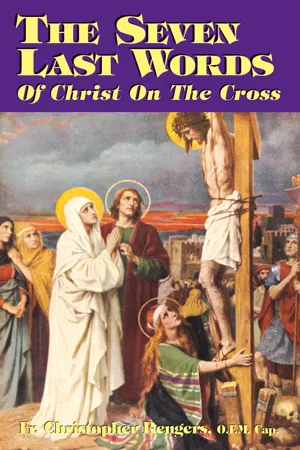
Few Christians can recall all Seven of Our Lord's Last Words on the Cross. Yet these Seven Words - brief sentences spoken by Him - give us Our Saviour's sacred parting instructions, messages intended not only for their few immediate hearers on the hill of Calvary, but spoken to all generations by way of Holy Scripture. Impr. 96 pgs,
- 96 pages
- English
- ePUB (mobile friendly)
- Available on iOS & Android
eBook - ePub
The Seven Last Words of Christ on the Cross
About this book
Information
Topic
Theology & ReligionSubtopic
Christian Denominations

“Father, forgive them, for they know not what they do.”
—Luke 23:34
Forgiveness
THE first words that Jesus spoke after being nailed to the Cross were words of forgiveness. He had gone through much suffering and strain. He had been taken from court to court, from Caiphas to Pilate to Herod and back to Pilate. He had felt the angry tide of human passion explode against Him in false testimony, in insults and in shouting for His death. He had already sweat blood, had been scourged and crowned with thorns. He had walked the exhausting, bitter steps carrying His Cross to Calvary and had been stripped of His garments.
He Forgives
But no doubt the actual nailing to the Cross brings with it a new and more severe pain. The long, roughly shaped spikes tearing through His hands and feet not only burn like fire but send new throbs of pain throughout His whole body. Most of the poor slaves or criminals who were executed by crucifixion screamed and shouted in despair at this point. Ordinarily all this new, intense suffering wrung words from the mouth of the victim of crucifixion. But Christ put into practice what He had counseled, by praying for those who were His enemies. The height of physical pain wrung from His lips only the words of forgiveness: “Father, forgive them.” He asked forgiveness for the soldiers, for the Jews who had maneuvered His execution, for all who by sinning in the years to come were to co-operate in His death.
He Excuses
Christ added words of excuse: “For they know not what they do.” No doubt these words applied most fully to the Roman soldiers, for they were just the rough instruments of execution. But the words were put forth as a plea for all, considering the blindness of human reason and the force of passion on the human will. The high priests and other leaders knew quite well what they were doing, but even for them the enormity of the crime may not have been altogether clear. Our Lord prayed for their forgiveness.
He had much to forgive even as a man, abstracting from the fact of His Divine Nature. These people who had brought on Him so much pain and disgrace were the very ones whom He had been trying to help. He had spent the past few years going about their country preaching, working miracles, even raising the dead from the grave. Yet, they closed their eyes to all this. They invented lies, tried to make it appear that this Man who lived in poverty, who had fled when some would make Him king, was plotting to overthrow the government and take over the power for Himself and His followers. The accusations against Him during the trial were absolutely false, as Pontius Pilate, the neutral Roman, also recognized.
Hard to Take
Most of us probably know from experience that if there is anything hard to take, it is a deliberately false accusation. If we are accused of something we have not done, our blood begins to boil immediately, and angry words rush to our lips. When false accusations come from ones we have been trying to help, they are even harder to take, for the ingratitude stings us. Yet this is exactly the situation, humanly speaking, that Christ found Himself in. To false accusation, to ingrained ingratitude, He reacts by a prayer for forgiveness.
St. Stephen
St. Stephen, the first martyr, comes to mind as a striking instance of one who followed the example of his Master in forgiving. His words of wisdom and truth so cut the Jewish leaders to the heart that they gnashed their teeth. They took Stephen out and cast stones at him. But while they were stoning him to death, he fell on his knees and prayed: “Lord, lay not this sin to their charge.” (Acts 7:59). He could have called out to those who stoned him: “Do not forget that there is a just God, and that you will be punished for this!” Filled with the spirit of Christ, he prayed for the forgiveness of his enemies.
So have the true followers of Christ acted through the ages. The lives of Saints are full of examples of ready forgiveness. The early martyrs prayed for their executioners. From our own shores have come stories of those who were tortured, yet prayed for those who tortured them.
In March of 1649, Father Jean de Brébeuf endured martyrdom at the hands of the Iroquois Indians. Many times he spoke the words: “Jesus, have mercy on us,” begging perseverance for himself and the other Christian prisoners, and forgiveness for their tormentors. The Indians poured scalding water over his head, jesting that without this baptism he could not be saved. “Jesus, have mercy on us” was his answer. He asked that God might forgive them since they did not know what they were doing, and would lead them all to a true Baptism. In fury at not being able to break Father de Brébeuf’s spirit, the Iroquois cut off his nose and upper lip. Unable to endure his prayers for mercy for them, they cut out his tongue. Even then, the dying martyr forced from his tongueless mouth a hoarse, guttural: “Jesus, have mercy!”
Note: St. John de Brébeuf was responsible for the conversion of some 7,000 souls. —Publisher, 2002.
St. John Gualbert
Back in the eleventh century, a man by the name of John Gualbert set out to avenge the death of his brother, Hugh. Hugh had been murdered, and John swore that he would kill the murderer. The father, also full of sorrow and resentment, encouraged him. John was a soldier and considered it upholding his honor to make up for the death of an only brother. So he set out to look for the killer.
He met him on Good Friday in a passage so narrow that there was no escape. The man was unarmed and fell on his knees. He stretched out his arms in the form of a cross and asked, for the love of Jesus Crucified, to be forgiven his crime. John Gualbert did not hesitate long. He responded to grace and forgave the man in the name of Jesus Crucified; he even went forward and embraced him. God did not allow John to go unrewarded, but filled his soul with grace, leading him to the monastery, where he was to lead a strict and holy life. The Catholic Church now celebrates the Feast of St. John Gualbert on July 12. Had he refused the plea for forgiveness, he would himself have become a vindictive murderer. But he forgave and became a Saint.
Forgiveness a Duty
To forgive is a duty. In the sermon on the Mount Our Lord said: “You have heard that it hath been said, Thou shalt love thy neighbour, and hate thy enemy. But I say to you, Love your enemies: do good to them that hate you: and pray for them that persecute and calumniate you: that you may be the children of your Father who is in Heaven, who maketh his sun to rise upon the good, and bad, and raineth upon the just and the unjust.” (Matt. 5:43-45). He then went on to say that even the heathens saluted and loved those who were friendly to them; that was only natural. What reward could you expect for being friendly to those who were good to you? The commandment of Our Lord was not a commandment merely to be friendly to other people in general. It was a specific command to love and do good to those who have done evil to us.
Not Always Easy
This does not mean to say that to forgive is always easy to do. In certain cases it may take great effort to forgive. Suppose somebody causes you to lose a good job; imagine somebody who deliberately ruined your health; put yourself in the position of St. John Gualbert, whose brother was murdered. No matter what effort it takes, no matter how greatly we have been wronged, the commandment of Christ stands. We must forgive. “I say to you, love your enemies.”
In some instances the wrong we suffer is genuine. In many more instances, it is much more a matter of hurt feelings and often of childishness that creates the wrongs. Very often the whole case can be seen by an unprejudiced observer to be a matter of pride. Perhaps there were some words spoken to us in anger, not altogether justifiable. The person who spoke them may regret his words very soon. But we rear up in indignation and make a big thing of them. Long after our “enemy” has humbly accused himself in Confession of harsh words, they still rankle in our hearts. A long-term grudge begins. There is not really much to forgive; but by refusing to forgive, the grudge becomes solidified. As time goes on, it is usually harder to forgive.
Refusal Hurts Oneself
To refuse to forgive does not in most cases harm the other person; but in all cases it harms the one who refuses to forgive. First of all, the person who refuses forgiveness harms his own soul by the sin of refusal, by going against the express command of Christ. Sometimes he plunges his soul into still further sin by cutting himself off from some good work in which he was engaged, for example, from some parish society that the other person also attends. The saddest cases are those who cut themselves off from the Church and the Sacraments. For some real or imagined wrong committed against them by a priest or some representative of the Church, such a person stops going to church.
More than 70 years ago a young man was told by a priest to take the family pew near the front of the church. He preferred to remain in the rear. When the priest insisted, the young man walked out of church. He never returned, for he could not forgive that order given to him before the congregation. The young man grew up, then married outside of the Church. His children grew up without the benefits of the truth and the Sacraments of the Church established by Jesus Christ. So did his grandchildren. The young man, grown old, died not long ago. More than 60 of his descendants live on, not one of them a child of the Church. Had this man forgiven, instead of having all this to answer for, perhaps he might have children or grandchildren in the convent or priesthood. Refusal to forgive harms the soul, and often the damage passes on to many other souls.
To refuse to forgive may also damage the mind and even the body. For it creates bitterness of spirit and blinds the mind to many of the good and happy things of creation. The effects of bitterness of mind can overflow into the body and bring on or increase physical disease.
On the contrary, to forgive may actually shame your enemy, supposing real wrong to have been done, and bring him to repentance. St. Paul says: “If thy enemy be hungry, give him to eat; if he thirst, give him to drink. For, doing this, thou shalt heap coals of fire upon his head.” (Rom. 12:20).
Brings New Graces
Forgiveness sets the stage for receiving new graces; lack of forgiveness blocks grace. Nowhere is this more true than in the reception of Holy Communion. To receive the full benefits of this Sacrament of love, we must be at peace with all men. Our Lord said: “If therefore thou offer thy gift at the altar, and there thou remember that thy brother hath any thing against thee; leave there thy offering before the altar, and go first to be reconciled to thy brother: and then coming thou shalt offer thy gift.” (Matt. 5:23-24). This was said originally to those who came to offer gifts of sacrifice according to the Old Law. It applies even more so to those who offer the Eternal Sacrifice of the Mass in the New Law, and who participate in the sacrifice through Holy Communion. It is a good practice in preparing for Holy Communion to forgive from the heart all who may have done anything that requires forgiveness. Only then are we fit to participate fully in the union of our souls with Christ who forgave His enemies even in the midst of His greatest pain.
No Limit
St. Peter asked one day, when Christ had been talking on the subject of brotherly love: “Lord, how often shall my brother offend against me, and I forgive him? Till seven times?” Peter thought he was being very generous in setting a high number. But the answer was: “I say not to thee, till seven times; but till seventy times seven times.” (Matt. 18:21-22). In short, there is no limit to the forgiveness that is demanded of us. God will always take care of just punishment. It is up to us to forgive.
Forgive Us . . . As We Forgive
Each day as we pray the Our Father, the prayer taught to us by His eternal Son, we pray to be forgiven even as we forgive—“Forgive us our trespasses, as we forgive those who trespass against us.” If we do not forgive those who trespass against us, we are actually praying to God not to forgive us our own sins. We pray to be forgiven as we forgive.
Robert Louis Stevenson, the English author, the writer of Treasure Island and other stories, was one night leading the prayers in his family circle. When he came to the words: “Forgive us our trespasses,” he jumped up and went outside. After about twenty minutes he returned and, with great emotion, finished the prayers. Later he explained to his wife and children: “When I came to those words, ‘Forgive as I wish to forgive others,’ I thought of a certain man who had offended me today. Feelings of hatred stirred up in my heart. I could not go on with that beautiful prayer until I had fought these feelings down and made myself forgive as I asked to be forgiven.” During the time that Robert Louis Stevenson was gone, he had conquered his feelings and gone to the home of the offender and assured him that all was well between them.
All of us hope that God will forgive us our sins. All of us have sinned, and perhaps mortally, many times. If we expect forgiveness, we must extend it to others. Otherwise, we will be like the unmerciful servant spoken of by Our Lord. (Matt. 18:2335). This man was called by the king to pay a very large debt. But he had no means of paying, so the king ordered him to be sold, together with his wife and children. But the servant fell down and besought the king, saying: “Have patience with me, and I will pay thee all.” So the king, moved by compassion, released him and cance...
Table of contents
- Front Cover
- Title Page
- Copyright Page
- Contents
- 1. FIRST WORD
- 2. SECOND WORD
- 3. THIRD WORD
- 4. FOURTH WORD
- 5. FIFTH WORD
- 6. SIXTH WORD
- 7. SEVENTH WORD
- Act of Contrition
- Fr. Christopher Rengers, O.F.M. Cap.
- Back Cover
- A Collection of Classic Artwork
- A BRIEF LIFE OF CHRIST
- TAN CLASSICS
- BECOME A TAN MISSIONARY!
- SHARE THE FAITH WITH TAN BOOKS!
- TAN BOOKS
Trusted by 375,005 students
Access to over 1.5 million titles for a fair monthly price.
Study more efficiently using our study tools.
Frequently asked questions
Yes, you can cancel anytime from the Subscription tab in your account settings on the Perlego website. Your subscription will stay active until the end of your current billing period. Learn how to cancel your subscription
No, books cannot be downloaded as external files, such as PDFs, for use outside of Perlego. However, you can download books within the Perlego app for offline reading on mobile or tablet. Learn how to download books offline
Perlego offers two plans: Essential and Complete
- Essential is ideal for learners and professionals who enjoy exploring a wide range of subjects. Access the Essential Library with 800,000+ trusted titles and best-sellers across business, personal growth, and the humanities. Includes unlimited reading time and Standard Read Aloud voice.
- Complete: Perfect for advanced learners and researchers needing full, unrestricted access. Unlock 1.5M+ books across hundreds of subjects, including academic and specialized titles. The Complete Plan also includes advanced features like Premium Read Aloud and Research Assistant.
We are an online textbook subscription service, where you can get access to an entire online library for less than the price of a single book per month. With over 1.5 million books across 990+ topics, we’ve got you covered! Learn about our mission
Look out for the read-aloud symbol on your next book to see if you can listen to it. The read-aloud tool reads text aloud for you, highlighting the text as it is being read. You can pause it, speed it up and slow it down. Learn more about Read Aloud
Yes! You can use the Perlego app on both iOS and Android devices to read anytime, anywhere — even offline. Perfect for commutes or when you’re on the go.
Please note we cannot support devices running on iOS 13 and Android 7 or earlier. Learn more about using the app
Please note we cannot support devices running on iOS 13 and Android 7 or earlier. Learn more about using the app
Yes, you can access The Seven Last Words of Christ on the Cross by Rev. Fr. Christopher Rengers, O.F.M.Cap. in PDF and/or ePUB format, as well as other popular books in Theology & Religion & Christian Denominations. We have over 1.5 million books available in our catalogue for you to explore.